

Exploring Elston, Algeria, Morocco, and the Renaissance
Exploring Elston, Algeria, Morocco, and the Renaissance
-
-
-
-
-
Exploring Elston, Algeria, Morocco, and the Renaissance
-
Post #1 - May 10th, 2005, 4:35 pmIf there's one obscure stretch I keep an eye on, it's Elston Avenue. The ultimate road for insiders (you don't know it exists until you've lived here long enough to realize it's the key to getting around the north side in a timely fashion), it's a mostly unlovely street of industrial buildings, but dotted with the kinds of places that reward the patient study of our city's more obscure districts-- Stanley's Fruit Market, Taqueria El Potosi, Latin Sandwich Cafe, Two-Way Grill, Smak Tak. So when a taco joint on Elston suddenly sports the new name of "Cafe Fez, Moroccan Delicacies," I notice it. Something's different. The back of my hand is no longer quite as recognizable as it was. The spirit of the Age of Exploration stirs in my blood. I set my sail-- little suspecting that in this case, a journey along this stretch of the New World will take me, a Wrong-Way Columbus, directly into contact with the Old World of half a millennium ago.
* * *
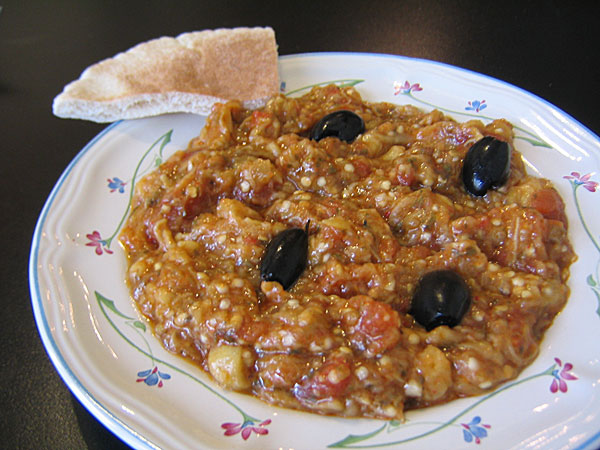
Cafe Fez is a homey place, modestly remade from Mexican to Moroccan on a budget of about $11, with more ambition on its menu than you would expect from its humble surroundings. On one visit I went for simple: this has a name like zatouk or zalouk, although it seems to me to be not unlike the Turkish imam biyaldi, mashed eggplant with a tomato sauce (though possibly different for lacking caramelized onion), a hearty, robust dip for starting a lunch:
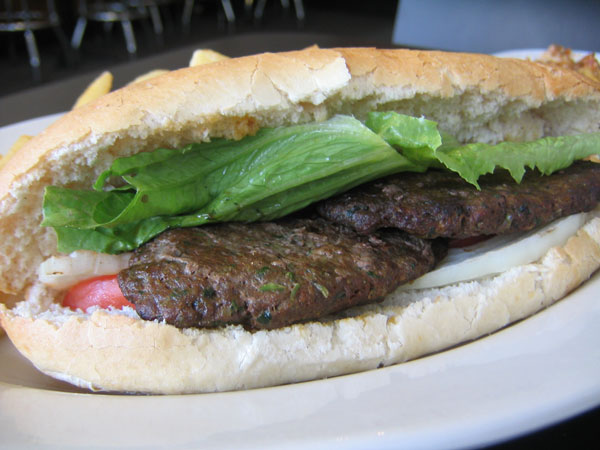
It was followed by a kifta sandwich, flavorful kifta somewhat let down by the use of a styrofoamish Mexican-bakery French roll, which needed something like the garlic sauce they offer at Semiramis to keep it from being too dry:
All this is simple and pleasant enough food, what you'd expect to find at a storefront sandwich shop. It is a considerable jump from there to what I had at my other visit to Cafe Fez.
During the Renaissance, Italian pasta was seasoned by spices of every description-- spices long used in the cuisines of ancient Persia and Arabia, Southeast Asia and China. The affluent Italian's taste for sweetness and spice was heightened by medieval trade links with the East and Arab occupations of southern Italy. So many old Italian court recipes seem influenced by the Middle East. Sweet spices like cinnamon, nutmeg, clove and ginger were accented by pepper, perfumed with rosewater, or their sweetness took on an arid/herbal overtones from generous doses of saffron. These blends, in turn, were mixed into dishes with nuts, fruits, meats and cheeses.
The ancestors of today's filled pastas were stuffed with these combinations and then sprinkled with grated cheese, sugar, and cinnamon...
Ever since reading that description of sweet/savory pastas and pies in Lynne Rosetto Kasper's The Splendid Table (the book, not the radio show she named after it), I've wanted to make one of these dishes, just to see how it would appear to modern palates. Little did I suspect that for no less than the second time, I would find something directly descended from those savory pasta dishes of long ago on a modern-day menu on Elston.
Chatting up the friendly proprietress, to find out what the more unusual specialties were, she mentioned pastillas-- a chicken one and a seafood one. Now, if you do a search for pastilla, you will mostly get South American references. That jogged my memory back to the dinner we had long ago at Latin Sandwich, where one of the items was a thing called pastel de choclo:
In a past life, Mike G wrote:...the hands-down winner for me, and luckily it's one of the things they always have in the fridge for carry-out, was the pastel de choclo, or the deconstructed empanada as I called it, not really fairly. Actually what it reminded me of was some of the sweet and savory Reniassance-era Italian dishes that Lynne Rosetto Kasper talks about in The Splendid Table-- a bunch of ground beef, a whole chicken leg (and as Dave noted, that was no small chicken) and fennel baked a good long time under a layer of sweetened cornmeal. Incredibly rich in flavor, primally satisfying, and since they reheated ours for us you'll have the same experience if you go there and pick one up.*
Now how does the same dish wind up in South America and Morocco, two places we don't normally think of together? The answer, surely, is Spain. The sweet and savory baked dishes Kasper talks about were probably known throughout at least Mediterranean Europe during the time when spices were one of the main objects of trade; and survive in the cultures Europe interacted with even if many of them would seem quite foreign on an Italian restaurant table today.**
So here is the Moroccan variation of the Italian dish which I have only had once before in its Chilean incarnation:
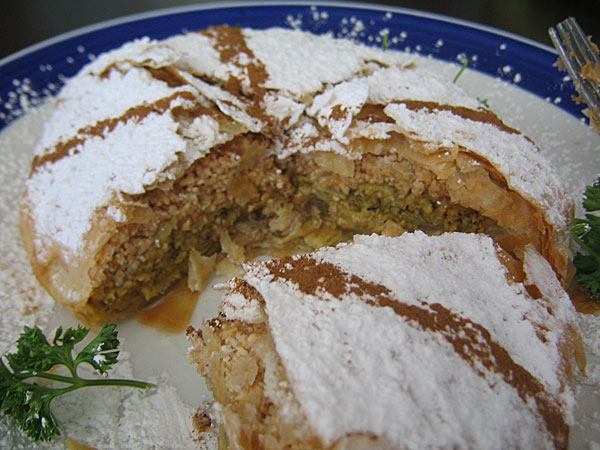
The structure is baked phyllo; the lowest filling is ground chicken roasted or sauteed in onion, the middle is egg fried up in the onion-flavored grease from the chicken, the highest filling is ground almonds, and on top is powdered sugar and cinnamon. How was it?
Discordant. Unsettling. My palate tried to make sense of the cues given off simultaneously by something that tasted like chicken pot pie below and baklava above, and couldn't. Sweet and savory fought each other all the way, and never came to a resolution. It was fascinating, but it never came together into a coherent dish to me; it was a Bach organ piece and a Cole Porter tune played in alternating bars. I am not often defeated by the things I try, but this did what Chinese dishes of eel intestines buried for a month could not, it beat me and I finished it by breaking it apart into a sweet half and a savory half. I guess you had to grow up eating it. Preferably 500 years ago.
But the woman who runs Cafe Fez couldn't be nicer, and there are some more things I want to try off the menu, starting with the seafood pastilla which I think doesn't have powdered sugar on it. At least I can hope. Toward the end, as I worked my way through it, she brought me gratis some tea with mint, exceedingly sweet but, you must admit, awfully photogenic:
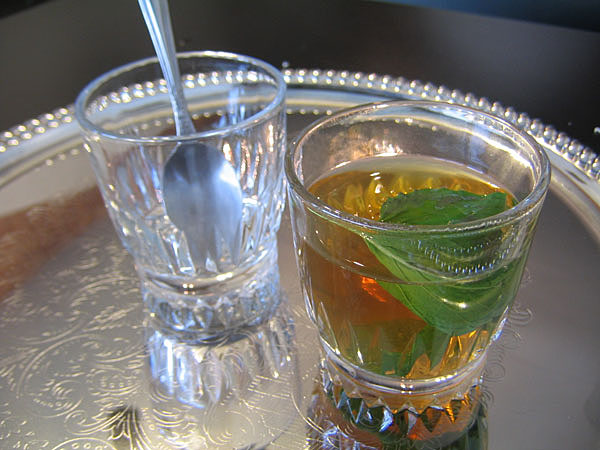
This is the hospitality of Cafe Fez.
* * *
Tassili n'Ajjer is a desert in Algeria, this website calls it the most beautiful desert of all, and who would argue with such enthusiasm?
I did not know that when I first saw the name "Tassili Cafe" in a window along Elston, but I surmised quickly that it probably indicated a middle eastern cafe of some sort, judging by the fact that the block it's on includes an actual mosque; and Google did the rest.
If Cafe Fez was like being invited into a North African home by the woman of the house, Tassili is a very male place, not just because all the customers whenever I've been there have been male, but because it has the raucous masculine energy of a coffee house or social club in that part of the world-- complete with cell phones and big screen TV (tuned, incongruously, to a cooking show on one visit).
I suspect Tassili's main business is very much tied to the schedule of the nearby mosque, and my initial welcome was not especially warm (though several degrees above certain Eastern European spots I've entered). It warmed up when I started asking about off-menu items (couscous on Friday is the big special), however, and on my second visit I was recognized and welcomed back.
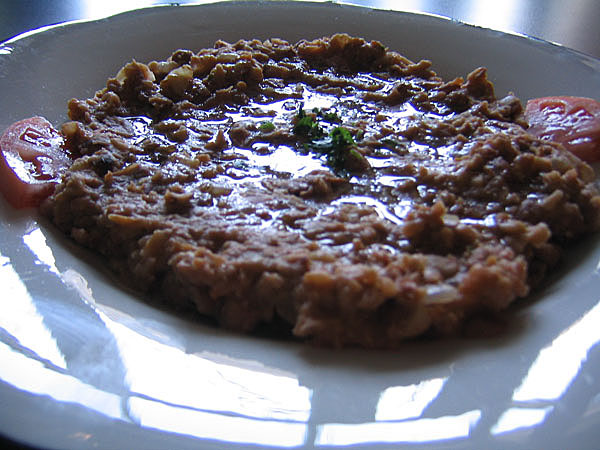
Foul, the classic dish of mashed fava beans with onion and olive oil, was one of the best versions I've had, certainly the most oniony and garlicy:
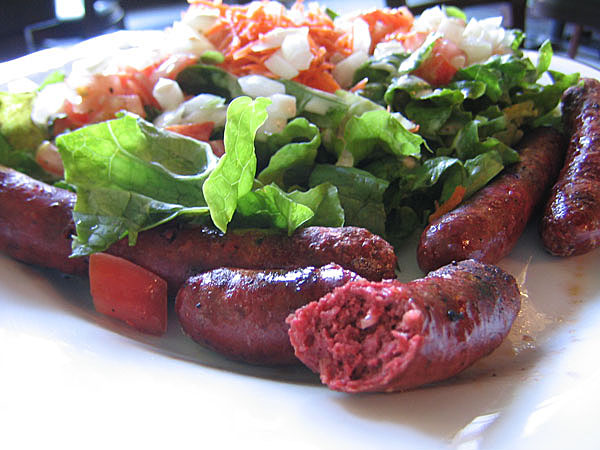
Merguez, the bright red sausages which I thought were always lamb but turned out to be beef in this case, were expertly grilled. Thinking of the uninteresting Mexican French bread at Fez, I ordered them minus the bread and French fries and with a salad. Having had them both ways now, they're much better eaten solo than in a sandwich, and the salad was pungently flavored:
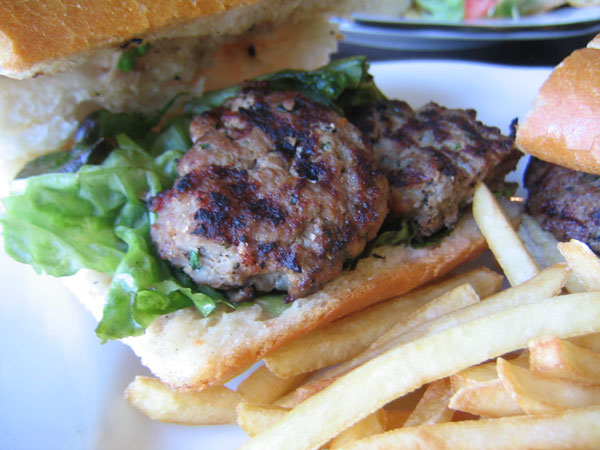
On a return visit with G Wiv and M'thu'su, we had a merguez sandwich and also a kifta sandwich. Actually, the bread was better here than at Fez, but I think we all would have preferred the sandwich with 2 or 3 times as much of the garlicky spread on it, or something else to make it a moister sandwich. Frankly, forget the bread and lettuce, just order the meat.
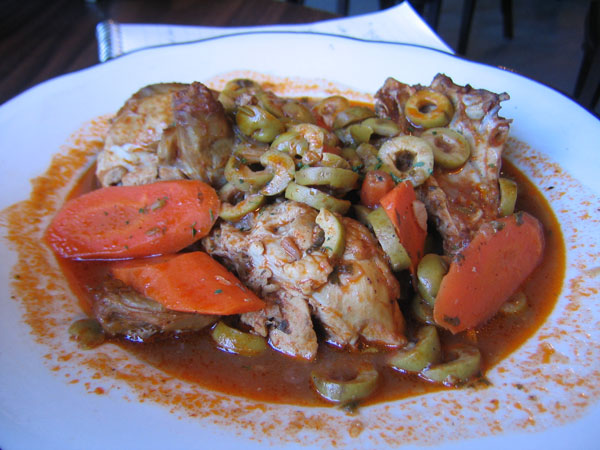
What was described as a chicken dish with peas on the specials menu turned out to be a chicken dish with green olives, in a tomato-cinnamony broth.
Tassili seems less ambitious at the moment than Fez, but possibly more accessible (at least, it must be said, if you are male). Neither is as accomplished as, say Semiramis, but they aren't the same kind of restaurant; they exist to provide a taste of the Old World to people who have settled far from home in the New. And in one case, the taste of the Old World they provide is older than most who visit will realize.
Cafe Fez
4659 N. Elston
773-286-8991
Tassili Cafe
4342 N. Elston
773-685-6773
* Please note that I have no idea whether this is still available there. Been a while.
** Kasper talks of most of these recipes in the past tense, so to speak, although one-- the sweet tagliarini tart of Ferrara-- she says is a common dessert. Anyway, it seems safe to say that they are not typical of northern Italian main course or meat course dining today. Actually, probably the most common dish today with a foot in this tradition is an English one, mincemeat pie.Watch Sky Full of Bacon, the Chicago food HD podcast!
New episode: Soil, Corn, Cows and Cheese
Watch the Reader's James Beard Award-winning Key Ingredient here.
-
-
Post #2 - May 10th, 2005, 4:53 pmThose are some articulate connections, and I think valid and well-established, you make between the sweet/savory dishes of the Middle East and Italy.
I'm not sure that I am so sold on the link to torta de choclo, which of course is based on maize and was probably eaten in what is now Ecuador, probably in nearly the same way, well before Cortez stood
Silent, upon a peak in Darien.
Maybe cuy and duck rather than beef and chicken, but the sweet choclo pie, I'm thinking they had.
-
-
-
Post #3 - May 10th, 2005, 4:54 pmI have had Moroccan Pastilla cooked by a friend who lived in Morocco for 5 years as a (flying) carpet buyer. She learned how to make it from a group of older women who befreinded her soon after she settled there and taught her the ropes, so to speak. Her version had the sweetness and cinnamon component, but was not dusted with powdered sugar and so was not cloyingly sweet. Her's also seemed to have many more layers of phylo and the chicken was shredded, rather than ground. I fell in love with the dish and have been meaning to go to Fez for a while ever since I noticed it on one of my frequent trips up and down Elston. Thanks for the report.Steve Z.
“Only the pure in heart can make a good soup.”
― Ludwig van Beethoven
-
-
-
Post #4 - May 10th, 2005, 6:00 pmStevez-- The chicken probably is shredded, now that you say it, and the almonds were ground.Watch Sky Full of Bacon, the Chicago food HD podcast!
New episode: Soil, Corn, Cows and Cheese
Watch the Reader's James Beard Award-winning Key Ingredient here.
-
-
-
Post #5 - May 10th, 2005, 6:11 pmI seem to recall having a Pastilla (or something like it) at L'Olive on Halsted (now occupied by Kabul). I was somewhat taken back by the juxtaposition of sweet and savory/spicy flavors, but I don't think the contrast was quite so extreme as Mike G has pictured. I wonder if this combination is the North African analogue to the North American taste for sweet and salty (Beer Nuts, Monte Cristo sandwiches, and more subtlely, the overloading of jarred spaghetti sauce, baby food, etc. with salt and "hidden" sugar). Regarding the Monte Cristo (a sandwich popular enough to be served at Bennigan's), I wonder how a North African would react to a battered and fried meat and cheese sandwich dusted with powdered sugar and served with a bullet of raspberry jam for dipping? I suppose your taste will be at least partly a matter of what you grew up with.
-
-
-
-
Post #6 - May 10th, 2005, 7:14 pmA long time ago, on a visit to Los Angeles, a friend treated me to a Morrocan meal at Dar Magreb. I really enjoyed the Bastilla there (note alternate spelling; also B'stilla, in the linked website). As an appetizer about the size in your picture, split between four people it was very good. The dish wasn't overly sweet, the majority of the sweetness was in the cinnamon & sugar dusting on top. The crisp flaky phyllo was a nice foil to the soft chicken shreds. I should note that I do like sweet flavours. However, my wife who doesn't (unless it is dessert) enjoyed it too.
The 'original' version of the dish, from what I've read, is made with pigeon*.
I look forward to checking these places out. Thanks!
edit*I've never seen this in any restaurant - you'll probably have to catch your own
-
-
-
Post #7 - May 11th, 2005, 1:25 pmGreat leads on Morrocan food in the Chicago area. I've been stuck on Lebanese Cuisine and especially Kibbe for years. I can't wait to try some thing new.
I believe the dish you're describing is called Bisteeya.
While looking for a class on Thai cooking I found a class called
"Morroccan Magic" at the Calphalon Culinary Center. They'll be covering Chicken Bisteeya and Lamb Tagine.
If anyone is interested, it's a demo class for $40 on June 25.
-
-
Post #8 - May 11th, 2005, 2:40 pmIt's most definitely spelled Pastilla at Cafe Fez, but the mention of it starting with B and including pigeon rang a bell, I just can't think where from.
Moroccan is popping up around town now, there's Marrakech Express on Damen near Lawrence, also M'thu'su mentioned a placed called Kasa (sp?) on Lawrence near Kedzie, and I've seen another place with Marrakech in the name on Ashland near Division, curiously. No idea if it's actually Moroccan.Watch Sky Full of Bacon, the Chicago food HD podcast!
New episode: Soil, Corn, Cows and Cheese
Watch the Reader's James Beard Award-winning Key Ingredient here.
-
-
Post #9 - May 11th, 2005, 2:48 pmI've had B'steeyah in restaurants a couple times, and made it myself. "Cooking Under Wraps" by Nicole Routhier has an awesome version that isn't all that sweet. The version pictured above looks more like a Dunkin Donuts version -- it should just be lightly dusted with powdered sugar and cinnamon.
Properly done, this should be a rich dish: chicken, eggs, butter and many, many spices make up the filling, and the sweet is balanced by the hot pepper, garlic and onions.
-
-
-
Post #10 - February 9th, 2008, 11:48 amMike G wrote:The structure is baked phyllo; the lowest filling is ground chicken roasted or sauteed in onion, the middle is egg fried up in the onion-flavored grease from the chicken, the highest filling is ground almonds, and on top is powdered sugar and cinnamon. How was it?
Discordant. Unsettling. My palate tried to make sense of the cues given off simultaneously by something that tasted like chicken pot pie below and baklava above, and couldn't. Sweet and savory fought each other all the way, and never came to a resolution. It was fascinating, but it never came together into a coherent dish to me; it was a Bach organ piece and a Cole Porter tune played in alternating bars. I am not often defeated by the things I try, but this did what Chinese dishes of eel intestines buried for a month could not, it beat me and I finished it by breaking it apart into a sweet half and a savory half. I guess you had to grow up eating it. Preferably 500 years ago.
Tried the pastilla at La Brochette last night, and I understand of what MikeG speaks.

The flavors, which at first didn’t (as reported) quite seem to come together, miraculously meshed when I dotted my plate with harissa, the peppery North African condiment. The heat helped integrate the richness of egg-meat-phyllo with the sweetness of sugary nuts and rosewater. This was the best thing I had last night. I gave it the morning-after test (had leftovers for breakfast) and it held up pretty well (though I will cop to the fact that having a savory-sweet thing for breakfast may be less cognitively jarring than having the same thing for dinner…but like I say, I liked it both times, with added heat)
I talked to one of our servers, who said his Moroccan mama made this dish all the time, especially for special events like birthdays and weddings.
My daughter quizzed him, “So, you have it for happy festivities, but never for things, like, you know, funerals?”
“Oh, well, yes,” he said, “We have pastillas for funerals, too.”
Pastillas. The any time food (with harissa at hand).
La Brochette
1401 N. Ashland
Chicago, IL 60622
773.276.5650"Don't you ever underestimate the power of a female." Bootsy Collins
-
-
-
Post #11 - February 9th, 2008, 4:39 pmThanks, Hammond, for reviving this thread!
When preparing for my daughter's Renaissance-themed 16th birthday party, I ran across a number of sites that really brought out my inner geek. ["Brought out?" you say. . .] Beginning with the Society for Creative Anachronism I eventually found a website dedicated to the recipes of the great Medieval chef Taillevent that included a sweet/savory rabbit pie made with sugar, spices, dried currants and pine nuts. I put these in a goose fat crust that was so good it made me feel that Taillevent himself would not have turned up his nose at it. It seems that Medieval recipes were current later, during the Renaissance. This isn't saying much, though, considering that some of the combinations and techniques used in the Viandier de Taillevent continue to be used in North African cuisine, (for instance, the chicken gilded with egg yolks). Still, it's nice to think that a Time Machine trip of many centuries might be undertaken as easily as a drive up Elston Avenue.
.MikeG wrote:If Cafe Fez was like being invited into a North African home by the woman of the house, Tassili is a very male place, not just because all the customers whenever I've been there have been male, but because it has the raucous masculine energy of a coffee house or social club in that part of the world-- complete with cell phones and big screen TV (tuned, incongruously, to a cooking show on one visit).
Sounds like just the spot for Cathy2, helen, jygach and me! The question is, do they serve breakfast at 4:00 AM?Man : I can't understand how a poet like you can eat that stuff.
T. S. Eliot: Ah, but you're not a poet.