
I am Katsu's Grasshopper
I am Katsu's Grasshopper
-
-
-
-
-
I am Katsu's Grasshopper
-
Post #1 - August 28th, 2007, 3:42 pmSince the escalation of epithets for what a dinner at Katsu does to you ultimately led to controversy, I have decided to take it down a few notches. Stevez and I recently popped into Katsu, and our request that he give us whatever he thought we should have led to Katsu taking us on a tour, item by item, through his process as he combines gorgeous fish with subtle accents from traditional Japanese ingredients.
In a world of gussied-up sushi full of improbable combinations, the spare simplicity of these combinations was truly beguiling, and the closest I've ever come, certainly, to a master class in sushi. So it seems only right to title the thread with the acknowledgement that Katsu was the master, and I... grasshopper!

Leading the specials card this week, for a mere $37... a special Boston toro and... um, Steve, help me if I got this one wrong... special hamachi? Is that right? The toro, though lush, was not as buttery and delightful as others I've had there; the hamachi, though, was marvelous, silky buttery and set off, per Katsu's suggestion, with the crunch of daikon.

A delicate, sweet giant sea scallop topped with tobiko and yuzu and concealing a bit of salty seaweed. If this looks familiar-- well, I didn't get a picture of it last time, but if it happens to sound familiar that might be because it was on my ten best list last year.

Mackerel-- oily but not at all fishy-- under a piece of vinegar-marinated seaweed, with a little ginger tucked underneath too.

Creamy-textured wild Tasmanian salmon with roe and a little gold leaf. He also gave us a bite of a more "everyday" Scottish salmon to contrast-- it was fattier-looking, big white stripes, but much less delicate.

Uni, used almost as a condiment along with wasabi and salty-tasting seaweed atop tuna. I'm no uni fan, but this was inspired, the way the flavors kept tossing and turning in your mouth.

Deep-fried-- jumbo shrimp? crayfish? langoustine? I have to admit, I'm not sure exactly, but a nice contrast at this point.

Sweet shrimp, tobiko.

And finally, a handroll with briny jellyfish and a bit of yuzu (I think), salty, fishy and lemony.

Thank you, Master, for showing your poor acolytes what sushi can be in your hands.Watch Sky Full of Bacon, the Chicago food HD podcast!
New episode: Soil, Corn, Cows and Cheese
Watch the Reader's James Beard Award-winning Key Ingredient here.
-
-
Post #2 - August 28th, 2007, 3:58 pmMike G wrote:Deep-fried-- jumbo shrimp? crayfish? langoustine? I have to admit, I'm not sure exactly, but a nice contrast at this point.
Those should be the shrimp heads from your ama ebi.
And thank you for those pictures which will now make all of my meals almost completely pointless until the next time I get to have sushi. The craving has begun.
Mmmmmm. Hamachi. Droooooollll. ( a la Homer J., of course)We cannot be friends if you do not know the difference between Mayo and Miracle Whip.
-
-
Post #3 - August 28th, 2007, 5:37 pmtraditionally, ama ebi are accompanied by their little shrimp heads deep fried (a kind of shrimp two ways). when i worked there, we served the connective muscle from bivalves like scallops and oysters as well when we served them. quite common. it's a textural thing the japanese are so good @."In pursuit of joys untasted"
from Giuseppe Verdi's La Traviata
-
-
Post #4 - August 29th, 2007, 7:54 amFrom the picture I'd have to say that, although fried, they are not shrimp heads. My vote would be for langostine. In my childhood my family would visit the shrimp boats as they came in with their catch. I've never seen a shrimp with legs like that.
Flip"Beer is proof God loves us, and wants us to be Happy"
-Ben Franklin-
-
-
-
Post #5 - August 29th, 2007, 8:04 amThose were the shrimp heads from our ama ebi. I've got to say that in all the times I have eaten at Katsu, this was the most intimate in terms of Katsu preparing and describing the fish. Things were a bit slow on a Monday night and Katsu delighted in taking his two willing disciples on a tour of the sushi case. We were very fortunate that he had some extremely fresh and unusual things to share. The price tag was surprisingly low for the amount of premium sushi we were served. This was also a first.Steve Z.
“Only the pure in heart can make a good soup.”
― Ludwig van Beethoven
-
-
-
Post #6 - November 2nd, 2007, 9:23 pmThank you LTH!
I've lived in Lincoln Square for over 15 years now and heve never even heard of Katsu until reading about it here when I became a member of this communitee just a few short months ago.
A sushi loving friend of mine and I decided tonight we'd give it a shot and all I can say is that I thought I'd eaten sushi before, and now realize until tonight I've never really eaten sushi.
We arrived without a reservation but were seated imediately. We were told almost right off that the wait would be a bit long for sushi but that was OK with us. We enjoyed a nice cold beer until our orders arrived. Not sure how to proceed with our order we each tried the Chef's Sushi and Sashimi combination ($46). When it did arrive (somewhere into our second beer) I was stunned not only with the amazing presentation but the amazing quality of the fish. I'm sure I'm missing a bunch of items but Sashimi included Blue fin, toro, halibut and smoked salmon. Sushi included salmon, tuna, ami-ebi, some very delicate and fatty white fish (white tuna?) and more that I can't recall from this blissfull state I'm currently in.
Instead of desert we decided we needed to try some of the butter like otoro for dessert. Wow, just wow.
Each piece of sushi was garnished with some roe, caviar or gold leaf. The added saltiness of the roe made using soy or wasabi pointless.
I can never eat sushi and enjoy it elsewhere in the city again.
What a mind blowing experience.
-
-
Post #7 - November 5th, 2007, 10:14 amThank you, JLenart. That's really heartening to hear. The group of us who founded this site, and put so much time into it, often getting caught up in very low-reward and unappreciated stuff-- sometimes we forget what all this is for, but this is it right here, a wonderful restaurant is truly the gift that keeps on giving, G Wiv gave it to me, and I gave it to my friend Wyatt, and he's given it to other people, and way back when, Reverend Andy gave it to G Wiv, and the other day one of my neighbors asked me what that great sushi place on Peterson was because I'd told them or at least they knew I'd know, and so on and on it goes in all directions. This is what it's about, spreading the love of a great place freely and generously. Thanks for the reminder.Watch Sky Full of Bacon, the Chicago food HD podcast!
New episode: Soil, Corn, Cows and Cheese
Watch the Reader's James Beard Award-winning Key Ingredient here.
-
-
Post #8 - November 5th, 2007, 10:41 amMike G wrote:Thanks for the reminder.
Mike,
Very well said, and thanks to both you and JLenart for the reminder.
Enjoy,
Gary
-
-
-
Post #9 - January 5th, 2011, 8:07 pmThe last time we visited Katsu, we had a less-than-encouraging visit. And though it took us a little longer than we expected, we finally returned last Thursday evening, a mere four and a half years later. The important thing is that we returned.
We decided that perhaps the best way to experience what Katsu (the chef and his namesake restaurant both) could offer would be to place ourselves completely in his hands and have an omakase. Omakase at Katsu begins at $120 per person and, theoretically, the sky is the limit. (In doing a little research before writing this meal up, I re-read some of my posts from a number of years ago. One of the meals I mentioned referred to an omakase the Lovely Dining Companion and I had at the now-shuttered Matsuhisa in Los Angeles. At that time, in 2006, $120 was the most expensive omakase available there. That fact alone amazes me now. Had the date been 1986, perhaps, but $120 at Matsuhisa in 2006 absolutely astonishes me.) After some discussion, we decided to start at the "bottom" and so we chose the $120 omakase. We were told, among other things, that we needed to give them a minimum of two days' notice; since we made the reservation a few weeks in advance, that was not an issue. Given Katsu's investment in time and effort—not to mention money—we were a little surprised that they didn't even ask for a credit card number in the event of a last-minute cancellation.
We arrived early for a 6 pm reservation. It turned out to be a good thing we made an early reservation: we were there for close to three hours. That being said, although there was always a pause between courses, it was never lengthy and pacing was just right. It helped, of course, that Katsu's wife, Haruko, our hostess, made sure we were okay, visiting occasionally. She is a very sweet woman, both serious and funny at the same time. We enjoyed speaking with her, learning more about individual dishes or ingredients, and she was wonderful at making sure that we were comfortable and wanted for nothing. For a Thursday evening, the restaurant was steady--never quite busy but never too quiet either. We sat in the dining room (as opposed to in the sushi bar portion of the restaurant) and there were always at least three other tables with diners. For those who have never been to Katsu, that may not sound like many, but it's a nice number--there's always a steady undercurrent of conversation, never the disquieting hush of being nearly alone in a deserted restaurant nor packed in elbow-to-elbow.
We never inquired and were never told how many courses the meal would encompass and as the meal wound its way through the evening, we often wondered what—if anything—was on its way. In a way, I was surprised to discover that I preferred not knowing. It heightened the sense of anticipation. Having had a very unhappy omakase at Tojo's in Vancouver (and with our own less-than-happy experience at Katsu impossible to purge from our minds), we spent the first course or two being concerned about everything. We need not have been.
The evening began with a trio of small bowls featuring roughly chopped big-eye tuna (from Boston, our hostess proudly announced) in a miso vinaigrette, white asparagus with goma-ae "sauce" (that was more like a paste), and agedashi tofu with enoki mushrooms (and many individual enoki caps, all floating top-up in the broth). Each bowl was lovely in its own way: from the quality of the ingredients to the mouth-watering presentations and the melding of flavors, I'd be hard-pressed to choose a single one to prefer over the others. Each was a hit in its own way.

Unagi chawan mushi
The second course was unagi chawan mushi with shiitake, gingko, and kamaboko (and a mitsuba leaf). One of LDC's issues on our first visit was the chawan mushi. Gone was any objection or complaint. This was a steamed custard of delicacy and smoothness, the egg custard complemented by the varying textures of eel, kamaboko, and gingko nut (though, sadly, one gingko somehow escaped its fate and never made it to my bowl). The mitsuba leaf was new to me and, in addition to its lovely appearance was its subtle but distinctive clean, herbal flavor. I've seen it described variously as a Japanese parsley or even watercress, but I found that it had a taste of suggestive of citrus without being citrus-y, akin perhaps to vaguely sweet celery.

Tempura soft-shell crab
Course three arrived showcasing soft-shell crab tempura in ponzu sauce accompanied by avocado and crab wrapped in tofu skin and a tiny "clear water" crab. The soft-shell crab was delicious and provided a change of pace, particularly in texture, from what had preceded it. I wasn’t particularly taken with the avocado and crab “roll” but was intrigued by the tiny crab, no larger than a thumbnail. Upon our pursuing the topic with her, Haruko told us about gathering them as a child growing up in southern Japan, but only from the cleanest freshwater streams; her brother would bring home buckets of them! The crab is so small that there couldn’t be (nor was there) much more to it than crunch but there was just enough of the crab itself to bring flavor as well. I could imagine a bowl of them salted, sitting in a bar.

Salmon and sea scallop
The fourth course was stunningly presented in a golden bowl: two pieces of top-quality fish, salmon and sea scallop, sitting on a bed of vinegared cucumber and topped with salmon roe. I think it would be wiser to say little about this dish. It relied on the simple presentation of superb ingredients. Katsu chose not to do very much with the fish and, after notwithstanding a knockout presentation, the contents of the bowl lived up to its gleaming interior.

Duck breast marinated in saikyo miso
Duck breast followed the sashimi. This course is part of the reason for advance notice requirement: Katsu marinated the duck overnight in saikyo miso. Saikyo miso is a sweet miso (different kinds and tastes of miso can be created by varying the ratio of rice to soybeans and the length of fermentation). Also among the items in Katsu's marinade, we were told, were orange and lemon peel. The next day, the duck is pan-fried to render some of the fat and finished in the oven. A stalk of pungent pickled ginger lies atop the duck and on the side, a sweetened chestnut, a decorative element that complemented the duck and brought out some of the sweetness of the marinade. I was disappointing to find the duck a bit overcooked and dry, though it still retained a lovely flavor and the presentation and overall impression were both quite attractive.
Wagyu beef
By this point, we were inclined to think we had to be at the end, save perhaps for a light dessert of some sort. We couldn’t have been farther from the truth. Course six arrived, shocking us into momentary silence: wagyu beef with ponzu sauce and a raspberry. The beef was, well, exactly what you might expect: grilled to an exact medium-rare, meltingly tender, and beefy. What's not to love? Well, actually, although the ponzu worked with it, I'm not sure that it's a combination that I would voluntarily choose—if given the choice. It worked, to be sure, but a trifle less beautifully than I would have hoped. The raspberry? Ah, the raspberry. I had it between slices and I will freely confess that I don't get it. Unless it was added solely and exclusively for the color—Lord knows it picked up on the rare beef perfectly—then I simply am confused. The flavor didn't go with the beef and it has little enough acid (especially given the presence of the ponzu) to cut the rich, unctuous umami of the wagyu. So, I'm left puzzled—but happily.

Sashimi course
Clam broth
The seventh and ultimate course: sashimi. Executed with Katsu's trademark overlarge slices, we each received a plate bursting with fish: saba (mackerel) with a strip of kombu, sea scallop, big-eye tuna, ama ebi (sweet shrimp), salmon, and hamachi (yellowtail). Just in case we might have any appetite remaining unfulfilled, a small bowl of small clams with a light broth. There’s really not too much to say about this course: the fish was surpassingly fresh, the execution and presentation impeccable. Either you like a given item or you don’t, but I’m hard pressed to find any flaw with this course unless it be the fact that I didn’t really have enough room in my belly to accommodate it readily. I’m less a fan than some on this board of the size of Katsu’s slices, but that’s another debate. As to preparation, presentation, and taste, I was mightily impressed.
Another server stopped after clearing the last plates away to ask if we wished to have dessert. I have no way of knowing whether it would have been included or not. Given our over-satiation, we both hastily declined the offer. We did receive, however, an artfully cut chunk of orange, the perfect note to close this great meal.
A couple of notes worth mentioning. LDC cannot eat much raw fish and so she and Mrs. Katsu discussed this issue when she made the reservation. Both compromised: there would have to be some, but it would be less than normal. In the event, we couldn't help but wondering how much more there could have been. Now I'm a fan and so had no issue--except for the vast amount of food. By the time of the generous sushi course, I was becoming concerned about whether I'd be able to finish. As noted above, Katsu's portions of sashimi are always extremely generously cut. While quality wasn't even remotely an issue, such large pieces can be too much of a good thing. Neither of us had a piece of fish all evening that was anything less than pristine. Though LDC's appetite might fairly be described as "smaller," mine would never be. So the nearly unspoken sense that one wants very much to finish everything that has been presented clashes with a very real concern about too much food.
As I wrote in my review of Tojo's, "Presentation is not only a key to Japanese food (and the Japanese esthetic generally), it's a hallmark of omakase." Katsu proved that attention to this kind of detail pays manifold benefits. First, the delivery of the food to the table. You are presented with a dish--no matter the ingredients, no matter the quality, yet--that can be immensely appealing (or not) based upon its physical presentation alone. The chef selects a vessel or container, he considers and selects the ingredients or components of the course and then the form (for example, whether to leave the mushroom whole, remove the cap, how or whether to slice it, and so on and so forth), and the choice of composition of those elements. Each choice is important, each interacts with every other choice and all are considerations that go into what you see before you can smell or taste anything or sometimes even before you know what is in front of you. We have all been delighted (or depressed) by dishes we've been served in restaurants, not just Japanese restaurants. Visual appeal has enormous power to set the stage and an omakase elevates presentation alone to an art.
Everything at Katsu was just so: lovely serving ware that was noteworthy for its attractiveness but not so stunning as to detract from the star of the show: the food. I can easily imagine dazzling plates or glittering bowls; but this meal is about the food and Katsu's omakase was just that. Katsu brought to my mind another omakase we had about five years ago—at the late-lamented Matsumoto. Presentation there was exceptional. Look again at the (distressingly poor) picture of the chawan mushi. Notice how the eel is incorporated into the mushroom "design" and appears to be the stem of the mushroom. Indeed, that ingredients are so beautifully trimmed and so carefully placed as to suggest themselves. Sadly, my photos from our meal at Matsumoto were mostly unusable. But to this day, I have some rather vivid memories of some of the presentations.
Finally, I need to reiterate what I hope I suggested above. Katsu's wife, Haruko, added that impossible-to-quantify, ineffable warmth that can elevate a "merely" very nice dinner into a truly wonderful evening. As we talked, asked questions, joked, and discussed Japan and the food, she became more comfortable, laughing more, and sharing stories with us. We would probably have enjoyed this dinner even with a stone-faced server, but her many kindnesses made it a meal to remember.
Needless to say, we had a great time. We entered with less-than-happy memories and a fair amount of trepidation; we left stuffed and elated. I am very happy to say that it won’t be four more years until we return. Indeed, we look forward to the change of seasons if only to see what Katsu creates.Last edited by Gypsy Boy on January 19th, 2014, 8:31 am, edited 1 time in total.Gypsy Boy
"I am not a glutton--I am an explorer of food." (Erma Bombeck)
-
-
-
Post #10 - January 7th, 2011, 5:38 pmWhen we go to Katsu's we always let Katsu feed us, no questions asked.
What we don't do is bring a camera of any kind and interrupt ourselves and any other guests while eating.
If you will Post when you are going to to Katsu's, I would appreciate the warning and i will avoid eating at the same time you are there.-Dick
-
-
-
Post #11 - January 7th, 2011, 5:43 pmbudrichard wrote:When we go to Katsu's we always let Katsu feed us, no questions asked.
What we don't do is bring a camera of any kind and interrupt ourselves and any other guests while eating.
If you will Post when you are going to to Katsu's, I would appreciate the warning and i will avoid eating at the same time you are there.-Dick
Have a bad day/week, did you? Wow...
Gypsy Boy, your pics were lovely and I hope you keep 'em coming."Knowledge is knowing a tomato is a fruit; wisdom is not putting it in a fruit salad." Miles Kington
-
-
-
Post #12 - January 7th, 2011, 5:49 pm
Cameras are part and parcel of dining out in 2011, I've been taking pictures of meals for a dozen years, should I post my dining out schedule for your avoidance? Far as avoiding Gypsy Boy, your loss as he and his lovely wife are interesting engaging people and wonderful dining companions. On the other hand, inflexible sorts who see black & white with no grey can be achingly tedious.budrichard wrote:If you will Post when you are going to to Katsu's, I would appreciate the warning and i will avoid eating at the same time you are there.-Dick
Regards,
Gary
-
-
-
Post #13 - January 7th, 2011, 5:50 pmbudrichard wrote:When we go to Katsu's we always let Katsu feed us, no questions asked.
What we don't do is bring a camera of any kind and interrupt ourselves and any other guests while eating.
If you will Post when you are going to to Katsu's, I would appreciate the warning and i will avoid eating at the same time you are there.-Dick
LTHForum.com is most certainly the wrong place to complain about people taking pictures of their food in restaurants, dontcha' think?
I'm still not sure how a camera with no flash can disturb diners at another table, unless the diners at the other table are control freaks who feel the need to manage everyone else's behavior.
=R=By protecting others, you save yourself. If you only think of yourself, you'll only destroy yourself. --Kambei Shimada
Every human interaction is an opportunity for disappointment --RS
There's a horse loose in a hospital --JM
That don't impress me much --Shania Twain
-
-
-
Post #14 - January 7th, 2011, 6:12 pm...plus, Dick, having fellow diners take pictures of their meal at Katsu makes for a more authentic Japanese dining experience. They were way out in front on this trend. I recently saw some Japanese tourists shooting themselves eating at a hamburger joint using a state-of-the-art camera held in place by a little flexible stand (shaped like a chef) that was clearly made specifically for dining-out photography. Maybe not for me or you, but it didn't rile me up, just made me smile.
-
-
Post #15 - January 7th, 2011, 7:19 pmronnie_suburban wrote:I'm still not sure how a camera with no flash can disturb diners at another table
Haters gotta hate...
And, that said:Gypsy Boy wrote:we look forward to the change of seasons if only to see what Katsu creates.
I'm not sure how much the seasons enter into it, I had a meal extremely similar to yours this past July... There were a few differences (an amuse with mountain yam & blue fin, uni instead of salmon atop the scallop, super white tuna in place of shrimp on the sashimi plate), but most of the dishes were exactly the same.
-
-
-
Post #16 - January 7th, 2011, 7:52 pmkl1191 wrote:And, that said:Gypsy Boy wrote:we look forward to the change of seasons if only to see what Katsu creates.
I'm not sure how much the seasons enter into it, I had a meal extremely similar to yours this past July... There were a few differences (an amuse with mountain yam & blue fin, uni instead of salmon atop the scallop, super white tuna in place of shrimp on the sashimi plate), but most of the dishes were exactly the same.
That's disappointing to hear. I'd be interested to hear whether others have had the same experience. My perusal of the various other Katsu threads led me to believe otherwise--although that may have been how I wanted to read it.Gypsy Boy
"I am not a glutton--I am an explorer of food." (Erma Bombeck)
-
-
-
Post #17 - January 7th, 2011, 7:58 pmJeffB wrote:camera held in place by a little flexible stand (shaped like a chef) that was clearly made specifically for dining-out photography.
WANTZ!
-
-
Post #18 - January 7th, 2011, 8:09 pmI think we need daily pictures from Katsu.
-
-
-
Post #19 - January 8th, 2011, 9:14 amI would be very surprised if there wasn't a Hello Kitty camera stand...
http://www.gadgetreview.com/2010/06/dig ... kfast.html
(ok, this isn't shaped like a chef, but...)Leek
SAVING ONE DOG may not change the world,
but it CHANGES THE WORLD for that one dog.
American Brittany Rescue always needs foster homes. Please think about helping that one dog. http://www.americanbrittanyrescue.org
-
-
-
Post #20 - January 20th, 2011, 1:59 pmLast weekend, I had the good fortune to spend an evening out with my lovely companion. This being our first night out sans others, I suggested Katsu. We've been going on and off for the last 8 years, but not as regularly as I would like, simply due to life getting in the way.
We were not disappointed.
As soon as we walked in (6:00pm on Saturday night!), we were warmly greeted and led to the sushi bar where Katsu was preparing for the evening ahead. He immediately caught my eye and said "where have you been!" with a welcoming smile. I didn't have the presence of mind to order kaiseki ahead of time, but seeing as how the place was pretty quiet, I asked if he would have the time to do an omakase style meal for me.
We started with sakamushi (baby asari clams in sake broth). It was a perfect mirror image to Hop Leaf's mussels. Briny, sweet, succulent, and just perfect in execution. No pics, though.
Course 2: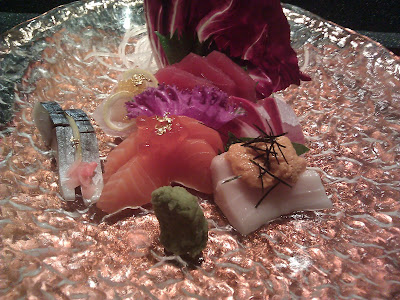
Clockwise from top: fatty tuna, snapper, yellowtail with uni,
salmon with roe and gold leaf, mackerel, flounder with lemon and
yuzu-flavored tobiko. Radicchio, daikon and mint garnish, fresh wasabi
Course 3: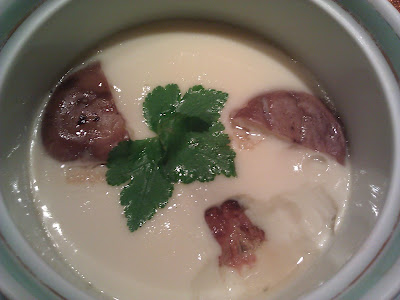
Chawan-mushi: savory custard with shiitake, ginko nut, unagi,
kamaboko (fish cake)
Course 4: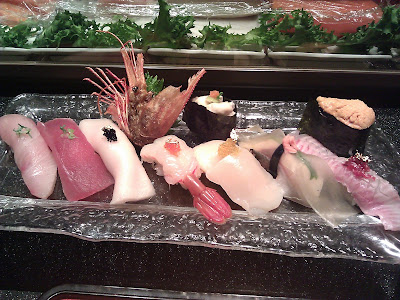
L-R top: Shrimp head, baby shigoku oyster, uni
Bottom: Yellowtail, fatty tuna, special yellowtail,
sweet shrimp, scallop, mackerel, flounder
Combined with some wonderful sake, I was grinning like a Cheshire cat, even after I saw the tab. On the way home, I said "We could've tried to go anywhere, but I'm so happy that we went back to Katsu."
Count me as a fellow grasshopper.
-s.
-
-
Post #21 - January 22nd, 2011, 12:40 amQuestion: I love sushi, but don't eat shellfish, or octopus/squid. How flexible is Katsu to this, were I to order a sushi combination or perhaps even an omakase?
-
-
Post #22 - January 22nd, 2011, 6:02 amThey are very accomodating and flexible, tell Katsu your likes and dislikes and he will put together a sushi experience for you that is as good as any I have had in Chicago.bshor wrote:Question: I love sushi, but don't eat shellfish, or octopus/squid. How flexible is Katsu to this, were I to order a sushi combination or perhaps even an omakase?
-
-
-
Post #23 - March 23rd, 2011, 12:53 pmWe are celebrating two birthdays (one of them being mine) at Katsu in a couple weeks & were wondering if the omikase will include any of that tuna from the Tsukiji fish market in Tokyo. I am sure chef Katsu wouldn't serve anything imperfect, but I imagine there could be disruptions in supply at the very least.
It's been awhile since I've been there, and the sea taste of the tuna has been hardwired into my brain ever since.
The best bet would be to call and ask. I would imagine fish from Tsukiji will be getting more and more scarce until the nuclear thing is over.
-
-
-
Post #24 - November 20th, 2011, 6:18 pmMrs. EdB and I made our inaugural visit to Katsu last night. When you walk in and a vestibule displays all the restaurant accolades, including a GNR and Dolinsky's "best sushi experience in Chicago" tribute, the expectations get set very high.
I had chosen deliberately *not* to read any of the LTH postings in advance, though my better half obviously had in choosing our destination. I was surprised on a Saturday night to find only five tables occupied.
I was a little stunned to see the first "appetizer" on the specials menu at $46, for a combo of yellowtail from Tsukiji and Big Eye from Boston.
We ordered the clam broth, goma-ae, a sushi/sashimi combination, some various nigiri, and the mastutake mushroom soup. I was a little surprised in reading older LTHForum posts to find the mastutake soup looked identical in 2006. I suppose the restaurant's promise is quality, consistency, and not messing with a good thing, still a little unexpected to see that dinner in 2011 and dinner in 2006 would have much in common.
The clam broth was nice but I didn't have the religious experience others have described with it. The mushroom soup, though, was really satisfying and perfect for a cold, fall day. The goma-ae was the best I've had in the area, more sesame-centric and without the peanut butter goop you often find; the spinach was obviously fresh.
As for the sushi and sashimi, it was indeed wonderful. I used to get to Japan on business, and Tsukiji fish market was a requisite 6 AM stop for the best sushi anywhere. Mrs. EdB was instantly transported back to Tsukiji through Katsu's procurement and preparation, and the generous slices likewise harkened back to the best in Japan. It's a rarity to find real fatty chu-toro or o-toro state-side, but there it was, right on our plate with a dollop of tobiko and something golden. I liked the salmon sashimi with lemon zest slices, it's a small extra thing that really enhances the flavor. The various types of tuna were all great. The sweet shrimp (ama ebi) was actually a little bitter, but I the fried head was an authentically Japanese treat. Mrs. EdB raved about the scallop nigiri, so much she got a second piece. She also thought the tamago was really good, always a good indicator of the chef's overall talent.
The sake selection is excellent but we noticed too late that they offer a flight so you can try the various distillations; good to try another time.
I was a little surprised that we were in and out of the restaurant in just an hour's time; I suppose the kaiseki would have paced it differently. I don't know how I feel about returning. I agree with others that it was clearly the best sushi I've had in Chicago, but is that step up in quality worth it? Perhaps for the omakase on a special occasion.
-
-
Post #25 - November 21st, 2011, 8:00 am"Perhaps for the omakase on a special occasion"
That is the only way to go!
Just tell Katsu a $$ value or maybe that should be $$$$ and he and the staff will do the rest!-Dick
-
-
Post #26 - November 21st, 2011, 9:01 amedb60035, I was there Saturday night too! Were you the table that sat 2 tables from the bar? Behind a table of 3 Asians (which would be me!)...
-
-
Post #27 - November 21st, 2011, 9:54 amCrazyC wrote:edb60035, I was there Saturday night too! Were you the table that sat 2 tables from the bar? Behind a table of 3 Asians (which would be me!)...
LOL - we were two tables from the bar - I am glad you didn't assume us to have been the unsophisticated-but-posing bento box orderers a few more tables away
I think either I or Mrs. EdB checked in on FourSquare/Twitter; some day those services will have an on-site display to tell you who has checked in! Looking forward to meeting you another time.
-
-
-
Post #28 - January 19th, 2014, 8:42 amIt pains me to have to add this review.
Almost exactly two years ago, the Lovely Dining Companion and I had a superb meal at Katsu. It was the mid-level kaiseki at $120. The restaurant was quiet that evening and we had the great good fortune to be served exclusively by Haruko, Katsu’s wife. It was a truly wonderful meal and a gem of an evening and you can find my review here.
We had occasion for a celebration and decided to revisit Katsu, this time choosing the omakase, “chef’s choice” for $220. Because of certain dietary restrictions, I called and spoke with Haruko a week in advance. Among other things, she specifically requested a list of our dishes from the last visit. Based on these few facts alone, we were more than seriously disappointed to have many of the exact same dishes and, more troubling still, to have several items (sashimi) repeated in two courses.
The house was busier last night and therefore somewhat noisier. We were also served by a number of different servers—all of whom, it must be said, were quite good, warm, and knowledgeable. But it was clear that Haruko was training one in particular, and she would often offer instructions sotto voce while hovering behind or leaving entirely. That server was quite knowledgeable (although her pronunciation of basic Japanese items was sadly lacking…a sore point with us) and genuinely kind and friendly. But it wasn’t quite the same as having Haruko to ourselves in a quiet house.
Still, at the end of the meal, we were troubled and very disappointed. Grace costs $185 without pairings. This meal was $220 without sake. Recognizing that it is difficult to compare the two, and even acknowledging that the quality of the ingredients was superb, $220 is simply not justifiable. The whole dinner becomes even more disappointing when we look back and see six of nine courses were virtually identical to what we received two years ago. Then, to have a sashimi course and a sushi course in the same meal where several of the items were identical further deepens our disappointment. Superb o-toro is a genuine treat. To be presented with it a second time several courses later is disheartening and sad. So too with the uni.
With that preface, let me share some pictures and brief comments:
Bluefin tuna “tartare” with yuzu and quail egg
A repeat course; beautifully executed, excellent quality, lovely presentation. This was our “tipoff,” I guess, that our dinner would not stray far from what we had two years ago.
Chawanmushi
Another repeat. Once again, nothing to criticize in quality (though I think we can safely say we’ve both had better. The custard was a little too “set” but the flavor lovely and the eel and gingko nut (in mine, anyway), perfect complements.
Grilled cod with pickled ginger(a substitution for LDC)
A very thoughtful substitution from the kitchen for the LDC who is not able to do much with sashimi. Great prep, great fish.
Sashimi: bluefin tuna, hirame, hamachi, o-toro, salmon
A repeat course, but the only one we would have expected to be repeated. Katsu’s sashimi is virtually impossible to fault: the quality of the fish is always top-notch and his portions quite generous. So it was here. Particular standouts for me were the tuna and the o-toro.
Tempura (shishito pepper, red pepper, okra, hedgehog mushrooms, kisu fish)
Done in a somewhat surprising “home-style” way: less crispy. This is more like a dish we would expect to encounter as Sunshine Café. Don’t misunderstand: it was very well done and we appreciated the unusual items (okra, hedgehog mushrooms, and kisu fish), but it’s a very un-fancy kind of dish and not what one would expect at a “fancy”/”high-end” place where the chef has greater tools (much higher hear, for example) and technique at his disposal. It’s not that we didn’t like the dish—we did—but we had tempura not so long ago at Takashi that was more difficult to execute, more unexpected, and, all in all, much more successful.
Ankimo (monkfish liver)
What to say that I haven’t already said: top-quality ingredient, top-notch preparation, but…nothing remarkable about the course, considered as a course.
Wagyu beef
A repeat course. Quality impossible to fault thought just another thirty seconds on the grill would have been welcome for us. Still, pristine beef; a beautiful dish.
Sushi: o-toro, ama ebi (sweet shrimp), uni, oyster, suzuki
A repeat course including not one but two repeat items: o-toro for the second time and uni for the second time. No complaints about quality, preparation or presentation.
Littleneck clams in broth
A repeat course. Frankly, it was better last time; the broth this time was largely one note--last time it had a wonderful depth of rich fullness of flavor that simply was missing this time.
Dessert, for what it’s worth, was a cop-out: we were offered a selection from what’s on the menu—green tea ice cream, azuki (red bean) ice cream, coconut gelato. In an omakase, particularly one with such a talented chef, Katsu couldn’t exert himself to come up with something I can’t buy at the grocery store? Disappointing.
As you can see, the meal was excellent in terms of quality and presentation. As I noted above, we were dismayed to have so many repeat courses and even repeat items. We hold Katsu to a higher standard. He knew a week in advance exactly what we had two years ago. And then proceeded to repeat two-thirds of the courses. Nothing stood out as exceptional; there was nothing unusual or particularly creative or challenging. It was wonderful food but there is no way to justify this price point when we had nearly the same meal two years ago for half the price. And with Grace at $185 and Alinea at $210-265, we’ll be far more discriminating when we return. We will return because Katsu’s talent and ingredients are among the best, but the omakase—at least last night—was simply not worth the bill.Gypsy Boy
"I am not a glutton--I am an explorer of food." (Erma Bombeck)
-
-
-
-
Post #29 - January 19th, 2014, 8:49 amAre you sure that your enthusiasm for the previous dinner wasn't mistaken as a request to do it again, plus a few additional courses?"Knowledge is knowing a tomato is a fruit; wisdom is not putting it in a fruit salad." Miles Kington
-
-
-
-
Post #30 - January 19th, 2014, 8:54 amboudreaulicious wrote:Are you sure that your enthusiasm for the previous dinner wasn't mistaken as a request to do it again, plus a few additional courses?
That was the first thing that occurred to me, also.Pithy quote here.
-