

I Watch MikeG Make Coppa
I Watch MikeG Make Coppa
-
-
-
-
-
I Watch MikeG Make Coppa
-
-
Post #1 - February 7th, 2009, 3:59 pmI Watch MikeG Make Coppa
When Hoesly’s in New Glarus took delivery of my hog Ermine from Valerie Rock, Pig Protectoress, I asked them to keep one shoulder whole so MikeG could make coppa from it.
First step was to figure out where to find the long thin shoulder muscle that would yield the right hunk of meat. MikeG analyzed the probable orientation of the shoulder.
We checked the internet for pix; MikeG had already gotten some direction from the good folks at Mado.
My contribution was grinding spices (salt, pepper, thyme, fennel), which Mike massaged into the meat.
Just about the time MikeG started to enjoy massaging the pork just a little too much, we decided it was done. Next step: 15 days of refrigeration, followed by a hang-time in a wine cooler.
MikeG also cured and smoked one-half of Ermine’s fatty belly. I sliced and vac-sealed it last night…and ate a bunch. It was really good; I intend to use some in the mulefoot pozole for next week’s small household exchange.
With the six-plus pounds of remaining shoulder, I did the first smoke of the year. Here’s a pic I took when I removed the shoulder to throw on some more charcoal.
For this smoking episode I used a variation on GWiv’s rub and various elements of his Five Step Program (soon to be a major publication), which has never led me astray (though it has led me to much overindulgence).
Hammond"Don't you ever underestimate the power of a female." Bootsy Collins
-
-
-
Post #2 - February 7th, 2009, 6:29 pmThat looks fantastic. Smoking meats is something I’ve been thinking about trying my hand at. Great pictures too! !The most dangerous food to eat is wedding cake.
Proverb
-
-
Post #3 - February 7th, 2009, 7:25 pmMy contribution was grinding spices (salt, pepper, thyme, fennel)
Plus a little red chile pepper, and some malto-dextrose.
I was rather proud of the process of removing the coppa muscle. (Think of it as sort of a roll of meat, running roughly parallel to the spine on the shoulder.) Every time I've had any interaction with a pork shoulder lately, I've poked and prodded it to try to figure this out, and had some guidance from both Nathan Sears at Vie and especially Rob Levitt at Mado, who let me photograph it step by step. Still, I can't say I was sure where it was...
Then we unwrapped David's mulefoot shoulder and... hey! There it was, a perfect little cylinder of meat tucked in next to the blade. (If you look at the picture with the laptop in it, look at the end of the shoulder nearest the edge of the computer, and you'll see an area where it's sort of round on one end, and then you see meat and fat running long and straight along the body of the shoulder. That's the cylindrical coppa, basically.)
I'm starting to think, actually, that when you get something that's been naturally raised, you're more likely to find its parts in the proper places and proportions, like on the charts, and it's only when you get meat that's been raised by some more artificial process that it seems kind of jumbled, irregular, like way too thin bellies or pork shoulders that each look like some different jumble of hunks of meat. So it was really a breeze cutting the coppa out to produce a nice little roll of meat and, just as importantly, a remainder of the shoulder that wasn't mangled and abused and would make a nice barbecued pork shoulder, as it did.Watch Sky Full of Bacon, the Chicago food HD podcast!
New episode: Soil, Corn, Cows and Cheese
Watch the Reader's James Beard Award-winning Key Ingredient here.
-
-
Post #4 - February 9th, 2009, 4:43 amGreat stuff, guys! Thanks for the post. I'm already looking forward to follow-ups.
I'm frankly amazed that the remains of that shoulder were manageable enough to smoke in that one piece. I don't care if that pig had had a PhD from Harvard and taken runner-up on Top Model, that's some fine knifework, MikeG.
-
-
Post #5 - February 9th, 2009, 8:08 amHI,
It certainly appears all the guys are having fun in the kitchen!
Did you use any pink salt?
I'm curious how much estimate hang time in the wine cooler is required.
Looking forward to seeing the pictured results.
Regards,Cathy2
"You'll be remembered long after you're dead if you make good gravy, mashed potatoes and biscuits." -- Nathalie Dupree
Facebook, Twitter, Greater Midwest Foodways, Road Food 2012: Podcast
-
-
Post #6 - February 9th, 2009, 8:58 amThanks for the compliment, Bridgestone.
The recipes I found called for No. 2 curing salt, not the conventional pink salt (No. 1), but Mado-- where I've eaten it and, so far as I'm epistemologically capable of determining, have not died-- just uses salt, no curing salts. So I'm giving that a shot.
Here's one online recipe I looked at for guidance:
http://curedmeats.blogspot.com/2007/11/ ... cured.html
They hung it for about two months. I just picked up a Vinotemp 12-bottle wine fridge for $99 at Best Buy, soon I'll have both lardo and coppa hanging in it.Watch Sky Full of Bacon, the Chicago food HD podcast!
New episode: Soil, Corn, Cows and Cheese
Watch the Reader's James Beard Award-winning Key Ingredient here.
-
-
Post #7 - February 9th, 2009, 9:36 amIt all looks terrific, but that pork belly (since it was processed with smoke, isn't that technically bacon now?) is making me want to join the SHFE even more.
-
-
-
Post #8 - February 9th, 2009, 9:41 amMhays wrote:It all looks terrific, but that pork belly (since it was processed with smoke, isn't that technically bacon now?) is making me want to join the SHFE even more.
Pork belly + cure/smoke = bacon
Just as
Guts + lots of water = chitterlings"Don't you ever underestimate the power of a female." Bootsy Collins
-
-
-
Post #9 - February 9th, 2009, 9:45 amAre you making chitterlings or tripas from Ermine, David? That's a process I'm curious about, though one I'd probably farm out to somebody else if it were me. I do love tripas, though.
At any rate, the bacon looks absolutely terrific, gorgeous color. Can't wait to see how the Coppa turns out.
-
-
Post #10 - February 9th, 2009, 9:51 amMhays wrote:It all looks terrific, but that pork belly (since it was processed with smoke, isn't that technically bacon now?) is making me want to join the SHFE even more.
Somehow, I don't think your idea of SHFE is the same as NASA's:NASA: Habitability & Environmetal Factors Division wrote:Human Research Program - Space Human Factors Engineering
The Space Human Factors Engineering (SHFE) project is part of the Human Factors and Habitability Systems element of the Human Research Program (HRP). SHFE’s goal is to ensure a safe and productive environment for humans in space. With missions using new technologies at an ever-increasing rate, it is imperative that these advances enhance crew performance without increasing stress or risk.
Human Factors Task CoordinationThe SHFE Element integrates knowledge about human capabilities and system engineering methodologies into space craft design and task design.
The objective of the SHFE Element is to advance the state of the art and develop standards for such items as:
human-machine interfaces
habitation systems and interior layout
information management
SHFE ground and flight research projects are developed from proposals submitted by NASA, and by academia, industry, and other government agencies.Cathy2
"You'll be remembered long after you're dead if you make good gravy, mashed potatoes and biscuits." -- Nathalie Dupree
Facebook, Twitter, Greater Midwest Foodways, Road Food 2012: Podcast
-
-
-
Post #12 - February 9th, 2009, 10:08 amMhays wrote::D OK, busted being lazy. SHFE
I had so many ideas, but never would have come up with that.
Regards,Cathy2
"You'll be remembered long after you're dead if you make good gravy, mashed potatoes and biscuits." -- Nathalie Dupree
Facebook, Twitter, Greater Midwest Foodways, Road Food 2012: Podcast
-
-
Post #13 - February 9th, 2009, 10:17 amisn't that technically bacon now?
It's a rasher, until it's sliced.Watch Sky Full of Bacon, the Chicago food HD podcast!
New episode: Soil, Corn, Cows and Cheese
Watch the Reader's James Beard Award-winning Key Ingredient here.
-
-
Post #14 - February 23rd, 2009, 8:51 pmSo it's a little over two weeks later and time to hang and dry the coppa. Here's how it looked when it came out of the plastic bag in the fridge, like a Stuckey's pecan roll's fantasy of transcendence:

30 minutes of rinsing the salt off (that was Rob Levitt's advice) and then wrapped in cheesecloth and tied off (if Ariane of Top Chef needs any tips on how to tie up meat, have her call me). Rob recommends cheesecloth as opposed to some kind of casing because you can remove it if it gets bad mold, wash the meat, and replace it. I also liked the fact that I didn't have to buy 100 feet of it at a cost of about $30 plus shipping, as was the case with the 65mm casing.
Then hang it in my wine fridge-- that's the lardo hanging above it-- and wait a month or so. Watch Sky Full of Bacon, the Chicago food HD podcast!
New episode: Soil, Corn, Cows and Cheese
Watch the Reader's James Beard Award-winning Key Ingredient here.
-
-
Post #15 - February 24th, 2009, 1:02 amLove the mood lighting in the cooler, MikeG. That last photo has a sort-of Tron-meets-cured-pork vibe.
I, for one, had a hard time waiting the two weeks for this report. How am I to survive another whole month?!
-
-
Post #16 - April 2nd, 2009, 6:18 pmAs I prepare to conclude this saga, I realize I never posted the middle section, The Two Towers of it, The Empire Strikes Back, here, only at Sky Full of Coppa. So here's the middle section, the thrilling conclusion to come tomorrow:
March 15: Coppamergency!
So I had been checking on my coppa in process more or less daily, and it seemed to be doing all right, no foul odors, just a nice pork-and-seasonings smell. The one potential problem seemed to be that the moisture it was losing was keeping the inside humidity of the wine fridge turned charcuterie chamber way too high, but cracking the door regularly seemed to be helping.
Then last night I examined it, maybe more closely than before, and… mold. Not just white mold, which is normal and even healthy, but… green spots. Oh hell, that’s the end of that, I thought. Yet nothing smelled bad, in fact, it smelled great.
So I read up and found that green mold could still be washed away— it’s black mold, with roots going into the meat, that really means death for your meat and sickness for you. So I hurriedly unwrapped the cheesecloth and discarded it and most of the mold with it, and then washed the outside with vinegar, scrubbing the mold away. I even made some unobtrusive cuts to see the inside, fully expecting to see death and destruction, but… it looked beautiful. It smelled right.
I wrapped it in fresh cheesecloth, retied it, and rehung it. I think it’s going to be okay. We’ll see. That’s part of the point.Watch Sky Full of Bacon, the Chicago food HD podcast!
New episode: Soil, Corn, Cows and Cheese
Watch the Reader's James Beard Award-winning Key Ingredient here.
-
-
Post #17 - April 3rd, 2009, 9:21 amCoppafinale!
When last we saw my coppa, it had green splotches which I washed off with vinegar. Back into the wine fridge for a couple of weeks, and finally I decided now was the time.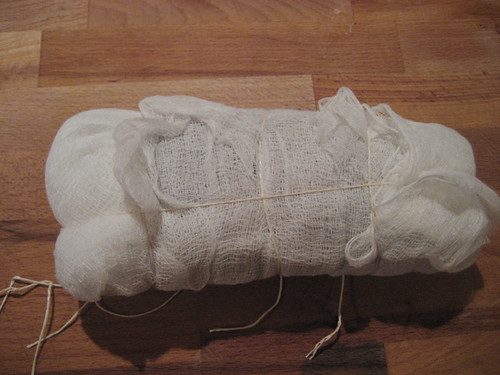
But, as in a horror movie, I had no certain idea what would lie behind the bandages once they were removed... flesh of tantalizing beauty... or of unspeakable horror?
I peeled them back, slowly...
A little white mold, the good kind, but no hideous green or orange growths.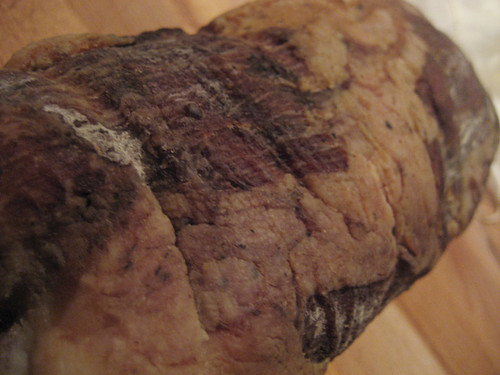
The smell, too, was the good funkiness of old school salume, not the bad funk of rot.
I sliced it in half, then cut myself the thinnest slice I could and tasted it.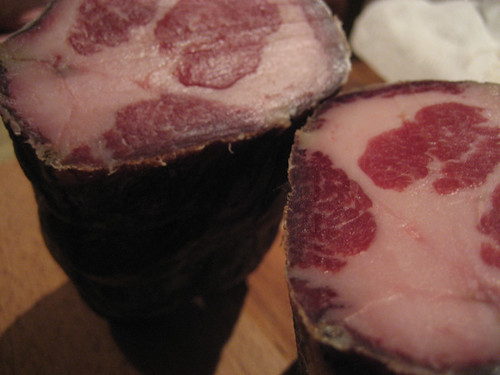
The flavor, like the smell, was funky and deep, but not offensive in any way. The texture was supple, buttery. This being mulefoot, it's more fat than meat, which is perhaps a slight disappointment, and I could wish for it being a little more salted, and perhaps a little more dried— it's very much like raw meat in the middle. But for a first try, I was extremely happy with having come so close to my model.
Half for me, half for Hammond whose pig it was. So he has something to really look forward to when he comes out of his current self-imposed fast.Hey, I got yer satori right here, pal.Watch Sky Full of Bacon, the Chicago food HD podcast!
New episode: Soil, Corn, Cows and Cheese
Watch the Reader's James Beard Award-winning Key Ingredient here.
-
-
Post #18 - May 16th, 2009, 8:49 amMike G wrote:I just picked up a Vinotemp 12-bottle wine fridge for $99 at Best Buy, soon I'll have both lardo and coppa hanging in it.
Did you do any research before picking a wine fridge? Any particular reason you chose this one? Do I need one with adjustable temp and/or humidity?
Anyone else who has cured meat using a wine fridge should feel free to weigh in with advice.
Thanks
-
-
Post #19 - May 16th, 2009, 9:42 amAny particular reason you chose this one?
It was $99 at Best Buy, that's why.
I think getting into serious humidity control takes a much more expensive fridge. Rob Levitt at Mado suggested putting a bowl of uncooked rice in there to soak up some humidity. I'd also just crack it about once a day and let it fall to the same level as the rest of the room.
One more note: I actually wound up deciding that it wasn't really dried out enough, rewrapped it, and hung for about another 5-6 weeks. It's much harder and smaller now, and seems more like what I was aiming for. So I'd say a good two months is about the minimum hang time you'd want.Watch Sky Full of Bacon, the Chicago food HD podcast!
New episode: Soil, Corn, Cows and Cheese
Watch the Reader's James Beard Award-winning Key Ingredient here.
-
-
-
Post #20 - May 16th, 2009, 2:42 pmMike G wrote:One more note: I actually wound up deciding that it wasn't really dried out enough, rewrapped it, and hung for about another 5-6 weeks. It's much harder and smaller now, and seems more like what I was aiming for. So I'd say a good two months is about the minimum hang time you'd want.
Have you tasted it yet or is it still hanging?Steve Z.
“Only the pure in heart can make a good soup.”
― Ludwig van Beethoven
-
-
-
-
Post #21 - May 20th, 2009, 3:56 pmAfter a bike ride this afternoon, I slit the vacu-pak to sample some of MikeG's coppa. It had a soft, peppery flavor and was very rich...almost too rich from fat. As has been mentioned, the fat seems to be one of the advantages with heritage breeds, which is great when cooking, but when making charcuterie, you may tend to get a somewhat lusher bite than you'd have with more conventional breeds. After the sun goes down, I'll try a little more of this coppa with an Italian red -- I think the wine will bring out some dimensions of this meat.
The coppa looks beautiful: deep red/pure white."Don't you ever underestimate the power of a female." Bootsy Collins
-
-
-
Post #22 - May 20th, 2009, 8:10 pmI have tasted it. It's good! I might wish it to have absorbed more of the salt/spice flavor, but in terms of a developed funkiness, it's quite good.
I was just looking at footage of LaQuercia's coppa and it's amazing how much bigger it is, though. Really points out how much smaller an older heritage breed often is than even the modern heritage breeds (ie Berkshire or Berkshire cross).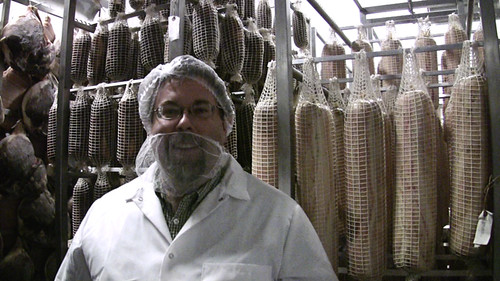
(The coppa's behind my head. The even bigger meat to my left is rolled pancetta.)Watch Sky Full of Bacon, the Chicago food HD podcast!
New episode: Soil, Corn, Cows and Cheese
Watch the Reader's James Beard Award-winning Key Ingredient here.
-
-
Post #23 - May 21st, 2009, 8:22 amMike G wrote:One more note: I actually wound up deciding that it wasn't really dried out enough, rewrapped it, and hung for about another 5-6 weeks. It's much harder and smaller now, and seems more like what I was aiming for. So I'd say a good two months is about the minimum hang time you'd want.
Were you going for a weight loss goal or going based on time/feel? I had always targeted 30-35% weight loss as a way to know something was dry enough, though I would imagine this is probably not particularly precise either.
When you were out at La Quercia did they say how they measure "doneness"?
I need to replace my broken curing fridge...
-Dan
-
-
Post #24 - May 21st, 2009, 9:33 amLa Quercia very much goes by weight loss.
I was going by feel/general impressions, learned I need to be stricter about weighing.Watch Sky Full of Bacon, the Chicago food HD podcast!
New episode: Soil, Corn, Cows and Cheese
Watch the Reader's James Beard Award-winning Key Ingredient here.
-
-
-
Post #25 - May 26th, 2009, 5:22 amDavid Hammond wrote:After a bike ride this afternoon, I slit the vacu-pak to sample some of MikeG's coppa. It had a soft, peppery flavor and was very rich...almost too rich from fat. As has been mentioned, the fat seems to be one of the advantages with heritage breeds, which is great when cooking, but when making charcuterie, you may tend to get a somewhat lusher bite than you'd have with more conventional breeds. After the sun goes down, I'll try a little more of this coppa with an Italian red -- I think the wine will bring out some dimensions of this meat.
The coppa looks beautiful: deep red/pure white.
Had a decent Italian red (not a Barolo) with the coppa last night and I must say, vino brings out the best in a rich snack like this, balancing the high fat content (and cleansing the palate) while highlighting the subtle herbiness and prosciutto-like meatiness.
We had one of Boy’s friends from the Art Institute over for dinner, and I thought he’d be turned off by the fatty slice, but he loved it; said it was like “meat cheese,” by which I think he meant funky, fermented flesh."Don't you ever underestimate the power of a female." Bootsy Collins
-
-
-
Post #26 - May 26th, 2009, 5:58 amhe loved it; said it was like “meat cheese,” by which I think he meant funky, fermented flesh.
Great description. Glad teenage boys like it.Watch Sky Full of Bacon, the Chicago food HD podcast!
New episode: Soil, Corn, Cows and Cheese
Watch the Reader's James Beard Award-winning Key Ingredient here.

 OK, busted being lazy.