

La Caja China
La Caja China
-
-
-
-
-
La Caja China
-
Post #1 - September 10th, 2004, 1:02 pmHi,
I just got an e-mail from Cook's Illustrated describing briefly their cook:
Cook's Illustrated wrote:We just hosted our end-of-summer pig roast at the farm. We bought an 80-pound pig that had been butterflied and cooked it in a roasting box made by La Caja China (800-338-1323, http://www.lacajachina.com). It is made of plywood and lined with sheet metal. The pig is placed in the box, and a metal grate and pan are placed over the top. Charcoal briquettes are burned on top of the grate/cover, and the fire heats up the contents of the box below. I injected the pig (the box comes with a large hypodermic) with a flavored brine the night before, and cooking time was about five hours. The result? The best (and easiest to handle) roast pig I have ever tasted: moist, fall-apart soft, and no leftovers. La Caja China sells roasting boxes in three different sizes. The smallest accommodates a turkey or a pork leg, and the largest, the model I purchased, can handle a pig weighing up to 100 pounds.
My Cuban-born neighbor has one, which he has used countless times with results he approves. I know MAG did a cook in July. I was wondering what are people's experiences with these.Cathy2
"You'll be remembered long after you're dead if you make good gravy, mashed potatoes and biscuits." -- Nathalie Dupree
Facebook, Twitter, Greater Midwest Foodways, Road Food 2012: Podcast
-
-
Post #2 - September 10th, 2004, 1:17 pmYes, MAG owes us a review, doesn't she?
I was a Caja skeptic, but I've heard so much good that I figure it must be worthwhile.
I for one would like to do a pig this fall without the huge prodction of an open pit or even a closed roaster. Tending a pig for all those hours can be fun depending on the beverages and the company, but a tidy pig box might be a good compromise, assuming that it eliminates some of the vigil. My main and constant concern is what I perceive to be the almost complete lack of smoke.
On the other hand, I could survive an outing of mojorific (but no smoky) pig, sausages and ribs smoked elsewhere in the yard, and some good fried oysters. Bring on the fall.
-
-
-
Post #3 - September 10th, 2004, 2:07 pmI just watched an episode of the Bobby Flay BBQ show that I had TiVo'ed a while back where they did a pig in on of those. It looked like a great way to do a whole hog, although I don't think there is much smoke involved in the cook. I'm sure it's very tasty and moist, but I think I would miss the smoke of a pit. I'm willing to be proven wrong, though (if anyone wants to cook a pig for me to try out)
 Steve Z.
“Only the pure in heart can make a good soup.”
― Ludwig van Beethoven
-
-
-
Post #4 - September 10th, 2004, 2:29 pmYes, MAG owes us a review, doesn't she?
I know, I know. And yes, Gwiv, it's not the only review I owe. Perhaps this weekend.
-
-
-
Post #5 - September 12th, 2004, 6:18 amThe Bobby Flay Caja China show is going to be shown today at 1:00 P.M. on The Food Channel for anyone who is interested.Steve Z.
“Only the pure in heart can make a good soup.”
― Ludwig van Beethoven
-
-
-
Post #6 - September 12th, 2004, 10:14 pmJeff B wrote:I for one would like to do a pig this fall without the huge prodction of an open pit or even a closed roaster. Tending a pig for all those hours can be fun depending on the beverages and the company, but a tidy pig box might be a good compromise, assuming that it eliminates some of the vigil. My main and constant concern is what I perceive to be the almost complete lack of smoke.
On the other hand, I could survive an outing of mojorific (but no smoky) pig, sausages and ribs smoked elsewhere in the yard, and some good fried oysters. Bring on the fall.
What have we got here:
1. La Caja China - we have two sources where one could be borrowed.
2. In my freezer are 3 quarts of frozen Seville orange juice, with another quart possibly available, from the oranges brought from LA last February by Daane. We have a post for making your Uncle's Criolla. For a pig, Gary has earlier advised we would need 2-3 gallons, which your Uncle's recipes allows. I can make this sauce, if that is agreed upon as the way to go.
3. There is a regular posse of WSM's ready to do the sausages and ribs; which would fit in nicely with timing required for the pig. Maybe a regular Weber grill to roast corn on where the corn actually chars a bit.
4. Somehow the oysters will find their way into the plan. Though I am somewhat intrigued by Yourpalwill's description of roasted oysters brought to a table by shovel today.
What is missing is a list of recommended side dishes, location and a time.Cathy2
"You'll be remembered long after you're dead if you make good gravy, mashed potatoes and biscuits." -- Nathalie Dupree
Facebook, Twitter, Greater Midwest Foodways, Road Food 2012: Podcast
-
-
Post #7 - September 13th, 2004, 8:13 amIn my freezer are 3 quarts of frozen Seville orange juice, with another quart possibly available, from the oranges brought from LA last February by Daane. We have a post for making your Uncle's Criolla. For a pig, Gary has earlier advised we would need 2-3 gallons, which your Uncle's recipes allows. I can make this sauce, if that is agreed upon as the way to go.
Actually, that would be way too much for a pig roasted in the Caja China manner. The pig is actually injected with a brine solution, which you can flavor with bitter orange juice or a mixture of orange and lime juice. For Caja China purposes, the mojo criollo is made afterwards with citrus juice, garlic and the juices that have accumulated on the grease tray.
-
-
Post #8 - September 13th, 2004, 8:51 amHI,
The cook instructions at La Caja China affirm what you indicate.
For clarification, I just talked to my neighbor about their pig preparation. The day before, her husband cracks the backbone with a hatchet to allow the pig to lay flat. My neighbor massages the interior with a mixture of salt, pepper, garlic and oregano, then pours in the bitter orange for an overnight marinade. I asked if they injected as indicated on the website, which they were unaware of. Apparently, injecting is an innovation since they started about 7 years with their cooker.
I inquired if they made a finishing sauce, sometimes they make Mojo Criolla but they have other sauces they like just as much. She reminded me of a Chipotle-Black Currant (or is it berry) sauce her husband likes to make for this pig.
She did indicate fire-control was something which took several cooks to understand. They use regular charcoal, which creates its own insulation with fine grey layer which accumuates. Her husband is careful to keep this grey insulation from building up too thick and cooling the fire. I wonder what the results would be if we used the wood charcoal instead, which certainly throws off much more heat and burns longer.Cathy2
"You'll be remembered long after you're dead if you make good gravy, mashed potatoes and biscuits." -- Nathalie Dupree
Facebook, Twitter, Greater Midwest Foodways, Road Food 2012: Podcast
-
-
Post #9 - September 13th, 2004, 9:13 amShe did indicate fire-control was something which took several cooks to understand.
Boy, that statement really surprises me - our experience was similar to that of the author of the New York Times article, which can be located at http://www.lacajachina.com/. In this, he describes his afternoon of alternating between making fire and sitting on couch.I wonder what the results would be if we used the wood charcoal instead, which certainly throws off much more heat and burns longer.
Thor's PA and I are ordinarily bbq purists, using only wood charcoal. I would not recommend it for this cook, most of all, because it would provide no benefit but would involve significant risk. The pig cooks inside the box, like a microwave, so even if you used hard wood charcoal, the pig's taste wouldn't reflect it.
-
-
Post #10 - September 13th, 2004, 10:03 amBoy, that statement really surprises me - our experience was similar to that of the author of the New York Times article, which can be located at http://www.lacajachina.com/. In this, he describes his afternoon of alternating between making fire and sitting on couch.
I am certainly glad your experience was good.
My neighbor has done a number of cooks in his La Caja China, which allowed him to make observations a single cook may not allow. He was probably satisfied with his initial cooks, then learned to tweak it for subtle improvements. He is an engineer who specializes in quality control, so he is constantly re-evaulating and experimenting.
As Gary advised in an e-mail this week, "It does all boil down to the old Belly Maynard BBQ saying though, "it ain't the pit, it's the pitmaster." Something I have come to newly appreciate with my WSM and the improved results I have experienced in the last few months.Cathy2
"You'll be remembered long after you're dead if you make good gravy, mashed potatoes and biscuits." -- Nathalie Dupree
Facebook, Twitter, Greater Midwest Foodways, Road Food 2012: Podcast
-
-
Post #11 - September 13th, 2004, 10:23 amAs Gary advised in an e-mail this week, "It does all boil down to the old Belly Maynard BBQ saying though, "it ain't the pit, it's the pitmaster." Something I have come to newly appreciate with my WSM and the improved results I have experienced in the last few months.
I definitely agree with that statement with regards to traditional barbeque, but La Caja China is really roasting, "roasting for dummies." Follow the instructions, you'll get a good pig. But I'm certain that there are variations on cook time and charcoal needs depending on the outside temperature.
-
-
Post #12 - September 13th, 2004, 11:15 amWhile I typically agree with his Devilness on most things, I must state that, having cooked a pig in the box, his BBQ quote does not apply here.
Since the pig does not see the light of coals or the smell of smoke, it really is the pit and not the pit master that controls in the caja china.
And, the NY Times article is correct--you really can sit on the couch in between coal dumps and sip a cocktail because there is nothing one can do for the pig as it roasts away.
Just my two cents--considering Thor was the pit master when the pig was cooked.
 Nothing says pork like pork!
-
-
Post #13 - September 13th, 2004, 11:37 amThor's Personal Assistant wrote:While I typically agree with his Devilness on most things, I must state that, having cooked a pig in the box, his BBQ quote does not apply here.
TPA,
Of course "It ain't the pit, it's the pitmaster" does not apply, La Caja China is not a BBQ Pit, it's simply a big ol' Dutch oven. Or, as they tend to call it in Louisiana, Cajun Microwave.
Now don't get me wrong, I'm sure La Caja China produces very tasty pig, the piece you brought back from NY I tried was flavorful, and I bet the skin was magical when hot from the box. La Caja China is more about an easy, introductory way for the backyard chef to have a whole pig roast, than BBQ.
I have some experience with whole pig, goat, etc, but it's all been direct pit cooking over wood burned to coals, which is quite different than La Caja China.
Picture is 'Gary' the goat, which I cooked direct on Bob in Ga's pit (in Ga). Goat is coated in Chili Oil, then layered with bacon. Damn tasty, if I do say so myself.
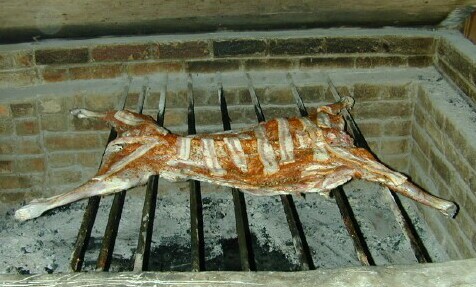
I will say I'm quite looking forward to Thor's first La Caja China party. Thor really knows how to throw a party.
Enjoy,
Gary
-
-
Post #14 - September 13th, 2004, 11:57 amGary wrote:Of course "It ain't the pit, it's the pitmaster" does not apply,
I think it does in one sense, and maybe I am too subtle, "it ain't the pit, it's the pitmaster" OR experience rules, whether it is BBQ, WSM, La Caja China, grilling or just about anything else really.
This turn in the conversation occured with my neighbor's comment on fire control. Their statements were based on maybe 2 dozen cooks and experience they acquired over time. Maybe they began at a different experience level than you or maybe he noticed a decline in interior temperature (he is likely to have monitored temperatures), which was altered by reducing ash on the coals. Neither experience disproves the other, you both observed what you observed.
I simply know I have had a good tool with my WSM for too many years underutilized because the operator/pitmaster was dealing with inferior information. In the "Stupid is forever, ignorance can be fixed" mode, I can now say my operating skills have improved dramatically.
Ok - I would be interested sometime with you or via my neighbor in doing a full La Caja China cook from start to finish, which includes clean up.Cathy2
"You'll be remembered long after you're dead if you make good gravy, mashed potatoes and biscuits." -- Nathalie Dupree
Facebook, Twitter, Greater Midwest Foodways, Road Food 2012: Podcast
-
-
Post #15 - September 13th, 2004, 12:07 pmCathy2 wrote:OR experience rules, whether it is BBQ, WSM, La Caja China, grilling or just about anything else really.
Cathy,
Hummm, I certainly agree with this, subtle variations, based on experience learned over time, can make a difference in just about anything.
I suppose one develops preference, type of marinade injection, number of injection points, number of coals per lb of pig, size of pig that yields best results for your particular taste etc.
Yep, experience certainly counts, but, nuance notwithstanding, La Caja China is still a relatively easy way for the backyard chef to throw a whole pig party with a high degree of certainty of it coming out well.
Enjoy,
Gary
-
-
Post #16 - September 13th, 2004, 12:10 pmmaybe he noticed a decline in interior temperature (he is likely to have monitored temperatures), which was altered by reducing ash on the coals.
I would definitely be interested to learn whether he was monitoring the internal temperature as he would have been required to modify the cooker - as manufactured, there is no way to do so. The reason la Caja China is nicknamed the cajun microwave is because once the pig is put into the box, it is covered with the ash pan, which should not be removed for at least 3 hours. The instructions are very specific providing the following troubleshooting chart listing reasons why the pig would not be perfect.Used the charcoal incorrectly.
Meat was not at room temperature prior roasting
You lifted the top, prior to the designated time.
You cut into the skin at the beginning of the roasting process, and not when turned the pork.
You applied marinade and condiments prior to roasting. These should be applied after the roasting process.
You did not try the salt level of the juice distilled by the roast.
Like the soon to be famous Wiviott's 5-step method, the "no peeking" rule should be strictly followed for a specified period of time.
-
-
Post #17 - September 13th, 2004, 9:31 pmSo what's the advantage of this cooker vs. a conventional oven? Is it just that it allows you to cook a bigger pig than you could indoors?
-
-
Post #18 - September 14th, 2004, 8:07 amThree advantages: You can cook up to a 100 lb. pig in La Caja China, the fantastically crispy skin or pig candy, and being able to cook outdoors.
-
-
Post #19 - September 12th, 2005, 11:45 amFor as long as it lasts, Cook's Illustrated just experimented with a La Caja China complete with photos.
Regards,Cathy2
"You'll be remembered long after you're dead if you make good gravy, mashed potatoes and biscuits." -- Nathalie Dupree
Facebook, Twitter, Greater Midwest Foodways, Road Food 2012: Podcast
-
-
Post #20 - September 13th, 2005, 8:45 pmI am the ghost of JeffB, communicating from the death that is intense litigation prep. I have had many, many things backing up that I would like to add to the Board on so many topics, including a travel report on my trip to NC going on 6 weeks back.
But first, Hail Antonius. Outstanding.
Second, a good friend of mine asked for me to help him do a cracker pig roast in his neighbor's suburban yard last week. I had no time to do it, but everything that needed to happen happened between Saturday at 4:30 and Sunday at 3:30 (pig purchase, marinade, materials purchase, pit construction, cooking). Not easy, but possible. We threw it together on a couple of days' notice, and the results were outstanding. If it were my gig, ya'll would've been invited. I plan to put up something about it here very shortly, as it is timely and possibly might be of some help. Pictures to follow.
-
-
-
Post #21 - September 14th, 2005, 8:01 pmI attended a food-fest last summer where La Caja China was used to cook a bunch of butts and I thought the results were fairly disappointing. With the heat source (in this case, Kingsford briquets) positioned over the food, the pork took on almost no smoke. Additionally, those in charge didn't control the temperature very well and the result was an abundance of temperature-cooked pork that wasn't really "done" in terms of its tenderness, etc. It was, in effect, done way too soon.
I do agree that in the end, it's the pitmaster, not the pit. I think I could have achieved better results than the folks whose party I was attending. But still, this device just doesn't seem to provide any real culinary advantages over other outdoor cooking methods -- although, I suppose it's slightly easier than digging a pit.
Of course, this is no beginner crowd. It'll be interesting to see how it goes with the box in the hands of some trained (non) professionals.
=R=By protecting others, you save yourself. If you only think of yourself, you'll only destroy yourself. --Kambei Shimada
Every human interaction is an opportunity for disappointment --RS
There's a horse loose in a hospital --JM
That don't impress me much --Shania Twain
-
-
-
Post #22 - September 18th, 2005, 3:51 pmHere, as promised, is a little step-by-step for roasting a hog over a cracker pit. Warning: Not for the squeamish or the vegans among us. Many thanks to Mike and Gary for hosting my pics. I am so ashamed that I still haven't caught up with the basic technology.
I roast a pig just about every year. Usually, I rent a large commercial roaster with a heavy duty mechanical spit. That way, the pig stays looking like a pig, and the hassle is minimized (though it is a pain to get the pig onto and off of the spit -- the pig must be very securely attached to the turning rod). For some time, I've been meaning to build a cracker pit like they do it in North Florida and Georgia. Last weekend, a friend with access to a yard soon to be torn up for a home demolition asked what I had planned, and said "why not roast a pig?" Other than having to work all weekend, I thought it sounded like a good plan.
Each and every thing that went into the following pig roast happened between 4:30 on Saturday and 3:30 on Sunday, from picking up the pig to buying the supplies and building the pit. It can be done.
Step 1, buy pig at Peoria Packing (ask for Larry). Peoria is open till 5 on Saturday -- nightclub hours for a meat wholesaler. If Larry's fresh out of pigs with heads, he might throw in one on the side for free (a pig head, that is). Truth be told, most of the guests were glad the pig was headless.
Get a good Thai cleaver at Thai Grocery, as seen here. Separate ribs from spine. Remove feet if you think they will be in your way later on. Be careful. Don't cut the skin or sever your hand. This is a 90 pounder. Smaller ones can be special ordered. This guy was very fresh. (Note they leave in the kidneys. Why? I don't know. I excised them.)

Getting the pig to the pit requires a fast car and dependable help. Note the clean, new garbage can and the plastic bags. Line the can with a bag, fill the bottom with ice, put the pig in the 2nd bag, put the pig-in-a-poke into the can, and cover with ice. Wheel it inside overnight. But before you do that, take a filet knife and separate the pig's skin from the flesh around the shoulders, hams and ribs. Slash the flesh in a few spots, under the skin, and place garlic in the slits. Slather under the skin with mojo criollo (a starter gallon is in the background). You can make your own or do as I did this time (no bitter oranges around this time of year anyway), and doctor the Lechonera product ($5/gal., La Unica) with lime juice, fresh garlic, black pepper, oregano and cumin. Rub the carcass down with the mojo. (Pig foot in middle frame for perspective.)

Step 3, build a pit and put a pig on it. This pit has a foot-deep hole in the bottom for the coals and three courses of cinder blocks above it, as shown. We used old tiles to line the bottom, which worked a little too well at first, reflecting and retaining much more heat than we needed. Foil lines the two bottom courses inside. Build 2 sides of a rack from rebar, aluminum poles, automotive hose clamps and rebar wire. Do not use any galvanized steel. Gives off toxic fumes. Scrub the oil off the metal with detergent first. Wire the pig into the rack, and set aside. Meanwhile, someone can make a fire. Using chimneys, get 10 or 15 lbs of lump natural charcoal going. Berger Bros. is closed on the weekend. Plan ahead. We used Big Green Egg brand charcoal, and it pretty much sucked. Giant chunks, dust, uncharred wood. We had plenty, so I picked through it. When the coals are white, move them to the 4 corners of the pit with a hoe. Put the pig on and cover with foil, banana leaves, or wet burlap. (Note the mojo and spice rub.)

Step 4: Get the temp right, as shown. When it dips, check to see if the coals are burning down. If so, you can add more fresh hot ones from the chimney you've been keeping filled. If the coals are still there, but cooling off, stoke them with a hair dryer to jack up the heat. You can move a corner of the foil or a block to do either. Have a hose ready in case it gets too hot, and be ready to take the pig off the pit if it starts to sear or burn (probably if the temp goes much over 375F). We had a close call early, but we worked it out.

Step 5: Two or three hours in, flip the pig. It takes two, obviously. Take a few test flips before the pig is hot to be sure you and your grate are up to it. This pig has been flipped. Note the grill with 15 lbs of Barbara Ann's hot links under the foil. Note also the deep brown. This is due to the sugary, oily mojo, and the light smoking I gave the pig with hickory (I gave in to popular demand there). Add wood toward the end. I put the sausages on the grate about 1.5 hours before the end. I finished them over a hotter fire for some color. If you are lucky, your pig will grab on to the rack like this guy did, securing himself for the flip.
If you remove the cover to flip or otherwise, baste the pig with mojo using a new, cleaned deck mop and bucket. Like I said, this pig took about 6 hours at a temp that ranged between 225 and 325, but usually 250-275. Because it is splayed out, it cooks much more evenly and quickly than on the the spit, where the ribs and belly tend to be dried out beyond recognition when the hams and shoulders are done. I'd say both have their merits, with the spit-roasted pig having somewhat less BBQ flavor, while being a bit more juicy in the deeper parts of the muscle. In terms of smokiness (or maybe better, BBQ-ness), the open pit method and the caja China might be looked at as the two extremes, with the covered spit roaster in between.


After around six hours in this case, the pig was well-done (use a meat thermometer in the deepest part of the hams). Take the pig off to a sturdy table, and cut off the grate. Use your cleaver to stave off the guests. Note garlic cloves in ham cutaway, N.B. also the shovel holding his cabeza in background -- I browned the jowls then wrapped the head in foil and cooked it in the bottom of the pit, barbacoa style, to be sure it was done. A delicacy reserved for the chef. Add a keg of beer, some yuca, and kids, and it's a party.
I like to use two cleavers to hack the skin, brown stuff, white stuff etc. together, then work in some mojo (or Carolina dip/sauce depending), NC style. But people don't want to wait for that, so I usually do it for the second round, letting folks go at the pig soon after it is off the pit.

-
-
Post #23 - September 18th, 2005, 4:56 pmGreat post Jeff.
Its interesting the way every one does it differently. The pigs I've cooked have always been skin side up. In this photo we are getting ready to brush the ashes off the skin and then flip the pig to blister the skin. Flipping the pig involves more of a backward rolling motion. The grate rods are not permanent and can be loose.

Here are some thoughts by Bob in GA, followed by my experience visiting Bob the first time. Bob's pit is built out of bricks and mortar in a shed. There is also a burn down fireplace in the shed. After burning some logs the shed heats up quickly. After putting the pig on and adding coals, the bricks hold heat much better than the cement blocks do. Alas, for those of us in urban and suburban areas building with bricks is usually not an option.
-
-
Post #24 - September 18th, 2005, 5:28 pmBruce, those GA pics are inspirational. If I ever make the move to the 'burbs (or get a summer shack in MI, IM, WI etc.), a permanent brick & mortar pit with a hinged metal cover and a permanent stainless steel grate on a rolling pivot are non-negotiable.
I'd like to do this more than once a year.
The first skin-side down pics are where we put him on the rack. The final skin side down photos are from the last 30 min, when I spread out the coals, put some salt and H2O on the skin, and go skin down to crisp up the chicharon. I should've mentioned that. Received wisdom from my Guatemalan "in-laws" (by marriage to my Cuban in-laws).
-
-
Post #25 - September 18th, 2005, 5:59 pmI go to Bob's 1-2x per year. I always plan to "document" my time. I end up having so much fun and keeping so busy I forget to take pictures. During my last trip I was able to document* butchering a hog. I stayed after the weekend for a couple of days. One of Bob's in-laws was there and he took all of the pictures.
*Click to download
I also have it in .wav format, but it needs emailed.
-
-
Post #26 - September 18th, 2005, 10:21 pmJeffB wrote:Here, as promised, is a little step-by-step for roasting a hog over a cracker pit.
Jeff,
Terrific series, really nice pics and Damn dat piggy looks good, love the cloves of garlic.!!
Question, I take it the pig was completely encased in foil for much of the time, correct?
Your pit is much like the one I originally built, and The Goat King then improved, for his Memorial Day BBQ's
I've eaten a lot of BBQ in the last three days, with the exception of tonight at Katsu, and, still, your piggy had me drooling like one of Pavlov's puppies.
Enjoy,
Gary
-
-
Post #27 - September 19th, 2005, 6:54 amGary, like you say, the pig was covered nearly the whole cooking time.
The foil came off just a few times for brief periods to flip and baste. At the end, we left it uncovered to finish the skin. By the time it was finished, the coals were more-or-less out, so we left the pig on the pit, uncovered, ten minutes or so to rest before moving to the table.
-
-
Post #28 - September 19th, 2005, 8:21 amJeff:
Fabulous. I'm tempted to dig up the main flower-bed in the backyard and turn it into a pig-pit.
You mention yucca and beer. What else did you have with Don Puerco?
AntoniusAlle Nerven exzitiert von dem gewürzten Wein -- Anwandlung von Todesahndungen -- Doppeltgänger --
- aus dem Tagebuch E.T.A. Hoffmanns, 6. Januar 1804.
________
Na sir is na seachain an cath.
-
-
Post #29 - September 19th, 2005, 12:20 pmMaestro,
I was there to cook a pig and hot links, and so I did. Others were responsible for things that ranged from potato salad to dips and crudites. My mother-in-law produced the yuca, which was especially good.
If we had planned ahead, I would have seen to it that my friends los moros y cristianos showed up. I also toyed with the idea of making a huge paella or fideua (clams are good and cheap) and/or BBQing the Virginia ham that's been getting moldy (good moldy) in my basement for the past few months. Honestly, the crowd was not large enough to support either, though I really wanted to maximize the pit's utility.
-
-
Post #30 - December 31st, 2009, 10:19 amI think I got my wife to sign off on the purchase of a la caja box # 1 w/ the galvinized steel lining, only $199(+$75 for shipping).
I will probably get this in March, after tax return time, and as a b-day present. PLenty of time to get a few practice runs in before Marseilles Meat -n- 3 in June.
they offer an aluminum lined model for over $300, I am curious what difference the aluminum lined box would offer(higher temp, etc?)