

America, Fish Yeah!
America, Fish Yeah!
-
-
-
-
-
-
America, Fish Yeah!
-
-
Post #1 - July 7th, 2009, 1:21 pmAmerica, Fish Yeah!
I was at the Shedd yesterday talking with some folks about how to select the right (i.e., sustainable) fish, whether in a grocery store or a restaurant, and one of my interviewees made the comment that, “In the United States, it’s estimated that about 40% of our fisheries are currently being over-fished. Now, globally, that number is much higher: 70-80% of fisheries are overfished. The reason for this is that the United States tends to have more stringent environmental regulations in place, so a very, very general rule of thumb when choosing fish is that oftentimes a domestic product is more sustainable than an imported product.”
We sometimes beat ourselves up (sometimes with justification) for throwing up more pollutants, eating more food, and burning more oil than most other human populations on the planet. It’s nice to know that maybe in the area of protecting our seafood and oceans, that the USA seems to be setting a good example, at least as regards overfishing.
A recent Harris poll found that 38% of people polled were “very likely” to choose sustainable seafood. That’s good, but that also means that 62% either don’t know or don’t care about how they select seafood at home or when dining out. The poll on this post is intended to gauge how the LTH population feels about sustainable choices."Don't you ever underestimate the power of a female." Bootsy Collins
-
-
-
-
Post #2 - July 7th, 2009, 1:24 pmDavid Hammond wrote:America, Fish Yeah!
I was at the Shedd yesterday talking with some folks about how to select the right (i.e., sustainable) fish, whether in a grocery store or a restaurant, and one of my interviewees made the comment that, “In the United States, it’s estimated that about 40% of our fisheries are currently being over-fished. Now, globally, that number is much higher: 70-80% of fisheries are overfished. The reason for this is that the United States tends to have more stringent environmental regulations in place, so a very, very general rule of thumb when choosing fish is that oftentimes a domestic product is more sustainable than an imported product.”
I think the real reason is that here in the US, we tend to eat more burgers and steaks rater than fish where in most other countries, fish is a much bigger part of the average diet. (I'm only half kidding)Steve Z.
“Only the pure in heart can make a good soup.”
― Ludwig van Beethoven
-
-
-
-
Post #3 - July 7th, 2009, 1:35 pmI admit I wanted a qualified yes. I do take into account if a fish is sustainable, but I might still select one that is not.-Mary
-
-
-
Post #4 - July 7th, 2009, 1:42 pmI guess I am lucky, the things I eat most of(crab, clams, u.s. crawfish, u.s. mahi, oysters, lobster, fresh water perch, walleye, scallops, gulf shrimp, & mussels), are all on the Monterey Bay Aquarium seafood recommendations list as being ok. Didnt know they were ok, & I dont eat them simply because they are on a list, I eat them because they are what I like. So I guess I am doing my part to "save the planet".

With that said, if I have a taste for swordfish, conch, Gulf of Mexico Grouper, Gulf of Mexico Snapper, and see it on the menu, or am in Florida & can get these items fresh I am going to order it with a clean conscience. probably not the most p.c. answer, but then again I am a globalvore.Last edited by jimswside on July 7th, 2009, 2:09 pm, edited 1 time in total.
-
-
Post #5 - July 7th, 2009, 1:51 pmjimswside wrote:I guess I am lucky, the things I eat most of(crab, clams, u.s. crawfish, u.s. mahi, oysters, lobster, fresh water perch, walleye, scallops, gulf shrimp, & mussels), are all on the Monterey Bay Aquarium seafood recommendations list
Moreover, they're in the aquarium itself.
There is a very amusingly-worded note on the Quadrangle Club menu (Hyde Park) that really makes it sound like the fish being served are FROM the Shedd Aquarium, rather than on the recommended/sustainable list. It's made me chuckle several times, and wonder why I can't have some reef shark, deep-sea fangly fish, or alligator snapping turtle as well.
-
-
Post #6 - July 7th, 2009, 2:01 pmI certainly try to be conscientious about my fish, but one of the complexities is the constantly changing seascape: seasonally (or more quickly) the recommendations about bacteria or mercury levels etc can oscillate between fresh and farmed, or at some points a different regional source is much worse or better, for political or ecological circumstances that vary. I don't personally have an Iphone, but I heard a nice story about an Iphone Application to help with just this problem when you're standing at the fishmonger or perusing a menu:
http://www.montereybayaquarium.org/cr/S ... Phone.aspx
-
-
Post #7 - July 7th, 2009, 2:33 pmThe GP wrote:I admit I wanted a qualified yes. I do take into account if a fish is sustainable, but I might still select one that is not.
I'm in the same boat. I'll also admit that I don't keep as up to date as I could on what's currently thought to be sustainable or not. I'll check a list like the Shedd's maybe once or twice a year, but don't necessarily remember where everything falls when I'm standing in front of the fish counter.
-
-
Post #8 - July 7th, 2009, 2:49 pmMark Bittman had an interesting take on this topic:
http://www.nytimes.com/2009/06/10/dinin ... ss&emc=rss
I heard an interview with him on KCRW's excellent Good Food podcast. His take is that it is basically impossible for the consumer to know if fish is really sustainable.
Jen
-
-
-
Post #9 - July 7th, 2009, 3:08 pmeli wrote:The GP wrote:I admit I wanted a qualified yes. I do take into account if a fish is sustainable, but I might still select one that is not.
I'm in the same boat. I'll also admit that I don't keep as up to date as I could on what's currently thought to be sustainable or not. I'll check a list like the Shedd's maybe once or twice a year, but don't necessarily remember where everything falls when I'm standing in front of the fish counter.
I buy most of my fish from Dirk's. He specifies right on the label in the display case which of the fish are the "best sustainable choice" as well as stating where and how the fish was caught most of the time..Steve Z.
“Only the pure in heart can make a good soup.”
― Ludwig van Beethoven
-
-
-
Post #10 - July 7th, 2009, 3:17 pmNot to get overly political, but...
I don't think our policies are any better than those of the countries that overfish more than we do. It is at best hypocritical to implement policies to control production without also implementing policies to control consumption. I'd actually rather see us overfish our own waters than serve as a huge market for other places that do it. Then we'd eventually be forced into a consumption-controlling mindset instead of being allowed to fool ourselves into believing that supply is unlimited. If we think child labor is unethical, we should stop buying from places where child labor is the main reason prices are low. If we think government mandated price controls are bad, then we shouldn't import pharmaceuticals from places that have lower prices solely because of such price controls. We should be consistent. Either let kids work here, or stop buying from other places that do. Implement our own government price controls, or stop importing from places that have them. Either open up the waters to our own fishermen or stop buying from places that open theirs....defended from strong temptations to social ambition by a still stronger taste for tripe and onions." Screwtape in The Screwtape Letters by CS Lewis
Fuckerberg on Food
-
-
Post #11 - July 7th, 2009, 3:21 pmThe GP wrote:I admit I wanted a qualified yes. I do take into account if a fish is sustainable, but I might still select one that is not.
I psuedo-voted the same way. It's a consideration but not the sole determinant in my selection.Objects in mirror appear to be losing.
-
-
Post #12 - July 7th, 2009, 3:22 pmeli wrote:The GP wrote:I admit I wanted a qualified yes. I do take into account if a fish is sustainable, but I might still select one that is not.
I'm in the same boat. I'll also admit that I don't keep as up to date as I could on what's currently thought to be sustainable or not. I'll check a list like the Shedd's maybe once or twice a year, but don't necessarily remember where everything falls when I'm standing in front of the fish counter.
I'll agree, again - though I assume that overfishing and scarcity usually means higher prices, which keep me away. Interestingly, the Shedd lists lake perch as "green" - is that really accurate, considering the Goby invasion? As I looked it over, I can see why there's confusion: many things are listed on all three lists, with the provenance of said seafood being the difference - how would you know? I'm with Kenny - why aren't we placing controls on what can be imported?
-
-
-
Post #13 - July 7th, 2009, 11:57 pmMhays wrote:As I looked it over, I can see why there's confusion: many things are listed on all three lists, with the provenance of said seafood being the difference - how would you know?
My understanding is that country of origin labeling (COOL) is now required on fish and other muscle meats: http://www.ams.usda.gov/AMSv1.0/cool"Don't you ever underestimate the power of a female." Bootsy Collins
-
-
-
Post #14 - July 8th, 2009, 9:27 amSantander wrote:jimswside wrote:
There is a very amusingly-worded note on the Quadrangle Club menu (Hyde Park) that really makes it sound like the fish being served are FROM the Shedd Aquarium, rather than on the recommended/sustainable list. It's made me chuckle several times, and wonder why I can't have some reef shark, deep-sea fangly fish, or alligator snapping turtle as well.
mmm.. snapping turtle...
as for shark, we have an agreement, I wont eat them, as long as they leave me alone when I swim in the ocean.
-
-
Post #15 - July 8th, 2009, 10:00 amWell, that's a bit silly! They can legislate a country of origin label, but they can't legislate to reduce importation of overfished fish or require labeling of an overfished fish?
I've never seen a label on anything I bought, so I can only assume that the label is on wholesale fish - and how would you know if you order anything but Tilapia in a restaurant?
-
-
-
Post #16 - July 8th, 2009, 10:15 amMhays wrote:I've never seen a label on anything I bought
Much of the shrimp we've bought is labeled as coming from Vietnam (shame on us, I guess) and the salmon The Wife buys from Costco usually indicates where it's from (Alaska, farm-raised, etc.).
This required labeling has not been in force for long, so it's possible that there are some frozen packages on the shelves (or in the refrigerator) that have no COOL."Don't you ever underestimate the power of a female." Bootsy Collins
-
-
-
Post #17 - July 8th, 2009, 10:29 amMy stance on fish really only falls into the category of "what's on sale and what looks freshest?"
But, I'd like to comment on the poll's title. Was the theme song to that puppet movie in your mind?
If so, (well, even if not,) LMAO.
There was a time I had my work phone ringer set with that very soundclip for a week or two.We cannot be friends if you do not know the difference between Mayo and Miracle Whip.
-
-
-
Post #18 - July 8th, 2009, 10:31 amMhays wrote:I've never seen a label on anything I bought, so I can only assume that the label is on wholesale fish
I thought the same thing, but following the link above, the regulation affects retailers also. There are some exemptions (i.e. for processed foods), but your mainstream fish retailers should have the COOL labels.
-
-
-
Post #19 - July 8th, 2009, 10:51 amMhays wrote:I've never seen a label on anything I bought, so I can only assume that the label is on wholesale fish - and how would you know if you order anything but Tilapia in a restaurant?
COOL is retail only and exempts restaurants. Processed foods are also excluded so raw tuna would require a country of origin, but canned tuna does not. The purpose of COOL was so consumers could make more informed decisions about what they buy.When I grow up, I'm going to Bovine University!
-
-
-
Post #20 - July 9th, 2009, 10:55 amThe Great Haddock Revival [scientist.com link]Scientist and fisherman are asking whether the haddock's dramatic recovery is a management triumph, a biological fluke, or simply a stroke of good luck.
-
-
-
Post #21 - July 9th, 2009, 9:26 pmsazerac-
Thanks for posting the link on haddock recovery - it gives a nice overview of the challenges in New England fish conservation.
On a related, if slightly tangential note, a traditional practice here in New England that aims to preserve both fishermen and fish populations is the blessing of the fleet. Stonington, Connecticut still observes this tradition. July 26, 2009 is the date of the 55th annual Blessing of the Fleet. The event features a mass and memorial service, the blessing of decorated fishing boats, a parade, family entertainment, and l feasting on lobster.
http://www.stoningtonblessing.com/index.html
I found this link to Frank X. Gaspar's humorous account of his Azorean grandfather and a blessing of the fleet ceremony gone awry:
http://www.upne.com/features/gasparex.html
For those who are interested, the Mystic Seaport has an oral history project on Connecticut fishing. Here is the link to their homepage:
http://library.mysticseaport.org/Man : I can't understand how a poet like you can eat that stuff.
T. S. Eliot: Ah, but you're not a poet.
-
-
-
Post #22 - July 12th, 2009, 9:52 pmDas, I saw the same article last week in The Scientist, and was greatly heartened. As the author noted, the haddock fishers were among the very first to deeply cooperate with the scientists and this aided greatly in the discerning of natural history facts about haddock behavior over life cycle; and, probably just as importantly, revealed the behavioral quirks of haddock which changed the design of the nets.
This article was the first I've seen—and, for whatever reason, I follow fisheries (must be my West Coast kidhood!) pretty closely—that held out some genuine hope for the future, at least for Eastern N. American groundfisheries. Damn, if only the cod and the halibut came back!! I don't have much hope for the West Coast...
BTW, the French eat dogfish pretty convincingly. I'm amazed that we haven't developed this emerging fishery in any economic fashion.
Friday night, in Niagara Falls, at Kettle o' Fish, I was thoroughly pleased to enjoy a big platter of haddock fish 'n chips!
GeoSooo, you like wine and are looking for something good to read? Maybe *this* will do the trick!
-
-
-
-
Post #23 - July 15th, 2009, 12:03 pmI have previously made the not-necessarily-intuitive case that happy pigs taste better, and I’m now gathering research regarding the possibility that sustainable fish may actually, and in some cases, taste better. A few nights ago, I interviewed Steve LaHaie, a LEYE partner at Shaw’s Crabhouse, who responded with the following when I asked him, “Do sustainable fish taste better?”
I’m going to say Yes. Shaw’s has always been about quality and buying the best stuff. And what I’m finding is the best quality stuff is handled better, it’s fished better, and most likely there’s a probability that it’s going to be sustainable over something that is less expensive or is not as good a quality…For instance, we wanted line caught salmon. Why? Because when it’s caught in nets it bruises, the quality of it isn’t so good, that sort of thing. Well, it’s also better for the environment to do the long-line versus the net-caught fish because the net-caught fish drags everything at the bottom, lot of bycatch with it…So, our preference has always been long-line fish, even before sustainable was the big buzzword. It turns out that that is the most sustainable fish as well, so I think that what we buy first and foremost is taste, that it’s going to be good quality, the best-tasting fish that we can buy. The fact that it’s sustainable is even one step better…they go hand in hand.
Just another data point, but I think it raises the interesting possibility that because some varieties of sustainable fish are handled better – from the point of harvesting all the way through the supply chain – they may actually have better flavor.
So, those who say they’re more interested in taste than sustainability might consider how sustainable practices may impact taste."Don't you ever underestimate the power of a female." Bootsy Collins
-
-
-
Post #24 - July 16th, 2009, 9:47 pmstevez wrote:I buy most of my fish from Dirk's. He specifies right on the label in the display case which of the fish are the "best sustainable choice" as well as stating where and how the fish was caught most of the time..
Tho, when I asked someone at Dirk's last year about buying Chilean Seabass, they told me that the party line of it being overfished is BS whereas the Monterray list says it is.
-
-
-
Post #25 - July 17th, 2009, 1:31 pmtem wrote:stevez wrote:I buy most of my fish from Dirk's. He specifies right on the label in the display case which of the fish are the "best sustainable choice" as well as stating where and how the fish was caught most of the time..
Tho, when I asked someone at Dirk's last year about buying Chilean Seabass, they told me that the party line of it being overfished is BS whereas the Monterray list says it is.
Dirk explained to me why he's carrying the Patagonian Toothfish, and his point was that his supplier (name escapes me) harvests the fish in a sustainable way. The challenge with pocket guides is that they are small and can include only top-level detail. There are a number of fish on the Red/Avoid list that, though they are generally listed as unsustainable, are available from some suppliers who harvest them in a sustainable fashion, which I believe makes them a "good" choice.
Chilean Seabass is not endangered (http://www.nmfs.noaa.gov/trade/chile.pdf) -- it's just usually harvested in an unsustainable manner. This does not make the Monterey list "BS," but it is admittedly limited."Don't you ever underestimate the power of a female." Bootsy Collins
-
-
-
Post #26 - July 17th, 2009, 2:23 pmWhole Foods carries patagonian toothfish much like Dirk's -- they only source it from a sustainable fishery.
-
-
Post #27 - July 17th, 2009, 3:05 pmDavid Hammond wrote:Dirk explained to me why he's carrying the Patagonian Toothfish, and his point was that his supplier (name escapes me) harvests the fish in a sustainable way.
I was gonna call BS, but found this tidbit on Wiki:
"Although overfishing and illegal 'pirate fishing' are still problems in places, the Marine Stewardship Council has certified the fishery in South Georgia for sustainable management. South Georgia has the largest toothfish fishery, with a TAC (Total Allowable Catch) of around 3000 tonnes per year, taken by approximately ten vessels."
Still haven't eaten PT in a long long time though...
-
-
-
Post #28 - July 17th, 2009, 3:16 pmJay K wrote:Still haven't eaten PT in a long long time though...
Ain't *that* the truth! I am soooo glad that this thread came around to this topic! I'm all about finding some sustainably-caught toothy Chilean fish, yea!
GeoSooo, you like wine and are looking for something good to read? Maybe *this* will do the trick!
-
-
-
-
Post #29 - July 18th, 2009, 5:50 am

Like most people reading this forum, I’ve been aware of the sustainable seafood issue for a good many years. During that time, I can’t say that this generally subliminal awareness has made much of a difference in the way I’ve purchased fish. I don’t know that I’d go so far as to say “I didn’t care” about sustainability, but my actions were effectively the same as if I didn’t care: I ate whatever I felt like eating.
Last week, when The Wife and I were at Siboney, for the first time in my life, I actually found myself NOT ordering the fish they had on the menu (red snapper and grouper) because these species were listed on the “Avoid” column of the Shedd’s Right Bite wallet card. Right now, it seems unlikely that in the near future I will purchase bluefin tuna, orange roughy, imported shrimp or any one of the many unsustainable seafood selections that I used to routinely enjoy. I can’t make such purchases in good conscience, and I’m actually kind of interested in seeing what this newly disciplined buying behavior will help me discover in the way of new foods (Wreckfish, anyone?).
Making food choices based on sustainability is new to me, and I hesitated to post about it lest it come across as self-congratulatory or preachy. I’ve been consciously selecting (or NOT selecting) seafood based on sustainability for less than a week; my horse is not high.
The argument is made that eating sustainable seafood – like local food or organic food – is more expensive or even elitist. Eating sustainable seafood is more expensive if, as is the case with most food, it’s served in huger than healthy portions. Last year, The Wife and I started avoiding corporate meat; we eat less in general but more of the good stuff (Ermine continues to be delish). I’m now trying to do the same with seafood.
I’m headed to the OP Farmers Market in a few minutes, and I’d love to buy fish, but it won’t be there. Someone mentioned to me last week that fish has been sold at some area farmers markets, but it seemed that people were reluctant to buy it because it was frozen. Frozen meat, fine; frozen fish, no thanks. I think this is because people feel that the delicacy of the fish is violated by freezing, but whatever the reason, it’s a damn shame that I can’t go to the farmers market to buy Lake Erie yellow perch or farmed catfish.
Anyway, here’s to a brighter 2048."Don't you ever underestimate the power of a female." Bootsy Collins
-
-
-
Post #30 - July 24th, 2009, 4:18 pmDavid Hammond wrote:it’s a damn shame that I can’t go to the farmers market to buy Lake Erie yellow perch
What's wrong w/ Lake Michigan yellow perch? It's been a great year for jumbos and the season's about to reopen in August. Sustainable. Inexpensive. Fishing license (as you know, but for others on this board) is only ~$13, purchase & print online and off you go to any of our shorelines or harbors for a creel of 15 per day.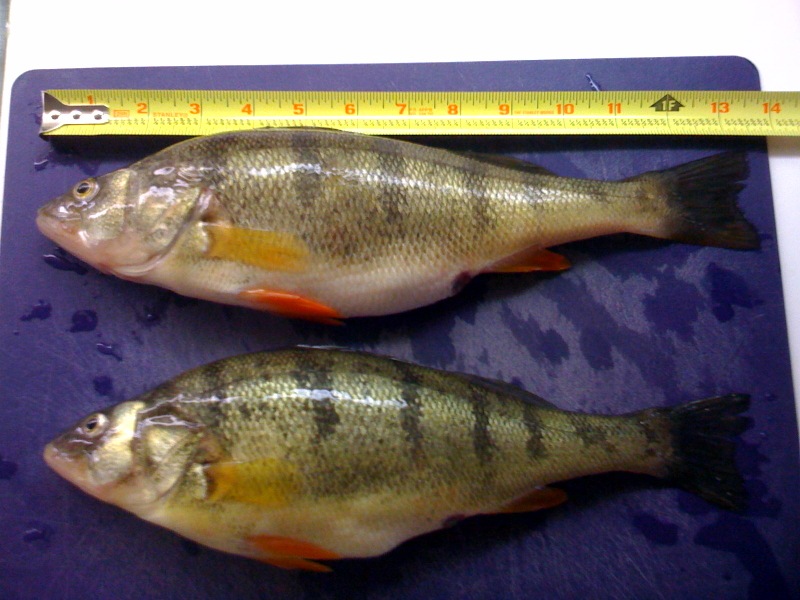
Salmon fishing will pickup in September for Cohos and Kings, also easily caught from shore.
The brown trout are always kicking about as well (That's Navy Pier BTW - great for winter perching and the odd trout)