

Latkes
Latkes
-
-
-
-
-
Latkes
-
-
Post #1 - December 10th, 2004, 8:59 amI don't really want to go to the loop today just go get some potato pancakes at the Christchildmunchfestandtchatchke Market, but I wouldn't mind driving to Skokie or someplace on the North Shore. Where do they serve fabulous potato pancakes?
Giovanna [the Sicilian girl with the nice Jewish girl hidden somewhere inside]=o=o=o=o=o=o=o=o=o=o=o=
"Enjoy every sandwich."
-Warren Zevon
-
-
-
Post #2 - December 10th, 2004, 11:35 amGiovanna,
As an unabashed latke lover, I have tried many restaurant latkes. I often taste latkes the same way I taste kreplach: with a strong bias towards the tastes that come from my grandmother's kitchen.
That being said, the only restaurant latkes that I can safely recommend are at Frances' Deli (Clark, near Diversey). They have a fresh, homemade flavor, and they're made with a dense potato batter, rather than coarsely shredded potatoes. They're the only ones I've ever eaten that even remotely remind me of my grandmother's.
On a side note, I have heard good things about the latkes at Ashkenaz Deli, but I have no first-hand experience.
Neither of these are anywhere near Skokie/North Shore, but it's all I got.
Best,
EC
Frances' Restaurant and Delicatessen
2552 N. Clark St.
773-248-4580
Ashkenaz Deli
12 E. Cedar St.
312-944-5006
-
-
Post #3 - December 10th, 2004, 11:58 amSince Giovanna mentioned the Christkindlmarkt but dismissed it on grounds of being too far away, I'll suggest also Resi's, who do serve potato pancakes, though of course they do not call them latkes.
I tried Resi's potato Puffer or pancakes once and thought they tasted really quite good. I did find the texture more dense than I know from home and have set in my mind as the appropriate standard (not unlike EC and his view of his grandmother's latkes), but they're tasty.* Also, I would assume that Resi's (northside of Irving Park, just west of Damen) isn't too long a trek from the unfashionably far Northwest.
Antonius
*The potato pancakes at the German Christmas market struck me -- when last I had them -- as very close to Mutta's in taste and texture.Alle Nerven exzitiert von dem gewürzten Wein -- Anwandlung von Todesahndungen -- Doppeltgänger --
- aus dem Tagebuch E.T.A. Hoffmanns, 6. Januar 1804.
________
Na sir is na seachain an cath.
-
-
Post #4 - December 10th, 2004, 12:01 pmThanks for the tip on Frances' latkes. I agree that the dense version is what one looks for. The up-market shredded ones are just some sort of gussied up hash brown/home fries. Frances' is out of the way so I don't get there much, but it's nice to have a destination place for latkes when the craving strikes.
FYI for all: my wife tried following Claudia Roden's hollow advice that latkes could be made with very little oil. I very much like her world Jewish cookbook (exact title escapes me now) and find it useful and infomative. But this was just wrong. That patties came out heavy, moist, fish-belly pale and hopeless. As soon as we added 3/8" of oil and got it shimmering hot, we were back in business."Strange how potent cheap music is."
-
-
Post #5 - December 10th, 2004, 12:11 pmThis may interest the opinionated home cooks in the audience.
Regards,
Erik M.
-
-
Post #6 - December 10th, 2004, 12:12 pmmrbarolo wrote:FYI for all: my wife tried following Claudia Roden's hollow advice that latkes could be made with very little oil.
Yikes! You might as well try making them with very little potatoes. But, then again, isn't that the theme of the holiday, making a little oil go a long way?
On another note: Most latkes I've eaten in restaurants (or other people's homes) have some level of minced onion in them. This has always been a sacrelidge in my family, and many people disagree with me. When I was younger, I asked my grandmother why she didn't use onions. Her answer was, "because they should taste like potato, not onion." Simple enough answer that I tend to agree with.
Best,
EC
-
-
Post #7 - December 10th, 2004, 2:27 pmAntonius wrote:I tried Resi's potato Puffer or pancakes once and thought they tasted really quite good.
Antonius,
Same here, I've only had Resi's potato pancakes once and found them quite delicious. I was motivated by JSM's post where he referred to them as Tater Men, in comparison to tater tots.
Resi's Tater Men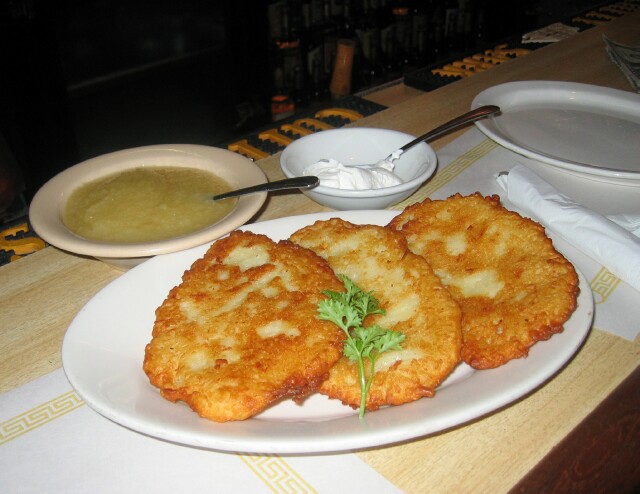
Enjoy,
Gary
-
-
Post #8 - December 10th, 2004, 2:28 pmeatchicago wrote:This has always been a sacrelidge in my family, and many people disagree with me.
EC,
No onion? I've never had a latke without a little grated onion. My recipe is simple, grate potatoes, onion and garlic on a box grater. Potatoes first, squeeze out water, then onion and garlic. Salt, pepper, egg and matzo meal or flour.
Generous amount of med-hot oil, don't rush the flip.
I've experimented with adding a little milk, baking powder, baking soda, but I've found simple works best.
The only thing I might change for the future is, as Erik's link suggested, make my own apple sauce. Mott's just ain't cutting it for me anymore.
Oh, and this year I used Mexican crema instead of straight sour cream.
Enjoy,
Gary
-
-
Post #9 - December 10th, 2004, 2:59 pmG Wiv wrote:No onion? I've never had a latke without a little grated onion. My recipe is simple, grate potatoes, onion and garlic on a box grater. Potatoes first, squeeze out water, then onion and garlic. Salt, pepper, egg and matzo meal or flour.
Generous amount of med-hot oil, don't rush the flip.
I know. I know. I get that response all the time. I do not consider onion to be the sacrelidge that my father or grandmother does, but I do love her latkes. Her recipe is the same, minus the onion and garlic. She claims there are 2 keys to her recipe:
1) Use the smallest grating on a box grater. Never a food processor. Hand-grating yields a potato batter that produces a real "pancake".
2) Blood. You are bound to nick a knuckle on the grater, and a tiny bit of her blood would invariably fall into the batter. She claimed that this was the secret ingredient that made them taste so "familiar". She would always say, "Michael, there's a little bit of you in that latke". Gross? maybe. Cannibalistic? barely. Unhealthy? eh....we're all family.G Wiv wrote:Oh, and this year I used Mexican crema instead of straight sour cream.
This year I'm bringing over some greek yogurt.
Best,
EC
-
-
Post #10 - December 10th, 2004, 3:31 pmManny's makes a good potato pancake, but it's very different from the ones my friend Debby serves at her annual latke party (which is this Sunday, by the way). It may be the difference between deep frying (Manny's) and pan frying (Debby). I don't think Manny's contain any onions. Debby's do.
Manny's
1141 S. Jefferson St., Chicago
Tel: (312) 939-2855
Debby's
(sorry, not telling)
-
-
Post #11 - December 10th, 2004, 3:39 pmcowdery wrote:Manny's makes a good potato pancake, but it's very different from the ones my friend Debby serves at her annual latke party (which is this Sunday, by the way). It may be the difference between deep frying (Manny's) and pan frying (Debby). I don't think Manny's contain any onions. Debby's do.
Manny's
1141 S. Jefferson St., Chicago
Tel: (312) 939-2855
Debby's
(sorry, not telling)
I actually had manny's for lunch (pastrami on rye with a potato pancake) not an hour ago.
The pancakes are good, and something about them appeals to me, but they aren't great. They're greasy, probably from sitting in a steam tray. Liberally sprinkling them with salt and dabs of horseradish mustard make them significantly better.
I don't notice any onion or garlic in manny's potato pancakes, even before I add the salt and mustard.
-
-
Post #12 - December 10th, 2004, 5:52 pm2) Blood. You are bound to nick a knuckle on the grater, and a tiny bit of her blood would invariably fall into the batter.
That's why you need the grated onion, too. What good's a latke without both blood and tears?"The fork with two prongs is in use in northern Europe. In England, they’re armed with a steel trident, a fork with three prongs. In France we have a fork with four prongs; it’s the height of civilization." Eugene Briffault (1846)
-
-
Post #13 - December 10th, 2004, 6:23 pmI actually had manny's for lunch (pastrami on rye with a potato pancake) not an hour ago.
Congratulations. I'm jealous.
-
-
Post #14 - December 11th, 2004, 1:09 pmAshkenaz Deli's latkes are good, but not great. They are definitely strong on the potato, a nice, heavy, dense smack-you-in-the-face kind of latke...but I find them not as crispy on the outside as I would want, and a little greasy to boot. But, keep in mind, I used to live right next to Ashkenaz and I would get them to go and then run them up the stairs to my apartment (four flights...), so they may have suffered in the moving process.
As a side note, I must say that I have recently made latkes with the pre-shredded "Simply Potatoes" or other brand from the supermarket and they have turned out pretty well, seeing as how all the shredding has been done and water pre-squeezed out for you. Then you grate your onion (and blood) in (and a little bit of carrot, in my world), add your seasonings and matzo meal, and practically instant latkes. Good when feeding a crowd.
Jacki
-
-
Post #15 - December 14th, 2004, 3:20 pmSo much nuance, so little time. This is like a midrash of latke making.
First, my history is the same as EC's. No onion. No garlic. Why, you ask?
Potato, motzo meal, egg, knuckle-fleisch, blood. (Plenty of oil, "don't rush the flip") You can have "tears" without onion just by scraping your knuckle hard enough. In fact, I think the rebbe of blessed memory would frown on taking the short-cut of "onion tears" rather than the tears of real latke-schmerz. The grater is is the world, the knuckle is the Jew. We have to toil in the world, and bleed and leave part of ourselves there to bring the latke good works, of light (of which, of course, the oil is the symbol), so there we are. Onion tears? Tasty, maybe, but feh.
I'm not arguing for the superiority of the recipe, just validating that strain latkic thought and tradition. (Perhaps it's different for the Sephardim. I wouldn't know.)
As for the virtual "instant latke" - leaving the Rebbe out of it for the present - achieving my family's traditional texture (it's own holiday miracle) depends on not squeezing the liquid out, but on adding the right amount of matzoh meal to absorb enough of the liquid to produce a batter with all components in perfect balance.
My grandmother's latkes had a shape and consistency I've never seen since. They were thin overall (unlike the German "totalitatermen" - and let's not even go down that road), thicker in the middle and then tapered toward the outer edge until at the very outside there was a magical crunchy brown lacework band that completed the miracle of the whole experience - rich and unctuous, but then also delicate and crisp as well."Strange how potent cheap music is."
-
-
Post #16 - December 18th, 2006, 8:24 amBumping this thread...anyone had any good ones lately? I'm a bit homesick.
-
-
Post #17 - December 18th, 2006, 8:34 amndgbucktown wrote:Bumping this thread...anyone had any good ones lately? I'm a bit homesick.
I had some great ones last night. Eighteen family-members filled my house while I peeled, grated, and fried 10lbs. of potatoes. I've got a sore arm and a pretty uncomfortable burn on my hand as a Chanukah 2006 reminder.
While there are some great potato pancakes to be had in restaurants around town (Resi's and Frances are two of my favorite), nothing beats a homemade latke. No special equipment, long cooking, or fancy ingredients required. A quick trip to the market and you're 20 minutes away from a bona fide homesickness cure.
Best,
Michael
-
-
-
Post #18 - December 18th, 2006, 9:07 amYears ago during Hanukkah, we used to have an annual latke competition at the Pigmon's between me and my siblings. The final year we did one, my oldest brother made some spectacular latkes but unfortunately for him, the potatoes turned green from oxidation before frying, forgetting to use baking soda to prevent this.
I hate to admit it but his latkes were definitely the best that year. However, the family voted mine as the winner largely to due to his latke's unpleasant visual aesthetic. The winning prize was a chef's hat.
Afterwards, I told my brother that I truly thought that his latkes were better than mine.
His response was "Meanwhile, you're wearing my hat."
-
-
-
Post #19 - December 18th, 2006, 11:35 amCertain foods have many, many variations on them, particularly those that we enjoyed at home growing up. If your mother made them differently from my mother, we may enjoy totally different styles of the same food. This certainly goes for latkes, as well as knishes, kugel, etc. Ten different cooks can make them ten different ways. All can be very good, and no particular one is necessarily more "authentic" than another.
-
-
Post #20 - December 18th, 2006, 11:10 pmPIGMON wrote:my oldest brother made some spectacular latkes but unfortunately for him, the potatoes turned green from oxidation before frying, forgetting to use baking soda to prevent this.
I was a first-time fryer this last Saturday night when I prepared a couple dozen of the spudcakes for my nearest and dearest. The quote above perfectly describes the problem that I had (although my gratings turned out orange, not green, and fried with no untoward hues, thankyouverymuch).
I knew that oxidation would be a concern, but I didn't think it would set in so fast. How are you supposed to grate 10# of potatoes with this chemical reaction in hot pursuit? Do you drop them straight into water? Employ baking soda or other bases?
What do folks do to keep their latke shavings and batter cloud-white (although I guess I would settle for Ivory dishwashing liquid-white)?
-
-
Post #21 - December 19th, 2006, 7:11 amLinks from a poster on the Smokering BBQ list.
Canadian-Latkes
Gratuitous-Latkes


