
Why isn't Chicago a GREAT hamburger town?
Why isn't Chicago a GREAT hamburger town?
-
-
-
-
-
Why isn't Chicago a GREAT hamburger town?
-
Post #1 - March 1st, 2007, 11:47 pmWorks cited in this post:
Time Out's 55 Best Burgers in Chicago
Hamburgers & Fries, by John T. Edge

I am a dance-with-the-gal-that-brung-ya type and, confronted with Erik's photos of the (very admirable when it comes to breadmaking) Nancy Silverton's big puffy meringue of a pizza, my response is to chuckle "What will those wacky Californians think of next" and give thanks that I live in Chicago, where pizza weighs 5 lbs. on the hoof and a slice of deep dish could feed a family of four for a week-- or shelter them, for that matter. Nosiree, you won't catch me praising LA over Chicago, Chicago, my kind of town Chicago is...
...then he posts pictures from a swanky burger joint and my whole facade crumbles. For cryin' out loud, we once killed more cattle here than anywhere on earth, why don't we have more great burgers? Why is LA a great, I do mean great, burger town and we aren't?
That we aren't may surprise some, especially coming off Time Out's 55 Best Burgers issue, which indeed found many fine burgers in Chicago's hipper precincts. That is, it found many fine burgers in the vicinity of $8.95 or higher. Many of Chicago's fine chefs and steakhouses have turned to the burger with gusto and the result is indeed an admirable creature; from restaurants like Erwin, David Burke and Sweets and Savories to bars like Kuma's, Riverview Tavern and Darwin's, these mighty hunks of meat on a bun rightly deserve Time Out's praise.
But lop $7 off that price and it becomes much harder to find a burger that's more than serviceable. The cheap burger in this town is mainly what I've come to call the Greek joint burger, even though they're as likely to be run by Koreans or even Indians (beef taboo aside) these days. It's a frozen patty, grilled on a gas grill or griddled, and then stuck in a bun with (like the Chicago hot dog) a full meal's worth of condiments-- thick slices of pickle, tomato, lettuce, and onion. To be honest, it's not a bad burger, but it tastes mainly of char-grilling, first, and then of pickle and salad.
So what is it that I wish a burger tasted of? Beef. Fresh beef, fried on a griddle till the edges are browny-crisp. It's the freshness that makes all the difference-- a frozen patty is like a meatloaf or a meatball, it has an rubbery outside skin and interior, where fresh ground beef splatted onto a hot grill has the texture of, well, fresh ground beef. It is what it is. Being thin and crumbly like that, it is best served with a light hand on the condiments-- what I've often called the "30s-style hamburger" restricted them to mustard, pickle and onion, and not that much of any-- so that beef flavor may shine through and enhance the whole, imparting beefiness to each of the rest.
And compared to that monster up above, it doesn't exude grease like a case of Pennzoil used for target practice.

It's that lack of fresh beef (and the restraint in condimentation that it all but mandates) that keeps so many Chicago burgers from achieving greatness. I notice that Time Out pays tribute to Susie's Drive In on Montrose in their article-- but they do so by honoring their fries. Susie's is a place that has everything a great ramshackle hamburger joint could ask for-- except a great piece of beef at the center of the bun. Somehow Chicago's hamburger culture came to accept the dull frozen patty as the measure of the hamburger. That's not how it is everywhere.
When I read John T. Edge's Hamburgers & Fries at first I was mildly miffed that he spent time in dubious hamburger states like Mississippi but skipped straight past Kansas for Oklahoma. Where the hell does he think cattle are raised, in deltas? What does he think they fatten on, cotton? Kansans take pride in local legends of the burger (that is, the modern mustard-pickle-onion burger) being invented there, and who knows, they could be true. But as I read Edge's section on Oklahoma, I had to admit that for all practical purposes he had visited the same culture-- Oklahoma produces televangelists and Kansas produces libertarian vice presidential candidates, but otherwise, they're basically the same part of the world (or "microclimate" as Edge puts it), and Edge's descriptions of serious burger joints in places like Ponca City (where Citizen Kane-like oil baron E.W. Marland controlled 10% of the world's oil supply from his Renaissance palazzo) rang true as mom's cooking for me.
And thus the circle comes complete. Oklahoma, 30s-style burgers... what do we all know about Okies in the 1930s? We know that they moved to California to harvest the grapes of wrath, that's what we know. Chicago's southern migration came from Appalachia and the deep black South, its other immigration came from sausage-making countries, and it's a hot dog town, certainly a far better one than L.A. (speak to me not of Pink's). But California's migration came from the Dust Bowl midwest, and that's why Los Angeles to this day is dotted with good authentic hamburger joints, why it has spawned In'N'Out and Fatburger and Tommy's and so many other well-beloved local joints and chains. They don't all make a fresh burger-- Tommy's doesn't for one-- but a lot more of them do there than they do here.
Perhaps it was our place as the final processing point for cattle that facilitated the rise of an industrial product-- the frozen hockey puck of beef-- over the handformed patty of freshly ground chuck popular in farm country. Whatever the reason, what we need now is for one of those chefs making a $10 burger to find his way back to the $2 variety (okay, $3 or $4). The wild success of contenders (or pretenders) such as Hamburger Mary's and Patty's surely means there would be a market for it here. Where is our Hot Doug of hamburgers to raise the standard and wrap lines around the block with freshly griddled, Wilshire-and-Sepulveda-by-way-of-Ponca-City classic American burgers?
Burgers depicted in this post:
Max's Italian Beef, 5754 N. Western Ave. Chicago, IL 60659, 773-989-8200.
Bionic Burger, Wichita.
You can read a portion of Edge's book here, in which, ironically enough, a Chicago chef-- Louis Szathmary-- offers some especially sharp insights into the hamburger as a product of immigrant workforces.
Watch Sky Full of Bacon, the Chicago food HD podcast!
New episode: Soil, Corn, Cows and Cheese
Watch the Reader's James Beard Award-winning Key Ingredient here.
-
-
Post #2 - March 2nd, 2007, 11:39 amI think that Chicago isn't a great burger town because its not a great buger bun town. The typical Chicago Burger place insists on using those big puffy buns that are made for soaking up the juice of an Italian Beef moreso than as a minimalist eating utensil for a great burger.
One of the better burgers I have eaten in Chicago is that of Paradise Pup which offers you your burger on toasted pumpernickle if you so choose. That cause the focus to be all on the meat and trimmings rather than on the 'monster bun" as is the case at many other greek run burger joints in town.
One of my favorite burgers in New York is Island Burgers and Shakes where a bit of plain toasted ciabatta comlpliments the accomppanying burger rather than overwhelming it.
-
-
-
Post #3 - March 2nd, 2007, 5:59 pmMike G wrote:
So what is it that I wish a burger tasted of? Beef. Fresh beef, fried on a griddle till the edges are browny-crisp. It's the freshness that makes all the difference-- a frozen patty is like a meatloaf or a meatball, it has an rubbery outside skin and interior, where fresh ground beef splatted onto a hot grill has the texture of, well, fresh ground beef. It is what it is. Being thin and crumbly like that, it is best served with a light hand on the condiments-- what I've often called the "30s-style hamburger" restricted them to mustard, pickle and onion, and not that much of any-- so that beef flavor may shine through and enhance the whole, imparting beefiness to each of the rest.
You have just described a hamburger from Culver's---No kidding.
Fresh ground beef, reasonably thin irregular shaped patty with crispy edges and a beefy taste. I have also searched far and wide for a good hamburger and I frequently find myself going back to Culver's. As I've posted in the past, I'm not 'big' on eating at chains--however they truly serve a good product.
-
-
-
-
Post #4 - March 2nd, 2007, 6:07 pmcito wrote:You have just described a hamburger from Culver's.
And Schoop'sSteve Z.
“Only the pure in heart can make a good soup.”
― Ludwig van Beethoven
-
-
-
Post #5 - March 2nd, 2007, 6:28 pmAnd Steak and Shake, for that matter.
I've never eaten at Schoop's, and I'm not extravagantly wild about either Culver's or Steak and Shake (though I wind up at both fairly regularly when taking the kids to farflung locales), but if there's anything to be said for either one, it's that old school burger realness.
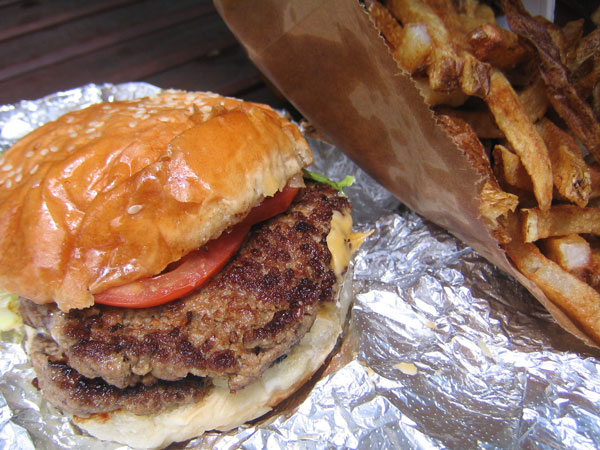
P.S. Here's the burger I'm jonesing for after writing this (but I would order a single, this was crazy):
 Watch Sky Full of Bacon, the Chicago food HD podcast!
New episode: Soil, Corn, Cows and Cheese
Watch the Reader's James Beard Award-winning Key Ingredient here.
-
-
Post #6 - March 3rd, 2007, 1:54 amYourPalWill wrote:I think that Chicago isn't a great burger town because its not a great buger bun town.
I'm not sure I quite agree. I was in LA a few weeks ago and, for the first time, found myself eating lots of hamburgers at the local chains. I am generally not a hamburger person, but when I get the urge I eat nothing but hamburgers for an entire week. Simply put, LA is a great hamburger town and it has little to do with the bun, as places like Fatburger and In N Out serve normal burgers on a normal hamburger bun. The main thing that jumped out at me with the LA burgers is that they tasted beefy. They tasted like real food. And these were just the chains--I didn't even have time to explore the independent hamburger stands.
So, for me, I'm not really keen on a fancy bun. The buns here in Chicago are perfectly fine. In fact, I'm quite partial to the sesame buns that grace our local establishments. It's what's between that can use work.
-
-
Post #7 - March 3rd, 2007, 8:28 amP.S. Here's the burger I'm jonesing for after writing this (but I would order a single, this was crazy):
I can't fault you... I have not stopped thinking about Five Guys since my trip to DC last weekend.
Probably the one of the best burgers that I have ever eaten, and definitely the best from fast food type place. And the coment that I remember making to my wife was that "this tastes like beef!".
-
-
Post #8 - March 3rd, 2007, 10:21 amYou guys should really head out to Brandt's Little Cafe in Palatine at the corner of Quentin and Northwest Highway (Rt 14).
I'm not the only one who would make the claim best burger in Chicago.
They have homemade chips too (wife gets those) but I love the big fries.
don't ask for the menu though when you go, they don't have one. Just ask your server what they have for the day (besides burgers of course).
mmmmm. now I'm hungry!!
John
-
-
Post #9 - March 3rd, 2007, 11:03 amstevez wrote:cito wrote:You have just described a hamburger from Culver's.
And Schoop's
I just ate at Schoop's in Chicago Heights on US 30. What a great burger. Just make sure when you say everything on it please that everything is only mustard, ketchup, relish and onion...the original everything. Now they load it up with lettuce tomato and other stuff. Takes away from the taste of the burnt ends...I mean edges. Started thinking about Q for a minute.
-
-
Post #10 - March 3rd, 2007, 1:31 pmI read recently that Culvers is expecting to open its first urban stores in Chicago sometime soon. Might explain the heavy city advertising and the Cubs relationship.
Also, I'd not put Steak & Shake in the Culver's/Schoop's category any more. I have memories of good burgers from S&S in other parts of the country, but what I've sampled from the Chicagoland stores has been pretty bad.
-
-
Post #11 - March 4th, 2007, 12:04 amI think (as Will says) the bun that's used here is breadier, and contributes (along with the too-thick pickle slices and so on) to the fact that the beef is a very small portion of the overall taste of so many burgers. Look at the bun on my picture from Bionic Burger-- that's a proper hamburger bun, a thin little clamshell of bread, ready to recede in importance next to the beef.
JeffB, I agree that Steak and Shake is usually disappointing, but at least it's recognizable as following the 30s-style hamburger archetype-- as is, for that matter, the original McDonald's hamburger. (It, along with the Whopper, the thin crust at Pizza Hut, the Big Boy sandwich, etc. illustrates Mike G's Rule of Mega-Chain Restaurant Survival: order the item that they served the day the first one opened, because it's still a recognizable example of its type-- 30s style hamburgers, 50s thin crust pizza, etc.-- and hasn't been conjured up out of chemicals and focus groups by corporate chefs in their test kitchens.*)
JeffB raised a fair question elsewhere:
I have to say, while Chicago is short on great fast-food burgers, NW Indiana and SW Michigan are not. That doesn't jibe with MikeG's ethnographic migratory theory of burgers, but hey.
I didn't mean that Okies or their close relatives are a necessary precondition for great burgers-- just that their presence in California helps explain why great burgers turn up there, in what is definitely not cattle country.
I think it's a lot like the question of why pie is rare in Chicago when it's pie country all around us. Indiana, Michigan, Kansas and Oklahoma, any state in this part of the country has cows, and thus a high level of comfort in small to mid-sized towns with butchering, grinding and eating fresh beef. In Small Town Illinois, Michigan, etc., the customers expected freshly ground beef, and there were local suppliers used to supplying it. Chicago, on the other hand, was all about processing beef, which means doing things like turning it into frozen discs, long-lived and easy to use. When the big distributors are all set up to go a certain way, when everybody's used to working with and eating a certain kind of product, it's hard for the little guy to buck them and do things his own way, even if he wants to and believes there will be a market for it. Which of course, most of the time he won't and doesn't.
* The one exception to this is Arby's, where anything they've added in recent years is better than the supremely nasty pressed-roast-beef-byproducts sandwich.Watch Sky Full of Bacon, the Chicago food HD podcast!
New episode: Soil, Corn, Cows and Cheese
Watch the Reader's James Beard Award-winning Key Ingredient here.
-
-
-
Post #12 - March 4th, 2007, 7:11 amMike G is conveniently forgetting the great 30's style burgers one can easily get in Chicago by going to places like Top Notch Beefburger and Kevins.Steve Z.
“Only the pure in heart can make a good soup.”
― Ludwig van Beethoven
-
-
-
Post #13 - March 4th, 2007, 7:59 amWell, I wasn't wowed by either one (Top Notch is the place I'd honor mainly for its fries-- admittedly I haven't been to the original, either) but I'll give them both points for trying and using fresh beef, yes.Watch Sky Full of Bacon, the Chicago food HD podcast!
New episode: Soil, Corn, Cows and Cheese
Watch the Reader's James Beard Award-winning Key Ingredient here.
-
-
Post #14 - March 4th, 2007, 8:44 amI think Bill's Drive In in Evanston fits the exact description of what you're looking for-
Bill's Drive In
120 Asbury
Evanston
-
-
Post #15 - March 4th, 2007, 8:53 amBill's is probably the most authentic 30s style burger in or close to the city-- the size is right, the toppings are right, wrapping it all in paper to steam itself is right-- but I'm pretty sure the patties are frozen. Well worth visiting nonetheless. Just don't try to take pictures!Watch Sky Full of Bacon, the Chicago food HD podcast!
New episode: Soil, Corn, Cows and Cheese
Watch the Reader's James Beard Award-winning Key Ingredient here.
-
-
Post #16 - March 4th, 2007, 11:29 amMike, I can't recall -- did you have the 1/4lb or 1/2lb burger at Top Notch?
The half pounders are awful, but I'm quite fond of the quarter pounders. They will make a half pound burger out of two quarter-pound patties on request, also.
-
-
Post #17 - March 4th, 2007, 12:52 pmGrowing up and living in Beverly for 30 years, I've had many a Top Notch BeefBurger. The last 2 times I went there I had awful, dry, burnt hamburgers. I think I had 3 or 4 diet cokes to get the meat down. That was about 3 years ago and I haven't been back. They are literally 2 blocks from where I work. Can anyone give me a reason to try them again?
-
-
Post #18 - March 4th, 2007, 12:56 pmEvilUs wrote:They are literally 2 blocks from where I work. Can anyone give me a reason to try them again?
Sure. It's close, it's cheap, and it's been fine the past few times I've been there.
-
-
-
Post #19 - March 4th, 2007, 3:20 pmgleam wrote:EvilUs wrote:They are literally 2 blocks from where I work. Can anyone give me a reason to try them again?
Sure. It's close, it's cheap, and it's been fine the past few times I've been there.
And, besides the great burgers, they've got the best chocolate shakes/malts in town...oh...and fries even Mike G likes.Steve Z.
“Only the pure in heart can make a good soup.”
― Ludwig van Beethoven
-
-
-
Post #20 - March 4th, 2007, 3:52 pmOK I'll give them a try tomorrow. Anyone know if they a re using trans-fat free oil for their fries?
-
-
Post #21 - March 4th, 2007, 4:03 pmAren't they still using, at least partially, beef fat? Maybe trans fats should be the least of your worries

-
-
Post #22 - March 4th, 2007, 5:44 pmYou make a good point, Binko. So, I'll alter my argument a bit. A good bun doesn't make a bad burger good. A bad bun can very well make an otherwise good burger bad and an average burger horrible. Look no further than Billy Goat for evidence supporting the latter.
-
-
Post #23 - March 4th, 2007, 6:05 pmYes, Top-Notch uses beef tallow, like everybody did until the health busybodies convinced them to switch to something deadlier.
I would definitely go back, especially to the original (I went, for convenience, to the one in the strip mall), and try it again, per Gleam's instructions, and have a shake. It may be a while before fate finds me on 95th street, though...Watch Sky Full of Bacon, the Chicago food HD podcast!
New episode: Soil, Corn, Cows and Cheese
Watch the Reader's James Beard Award-winning Key Ingredient here.
-
-
Post #24 - March 4th, 2007, 6:54 pmIt was only about a month ago that the family and I ate at the Top Notch in Oak Lawn. No decline at all. Just top notch, and the fries were beyond top notch. On that day (night) at least, they could have been the best fries in Chicago. Better than Gene and Judes, better than Jimmy's, better than any too skinny frite around, better.
My only regret: between the bitter cold and too much food already that day, I could not muster the trip across the street for a turtle sundae at Cupid Candies.Think Yiddish, Dress British - Advice of Evil Ronnie to me.
-
-
-
Post #25 - March 4th, 2007, 6:57 pmGreat burgers are sizzling just north of Chicago in southeastern Wisconsin. No fancy buns, lettuce and tomato, or fancy condiments. No sirlion, no chuck. Just pure, fresh, hand pattied ground beef, flat grilled, and dripping with grease. In Kenosha, The Spot Drive-In and Big Star Drive-In reign burger supreme. Big Star still uses Velveta, just like mom's home-made cheeseburgers. In Racine, Kewpee's is my favorite. Open daily at 7:00am, there's always a line at the door. In Milwaukee, Sobelman's Pub & Grill(Rated Milwaukee's #1 burger) is a "must stop." With the exception of Sobelman's, all serve a cheeseburger for under $2.00 including tax. While in Chicago, Paradise Pup and Poochie's are my char cheddar burger stops. I just can't resist Poochie's grilled onions.
CSD
Born in Chicago
Escaped to Wisconsin
Selling Vienna Beef hot dogs & PolishLast edited by chicagostyledog on February 10th, 2008, 6:23 pm, edited 1 time in total.
-
-
-
-
Post #26 - March 4th, 2007, 7:15 pmI think the real answer to the original question is the Chicago Hot Dog. The average fast food joint in the area doesn't bother to make a great burger because the hot dog is so popular.
Superdawg actually has a pretty good burger. But it's really difficult to stand in line there waiting for it and seeing 20 or 30 people that ordered dogs passing you by.
But if you live in a town with lousy hot dogs, the wait for a burger is worthwhile. And to compete they need to provide a better burger than the guy down the street.
-
-
-
Post #27 - March 4th, 2007, 7:58 pmYourPalWill wrote:You make a good point, Binko. So, I'll alter my argument a bit. A good bun doesn't make a bad burger good. A bad bun can very well make an otherwise good burger bad and an average burger horrible. Look no further than Billy Goat for evidence supporting the latter.
Hey! I actually like Billy Goat burgers.
Chicagostyledog, what do you mean by "no chuck"? I thought chuck was the default cheap fatty beef cut of choice, I never associated with anything fancy, like perhaps sirloin is (and I hate burgers made from sirloin--too lean.)
-
-
Post #28 - March 4th, 2007, 9:00 pmstevez wrote:Mike G is conveniently forgetting the great 30's style burgers one can easily get in Chicago by going to places like Top Notch Beefburger and Kevins.
How interesting... just today in the Tribune's Sunday magazine supplement, there was an article focused on "Top-Notch Beefburgers" in Beverly, along with a reference to The Billy Goat Tavern for good measure (guess which other burger documentarian George Motz also considers the best in Illinois):
"Top nosh: BEVERLY EATERY'S HAMBURGER NAMED ONE OF THE TWO BEST IN ILLINOIS" by Rick Kogan
http://www.chicagotribune.com/features/ ... gazine-hed"I eat here twice, three times a week," said 17-year-old Allison Ware, a surprisingly thin 17-year-old student at nearby Mother McAuley High School, sitting with friends and eating her usual quarter-pound burger with bacon and cheese. It was a busy lunch hour and a quick and unscientific survey of the crowd had about 80 percent eating burgers.
There are other items on the menu, such as turkey burgers, a BLT, pork chops and some chicken offerings. There are also tasty milk shakes and fabulous fries, which the place touts as being "pre-WW II style."
Just a little more fuel for the quarter-pound fire.
Pre-WW II style,
Dan
-
-
Post #29 - March 4th, 2007, 11:01 pmThere's a lot of synchronicity in the air tonight-- besides the Trib talking about Top Notch, I can tell Chicago Style Dog that I checked the hours for both Kewpee's and Nite Owl this morning, before his post-- closed Sunday, both of them. (I was heading up to Milwaukee with younger son for the annual train exhibit at the Mitchell Park Domes.)Watch Sky Full of Bacon, the Chicago food HD podcast!
New episode: Soil, Corn, Cows and Cheese
Watch the Reader's James Beard Award-winning Key Ingredient here.
-
-
Post #30 - March 5th, 2007, 12:48 amfastfoodsnob wrote:stevez wrote:Mike G is conveniently forgetting the great 30's style burgers one can easily get in Chicago by going to places like Top Notch Beefburger and Kevins.
How interesting... just today in the Tribune's Sunday magazine supplement, there was an article focused on "Top-Notch Beefburgers" in Beverly, along with a reference to The Billy Goat Tavern for good measure (guess which other burger documentarian George Motz also considers the best in Illinois):
Wow. As much as I do enjoy the Billy Goat burger, I am shocked to hear someone else likes it that much.


