

Kare-Kare & Halo-Halo at Filipiniana, Niles
Kare-Kare & Halo-Halo at Filipiniana, Niles
-
-
-
-
-
Kare-Kare & Halo-Halo at Filipiniana, Niles
-
-
Post #1 - July 19th, 2007, 1:03 pmKare-Kare & Halo-Halo at Filipiniana, Niles
Last night I had a Filipino dish I liked a lot. Not only did I “get” it (I mean, I think I got it), I enjoyed it a great deal.
Now, I've had other Filipino dishes I've liked a lot (lechon kawali being primary among them), but this was a standout amidst maybe 20 Filipino dishes I've had in the past 6 months that left me somewhat less enthusiastic about ordering them again. Maybe what is required is more patient study of this cuisine.
Anyway, the newfound object of my affection is kare-kare: oxtail in a peanut sauce with a hefty admixture of veggies such as eggplant and bok choy for bitterness and crunch, some green beans for sweetness, it was really fine. Oxtail takes well to stewing, and the chunks of tail meat in this dish were tender and lush.

I just had the kare-kare for lunch, and it passed the “next day test” of being just as good and maybe even better than the night before.
After dinner last night, we had halo-halo:

This dessert…I’m not so sure about. The flavors of the purple yam, red bean and corn (!) were surprising and good, but crunching through ice hurt my teeth. Maybe (more than likely) I’m just too damn impatient, but sitting in an air-conditioned room, there was no way the ice was going to melt anytime soon, so I dug in and suffered tooth freeze; it was frustrating, painful and…I didn’t get it.
Still, I like this place. I also like what I understand to be the Filipino custom of eating with fork and spoon, which makes a lot of sense. The fork has obvious uses as spear and holding device, and the spoon is good for serving or slurping and is probably as “sharp” as most knives in restaurants, so like other patrons last night I used it to cut and separate food as well. I’m taking to eating with spoon and fork at home; it’s very efficient and well-suited to the impatient.
Filipiniana Restaurant
9060 Golf, Niles
773.205.6829"Don't you ever underestimate the power of a female." Bootsy Collins
-
-
-
Post #2 - July 19th, 2007, 1:41 pmBeing filipino, kare kare is one of my favorite dishes also. Glad you liked it! Did you have it with bagoong/salted shrimp paste?
-
-
-
Post #3 - July 19th, 2007, 2:11 pmBlown Z wrote: Did you have it with bagoong/salted shrimp paste?
Yes, in addition to salt and pepper, bagoong was the primary condiment; it was sprinkled on some dishes (e.g., pancit) and was also placed in a dish on the table.
I was kind of expecting to see a bottle of vinegar -- is that ever/usually on Filipino tables?
Hammond"Don't you ever underestimate the power of a female." Bootsy Collins
-
-
-
Post #4 - July 19th, 2007, 2:17 pmDavid Hammond wrote:Blown Z wrote: Did you have it with bagoong/salted shrimp paste?
I was kind of expecting to see a bottle of vinegar -- is that ever/usually on Filipino tables?
Hammond
In most Filipino homes, vinegar is on the table along with salt and pepper. The type of vinegar mostly used is Datu Puti cane vinegar also known as "sukang maasim".
-
-
Post #5 - July 19th, 2007, 2:50 pmDavid Hammond wrote: I’m taking to eating with spoon and fork at home
and what did you use before?
-ramon
-
-
-
Post #6 - July 19th, 2007, 2:55 pmRamon wrote:David Hammond wrote: I’m taking to eating with spoon and fork at home
and what did you use before?
-ramon
Knife and fork pretty much all the time. Smartass. "Don't you ever underestimate the power of a female." Bootsy Collins
-
-
-
Post #7 - July 19th, 2007, 10:26 pmFilipiniana has an interesting Sunday brunch, too. Not cheap, but you can try a fairly substantial array of Filipino dishes all in one fell swoop.
And a note on the fork and spoon -- I've seen that all across Southeast Asia, too. In Cambodia, you use your fork primarily to push things onto your spoon. (Chop sticks are just for noodles.)"All great change in America begins at the dinner table." Ronald Reagan
http://midwestmaize.wordpress.com
-
-
Post #8 - July 19th, 2007, 10:36 pmCynthia wrote:And a note on the fork and spoon -- I've seen that all across Southeast Asia, too. In Cambodia, you use your fork primarily to push things onto your spoon. (Chop sticks are just for noodles.)
Same in Thailand, too.
Regards,Cathy2
"You'll be remembered long after you're dead if you make good gravy, mashed potatoes and biscuits." -- Nathalie Dupree
Facebook, Twitter, Greater Midwest Foodways, Road Food 2012: Podcast
-
-
Post #9 - July 19th, 2007, 10:44 pmI've been to Filipinana about 4 times in the past year... Most of the Filipino dishes are an acquired taste in my opinion, but the one dish I really love is called "Bangus" - which is Milkfish and popular amongst Filipinos. Filipinana does a great Bangus dish which is fried fish in some kinda soy sauce I believe... One of the better things on the menu if you happen to try Filipino food and like fish try the Bangus (Milfish)
-
-
-
Post #10 - July 19th, 2007, 10:50 pmCynthia wrote:And a note on the fork and spoon -- I've seen that all across Southeast Asia, too. In Cambodia, you use your fork primarily to push things onto your spoon. (Chop sticks are just for noodles.)
See, I did it the other way: using the spoon to push things onto my fork seemed more "natural.""Don't you ever underestimate the power of a female." Bootsy Collins
-
-
-
Post #11 - July 20th, 2007, 7:35 amDavid, I'm happy you discovered kare-kare. I haven't had it at Filipiniana, but I just made some this past weekend and have been eating leftovers for lunch all week. I've been trying to decide on the recipe I want to use for my Filipino dinner. I was pretty happy with the outcome when I cooked it on Sunday...
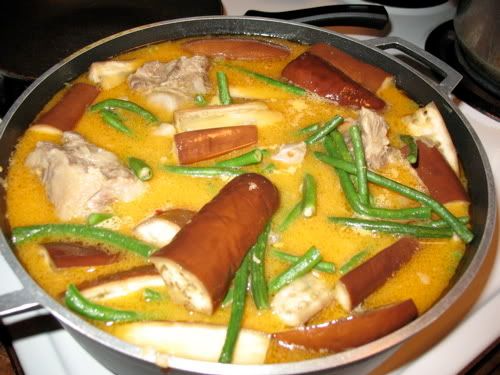
but my mom declared it "all wrong." According to her, I got it right by using Chinese eggplant and long beans, but she pitied: my refusal to use ready peanut butter (I insisted on grinding my own peanuts); my inclusion of stewing beef in addition to the oxtail (I figured that if I'm going to cook kare-kare for 20 people, some of those people might want meat other than oxtail); my coloring of the sabow with achuete (my attempt at "authenticity"?); my addition of some bagoong to the sabow (I also served it on the side, but her issue was that I didn't serve it EXCLUSIVELY on the side); and my exclusion of tripe, which she believes is integral to the best kare-kare.
I'll say, only here, that my mom was right on all counts. (Maybe except for the tripe.) My kare-kare was good, but hers is much better. She's going to show me the "right" way to do it this weekend.
-
-
Post #12 - July 20th, 2007, 8:43 amHS,
No matter, your Mom must be pleased you are now learning how to make these dishes. The torch has been passed on!
Regards,Cathy2
"You'll be remembered long after you're dead if you make good gravy, mashed potatoes and biscuits." -- Nathalie Dupree
Facebook, Twitter, Greater Midwest Foodways, Road Food 2012: Podcast
-
-
-
Post #13 - July 20th, 2007, 9:50 amhappy_stomach wrote:but my mom declared it "all wrong." According to her, I got it right by using Chinese eggplant and long beans, but she pitied: my refusal to use ready peanut butter (I insisted on grinding my own peanuts); my inclusion of stewing beef in addition to the oxtail (I figured that if I'm going to cook kare-kare for 20 people, some of those people might want meat other than oxtail); my coloring of the sabow with achuete (my attempt at "authenticity"?); my addition of some bagoong to the sabow (I also served it on the side, but her issue was that I didn't serve it EXCLUSIVELY on the side); and my exclusion of tripe, which she believes is integral to the best kare-kare.
I'll say, only here, that my mom was right on all counts. (Maybe except for the tripe.) My kare-kare was good, but hers is much better. She's going to show me the "right" way to do it this weekend.
happy_stomach,
According to a handy glossary of Filipino food (http://www.seasite.niu.edu/TAGALOG/filipino_food_glossary.htm), tripe is integral to the dish, but I don't believe there was any tripe in the kare-kare we had (although, having eaten a bowl of pig ears and a platter of sizzling jowls, my offal sensors may not have been as perky as usual).
The bagoong was on the side of several dishes, but I don't believe there was any in the kare-kare, however there could have been stew meat in the mix. Thinking back, we had some meaty hunks in the broth that were quite possibly not simply ox tail.
Very much looking forward to the dinner,
David"Don't you ever underestimate the power of a female." Bootsy Collins
-
-
-
Post #14 - July 20th, 2007, 10:32 amWas the Kare-Kare at Filipianna made with banana blossoms?
In another thread (maybe the one about banana blossoms), I linked to a great 2-part article from the Manila Inquirer, in which several Filipino scholars exchange theories about the origin of this dish. I tried to find the article again, but unfortunately, it is no longer available. As I recall, according to one historian, the conventional wisdom is that the dish found its way to the Philipines several centuries ago, via the Malay pennisula, hence its resemblance to Malaysian curries. However, the article's author suggested that the dish was much younger and was first introduced to the Philipines by the muslim militias brought in from India by the British East Indies Company to guard their ports. The English officials of the company brought their own cows for beef, and would give the offal to the guards, who would make it into a stew. At first they used spices and ingredients they had brought with them, but when those ran out, they substituted local ingredients. I will keep searching for the article (nothing ever disappears from the internet completely).
Meanwhile, here is a link to an interesting blog entry about making Kare-Kare that first peaked my interest in the dish.
http://www.nyu.edu/classes/bkg/forklore ... ekare.html
-
-
-
Post #15 - July 20th, 2007, 10:42 amd4v3 wrote:Was the Kare-Kare at Filipianna made with banana blossoms?
Not to my knowledge. I didn't detect any in the dish, and it's not listed as an ingredient on the (admittedly not very detailed) menu description: "Kare-Kare (boiled, sautéed oxtail and vegetables in broth and peanut sauce, served with salted shrimp fry)"
Thanks for the link, and it'd be interesting to see that article you mentioned -- I like dishes that have some history behind them."Don't you ever underestimate the power of a female." Bootsy Collins
-
-
-
Post #16 - July 20th, 2007, 11:17 am
Although I still haven't found that article, I did find a Filippino food blog that mentions it. It is a phenomonal blog called Market Manila. It is really amazing, full of details and photos, tons of good info. Here is a link to the Kare-Kare entries, but check out the extensive archives.David Hammond wrote:Thanks for the link, and it'd be interesting to see that article you mentioned -- I like dishes that have some history behind them.
http://www.marketmanila.com/archives/2006/06/page/3/
-
-
-
Post #17 - July 20th, 2007, 11:35 amd4v3 wrote:It is a phenomonal blog called Market Manila. It is really amazing, full of details and photos, tons of good info. Here is a link to the Kare-Kare entries, but check out the extensive archives.
http://www.marketmanila.com/archives/2006/06/page/3/
It is indeed a great blog, which I've read in the past. In fact, I recall coming across another kare-kare post, with some insightful comments by the estimable RST.
-
-
-
-
Post #18 - July 20th, 2007, 10:02 pmhappy_stomach wrote:but my mom declared it "all wrong." According to her, I got it right by using Chinese eggplant and long beans, but she pitied: my refusal to use ready peanut butter (I insisted on grinding my own peanuts)
From the legendary RST's comments referenced above:
"The peanut should properly be ground in a molcajete (w/ mortar and pestle), but, alas, no one-absolutely no one-does that anymore in the Philippines. The Thais, the Malays, the Indonesians and other SEAsians (who retain a deeper sense of culinary tradition than we do) all still have a culture of the mortar and pestle, which are everyday items in virtually every kitchen in their countries. We have long capitulated to the culture of the blender and of convenience food. And yes, another circle of Hell is reserved for peanut-butter users."
I strongly suspect the kare-kare I had at Filipiniana contained peanut butter, and I liked it just fine, though hand-grinding the nuts would probably give the sauce a brighter flavor and better texture."Don't you ever underestimate the power of a female." Bootsy Collins
-
-
-
Post #19 - July 22nd, 2007, 2:09 pmI found those articles about the origins of Kare-Kare.
Origin of Kare-Kare part 1
Origin of Kare-Kare part 2
-
-
Post #20 - July 23rd, 2007, 8:22 amI found those articles about the origins of Kare-Kare.
This is really interesting stuff. Thanks for posting. I especially liked the discussion of etymology. I tried to check for sources in Tagalog that might add to the information you've already collected, but Tagalog doesn't seem to be one of the languages with which I could narrow a search on Google...

