

Exploring a Cookbook: "The New Spanish Table"
Exploring a Cookbook: "The New Spanish Table"
-
-
-
-
-
Exploring a Cookbook: "The New Spanish Table"
-
Post #1 - May 11th, 2006, 9:39 pm

When Eatchicago started his series of posts on Exploring a Cookbook: Authentic Mexican, I had the idea of doing the same thing with my newest cookbook acquisition, The New Spanish Table by Anya Von Bremzen. Frankly, all I knew about Spanish cuisine was that it apparently includes a lot of Campbell's Cream of Mushroom soup and Watney's Red Barrel, so I figured following in Eatchicago's footsteps would be a good way to gain a more varied and authentic appreciation of its full range.
As I've delved into my cookbook, however, my experience has proven to be different from Eatchicago's with his-- where he's getting a grounding in the basic techniques of Mexican cuisine, and will probably be opening his own birrieria within months, I'm getting a Cubist portrait of Spanish food, a lot of different angles but little in the way of a comprehensive picture. So rather than wait for the day when it all makes sense, I thought I'd post on the individual dishes I've made so far. Here goes:
Pollo a la Vasca (basque chicken with peppers), p. 290, with Espinacs a la Catalana (spinach with raisin and pine nuts), p. 388
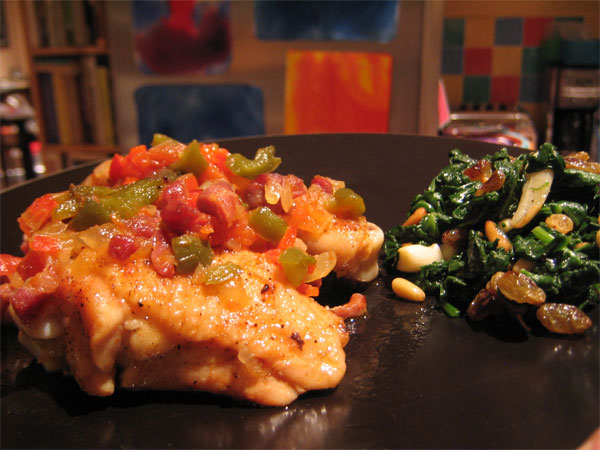
I discussed these in this post on Valentine's Day. If there's one theme that seems to run through the recipes in this book so far, it's jamón serrano (the Spanish ham from the white pig which is an everyday meat next to the more treasured jamón iberico, but nevertheless an outstanding pig product next to American hams), used as a flavoring agent in things cooked slowly. That plus brandy made this chicken dish an easy and recognizably "Mediterranean" meal, if one that could just as easily have been in a cookbook of American-invented recipes with only a surface-level Spanish tinge; I was more impressed with the garlicky spinach, which von Bremzen describes as "one of the best-known Catalan dishes... as a side dish it goes with just about anything, and nothing beats it in the morning on toast."
Jarret de Vedella amb Naps i Peres (veal shanks with baby turnips and pears), p. 263

This was the second thing I made in my new Dutch oven after a roast chicken dish from the Balthazar cookbook. Osso buco-style cuts of veal shank, plus browned turnips and pears:

Frankly, despite the fact that it was a different meal and vegetables, not to mention a different nationality, the basic combination of rosemary, tomatoes, wine and an hour and a half in a Dutch oven meant that the veal dish came out strikingly similar to the Balthazar chicken-- which wasn't exactly to the credit of the one that cost a lot more. Likewise, after that long stewing in the same tomato-based sauce, the pears and turnips were largely indistinguishable, as unlikely as that may seem.

This was heartily satisfying, as its ingredients and cooking method surely suggest, but not quite to the level of its cost (and von Bremzen does suggest some lower-cost alternative cuts). Oh, and one other note: von Bremzen says to be sure to scoop out the "delicious" marrow. I know some people prize that as a great delicacy. Having tried the blubbery, blood-tasting goo, I am not one of them.
Salsa de Tomate Picante (spicy tomato sauce), p. 71
One of my favorite dishes at the most reliable and reasonably priced Spanish restaurant in town, Iberico, is queso de cabra, the simple goat cheese baked in a tomato sauce and scooped onto toast. I wanted to make it for a get-together and rather than simply use an Italian pasta sauce from a jar, I followed this recipe in which canned tomatoes simmer down to a puree in onion, garlic, cumin, paprika and a little vinegar and sugar. I had great hopes for this having flavor which would kick a jarred sauce's butt, but it came out... pretty average. I mean, a tomato sauce on its worst day is better than most things, but this didn't wow me. Do I need jazzier, more flavorful tomatos? Did I cook it to the point where the seasonings lost their punch? I don't know. It was fine for its purpose, but not entirely worth the work.
Pollo Asado con Compota de Manzanas y Membrillo (garlicky roast chicken with apple and quince compote), p. 274, with Judias Verdes con Jamon (garlicky braised beans with jamon), p. 376

One of the limitations all these recipes run up against, of course, is the caliber of the foods available to us when we make something that the Spanish make with things from a farmer's market or their own garden. This dish calls for quince, something I think I have seen in local groceries but did not find this time. So my first accomodation was substituting membrillo, quince paste, upping the Granny Smiths with which the quince was supposed to stew until it made a tangy, mushy compote:

How close was this to what it would have been with real quince? Who knows? It definitely was closer to applesauce with a hint of spice than to a 50/50 apple/something else flavor.

Alongside the chicken I made a green bean dish, also billed as garlicky (though neither was overpoweringly so), which von Bremzen introduces with this bit of modern cooking heresy: "Vegetables cooked al dente may be fashionable and pretty to look at, but often they can't compare to the sweet, fully realized flavor of vegetables slowly cooked. Green beans, parboiled and gently braised with garlic and smoky bits of jamón are pretty fundamental to Spanish cooking."
I liked this roast chicken, though I didn't necessarily like it better than the Balthazar one, or my most standard fancy-whole-chicken dish, the Chicken Balsamico from Lynne Rosetto Kasper's The Italian Country Table (which is truly outstanding). However, as with the earlier chicken dish, I was more impressed by the side dish, which seemed to me to have more soul and authenticity (even given that I had to substitute prosciutto for the serrano which, unbelievably, Whole Foods doesn't carry), and to be well worth making on its own sometime for any entree, Spanish or not.
Crema de Garbanzos con Jamon Crujiente (garbanzo cream with ham cracklings), p. 83, with jamon serrano and manchego cheese

Most of these dishes took some advance preparation; this meal I threw together fairly quickly, and there might just be a lesson here in the fact that it was the biggest hit from the book so far.
We've all had colds, so I wanted a quick soup, although soup can be something of a hard sell to the kids, or at least the younger one. A soup made from garbanzos had a built-in selling point, though-- hummus soup! Add in the fact that it was sprinkled with something I could plausibly pass off as bacon and there was no reason the kids should fight it.
The soup is extremely easy-- saute onions, garlic, carrots and some leek, add garbanzos and some chicken broth and a hunk of bacon (which does not end up in the final dish), and puree at the end. Sprinkle the result with fried bits of jamón serrano, and if you want to KICK IT UP A NOTCH, make a quick paprika-infused olive oil and drizzle it on top.
Since I knew I'd only use a small portion of the package of jamón I bought at Paulina, I got an aged manchego at Whole Foods and served the two up in imitation of one of our dishes at Del Toro-- although mine was better (sniff) because the ham had so much more flavor than the bland stuff they offered.

Here's how mine came out, next to the picture in the book:

Everybody had a happy plate when they were done. A big hit, and as easy as soup gets-- at least, assuming it isn't Campbell's Cream of Mushroom, the first item on the menu of international cuisine...
Now on to other things. I think I've roasted enough chicken, I need to try some seafood things (a significant portion of the book), and I need to try things that don't just look like Spanish-inflected American dinners but that really reflect the way the Spanish eat. After all, the spinach is served on toast for breakfast, the green beans are often served as a meal topped with a fried egg, she says-- there's a lot more to learn in this thick and, on the whole, enlightening and tasty book.Last edited by Mike G on May 12th, 2006, 7:36 pm, edited 1 time in total.Watch Sky Full of Bacon, the Chicago food HD podcast!
New episode: Soil, Corn, Cows and Cheese
Watch the Reader's James Beard Award-winning Key Ingredient here.
-
-
Post #2 - May 12th, 2006, 9:20 amMike, I think you described pretty well how your cookbook presents Spanish food, through sort of a fractured, nuevo lens. Nothing wrong with that, and everything looks great. Spain, probably as much as any other great food country, is not easily summed up in one cookbook because of the regionalism of the people, language and food.
The garbanzos are a good example of how the recipes update, or are "inspired by" basic homey Spanish cooking. Potaje de Garbanzos is about as fundamental a northern Spanish soup as there is. I make it all the time. The recipe you followed makes the dish a much fresher, lighter thing that is relatively low on the number and volume of pork products.
Unfortunately, I have not found an excellent version of potaje de garbanzos in Chicago outside of casa de abuelita or my own kitchen, so I can't send you somewhere to evaluate the dish you made against a classical baseline. La Unica has an ok version of the soup. Potajes de Garbanzos are ubiquitous in Florida because the people of Cuban and Spanish heritage largely have roots in areas where the soup is common. (Consider the name of the large Spanish/Sicilian importer from Tampa, Vigo/Alessi).
Believe it or not, one of the larger US packers of Spanish/Criollo beans and soups (and easily the best) is here in Chicago. El Ebro, named after the river that defines the Southern part of Northern Spain, makes swell garbanzos (for something in a can) with the full compliment of pork products, frijoles negros (better in their way than most restaurant beans here), caldo gallego, and even tamal en cazuela.
One can buy cans at La Unica for a very reasonable price. I lived on this stuff at college.

PS, membrillo means, literally, quince. Pasta de membrillo is quince paste.
-
-
Post #3 - May 12th, 2006, 9:41 amI meant to get into some of those issues last night but ended up just posting the damn thing (which has, needless to say, been waiting a long time to get written and put up). Much like my Belgian cookbook from the 1950s, this book makes adaptations not only for the lard-and-such-things-averse American chef but for the fact that you simply can't get some key ingredients here, or at least not readily even in Chicago.
In the case of the garbanzo soup, von Bremzen writes "While Spanish chickpeas are creamy and nutty, the dried legumes found in America are usually not much of an improvement on the canned stuff. So I offer a quick version of the soup, using canned garbanzos, which are greatly improved by a simmer in a bacon-infused broth." And indeed, it was the flavor of jamón paulina that was key to the dish. Of course, the thing that would be a killer on this dish if you started with anything other than canned garbanzos would be shucking them all; that would be the end of it as a quick and easy dish doable within an hour or so.
One of the things I hope to start to get from the book, though I haven't yet, is a little more sense of the regional differences in Spanish cooking. I know very little of the geography of Spain-- it wasn't a country that I paid much attention to growing up, one, because it was encased in the amber of the Franco years, two, because there was so much Spanish kitsch around in the 60s, bullfight posters and tar paintings of galleons and armor as a decor element and so on, that I avoided the whole culture until recently. So it really is a place of entirely new discovery for me, in a way that very little else in Europe (west of Albania, anyway) is.Watch Sky Full of Bacon, the Chicago food HD podcast!
New episode: Soil, Corn, Cows and Cheese
Watch the Reader's James Beard Award-winning Key Ingredient here.
-
-
-
Post #4 - May 12th, 2006, 1:04 pmJeffB--
Would you be willing to share your recipe for Potaje de Garbanzos?! One of my favorites, oh boy. It might be hard to find serrano here in Montreal, but maybe not.
GeoSooo, you like wine and are looking for something good to read? Maybe *this* will do the trick!
-
-
-
Post #5 - May 12th, 2006, 1:28 pmMike,
It made my day to find someone else carrying the "Exploring a Cookbook" banner. (This reminds me that it is time again to crack open the Bayless book and finally give a mole a try). My final wish is that these "Exploring" threads become collaborative, meaning that other LTHers who own the same book will contribute their own experiences with cooking from it.
The veal shanks with pear and turnip sounds very interesting to me, as I am a big fan of all three major components. It is sad that the two non-meat items came out indistinguishable from each other. I wonder if the dish would improve by avoidng the stewing of the pears and turnips and just adding them in right at the end.
The crema de garbanzos sounds and looks wonderful. I've been experimenting a lot lately with simple soups that get most of their base from vegetable puree, and this looks like a fantastic new addition. Beautiful work.
Best,
Michael
-
-
Post #6 - May 12th, 2006, 1:57 pmMike,
I also love the queso de cabra at Iberico and have made a similar dish from a recipe from Rick Bayless linked below (is it possible to have an Exploring a Cookbook thread without mention of a Bayless recipe?):
http://www.fronterakitchens.com/cooking/recipes/salsa_baked_cheese.html
Although it is theoretically a Mexican recipe, it is a worthy substitute for Iberico's baked cheese in the Spanish food wasteland that is San Diego. I've made it both with a sauce using tomatoes from the farmers' market and with the bottled salsas mentioned in the recipe, and it has been a hit in both incarnations. It only takes about five minutes to put together using the bottled salsa, though, and it is definitely worth that level of work.
-
-
Post #7 - May 12th, 2006, 3:52 pmI too would think it was so cool if somebody else bought the book and cooked and posted from it too.
PS, membrillo means, literally, quince. Pasta de membrillo is quince paste.
Although von Bremzen writes "quince has a special place on the Spanish table, most notably as membrillo, the dark fruit paste usually eaten with cheese." So apparently colloquially the paste is referred to simply with the fruit's name, sort of the reverse of the way in Kansas, we say we want "a French dip sandwich with au jus."Last edited by Mike G on May 12th, 2006, 6:16 pm, edited 1 time in total.Watch Sky Full of Bacon, the Chicago food HD podcast!
New episode: Soil, Corn, Cows and Cheese
Watch the Reader's James Beard Award-winning Key Ingredient here.
-
-
-
Post #8 - May 12th, 2006, 4:03 pmMike G. says:
"the way in Kansas, we say we want 'a French dip sandwich with au jus.'"
Huh. What part of Kansas you from Mr. G?? Around Westwood, Westwood Hills, Wyandot County, etc. we don't say that.
Of course the reason being, nobody round here even SERVES
"French dip "sandwiches. :^)
Welllll, maybe they do. But I never seen eeny.
But then maybe I'm hanging in all the wrong places. Wouldn't be the first time for that in my life; albeit other wrong places were in consideration of other things than food.
GeoSooo, you like wine and are looking for something good to read? Maybe *this* will do the trick!
-
-
-
Post #9 - May 12th, 2006, 4:08 pmWhat part of Kansas you from Mr. G?
Wichita, where we also say "I went to Woolsworth to git something to warsh the Jagwire with."
It is a vicious calumny, however, to suggest that we order the soup du jour of the day.Watch Sky Full of Bacon, the Chicago food HD podcast!
New episode: Soil, Corn, Cows and Cheese
Watch the Reader's James Beard Award-winning Key Ingredient here.
-
-
-
Post #10 - May 12th, 2006, 5:54 pmMike G:
"It is a vicious calumny, however, to suggest that we order the soup du jour of the day."
OK, alright, I won't make that claim; it is, indeed, probably true. BUT: truth! heard a Wichitaen say the other day "Gimme some of that vin du maison house wine, ok?"
Deny THAT!
Geo
PS. In Johnson County we say "Jag-you-wahr". Leave no syllable unpronounced, that's my philosophy. And I'm stickin' to it.
PSS. On topic, anybody ever use Miramar Torres' _Spanish Table_ ? That's my olde standarde for the cuisine.Sooo, you like wine and are looking for something good to read? Maybe *this* will do the trick!
-
-
-
Post #11 - May 12th, 2006, 7:30 pmToto, I don't think we're in Catalonia any more...
Tortilla de patatas (potato tortilla), p. 139
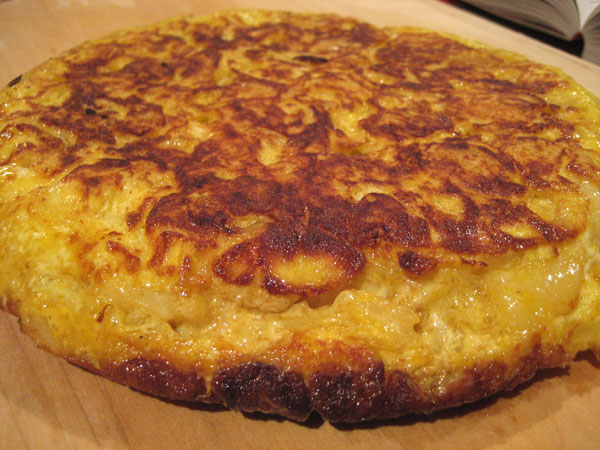
Tonight I took a shot at the iconic Spanish dish, the tortilla. (No relation, except in flatness, to the Mexican kind.) Potatos, eggs and onion, fried in olive oil. What's not to like?
It certainly came out a lot better than my first shot at the iconic Jewish dish.
Not surprisingly, the chapter on eggs starts with this dish, then offers a dozen or more variations on it. One of them involves truffle oil (it also involves mushrooms and caramelized onions, but we'll let that pass), and so I drizzled the grownups' tortillas with a little of the stuff.
Terrific. Simple is good.Watch Sky Full of Bacon, the Chicago food HD podcast!
New episode: Soil, Corn, Cows and Cheese
Watch the Reader's James Beard Award-winning Key Ingredient here.
-
-
-
Post #12 - May 13th, 2006, 7:12 amA variation of the Spanish tortilla de patatas is made in Tunisia, where my mother was born. The dish is called Ma' quda and is very similar except with the use of minced chicken, some chunks of whole eggs, onion, and a pinch of turmeric.
On very special family occasions, my grandmother would happily prepare this dish with brains. My American-born father used to say that this was a real treat, even for him.
I'm not quite sure if this is an indigenous Arabic recipe or one that made its way to North Africa via the influx of European Jews sometime earlier.
-
-
-
Post #13 - May 13th, 2006, 12:15 pmMike G wrote:Tonight I took a shot at the iconic Spanish dish, the tortilla.
Mike,
Looks terrific, I think I'll make one myself, maybe even with the Pigmon variation.
Re latkes, I outlined my latke method here, but my main piece of advice for avoiding hash brown like latkes is use plenty of oil. Once I started filling the pan with enough oil to come half way, at least, up the side of the latkes they started turning out much better.
Enjoy,
Gary
-
-
Post #14 - May 21st, 2006, 1:45 pmTortilla Trufada (truffled tortilla), p. 141; Tortilla de Patatas, Alcachofas y Pimientos de Piquillo (tortilla with artichoke hearts and red pepper), p. 143; and Tortilla de Roscoe Village (tortilla with sorrel), n.p.

Made a few more tortillas for a brunch party-- once you've got the basic skills down, it's pretty easy to start cranking them out assembly line style, and since they can sit out at room temperature, they're perfect for that kind of event.
The one with the big red thing in it was the pepper and artichoke heart one; the one with green flecks in it was a basic one to which I added a little sorrel for a slight spinachy tang; and the other one was the truffled one, which I made with both truffle salt on the potatos as they cooked, and a light drizzle of truffle oil after it was done.
They were a hit, each very satisfyingly offering a variation on the basic theme. And they'll be a hit for dinner tonight, too...Watch Sky Full of Bacon, the Chicago food HD podcast!
New episode: Soil, Corn, Cows and Cheese
Watch the Reader's James Beard Award-winning Key Ingredient here.
-
-
Post #15 - May 21st, 2006, 5:05 pmMike G wrote:They were a hit, each very satisfyingly offering a variation on the basic theme. And they'll be a hit for dinner tonight, too...
Mike,
Tortillas look delicious, have any bacon to go with those?
Enjoy,
Gary
-
-
Post #16 - May 21st, 2006, 11:27 pmMike G wrote:Toto, I don't think we're in Catalonia any more...
Tortilla de patatas (potato tortilla), p. 139
Mrs. Ro and I love a good tortilla de patata (and yours looks very good), fresh and hot or served cold on a sandwich, but we often run into trouble with sticking on the flip. If you don't mind sharing, what is your flipping technique?
Thanks in advance.
Keep eating,
J. Ro
-
-
Post #17 - May 22nd, 2006, 6:14 amWell, the keys according to the book are, enough oil in the first place that it gets a solid surface, dig under it with a spatula to make sure it's not sticking anywhere and can move freely in the pan, and then you just put the plate on and flip fast.Watch Sky Full of Bacon, the Chicago food HD podcast!
New episode: Soil, Corn, Cows and Cheese
Watch the Reader's James Beard Award-winning Key Ingredient here.
-
-
Post #18 - June 19th, 2006, 9:11 pmAmfos a la Mallorquina (Mallorcan Braised Grouper), p. 189
Back to this cookbook for the first time in a month, and my first shot at seafood dishes in it. This was a simple but appealing-sounding one-dish dinner-- well, I thought it'd be a one-dish dinner-- which is said to represent old-style Mallorcan cooking, with a definite Moroccan influence. It comes from a restaurant in Palma, Mallorca, called Es Baluard.
Alas, when I got to Dirk's a lady ahead of me was buying the last of the grouper, so I substituted halibut filets. Boil some potato slices, sear lightly floured and S&P'd filets...

And cover with a sauté you've made of roasted red and yellow peppers, onion and garlic, swiss chard, parsley, currants, wine, paprika and a dash of red pepper flakes.

Bake about 50 minutes. Especially with the sweetness of the currants and the mellowing of the peppers, onion and garlic, this was a totally likable dish; the fish came out tender and delicately flavored with the stuff on top of it.
I'd planned to just make a spinach salad to start but discovered that my tub o' spinach had frozen in the basement fridge; luckily there was just enough time and all the ingredients to whip up our old friend Espinacs a la Catalana from my first meal in this thread (I had to scrounge the raisins out of the little boxes for the kids' lunches), and so I salvaged the spinach as well. A big hit for a dinner welcoming an old friend who'd lived in Kenya for a few years (and another big hit was digging up what little there was about African food here on LTHForum and printing it out for her).Watch Sky Full of Bacon, the Chicago food HD podcast!
New episode: Soil, Corn, Cows and Cheese
Watch the Reader's James Beard Award-winning Key Ingredient here.
-
-
Post #19 - September 12th, 2006, 8:19 pmAtun a la Brasa con Salmorejo (grilled tuna with salmorejo sauce), p. 203
I'd had some frozen tuna steaks in my freezer since... uh, longer than recommended, so I looked through the von Bremzen book and here was a relatively quick and easy recipe, grilled tuna with a dipping sauce called salmorejo, take some tomato, some onion, garlic, pepper, puree... hey, wait a minute, this is starting to sound familiar--

Sounds like gazpacho, looks like gazpacho, tastes like gazpacho, just thickened up with bread crumbs. The recipe comes from a bar in Madrid, and it has the hallmarks of a dish made out of what you already have in a small kitchen. Practical restaurant food, not time-honored traditional food. But hey, it worked. Sear some tuna:

Top with fried leeks (which incidentally negated the savings from the pre-owned frozen tuna, since I only used the small white end and the leeks at Whole Foods were enormous-- especially at Whole Foods per-pound prices; next time, I'm taking my own machete to shop):

Porc Guisat amb Fruita Seca (Catalan braised pork shoulder with dried fruit), p. 231, with Patatas Revolconas (smoky mashed potatoes from Extramadura), p. 323
After the last few drizzly, wintry days it seemed like a day to break out the dutch oven again. Brown a pork shoulder, saute some onions and carrots:

Cook a little kirsch down, then throw in some wine, broth, rosemary, a cinnamon stick, dried apricots and cherries, and the pork shoulder:

Von Bremzen recommends with this a potato dish, basically mashed potatoes turned bright orange with olive oil, chunks of onion and garlic, and smoked paprika (which was, I suspect, the secret ingredient in the lamb dish Hammond and I tried at Haro a week or so ago):

I observed before that things cooked with wine and some rosemary all wind up tasting the same; but things cooked with a lot of dried fruit and some brandy on top of that don't, quite. I forgot von Bremzen's advice about adding a little vinegar if it was too sweet, but it was damn fine, in all those slow braised dutch oven ways, all the same:

and so the exploration continues...Watch Sky Full of Bacon, the Chicago food HD podcast!
New episode: Soil, Corn, Cows and Cheese
Watch the Reader's James Beard Award-winning Key Ingredient here.
-
-
Post #20 - September 13th, 2006, 5:16 pmI got this book a few months ago. Although the only recipe I've made so far is the traditional Gazpacho (which was pretty good), I feel indebted to the author for enlightening me about ventresca. After reading her description of what a wonderful surprise this tinned spanish tuna was for her (she evidently found several cans stashed away in a chef friends pantry, and opend some without realizing what it was) I was motivated to find some and try it myself. For those not yet exposed to this stuff...it's essentially canned toro. I really can't overstate how good it is. I like all fish in general, and tuna ( canned and fresh) in particular, so maybe I'm too biased here, but this is really delicious. Clearly the best thing I have ever had from a can. It's ridiculously expensive and my wife thinks I'm nuts for doing it, but I've been getting a can a week (from Trotters to go) and having it for lunch on the weekend. I think it's worth every cent. Try it sometime if you haven't already.
By the way, the dishes pictured above look beautiful.... nice job!
-
-
Post #21 - September 13th, 2006, 9:32 pmI've had this book for a couple of months now and have been too engrossed with reading to do much cooking out of it. But with the last of the Michigan sweet cherries stuffed in the freezer before we went on vacation and some very nice tomatoes and beets at the market upon return, Mrs. Fillay and I decided to try the Cherry-Beet Gazpacho.
Not much definable cherry or beet character, just a nice earthy sweetness rounded out by acidity from the tomatoes and sherry vinegar. Mint granita - the recommended garnish - was not in the cards for a lazy Saturday afternoon, but chopped pistachios added some richness. A Lynmar Vin Gris de Pinot Noir did very nicely alongside for a perfect summer dinner.

- Fillay"Grenache is Catholic, Mourvèdre is Huguenot"
- Fabrice Langlois, Château de Beaucastel
-
-
Post #22 - September 14th, 2006, 8:18 amKuhdo and Fillay, thanks to both of you for posting about what you've cooked out of the book, too. Please continue to do so, I'd really love to hear multiple perspectives on the book or Spanish food generally. And I'm going to have to look for ventresca-- well, at least once.Watch Sky Full of Bacon, the Chicago food HD podcast!
New episode: Soil, Corn, Cows and Cheese
Watch the Reader's James Beard Award-winning Key Ingredient here.
-
-
Post #23 - January 31st, 2007, 12:21 pmManchego Crackers, Tangerine-Marinated Olives and Dry Amontillado Sherry
This was a combination recommended by the author. I made it for my book club meeting this Sunday, which was Spanish-themed. Due to being stuck in a snowstorm driving back from Michigan for 4 1/2 hours, I rushed out the door with my food without taking any pictures. Mea culpa.
The manchego crackers were an absolute cinch to put together. I made the dough 4 days in advance with artisanal manchego purchased from Whole Paycheck ($17.99/lb). Von Bremzen suggests 1/4 lb. for the recipe to yield one cup. I found that recommendation to be accurate.
While the dough was crumbly coming out of the food processor, a slight kneading allowed it to get into cylindrical shape required in order to later cross-slice into crackers. I got the sense that the dough needed to be refrigerated for more than the recommended minimum 1 hour in order for the dough not to crumble when sliced. After the fourth day, however, they were perfect.
I sliced them into the recommended 1/4 inch. Next time, I think I'll slice them into 1/8 inch. The 1/4 inch slices seemed too thick (kind of like shortbread) and extended the recommended baking time by 5-10 minutes. 1/8 inch slices might seem more crackerish.
Having said that, the crowd inhaled these, with everyone commenting that they were like manchego cookies.
I marinated the tangerine olives for about 5 days. I don't think they could properly develop their flavor for less than 4 days and I think after 6 days, they will be too intense.
I used bulk green olives from the olive bar at Sunflower Market and gave them a rinse when I came home. The recipe calls for a lot of garlic - 6 cloves in fact. I would definitely pay attention to the clove size. If you've got large cloves, you might want to cut it to 3. It also calls for 3-4 tablespoons of vinegar. If you are marinating for a shorter period, go for 3. After Days 2 and 3 of marinating, the taste of tangerine juice on the front and the vinegar on the back were overwhelming. By Day 5, the flavors balanced out. At first bite, you tasted a clean tangerine flavor which ended with a muted kick of vinegar at the end; the remaining flavors in the marinade stayed in the background. Excellent!
A note on serving the olives. This recipe calls for a ton of ingredients including minced garlic, tangerine zest, sliced lemons, arbol chiles, bay leaves etc. After a few days of marinating, this looked like a swamp (even after bringing the oil to room temperature). To serve, I poured the whole mixture into a strainer, gave it a quick rinse, and then piled the olives and some garnishes, such as the lemon, chile and bay into a serving bowl, and gave it a fresh coat of olive oil. This gave the olives a nice gloss and I think cleaned up the flavor a bit.
In short, the crackers, dry sherry and olives were a combination that everyone loved. The host kept pushing his off-dry sherry instead of the dry one that I brought ( ), so I had the chance to try this with both sherries. Von Bremzen is correct- dry is the way to go.
-
-
Post #24 - February 2nd, 2007, 8:19 amI little comment on the Tortillas area. You can make them of, practically anything, spinach, zuchinni, white beans and salted cod, chorizo, fried bread and pancetta, lamb brains, sparragus,etc. etc.
A very nice way of doing it is called Pastel de Tortillas. You make three or four tortillas (your choice on the filling) put them one on top of the other, spread mayonnaise in between and make a sauce (tomato, hollandaise, whatever) and cover it all. You cut it just like if it was a cake, in wedges. It comes out very nice. The fun part is try to see what is the combination of tortillas that you like best.
Another comment on the pimenton question. Normally the one used is the smoked , sweet one, instead of the hot, picante one. If you want picante what generally is used is a dry, hot pepper, kind of a chili.
Got to be very careful when you add pimenton into hot oil. It burns very fast and leaves a bitter after taste, so the thing to do is to stir it and add the liquid to cook on or to take it out of the fire, before it burns.
-
-
Post #25 - March 23rd, 2007, 6:51 pmGuiso de Ternera a la Asturiana (Asturian beef stew), p. 256
A cool day again, felt like a good day to break out the Dutch oven and the Spanish cookbook in search of another hearty stew. This one's from Asturia, and as von Bremzen says, "Whenever you see a recipe for a folksy dish that features turnips, meat and smoked porkstuffs, you can pretty much bet it's from the mountainous region of Asturia. This stew is great rib-sticking fare for a cold winter night."
Works for me! Brown some cubes of chuck, set them aside, brown some littler cubes of bacon and some vegetables...

Toss wine, stock, a little flour, tomatoes and the chuck back in along with white beans...

Two hours later add turnips and/or potatoes. An hour after that blanch some turnip greens and add them. Result: very satisfying winter stew, as promised.
 Watch Sky Full of Bacon, the Chicago food HD podcast!
New episode: Soil, Corn, Cows and Cheese
Watch the Reader's James Beard Award-winning Key Ingredient here.
-
-
Post #26 - September 2nd, 2007, 11:23 pmA classic Spanish feast

Only a little of the following comes out of The New Spanish Table, but it's the culmination of my interest in Spanish cookery to date and so this seems like a good place to put it. After our trip to Madrid and Catalonia earlier this year, which Pigmon had been very helpful in planning, he had talked about wanting to cook black rice, a squid-ink-colored variation on the classic paella style of cooking. So we gathered a dozen or so LTHers on a Labor Day weekend day for an attempt at making as authentic a Spanish feast as could be reasonably achieved in Chicago.
We started, unsurprisingly, with a range of Spanish nosh-- two kinds of chorizo including the chorizo riojana fortuitously mentioned by Bster just a day or two ago; many, many cheeses, which someone else can do a better job of listing than me; a very nice Albariño recommended on the rack just inside the door at Sam's; and roasted piquillo peppers, which we had eaten at Maceiras in Madrid. According to Trixie-Pea, these are known as Russian Roulette peppers-- most have a little kick, one out of 20 or so is wildly hot.


This was my attempt at imitating this, from La Taberna de la Dolores:

I had white wine vinegar-cured anchovies instead of the fresh boquerones they'd had, and the cheese I got was maybe a little more assertive than the feta-like one they'd used, but on the other hand, my tomato was better than theirs. All in all, not a bad version, accurately conveying the simplicity of so many Spanish tapas.
Trixie-Pea next offered a couple of tortillas:

Hopefully she'll link to the site she said taught her how to improve her tortilla technique. And she made something I'd basically made above, salmorejo, which is almost, but not exactly, gazpacho:

This was about 100 times better than my attempt above, though, maybe because of the quality of produce available at this time of year. Really fresh and refreshing. Next was escabeche, which is similar to ceviche except the fish to be marinated is fully cooked:

This got a bit overlooked as the last of the appetizers, I didn't want to fill up on tuna at this point; light and tangy, it deserved more attention.

The crowd was getting pretty crazy hopped up on Jupiter juice, so it was time to fire up the turkey fryer and start making the black-rice-that-is-not-exactly-a-paella. Fry some green pepper and onion, then some seafood:


Add squid ink:


Then the rice and fish stock:


One important thing, Pigmon said, was not to stir. He tasted and tested, occasionally adding more fish stock here or there, but never stirred the rice.

A savory-sweet prentree™ of chorizo and prunes roasted tided us over until our entree was ready:

While I prepared roasted red peppers, like we'd had at Julian de Tolosa in Madrid. They didn't really come close to that magical dish, though.

At last it was ready, topped with diced shrimp (or else mini marshmallows, I forget) and to be garnished with a little aioli:


A great, briny dish that really brought back for us the magical quality that seafood dishes have in Spain. Thank you, Trixie-Pea and Pigmon, for this wonderful centerpiece to the feast.
Following our main course, we put out a variety of dessert wines and liqueurs; I offered pacharan, another thing we'd tried at Julian de Tolosa, although the Baines pacharan offered in the US isn't as nice as what we had there; while Gypsy Boy brought us all two real treats: a pair of Pedro Ximenez dessert wines, from 1971 and 1945 respectively. While the 1945 was a treat to taste, with its more astringent, almost distilled character, most of us much preferred the 1971, which bloomed in the mouth with flower, vanilla, butterscotch and many other flavors. Really a marvelous wine, and a great thing to have the chance to try.
Meanwhile, for dessert, the fact that I wasn't responsible for the main course freed me to go nuts with desserts (and presentation, as you'll see), all at least inspired by recipes in The New Spanish Table. First a palate cleanser, a sorbet based on an ice cream recipe in the book, in which peaches are macerated in muscatel, along with some mint (which is removed after steeping). The subtle mint and liquor flavors add complexity to the bursting flavor of prime season peaches.

Looking for interesting (yet not too expensive) dishes to serve ice cream in, we found these Crate and Barrel tea lights, which were the perfect size for a scoop from a cookie-dough scoop.
The next dessert, according to von Bremzen, is an example of the sort of traditional flavor-mixing in Catalonia that inspired chefs like Ferran Adria. Start with a little ball of chocolate ganache (I used 70% bittersweet Scharffenberger), surround it with a peppery olive oil and sprinkle with sea salt-- and eat with a breadstick:

It may sound weird but it's a wonderful salty-sweet combination and as Seth, I think, said, the olive oil gives the chocolate a lush mouthfeel that was really quite wonderful and made me feel like I'd pulled off an Adria-style trick with flavors and textures. Hmm, wonder where I could get some liquid nitrogen or a kitchen laser...
Last was, no, not pepperoni pizza, a tart-- a sweet pastry crust with a bit of rosemary in it, a basic custard or curd flavored and colored with saffron brought back from Spain, and topped with golden raspberries.

I didn't know what to expect from the combination of custard and rosemary but it was surprisingly wonderful, the rosemary giving the pastry crust depth of character while the sweet saffron cream and the berries were all you could ask for from a summer dessert.
Thanks to all, especially Pigmon and Trixie-Pea and my hostess King's Thursday, for this opportunity to explore real Spanish food in greater depth with the ever-interesting and eager folks of LTHForum.Watch Sky Full of Bacon, the Chicago food HD podcast!
New episode: Soil, Corn, Cows and Cheese
Watch the Reader's James Beard Award-winning Key Ingredient here.
-
-
-
Post #27 - September 3rd, 2007, 4:43 pmWhat an extraordinary dinner! The pictures and Mike G's descriptions do this leisurely repast far more justice than my feeble attempts at description ever could. Suffice to say that there wasn't a misstep all afternoon (or evening). Each and every course, from the cheeses and chorizos to the tortillas and escabeche all the way through the three desserts (three desserts!!) was magnificent. Kudos to Pigmon and trixie-pea as well for preparing and bringing a multitude of dishes, culminating in a superb squid ink paella. It's truly impossible to single out any one thing as everything was just a real pleasure (though that saffron-flavored tart was just exquisite, Mike).
(One tiny correction: the little green peppers that trixie-pea bought that morning at the Evanston Farmers' Market and then roasted are pimientos de padron and are, indeed, known as Russian roulette peppers in some quarters. Piquillos are red, quite bit larger, sweeter and, to my taste, with a seductive, albeit indefinable, tang.)Gypsy Boy
"I am not a glutton--I am an explorer of food." (Erma Bombeck)
-
-
-
Post #28 - September 3rd, 2007, 5:49 pmYeah, I don't know why I had piquillo on the brain. Actually I do, because I saw some nice ones at Green City on Saturday. Pimientos, yes, that's what they are.
It's funny, other than gelato I wouldn't say that I had a really stellar dessert in Spain, at least for a country next to France, but boy, those three desserts are really the best things I've made out of The New Spanish Table.
I should also point to Gypsy Boy's previous thread on the Pedro Ximenez dessert wines; I went to Sam's today and picked a bottle of the '71 up for about $40. Amazing stuff.Watch Sky Full of Bacon, the Chicago food HD podcast!
New episode: Soil, Corn, Cows and Cheese
Watch the Reader's James Beard Award-winning Key Ingredient here.
-
-
-
Post #29 - September 3rd, 2007, 9:21 pmAlong with the 3 cheeses ReneG brought (including Manchego, a sheep's milk cheese from La Mancha as well as 2 other unknown varieties), we tried Ros (Basque-sheep), Zamorano (Castille-Léon-sheep), Pau St. Mateu (Catalan-goat), and Garroxta (Basque-goat).
This wonderful YouTube video gave us some nice pointers on how to make a very pleasant tortilla de patata.
We drizzled a bit of truffle oil over one of the tortillas which I thought worked quite well.
-
-
-
Post #30 - September 3rd, 2007, 9:35 pmPigmon,
Garrotxa cheese is not Basque but Catalan, from Girona.
AntoniusAlle Nerven exzitiert von dem gewürzten Wein -- Anwandlung von Todesahndungen -- Doppeltgänger --
- aus dem Tagebuch E.T.A. Hoffmanns, 6. Januar 1804.
________
Na sir is na seachain an cath.