

How To Cook An Enormous Beet?
How To Cook An Enormous Beet?
-
-
-
-
-
How To Cook An Enormous Beet?
-
Post #1 - September 12th, 2007, 10:06 amSo there I am at the Evanston farmer's market, minding my own business when I hear a challenge.
"Buy me," says the beet.
It was an epic beet. A titan of subterranean realms, nestled among its equally titanic brothers and sisters.
"Cook me," says the beet.
The sign over the beets read Great For Grilling - which sounded like madness. But I took the bait and the beet and brought it home.
There it sits, in my refrigerator. All 2lb15oz of beet. All 17" circumference of beet.
I am thinking of making a sliced beet salad for Rosh dinner tonight.
But how on earth do I cook a beet this big?
-
-
Post #2 - September 12th, 2007, 10:15 amPersonally, I would peel it, cut it into quarters and roast the beet.
-
-
Post #3 - September 12th, 2007, 11:10 amQuarter it and plan accordingly. I find that a medium to medium-large beet (not cut up) needs about 1 hr to 1 hr 15 min in a 400 degree oven in order reach optimal tenderness.
-
-
Post #4 - September 12th, 2007, 11:22 amI was leaning towards roasting, but I wanted to poll the board for brilliant ideas.
Usually beets are easier to peel after roasting. Would removing the peel significantly cut down on cooking time? If not, is there a reason to do it ahead of time?
Aschie30, I find similar time frames for roasting whole beets. I imagine that for a beet this big, I would have to lower the oven temperature a bit to keep the thinner bits from drying out.
-
-
Post #5 - September 12th, 2007, 11:28 amgastro gnome wrote:I was leaning towards roasting, but I wanted to poll the board for brilliant ideas.
Usually beets are easier to peel after roasting. Would removing the peel significantly cut down on cooking time? If not, is there a reason to do it ahead of time?
Aschie30, I find similar time frames for roasting whole beets. I imagine that for a beet this big, I would have to lower the oven temperature a bit to keep the thinner bits from drying out.
I think if you quarter it, then you might not have that issue. Instead of just placing in on a roasting pan, you could also double-wrap (I stress double-wrap, otherwise you'll have beet juice all over your kitchen - I'm still swearing about that) the beet in aluminum foil as the steam coming off the beet will be trapped in the foil package; that should provide drying out protection.
I don't think removing the peel would significantly cut down on the cooking time.
-
-
Post #6 - September 12th, 2007, 12:31 pmWouldn't both quartering and peeling increase the likelihood of bleeding? I always toss beets on the grill with dinner (albeit smallish ones) and leave them until the skin chars and splits...was it really seventeen inches? That's a massive beet!
-
-
-
Post #7 - September 12th, 2007, 1:10 pmI believe I saw Louisa Chu on Diary of a Foodie bake a very large beet in a mound of kosher salt. You need a heckuva lot of salt, but it looked great."Don't you ever underestimate the power of a female." Bootsy Collins
-
-
-
-
Post #8 - September 12th, 2007, 1:29 pmI roast beets indirectly on the grill over medium hight heat until the outside is charred and the inside is soft. Cool, peel, and use however you want.
-
-
-
-
Post #9 - September 12th, 2007, 3:01 pmI think you are doing a disservice to us all by not posting several pictures of the big beet.
Since everyone is fascinated by giant produce be a good citizen and post a few pics, please.I'm not Angry, I'm hungry.
-
-
-
Post #10 - September 12th, 2007, 5:43 pmI have roasted beets of this size numerous times. You simply need to leave the skin on, coat with olive oil and roast in a 250 degree oven for 2-3 hours. When you can easily pierce it with a filet knife it is done.(also another way you can tell it is done is when the beet juice runs out on the sheet pan and they begin to caramelize) Remove it from the oven and place it in the refrigerator until it is cool. Once cool put on a pair of latex gloves, line your cutting board with plastic wrap and remove the outer skin. Then chop er' up however you would like. Just make sure you have plastic wrap down (or wax paper). And make sure you take some pictures for everyone.
-
-
Post #11 - September 12th, 2007, 6:39 pmI would carve out the insides, poke out eye holes, and wear it.Watch Sky Full of Bacon, the Chicago food HD podcast!
New episode: Soil, Corn, Cows and Cheese
Watch the Reader's James Beard Award-winning Key Ingredient here.
-
-
Post #12 - September 12th, 2007, 9:32 pmYou could slice it into 1/4" thick slices and grill it, but I think it's better to quarter it and go with a slower method - roasting, braising, or indirect grilling/smoking. If you're looking for something new to try I've had good luck with this (with smaller beets):
Quarter and marinade overnight in a pureed and strained combo of 1/2 cup balsamic vinegar, 1/4 cup olive oil, 2 tbls honey, 1 tbls date molasses, 4 roasted Anchos, 4 garlic cloves, 1 tsp cumin, s+p to taste.
Low indirect grill (275-300) over an apple or cherry fire for an hour or so.
What sort of beet is it and what is it's color? There are beets like Crosby Egyptian that can be good at that size, but in general really large beets are often beets that have grown way past the point they're edible (I've dug up cantelope sized beets that looked impressive, but tasted awful).
-
-
Post #13 - September 12th, 2007, 10:32 pmAngrySarah wrote:I think you are doing a disservice to us all by not posting several pictures of the big beet..
Ask and you shall receive.
How to roast an enormous beet.
First, compare it to common objects for sizing:

Next, find 12" knife with which to cleave it:

Then assault it with herbs and aromatics:

Stuff in oven and roast at 400 for an inordinate amount of time (over 2 hours) until roasty, toasty and soft when poked with a paring knife:

Then let it cool and put in your fridge until you decide what to do with it.
Now the question is how to serve an enormous beet.
I have a pot luck dinner on Friday and I like the sound of your spicy marinade Attrill. I'm thinking cut it into matchsticks, marinate with some honey, oil, cumin and ancho puree. Sautee some greens, sprinkle with queso fresco and serve in hot tortillas for some hand-staining beet tacos.
Roasted tomato/ancho salsa passed separately.
Oh and for what it is worth, I don't know the beet variety. But I did sample some and while the sweetness was a bit muted it tasted like...roasted beet.
-
-
-
Post #14 - September 13th, 2007, 9:35 amExcellent work.
That was indeed a very large beet.
Am I the only one a little sad he was cut up?I'm not Angry, I'm hungry.
-
-
-
Post #15 - September 13th, 2007, 9:50 amAngrySarah wrote:Am I the only one a little sad he was cut up?
A little sad, but at two hours to cook him quartered, I don't see that there was a choice unless you're willing to devote hours to roasting (maybe the salt-crusting, but even then).
-
-
Post #16 - September 13th, 2007, 12:33 pmThat is a gorgeous beet. Salt crusting does work great. Next time
 try rock salt. In fact I just saw a Good Eats where Alton Brown salt roasts shrimp - he pre-heats the salt, which is another terrific Alton idea.
(And that was Alain Passard who roasted the beet on Diary of a Foodie - who can afford to use French sea salt.)
-
-
Post #17 - September 13th, 2007, 12:39 pmLouisa Chu wrote:(And that was Alain Passard who roasted the beet on Diary of a Foodie - who can afford to use French sea salt.)
I'm curious: does the type of salt really matter here? I always thought the purpose of this technique was to essentially create a hard chamber for the food to cook within, the salt being a construction tool rather than something to season or enhance the food.
Certainly, you want a "flakier" salt rather than iodized table salt for construction purposes, but if it can make a shell is the good stuff really necessary?
-
-
Post #18 - September 13th, 2007, 12:46 pmeatchicago wrote:Louisa Chu wrote:(And that was Alain Passard who roasted the beet on Diary of a Foodie - who can afford to use French sea salt.)
I'm curious: does the type of salt really matter here? I always thought the purpose of this technique was to essentially create a hard chamber for the food to cook within, the salt being a construction tool rather than something to season or enhance the food.
Certainly, you want a "flakier" salt rather than iodized table salt for construction purposes, but if it can make a shell is the good stuff really necessary?
The type of salt does matter - but for different reasons. The rock salt works great because it's a wonderful conductor of heat and it can be rinsed off and re-used. The moist, French grey sea salt works similarly and creates a crust which can be cracked into at the table for dramatic presentation. Rock salt is pretty cheap so the good/expensive/Alain Passard French grey stuff is not necessary at all.
-
-
Post #19 - September 13th, 2007, 1:02 pmThe beet complained a little prior to quartering, but eventually agreed that it would be more efficient.
I had forgotten about the recipe you profiled, Louisa. Thanks Hammond for suggesting it, but by that time, the beet was already in the oven. I might try the salt trick next time. I will keep my eyes out for more uber-beets at the farmer's market as we turn to Fall.
The one time I baked something in a salt crust, it was also from Good Eats. The problem was that, the salt 'dough' never really cohered completely. The crust, was indeed crack-able, but much loose salt also clung to the fish. Made for a bit of a hassle to remove and a little bit of a mess. I haven't tried again.
So, is there a golden ratio to remember when salt-encrusting something?
Maybe using rock salt will solve the problem as its large size will make for easier clean-up.
-
-
Post #20 - September 13th, 2007, 1:12 pmMike G wrote:I would carve out the insides, poke out eye holes, and wear it.
GAAA: a vegetarian Gregor Samsa.
-
-
Post #21 - September 13th, 2007, 1:52 pmgastro gnome wrote:The one time I baked something in a salt crust, it was also from Good Eats. The problem was that, the salt 'dough' never really cohered completely. The crust, was indeed crack-able, but much loose salt also clung to the fish. Made for a bit of a hassle to remove and a little bit of a mess. I haven't tried again.
So, is there a golden ratio to remember when salt-encrusting something?
Maybe using rock salt will solve the problem as its large size will make for easier clean-up.
I recently made a salt-encrusted pork tenderloin from The New Spanish Table. It called for 5 egg whites combined with 3 cups kosher salt. While I thought the crust was a little runny going on, it crisped up nice in the oven and I didn't have any residual salt on the meat.
-
-
-
Post #22 - September 13th, 2007, 2:02 pmI've made small potatoes baked in kosher salt for Wolfort's Southwest France book. Tasty and you can get the salt off the taters pretty easy.I'm not Angry, I'm hungry.
-
-
-
Post #23 - July 19th, 2009, 7:05 pmHi,
I bought two baseball sized beets, which I cooked in the microwave. I then made a beet salad of Russian origin:
5 medium beets, scrubbed - I used my two big boys
1/2 cup chopped walnuts - I used pecans, because it was available
1/2 cup mayonnaise - I did this to taste.
20 pitted prunes, chopped
3 cloves garlic smashed in a garlic press
salt to taste
DIRECTIONS:
Microwave or bake beets until tender to the middle. When cool enough to handle, slip off the skins. Grate the beets into a bowl. Stir in finely chopped nuts, prune and garlic into the beets, then mix in the mayonnaise and season to taste with salt.
I was inspired to make this after a visit to Bread N'Bowl in Niles.
Regards,Cathy2
"You'll be remembered long after you're dead if you make good gravy, mashed potatoes and biscuits." -- Nathalie Dupree
Facebook, Twitter, Greater Midwest Foodways, Road Food 2012: Podcast
-
-
Post #24 - July 19th, 2009, 8:55 pmI have a giant zip-top bag of salt that I use for roasting beets. It started as a couple of boxes of Kosher salt that I mixed with a little water and piled up over some beets. When the beets were cooked I felt silly throwing away the salt, so I've just continued to reuse it (probably 5-6 times now) just breaking it up after each use and tossing it back in the bag. It's taken on a bit of a reddish-brown hue from all the beet leakage, but I figure it's just salt - it can't really go bad, right?
-Dan
-
-
Post #25 - July 19th, 2009, 9:08 pmMike G wrote:I would carve out the insides, poke out eye holes, and wear it.
I think you will be doing a disservice if you don't post a picture of that!"Your swimming suit matches your eyes, you hold your nose before diving, loving you has made me bananas!"
-
-
Post #26 - July 20th, 2009, 6:35 amRick T. wrote:I roast beets indirectly on the grill over medium hight heat until the outside is charred and the inside is soft. Cool, peel, and use however you want.
i was going to suggest the same thing..grilled beets are great!
I like to coat them very lightly with a bit of oilive oil before grillingFirst Place BBQ Sauce - 2010 NBBQA ( Natl BBQ Assoc) Awards of Excellence
-
-
Post #27 - July 20th, 2009, 8:11 amMy great great grandfather Manheim cultivated Beets in Manheim, Germany. Some of the worlds greatest emporers and Czars have sipped Borscht made from the Beets of a Schrute. Then they wiped their Germanic lips and went off to conquer, warm tummies filled with my beet juice.

-
-
Post #28 - July 20th, 2009, 10:05 amChoey wrote:Mike G wrote:I would carve out the insides, poke out eye holes, and wear it.
GAAA: a vegetarian Gregor Samsa.
Als Gregor Samsa eines Morgens aus unruhigen Träumen erwachte, fand er sich in seinem Bett zu einem ungeheuren Bete verwandelt.
Interestingly, the German words for beet (Bete) and bed (Bett) have the same origin.
-
-
Post #29 - October 4th, 2009, 8:01 pmLTH,
Wanting to utilize the remaining fire after a fresh picnic pork shoulder cook on the Big Green Egg I smoke/roasted 5-medium size beets.
Beets on smoker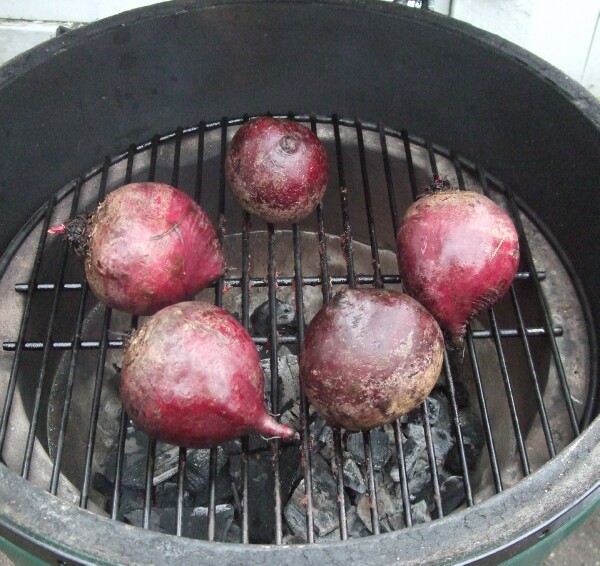
Salad of roasted beets, pear, honey, lemon juice, salt, pepper. Toasted walnuts would have been perfect if I had any.
Used two in the salad, one in a beet, gorgonzola, smoked pork, onion, olive pizza and have two left for another day.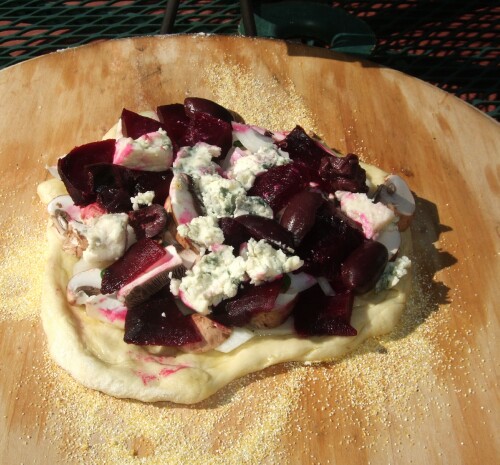
Not enormous beets, but tasty none the less.
Enjoy,
Gary
-
-
Post #30 - October 5th, 2009, 11:11 amG Wiv wrote:Used two in the salad, one in a beet, gorgonzola, smoked pork, onion, olive pizza and have two left for another day.
How were the beets on the pizza? Avec had a beet flatbread as its woodfired pizza/flatbread offering the last couple of times I went and I thought it was excellent and worked much better than I would have thought. The beets for that dish were very thinly sliced (in rings), though, and presumably went on raw.


