

Asparagus Risotto
Asparagus Risotto
-
-
-
-
-
Asparagus Risotto
-
Post #1 - April 29th, 2008, 9:00 pmOnce a long time ago during Restaurant Week in NYC, I had a transcendent asparagus risotto at La Cote Basque. The rice itself was infused with a lovely asparagus flavor in addition to pieces of asparagus sprinkled throughout. It made me weep.
I have been trying to replicate the risotto ever since. I cooked the fresh asparagus in the chicken broth. The broth itself had a nice asparagus flavor; the rice, not so much.
My latest try was to use canned asparagus (gross, yes, but the water in the can is completely infused with asparagus flavor, no?) to add flavor. I used the water in the can as part of the liquid, and processed the asparagus to add to the rice. Still not enough to infuse the very rice itself with the asparagus flavor that I remember.
Any help?
-
-
Post #2 - April 29th, 2008, 9:19 pmMy guess is they used the fibrous part of the asparagus stalk to make the stock. I've never tried this before, but I'm sure you can find a recipe somewhere.
-
-
Post #3 - April 30th, 2008, 2:31 amLike the previous member said buy the entire bundle of asparagus and use the bottom inch off of each piece to make a stock. The flavor is full and dense while not palatable to eat the bottom alone. And yeah this will take a lot of bottoms but if you save them each time you use asparagus by freezing them each time you're set.GOOD TIMES!
-
-
Post #4 - April 30th, 2008, 6:20 amOne thing I do when I make squash risotto is to roast the squash, puree it in a blender, and then add it to the stock to thin it out so that it's not chunky, but easily ladled. I then ladle out the stock/squash combination out as I cook the rice. As a result, the squash flavor is pervasive. I suppose you can steam the asparagus after you peel off the fibrous strands), puree it and add it to your stock, although I think that might turn the risotto green. (Maybe use white asparagus for this stock, and pieces of green in the risotto?)
Just a thought.
-
-
Post #5 - April 30th, 2008, 7:43 amHere's how we made a very intense asparagus risotto at the Italian-Grandmother owned restaurant at which I cooked:
1. Make asparagus stock: Do NOT use chicken stock for this step. Simply simmer lots of asparagus bottoms in plain water with a little chopped onion and lemon. Chicken broth will not allow the asparugus flavor to shine as intensely. Simmer this for about 1.5 hours, then strain.
2. Steam some more fresh asparagus, cut into about 1 inch pieces. After about 10 minutes, remove half of the asparagus, which should be crisp-tender. Reserve this, and let the other half cook an additional 15-20 minutes until very soft - almost mush.
3. Puree the mushy asparagus with just enough stock to get the blades of the blender going. You're looking to make a relatively thick puree here.
4. Follow standard risotto-making procedure, using the asparagus broth for 3/4 of your liquid and a dry white wine for the other 1/4.
5. When risotto is just about done, stir in the bright green puree and the reserved crisp-tender spears.
6. Squeeze a little lemon and shave a healthy dose of pecorino romano. Serve.
-
-
Post #6 - May 1st, 2008, 9:36 amThat sounds fabulous. I can't wait. We always save the ends and make some broth, but never with as rigorous a procedure as you described. I can already see and smell it just reading about it.
So is your puree more or less like split pea soup, texture-wise?
Separate question: what about age of rice and absorbtion? I always wonder how old the pacakges of arborio that one picks up are, and how that affects the starch and the overall outcome.
I know that on Argyle, the shoppers were very picky about when certain varieties of rice were coming in from a fresh harvest, and when not to bother buying certain types. But I don't know any of the detail. Anyone?"Strange how potent cheap music is."
-
-
Post #7 - May 1st, 2008, 10:34 amI'm very interested in making broth out of asparagus tips. If I don't want to make a risotto, what are some other uses?
Thanks,
Jonah
-
-
Post #8 - May 1st, 2008, 10:53 amJonah wrote:I'm very interested in making broth out of asparagus tips. If I don't want to make a risotto, what are some other uses?
I wouldn't advise using asparagus tips to make a broth - they're too good on their own. I'd use the stems instead. The broth can make an excellent soup - throw in some cream, and then you can can toss in those tips that you didn't waste on the broth.Last edited by nr706 on May 1st, 2008, 2:30 pm, edited 1 time in total.
-
-
Post #9 - May 1st, 2008, 12:02 pmmrbarolo wrote:Separate question: what about age of rice and absorbtion? I always wonder how old the pacakges of arborio that one picks up are, and how that affects the starch and the overall outcome.
I know that on Argyle, the shoppers were very picky about when certain varieties of rice were coming in from a fresh harvest, and when not to bother buying certain types. But I don't know any of the detail. Anyone?
With arborio and carnaroli, aged rice is best. Aging retards the development of starches, so the risotto is able to absorb more liquid for plumper, more flavorful, yet firm grains.
Basmati rice gets better with age, too.
But for Asians who prefer very sticky, soft, glutinous rice, young rice is better.
Here's Harold McGee with some info.
-
-
Post #10 - May 1st, 2008, 12:11 pmnr706: I was typing too quickly; I meant making a broth with the stems, not the tips. I hate throwing parts of food away. Thanks for the soup suggestion.
Jonah
-
-
Post #11 - May 17th, 2008, 9:52 ammrbarolo wrote:That sounds fabulous. I can't wait. We always save the ends and make some broth, but never with as rigorous a procedure as you described. I can already see and smell it just reading about it.
So is your puree more or less like split pea soup, texture-wise?
Separate question: what about age of rice and absorbtion? I always wonder how old the pacakges of arborio that one picks up are, and how that affects the starch and the overall outcome.
I know that on Argyle, the shoppers were very picky about when certain varieties of rice were coming in from a fresh harvest, and when not to bother buying certain types. But I don't know any of the detail. Anyone?
sorry, a little late in noticing your questions. Split pea soup texture sounds about right; though, to be honest, I don't worry much about making the puree a consistent texture. It can mix in with the broth used to cook the risotto anyway, so if it's too thick or too thin, I just add it a little before the risotto has finished cooking. It's more about creating a puree with really intense asparagus flavor than getting the texture perfect.
I'm not an expert in rice aging, but I would say that what LAZ describes as an advantage of aged rice actually strikes me as a disadvantage. For risotto, I want lots of starch in the rice so it can release while cooking and create a creamy, luxurious consistency. It doesn't strike me as a positive to use rice in which the starch-development process is retarded.
In the article LAZ linked to, McGee wrote that: "...apparently as a rice grain sits in storage, the surface proteins become oxidized, bond to each other, and form a thin skin on the grain, which limits water penetration into the grain, and limits the starch leakage outward that causes stickiness. That's at least part of the cause of the firmer cooked texture in aged rice."
Liquid penetration into the grain is exactly what I want to see happen to my risotto, because that is what flavors the grains. And starch penetration into the liquid sounds exactly like what I'd want too, for the textural reasons above. Based on McGee's info, I'd have to say fresher rice is what you're after if you want the best risotto. I can see why aged rice might be better for certain asian varieties like basmati or jasmine, where the goal is to preserve and heighten the flavor of the grain itself, rather than infuse it with flavors from the liquid....defended from strong temptations to social ambition by a still stronger taste for tripe and onions." Screwtape in The Screwtape Letters by CS Lewis
Fuckerberg on Food
-
-
Post #12 - May 17th, 2008, 12:02 pmI haven't tried it myself yet but FYI, here's a link to a recipe for asparagus risotto from the NY Times courtesy of Mario Batali. It comes with an accompanying video of him making it at Del Posto with the Minimalist, Mark Bittman.
http://www.nytimes.com/2007/05/02/dinin ... tto&st=cse
You may need a subscription to view it as it's several months old.
Cheers
-
-
Post #13 - May 18th, 2008, 4:42 pm
[Emphasis added.]Kennyz wrote:1. Make asparagus stock: Do NOT use chicken stock for this step. Simply simmer lots of asparagus bottoms in plain water with a little chopped onion and lemon.
Kenny-
What goes into the stock to simmer: just the juice from the lemon or the lemon itself? (I'm embarking on making a batch, but I fear that putting in a lemon, pith and all, might impart the pith's bitterness to the stock.)
-
-
Post #14 - May 18th, 2008, 7:14 pmI just squeeze a little lemon juice - no peel or pith. To be honest, I doubt the lemon makes much of a difference in the stock, but it was how my boss wanted me to do it. We also squeezed lemon onto the risotto before serving, which makes a whole lot more sense to me....defended from strong temptations to social ambition by a still stronger taste for tripe and onions." Screwtape in The Screwtape Letters by CS Lewis
Fuckerberg on Food
-
-
Post #15 - May 18th, 2008, 9:16 pmKennyz wrote:I just squeeze a little lemon juice - no peel or pith. To be honest, I doubt the lemon makes much of a difference in the stock, but it was how my boss wanted me to do it. We also squeezed lemon onto the risotto before serving, which makes a whole lot more sense to me.
Actually, I used a half of a lemon, pith and peel, thinking that the heat might tame it. And, that I would taste it early on and if I detected any bitterness, I'd fish it out. I actually thought it worked quite nicely. Within the first 1/2 hour simmering, the stock had too strong of a lemon flavor, but after another hour, hour-fifteen, the asparagus caught up and balanced it out. I liked the lemony taste it added to the risotto. I also added an asparagus puree (something I like to do with vegetable-based risottos), along with reserved asparagus tips. I can't imagine a better way to use a bounty of fresh, local asparagus.
-
-
Post #16 - May 18th, 2008, 10:16 pmKennyz wrote:Liquid penetration into the grain is exactly what I want to see happen to my risotto, because that is what flavors the grains. And starch penetration into the liquid sounds exactly like what I'd want too, for the textural reasons above. Based on McGee's info, I'd have to say fresher rice is what you're after if you want the best risotto.
A whole lot of famous chefs who swear by Acquerello would disagree. Aged rice is able to absorb more liquid without getting mushy, so you get more flavor. That's one reason why Acquerello, aged one to three years, is considered one of the finest rices for risotto.
I have some regular carnaroli that I found on closeout sale and stocked up on a couple of years ago, and it keeps getting better and better.
-
-
Post #17 - May 19th, 2008, 2:29 pmLAZ wrote:Kennyz wrote:Liquid penetration into the grain is exactly what I want to see happen to my risotto, because that is what flavors the grains. And starch penetration into the liquid sounds exactly like what I'd want too, for the textural reasons above. Based on McGee's info, I'd have to say fresher rice is what you're after if you want the best risotto.
A whole lot of famous chefs who swear by Acquerello would disagree. Aged rice is able to absorb more liquid without getting mushy, so you get more flavor. That's one reason why Acquerello, aged one to three years, is considered one of the finest rices for risotto.
I have some regular carnaroli that I found on closeout sale and stocked up on a couple of years ago, and it keeps getting better and better.
You linked to one article (McGee) that says aging limits water penetration into the grain, and then another (the Aquarello marketing piece) that says aging allows it to absorb more moisture. I based my comments above on the McGee article in your first post....defended from strong temptations to social ambition by a still stronger taste for tripe and onions." Screwtape in The Screwtape Letters by CS Lewis
Fuckerberg on Food
-
-
Post #18 - May 20th, 2008, 3:58 amKennyz wrote:You linked to one article (McGee) that says aging limits water penetration into the grain, and then another (the Aquarello marketing piece) that says aging allows it to absorb more moisture.
As I understand it, limiting liquid penetration causes the rice to absorb the liquid more slowly. Therefore, it takes a bit longer to cook, but ultimately absorbs more fluid and flavor without getting mushy or sticky.
-
-
Post #19 - May 30th, 2009, 8:42 pmStock for asparagus risotto:

stock has asparagus bottoms, parmesan rinds, onion, scallion, thyme, peppercorns
I pretty much followed the recipe above - made stock, pureed some spears and reserved others, sauteed a fresh shallot, added rice, then a glug of dry white wine and a ladle of stock every few minutes. Stirred in butter, grated cheese, a squeeze of lemon and topped with fresh herbs. It came out better than ever.
Asparagus risotto: ...defended from strong temptations to social ambition by a still stronger taste for tripe and onions." Screwtape in The Screwtape Letters by CS Lewis
Fuckerberg on Food
-
-
Post #20 - April 25th, 2010, 8:37 ampicked up the season's first asparagus yesterday, and - as I am wont to do - rushed home to cook them and preserve every bit of flavor, which tends to dissipate quickly after asparagus are harvested. End result was a fantastic, especially asparagussy risotto.
Asparagus Risotto:
I altered last year's recipe just a bit - this time leaving out the thyme to avoid distracting from the asparagus flavor, and roasting the asparagus to intensify it....defended from strong temptations to social ambition by a still stronger taste for tripe and onions." Screwtape in The Screwtape Letters by CS Lewis
Fuckerberg on Food
-
-
Post #21 - June 1st, 2010, 11:21 pmInspired by this thread and some good produce, I debated asparagus risotto with a side of sauteed mushrooms or mushroom risotto with grilled asparagus, and the latter (and the dining partner) won out. I'm posting here since I am a big fan of Kenny's stock, proportions, and rice advice; I love saffron with mushroom risotto (and just about everything, thanks to Spain) so that's my main stock addition.


-
-
Post #22 - June 2nd, 2010, 8:25 amI don't have a recipe to share but the best asparagus risotto I ever had was at Trio in Puerto Vallarta. We smelled it as we passed the restaurant and were attracted by the aroma. It was the first time (of many) that we ate there and their asparagus risotto with lime is my chasing-the-dragon experience. I've tried to replicate it and have sought it out everywhere I go without success. Ironically, it fell off their menu rotation and I asked them to try to replicate it and while they came close, it wasn't quite there.
-
-
-
Post #23 - June 10th, 2010, 8:25 pmFrom the Kennyz school of asparagus risotto (with a few minor alterations):
Asparagus stock (asparagus bottoms, onion, thyme, parm rinds, bay leaf, few leaves of lemon verbena that happened to be sitting on the counter)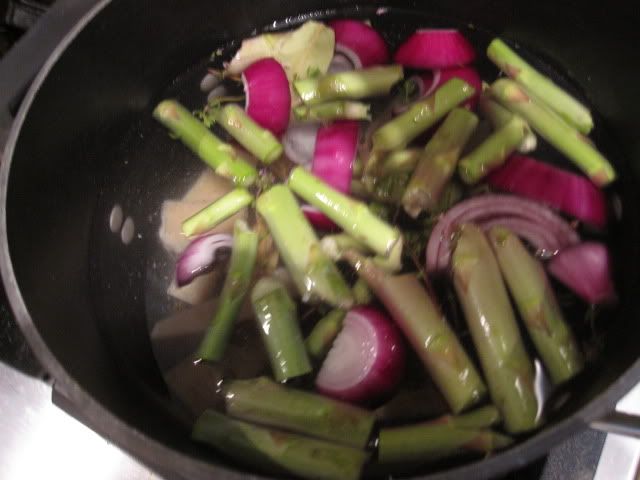
Other ingredients (vermouth--I had no white wine, onions, butter, garlic, lemon zest/juice, parm)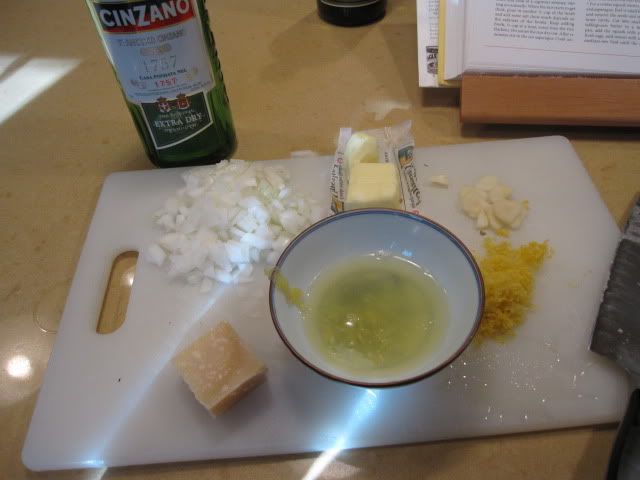
I sauteed the onion and garlic, added carnaroli rice, then gradually added vermouth and simmering asparagus stock (about 4-5 cups total).
I steamed the asparagus (half for about 8 minutes, the other half for 20 minutes) and pureed the very-cooked stuff with a little asparagus stock and olive oil.
I added the lemon zest, lemon juice, a little butter and puree to the finished risotto, seasoned with salt and topped it with the lightly steamed asparagus.
Finished risotto with a little mint and black pepper: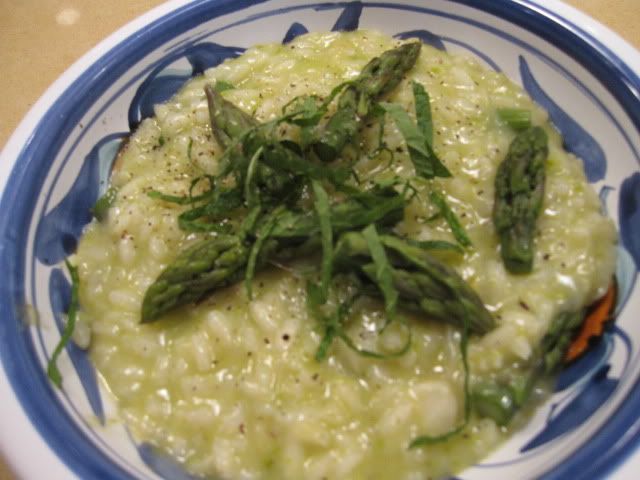
-
-
-
-
Post #24 - June 10th, 2010, 9:48 pmthaiobsessed wrote:From the Kennyz school of asparagus risotto (with a few minor alterations):
Asparagus stock (asparagus bottoms, onion, thyme, parm rinds, bay leaf, few leaves of lemon verbena that happened to be sitting on the counter)
Other ingredients (vermouth--I had no white wine, onions, butter, garlic, lemon zest/juice, parm)
I sauteed the onion and garlic, added carnaroli rice, then gradually added vermouth and simmering asparagus stock (about 4-5 cups total).
I steamed the asparagus (half for about 8 minutes, the other half for 20 minutes) and pureed the very-cooked stuff with a little asparagus stock and olive oil.
I added the lemon zest, lemon juice, a little butter and puree to the finished risotto, seasoned with salt and topped it with the lightly steamed asparagus.
Finished risotto with a little mint and black pepper:
this looks and sounds absolutely lovely--can't wait to try your version!!"Knowledge is knowing a tomato is a fruit; wisdom is not putting it in a fruit salad." Miles Kington
-


