

DIY Cancha -- The Feel-Good Corn Nut
DIY Cancha -- The Feel-Good Corn Nut
-
-
-
-
-
DIY Cancha -- The Feel-Good Corn Nut
-
Post #1 - October 11th, 2007, 10:14 amDIY Cancha (The Feel-Good Corn Nut)
The release of the documentary “King Corn” (reviewed today in the NY Times) had nothing to do with the timing of this post.
I’m trolling the aisles of Casa del Pueblo, and I see an end cap display with bags of big, fat kernels of yellow and red (technically “maize negro”) corn – the same type seen in Mr. Hammond’s Resurrection of Honky Tonk Leftovers. I buy a bag. I’m feeling nutty. Corn nutty, to be exact.

Although I love a good, spicy CornNut, without industrial strength fryers, I think the at-home cook is only capable of producing cancha, the long-lost Peruvian cousin of the commercial CornNut. Not quite the Frito-fied, greasy, salty, crackly through-and-through treat the way a CornNut is, cancha is a cornier snack—more of a semi-popped, old-school healthy-ish version (thus, the “feel-good”).
To roast or fry? was my first question. A cursory search for recipes and hints online for the answer: either. Whatever the cooking method (I tried both), a good soak in water is required. I soaked the kernels for about 20 minutes, but I think a longer dip might produce better results. According to Wikipedia, the commercial CornNut is soaked for three days.

Then, drain and dry the kernels.

To fry: I heated canola oil (enough to fill the skillet by about 1/8”) until shimmering (not smoking) over a medium-high flame, then carefully poured the kernels into the hot oil. It’s tempting to watch the kernels pop and sizzle…until you get hit in the neck with a shower of searing-hot spittles of oil.

A tight-fitting lid is critical for keeping the oil burns to a minimum. And, like making stovetop popcorn, you want to give the skillet a few shakes during cooking -- a far better method than opening the lid, stirring the corn and getting hit with oil and flying kernels. I teach what I learn the hard way.

After 5-10 minutes, the kernels start to brown.

I didn’t time the process, but I’m guessing it took 10-15 minutes total. I gauged by the microwave method—waiting until the sound of popping kernels died down to a few (or no) pops.
Pour the browned kernels over a grease splatter screen set over paper towels and newspaper.

Sprinkle with Tony Chachere’s [SASH-er-eez – for anyone who’s ever been befuddled by the pronunciation of this Louisiana seasoning].

Wait until cooled. Eat. Tasty.

To roast: Pre-heat oven to 400 degrees. Spread kernels on a baking sheet and coat with canola oil.

Shove the baking sheet in the oven. Wait 5 minutes. Realize that the sound of popping and hissing means that the bottom of your oven and broiler will be littered with burnt projectile kernels. Decide to stick it out and see what happens anyway, for the sake of LTH research.
Wait 10 more minutes (until the kernels reach the desired brownness) and remove from oven.

Conclusion: The fried-in-oil stovetop method, while slightly messier and more conducive to injury, produced a crunchier, corntastic cancha. I will soak the kernels longer and fry in a deeper, heavy-bottomed pot next time to keep the splatter down. The oven-roasted kernels were fine, but didn’t achieve the same level of crispiness and had more of a burnt flavor. Even with the fry method, the center of the kernels remain slightly chewy, like popcorn. The longer soak and fry might achieve a closer-to-CornNut level of crunch.
La Casa del Pueblo
1810 S Blue Island Ave
Chicago, IL 60608
(312) 421-4640
-
-
Post #2 - October 11th, 2007, 12:37 pmccrush, I've been thinking about these ever since Salamera closed (she used to sell the bags of corn as well) I'm gonna have to find some and try them out.
Thanks for the empirical testing - my inclination would be to go for oven roasting, but, as you show, why when you can fry?
-
-
Post #3 - June 20th, 2008, 6:41 amRecipe update:
Soak the cancha overnight (or longer--recent batch soaked for two days) in lightly salted water.
Drain and dry. Toss the corn with canola oil.
Roast in the oven at a low 200 degrees for an hour or two. (This seems to dry out the corn slowly, so the center isn't as popcorn-y soft, as in the first recipe). Crank the heat to 400 to finish, about 15-20 minutes. Shake the pan in the oven a few times during the high roast.
Haven't tried the stovetop fry method with the fully soaked kernels, yet.
-
-
Post #4 - July 6th, 2008, 9:49 pmG Wiv wrote:Foreground, Ronnie_Suburban Kalamata olive dip, G Wiv Crrush's cancha
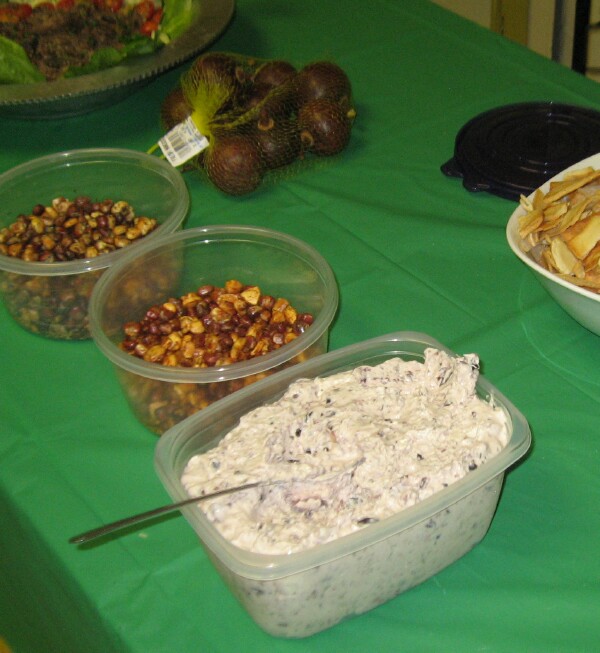
G'Wiv made crrush's cancha for the LTHForum 1,000-Recipe Potluck, June 22, 2008 and took this shot, among others.
-
-
Post #5 - July 8th, 2008, 2:23 pmI feel remiss in not thanking GWiv for the cancha, which I took home (not to mention the two disposable tupperwares
 ) they are very good, crunchy and satisfying - but unfortunately a bit outside my capsaicin-tolerance range. Perfect for spouses and firefighters, though!
-
-
Post #6 - July 8th, 2008, 2:41 pmThis recipe calls for no soaking, and roasting at 300*F i/o frying. I like the looks of the seasoning blend--more salt than heat. And I really like the addition of crumbled, fried cilantro on top. Something to try soon...in all that spare time.
-
-
Post #7 - July 8th, 2008, 4:20 pmMhays wrote:they are very good, crunchy and satisfying - but unfortunately a bit outside my capsaicin-tolerance range.
I liked the flavor but the hardness made me fear for my dental work.
-
-
Post #8 - August 5th, 2008, 9:25 amI had cancha for the first time at a lunch served by some Ecuadorian friends. He served it as a topping for ceviche, just sprinkle it on the top. It was great. It was crunchy and a bit chewy, not hard on the teeth at all like corn nuts. There also seemed to be green scallion tops roasted w/the cancha. Yummy stuff, it was nice to see it here first before tasting in person.