

on the pricing of vegetables at some chinese restaurants
on the pricing of vegetables at some chinese restaurants
-
-
-
-
-
on the pricing of vegetables at some chinese restaurants
-
Post #1 - September 3rd, 2008, 9:58 amLet me preface by noting this is a matter of curiosity, not a critique.
Whilst perusing the menu at Ed's last night, I found myself thinking of the $9.95 eggplant dishes they offer; I found myself thinking of the $8 watercress and $9 pea shoots Sun Wah offers. And then I found myself thinking about the prices at H-Mart recently for such things, all of which were in the $0.79 - 1.99/lb range, IIRC. And I also thought about some of the shockingly low prices at these very same restaurants: $2.95 for two fried fish and corn cakes at Ed's, the $4-5 bbq-on-rice plates at Sun Wah.
So I wondered, "what gives?"
Sure, they fill a large plate, no doubt--but the cost of the produce and the sauce placed on it is not even remotely close to $9. That's steakhouse or haute barnyard prices (i can't remember what I paid for vegetables at Bluck Duck Tavern in D.C. when I was there in June, but I want to say it was $7 for the globe artichokes i had w/ prosciutto). Granted, less product but one could argue a higher quality product justified the charge. In light of what a bargain other things on the menu are at Ed's and SW, I don't understand why the vegetable plates in particular are priced what they are. Anyone know the rationale?
-
-
Post #2 - September 3rd, 2008, 11:01 amA worthy observation. You can throw in the "steamed rib with mashed rice" at Lao Sze Chuan ($4.95), a generous and most succulent portion of beef short rib (I'm about to post on it in another thread) vs. their Baby Bok Choy with Straw Mushrooms ($9.95 with extra mushrooms, the way I like it).
These are only guesses:
- restaurants have a harder time guessing who will order which vegetable; veggies perish faster, so getting just the right level of stock is a struggle, and the cost of lost / unusable produce is built in. Many of the vegetables used in Chinese cuisine are not mass-produced or preservative-pumped like the salad-in-a-bag, celery, carrots, etc. used by some of the chains, which offer cheaper prices and longer shelf life.
- restaurants do check on each other's menu prices, so even those without the above stock management problems are following the market
- Asian-cuisine vegetables are more of a novelty for most diners than are the meats (especially since the majority are ordering familiar things like fried chicken, battered shrimp, and sauteed beef, just with the "new" flavors a restaurant offers), and many restaurant-goers are not also Asian market shoppers, and have no idea what the pricepoints are. Hence, the restaurants know they can charge pretty much what they like (within reason).
-
-
Post #3 - September 3rd, 2008, 11:51 amSantander, I am with you to a point. Chinese people eat in Chinese restaurants, and they know how much veggies cost. I too am very curious to know from a Chinese owner what the reasoning is, I always order some sort of vegetable as a stand alone, mini bok choy with mushroom a favorite, but rarely on a menu, normally you see green beans and broccoli of some sort. Do they think these prices are ok because they are charging for the vegetarian entree? In China, the green vegetable is barely even priced. It's a dollar or two.
-
-
Post #4 - September 3rd, 2008, 12:14 pmGood question. I don't think it has much to do with novelty -- in my observation, things such as ong choy, watercress, yellow chives, and pea shoots are only on offer at relatively "serious" Chinese retaurants, where most of the buyers of these veggies are Chinese. It seems to me that many of the veggies are labor-intense to prepare (you can very often see the matrons at Tank and any number of places on Argyle or in Chinatown picking through green veggies at an out of the way table), and they do not have a long shelf-life.
The restaurants that serve these types of greens also tend to give you a huge portion. The volume of uncooked water spinach/ong choy that results in a big platter of the stuff at Sun Wah is really a lot of plant life.
All of that said, it remains true that the veggies are very, very cheap. Heck, ong choy is a prodigious weed that's almost impossible to eradicate.
I had heard that the veggies are among the "prestige" items on serious Chinese menus, but the comments above about how nominal the veggies' prices are in China make me think that's not really the case.
Interesting to me is the fact that the pho shops meticulously wash and prune any number of delicate, short-lived greens, only to give them away as condiments on the side of a bowl of dirt-cheap soup. Quite a contrast to other parts of the menu where one pays (relatively) dearly to have the same things wok fried with bean paste.
-
-
Post #5 - September 3rd, 2008, 12:27 pmI have to wonder if it's simply the Chinese restaurant equivalent of the fountain soda: a high margin item that allows them to keep other prices on the menu low because people will buy it no matter the price (unless it's obscene). The cost of your fountain soda is almost pure profit, but everybody needs a drink. Similarly, I get the impression that, in China, a meal without some of those simple vegetables is unthinkable. I've had hundreds of meals in China that didn't include any rice. But I could probably count the number of meals that didn't include at least one steamed or stir-fried green vegetable on one hand. And overcharging for an actual prepared dish, no matter how cheap the ingredients, somehow strikes me as less crass than overcharging for rice or tea.
Just a thought. I don't base this on any keen cultural insight.
-
-
Post #6 - September 3rd, 2008, 1:18 pmI agree with the insights in the previous posts. I'm not sure that the vegetables are necessarily more labor-intensive than cleaning tripe, knuckles, other offal, fish (!), lean cuts of meat, etc., but grant that they are certainly more work than rice or noodles, and merit a charge that justifies their preparation.
As for the Asian clientele at the type of restaurants we're talking about: Mandarin and Thai-originating / reading friends swear up and down that many tables aren't ordering from the printed menu (or even the translated or untranslated "Chinese menu" or "Thai menu") but just have casual arrangements with the restauranteurs about what they want, and get better prices, sometimes for smaller portions or similar preparations, sometimes not.
We had a frank conversation with Ben Li (of Double Li) about this, after noticing that the same menu items were on the glossy printed menu and the all-in-Mandarin table tents for two different prices shortly after the restaurant opened. He said that they were intended to reflect entree (glossy) vs. snack (Chinese) portions, but that in reality the kitchen would probably make the same size dish, so he would give us the lower price and probably work to reconcile the menus (not sure if this happened). Lao Sze Chuan similarly initially had much lower prices on hot pot items in Mandarin than in English, and always gave us the Chinese prices since we noticed.
I actually think this can be justified in some cases - glossy 'chef's pride' or 'chef's specials' command a premium when ordered as such, and if you happen to find them elsewhere (or can put the same dish together ordering the two components separately, or get a similar quantity of produce with a slightly different preparation at a lower price), it's a bonus. It's kind of like gaming Burger King with the Rodeo Cheeseburger.* If you're part of the culture, extended family, or can speak the language, so much the better.
While many places don't do anything like this, there is enough anecdotal evidence to suggest that those tables of Chinese and Thai diners might not be paying $9.95 for that celery in ubiquitous white sauce (UWS, cap-tip to stevez/kuhdo), or ordering off the printed menu at all. So there may not be a "gringo tax," but there is a premium for ordering flagship vegetables right off the glossy instead of working your way around ("we'd just like some bok choy in soy sauce on the side, please.")
* you could order onion rings, a tub of barbecue sauce, and a burger with cheese and combine yourself for $3.50, or just get this menu (sometimes off-menu, but they'll make it for you anywhere) item for $1.
-
-
Post #7 - September 3rd, 2008, 3:36 pmAre the cost of ingredients for one of these vegetable dishes that much lower than say in a pork dish? In some cases, I would think the wholesale price difference might only be a buck or two. If you look at Lao Szechuan's prices on their website, their vegetable starts at $8, pork at $9, seafood at $12, which I could believe roughly aligns with wholesale price differences in ingredients.
Especially if you think of the markup (for prep, overhead, etc.) as being fixed per dish (which would make a lot of sense) rather than a percentage markup on ingredients, those prices at least don't seem way out of whack.
-
-
Post #8 - September 3rd, 2008, 3:38 pmJust to add, some of the bargains are perhaps targeting a different customer than the "main" dishes. You most likely wouldn't order the bbq rice plate for family dinner.
-
-
Post #9 - September 3rd, 2008, 3:39 pmIf you look at Lao Szechuan's prices on their website, their vegetable starts at $8, pork at $9, seafood at $12
In the entree categories, at least (and of course all meats are listed under "poultry," long linguistic story on that one). In the "snacks," "very chinese special," and "appetizers" sections, all bets are off. Some of the $2.95-4.95 plates are bigger and more complicated than the $8.95-12.95 ones.
-
-
Post #10 - September 3rd, 2008, 3:55 pmSantander wrote:If you look at Lao Szechuan's prices on their website, their vegetable starts at $8, pork at $9, seafood at $12
In the entree categories, at least (and of course all meats are listed under "poultry," long linguistic story on that one). In the "snacks," "very chinese special," and "appetizers" sections, all bets are off. Some of the $2.95-4.95 plates are bigger and more complicated than the $8.95-12.95 ones.
A fair point, but then the issue is less pricing of vegetable versus other dishes, and more pricing of standard entrees versus the snacks, etc. I fear I don't have a general theory of Chinese restaurant pricing to propose yet.
Another pricing "anomaly" that has struck me is coffee versus latte-type drink prices. There's a pretty big premium in the US for a latte. Not so much in say Japan and (I think) England. One possibility I've been mulling is that it's a function of how much take out traffic there is. There are almost surely somewhat higher costs of making a latte, but if you have mostly drink in business, then proportionally you need to recover more of your overhead costs, which don't vary by type of drink, as opposed to labor costs of making the drink. Another possibility is price discrimination. The question is how to discriminate between the two hypotheses. This is actually a plausible econ research project if anyone is interested.
-
-
Post #11 - September 3rd, 2008, 4:15 pmThis I can speak to: you're mostly paying for milk, which is perishable and a lot of it gets thrown away in the steaming process (you can't get foam from warm milk) and which requires expensive refrigeration (i.e. takes up both real estate and electricity.) Coffee can be made into a vacuum pot and held without electricity; even though it's perishable, considerably less of the portion that's expensive gets thrown away; you also use more ground coffee per drink in an espresso drink. That and you're paying for more labor that's more skilled in an espresso drink vs a drip coffee drink.
Of course, the proliferation of coffee bars and drinks and their status as a luxury item haven't hurt prices, either.
-
-
Post #12 - September 3rd, 2008, 5:07 pmJeffB wrote:It seems to me that many of the veggies are labor-intense to prepare (you can very often see the matrons at Tank and any number of places on Argyle or in Chinatown picking through green veggies at an out of the way table), and they do not have a long shelf-life.
That was my thought as well.
With meat, you just rinse it off, chop it up and cook it.
But vegetables need careful washing to remove dirt or sand. Peapods have to be strung. Greens and pea shoots have to be picked over. Eggplant may need salting or pressing.
-
-
Post #13 - September 3rd, 2008, 5:09 pmHI,
I remember reading a post where the restaurant's owner was the only one who sorted fussy time-consuming vegetables like pea shoots. She felt it was too expensive to pay someone to do it.
In the early 80's, I loved to order the scallion pancakes at Szechuan North on Michigan Avenue. They had a wonderful presentation with a piece of dried ice buried in a statuette providing wisps of smoke. I recall paying around $3 to $5 for this appetizer. I bought a book on Dim Sum to allow me to make it in Moscow. The ingredients: Scallions, hot water, flour, salt and a dab of sesame oil, which I estimated cost of ingredients around 25 cents. As much as I loved this appetizer, I never ordered it again because I wasn't willing to pay 10X to 20X the cost of ingredients.
I have had a similar reaction to the cost of vegetables. Last night I was at Seven Treasures around 11 PM. I ordered Singapore Noodles, then asked for the extra Chinese brocolli for $1.50 from the soup noodle menu. The waiter's first reaction, "I don't know if the computer will allow me to do this. It might cost you more." I responded, "If the charge is $2 or less, then do it." He came back a few moments later to advise the charge would be $2.50. A full order of Chinese brocolli with oyster sauce is around $6.00.
Excessive price for vegetables is not limited to Chinese, just consider the side dishes in steak houses. Asparagus, creamed spinach, hashbrows and double-baked potatoes are pretty pricey when compared to the cost of ingredients.
Regards,Cathy2
"You'll be remembered long after you're dead if you make good gravy, mashed potatoes and biscuits." -- Nathalie Dupree
Facebook, Twitter, Greater Midwest Foodways, Road Food 2012: Podcast
-
-
Post #14 - September 3rd, 2008, 6:17 pmMhays wrote:This I can speak to: you're mostly paying for milk, which is perishable and a lot of it gets thrown away in the steaming process (you can't get foam from warm milk) and which requires expensive refrigeration (i.e. takes up both real estate and electricity.) Coffee can be made into a vacuum pot and held without electricity; even though it's perishable, considerably less of the portion that's expensive gets thrown away; you also use more ground coffee per drink in an espresso drink. That and you're paying for more labor that's more skilled in an espresso drink vs a drip coffee drink.
True, but that certainly doesn't account for the discrepancy in its entirety. When it comes to lattes and such, you're talking about a market that was basically created (large scale, at least) by Starbucks, and while I'm not in Starbucks marketing, were they to speak candidly I'm fairly certain they'd talk about how price is dictated by perceived value rather than actual value. While I'm sure the issues you mention are partially responsible for the difference in cost, I suspect it's determined more by psychology than a balance sheet. You weigh the added profit of higher prices against the sales you lose, find the magical point where you make the most money, and charge that regardless of what the ingredients cost. In the case of lattes, I suspect you have a larger perceived vs. actual value gap as compared to regular coffee. Also see: bottled water.
I doubt this is how most Chinatown restaurants determine their pricing.
-
-
Post #15 - September 4th, 2008, 6:50 amMhays wrote:This I can speak to: you're mostly paying for milk, which is perishable and a lot of it gets thrown away in the steaming process (you can't get foam from warm milk) and which requires expensive refrigeration (i.e. takes up both real estate and electricity.) Coffee can be made into a vacuum pot and held without electricity; even though it's perishable, considerably less of the portion that's expensive gets thrown away; you also use more ground coffee per drink in an espresso drink. That and you're paying for more labor that's more skilled in an espresso drink vs a drip coffee drink.
Interesting, but it doesn't fully answer why there is a premium in the US but not in some other countries.
-
-
Post #16 - September 4th, 2008, 6:55 amCathy2 wrote:In the early 80's, I loved to order the scallion pancakes at Szechuan North on Michigan Avenue. They had a wonderful presentation with a piece of dried ice buried in a statuette providing wisps of smoke. I recall paying around $3 to $5 for this appetizer. I bought a book on Dim Sum to allow me to make it in Moscow. The ingredients: Scallions, hot water, flour, salt and a dab of sesame oil, which I estimated cost of ingredients around 25 cents. As much as I loved this appetizer, I never ordered it again because I wasn't willing to pay 10X to 20X the cost of ingredients.
Not sure why it's the multiple that matters, as opposed to the idea of paying, e.g., a fixed $3/appetizer, $6/entree, above food costs? Especially when you are eating in, the cost of covering rent, waitstaff, "free" items (rice/tea), doesn't vary by type of dish. If someone came in and ordered a bunch of low cost items, their meal might only be a few dollars a person, not enough to cover costs. Not to say that it's priced fully rationally, but also not clear that a multiple is necessarily more rational.
-
-
Post #17 - September 4th, 2008, 8:41 amJeffB wrote:The restaurants that serve these types of greens also tend to give you a huge portion. The volume of uncooked water spinach/ong choy that results in a big platter of the stuff at Sun Wah is really a lot of plant life.
Jeff,
Yes, absolutely. For example, I recently sauteed Swiss char, seemed a lot to start.
Chard
Cut Chard in a 12-inch saute pan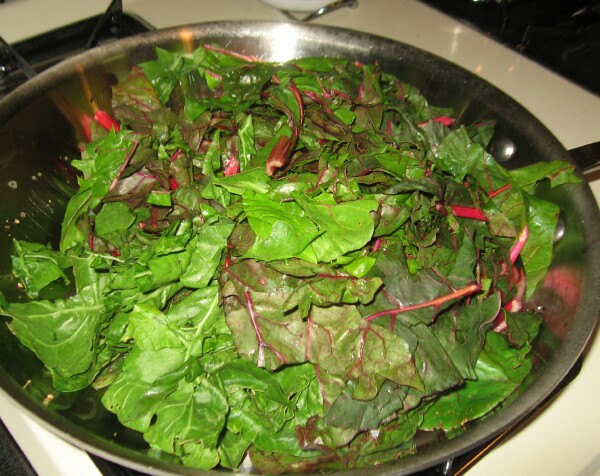
What started as a large amount of chard reduced to fit in a small salad bowl. (I covered chard with tomato instead of plastic wrap or foil to keep warm)
Cooked chard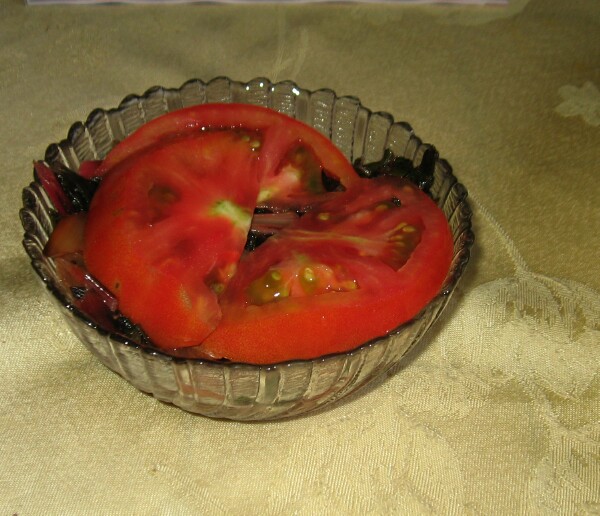
Veg are labor intensive as well.
Pea Shoots at Sun Wah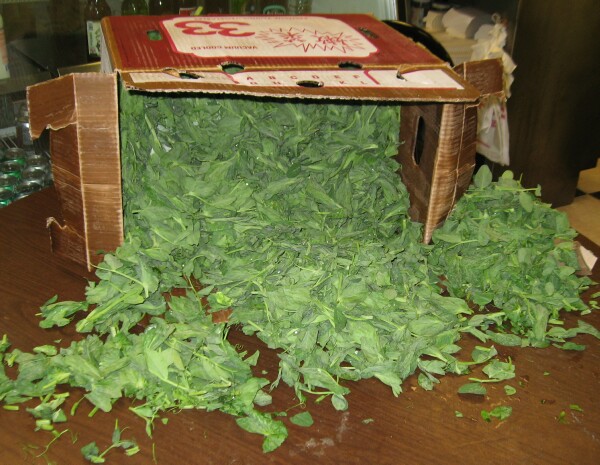
I should note even given the points above, I've occasionally had the same thought as to veg pricing at Chinese restaurants as Chezbrad.
Enjoy,
Gary
-
-
Post #18 - September 4th, 2008, 10:41 amChrisH wrote:Cathy2 wrote:In the early 80's, I loved to order the scallion pancakes at Szechuan North on Michigan Avenue. They had a wonderful presentation with a piece of dried ice buried in a statuette providing wisps of smoke. I recall paying around $3 to $5 for this appetizer. I bought a book on Dim Sum to allow me to make it in Moscow. The ingredients: Scallions, hot water, flour, salt and a dab of sesame oil, which I estimated cost of ingredients around 25 cents. As much as I loved this appetizer, I never ordered it again because I wasn't willing to pay 10X to 20X the cost of ingredients.
Not sure why it's the multiple that matters, as opposed to the idea of paying, e.g., a fixed $3/appetizer, $6/entree, above food costs? Especially when you are eating in, the cost of covering rent, waitstaff, "free" items (rice/tea), doesn't vary by type of dish. If someone came in and ordered a bunch of low cost items, their meal might only be a few dollars a person, not enough to cover costs. Not to say that it's priced fully rationally, but also not clear that a multiple is necessarily more rational.
I understand there are fixed and variable costs associated with the business. I just simply lost interest when I realized how relatively inexpensive this dish happened to be. I am sure I am not alone on having a mental threshold of what I am willing and not willing to pay. This one simply hit me wrong, though I continued to enjoy other items on the menu.
Regards,Cathy2
"You'll be remembered long after you're dead if you make good gravy, mashed potatoes and biscuits." -- Nathalie Dupree
Facebook, Twitter, Greater Midwest Foodways, Road Food 2012: Podcast
-
-
Post #19 - September 4th, 2008, 11:14 amA lot of interesting observations on the psychology/economics of restaurants.
For what it's worth, many years ago when I was an accountant I was told that a rough rule of thumb for the restaurant business was that revenue, like ancient Gaul, was divided into three parts. One third for labor, one third for food, and the remaining third for overhead (rent, supplies, utilities,etc.) and for the owner's pot of gold (or bowl of noodles as the case may be).
These are only approximate numbers which can vary from dish to dish. As was suggested above, higher margins on veggie dishes can help keep other dishes more competitively priced.
Also, with a small owner-operated business a portion of the labor component goes to the owner and family.Where there’s smoke, there may be salmon.
-
-
Post #20 - September 4th, 2008, 11:46 amCharging different prices for the same entree based upon one's lack of knowledge of the language is wrong. Around the country non english speaking business owners have fought to allow foreign language only signs on retail establishments. Yet they have special prices for those who can read chinese, korean and other languages on seperate menus and specials tents? We will not frequent a place that does this.What disease did cured ham actually have?
-
-
Post #21 - September 4th, 2008, 6:38 pmCathy2 wrote:I am sure I am not alone on having a mental threshold of what I am willing and not willing to pay.
I think you just hit the nail on the head. It's all about pricing to what the market will bear, not to production cost.
It's certainly how a lot of pricing in my industry works - we always (at least try to) make sure that we're making money on everything we sell, but some of our products have much higher margins simply because people will pay more for it. IMHO, here's nothing wrong with it, it's a free market; if it isn't worth it to that one consumer, they won't buy it - if it's not worth it to enough consumers, we'll lower the price.
-Dan
-
-
Post #22 - September 4th, 2008, 8:29 pmChrisH wrote:Mhays wrote:This I can speak to: you're mostly paying for milk, which is perishable and a lot of it gets thrown away in the steaming process (you can't get foam from warm milk) and which requires expensive refrigeration (i.e. takes up both real estate and electricity.) Coffee can be made into a vacuum pot and held without electricity; even though it's perishable, considerably less of the portion that's expensive gets thrown away; you also use more ground coffee per drink in an espresso drink. That and you're paying for more labor that's more skilled in an espresso drink vs a drip coffee drink.
Interesting, but it doesn't fully answer why there is a premium in the US but not in some other countries.
Right - but that would be where the luxury item, line-round-the-block, aren't we European stuff comes into play. I would hope that Europeans aren't drinking espresso to appear continental.
Hey, when I ran a cafe for a short while, I charged $1.50 for a bottle of water whose extremely minimal cost I forget - because we had perfectly good filtered tap water you could have free, without even asking (we had a large cooler and cups) I came up with that price (which seemed insane at the time) by shopping around. You'd be amazed how many bottles we sold, even though the cooler was in plain sight and there was an Osco a block away where you could get a case for the same as I paid.
-
-
Post #23 - September 4th, 2008, 9:35 pmIn an otherwise empty, rain-dampened Shui Wah tonight, the staff was cleaning a gigantic box of pea shoots.

The menu board of "Chef's Specials" was entirely in Chinese, and without my hua-savvy dining companions, nobody could translate them for me (the best the waiter could do was to identify "meat" or "fish meat" as the core element of the dishes, which is about what I can do thanks to the McCauley).
I ended up with the "special pork chop in spicy salt with lemongrass sauce" which tasted exactly like lightly-fried Canadian bacon in maple syrup. In fact, it might have been. I think I'm only ever going back there for dim sum.
-
-
Post #24 - September 5th, 2008, 7:06 pmI'll say this - I'm very turned off by, and unlikely to return to, a Chinese restaurant that advertises a meat dish and serves/delivers it with huge chunks of cost-saving, space-occupying, largely tasteless green peppers."Your swimming suit matches your eyes, you hold your nose before diving, loving you has made me bananas!"
-
-
Post #25 - September 5th, 2008, 8:30 pmSantander wrote:In an otherwise empty, rain-dampened Shui Wah tonight, the staff was cleaning a gigantic box of pea shoots.
The menu board of "Chef's Specials" was entirely in Chinese, and without my hua-savvy dining companions, nobody could translate them for me (the best the waiter could do was to identify "meat" or "fish meat" as the core element of the dishes, which is about what I can do thanks to the McCauley).
I ended up with the "special pork chop in spicy salt with lemongrass sauce" which tasted exactly like lightly-fried Canadian bacon in maple syrup. In fact, it might have been. I think I'm only ever going back there for dim sum.
The restaurant is "run" by two different "owners" if you will, during the day and the evening. The AM is a dim-sum operation and in the evenings, it's an entirely different "business." So, by no means should you compare the most excellent dim-sum offerings/chef's skill to what you might expect in the evenings. IIRC, I think the owners "rent" the space to the evening crew to run their business. An interesting arrangement 'eh?
Nonetheless, even if it were the same restaurant, dim-sum chefs are entirely separate in their skillset from "regular" food chefs. Also, in many Chinese restaurants (which are not as busy during the lunch hours), the lunch chef is the less-skilled and one should never order the "fancier" dishes during lunch hours as inevitably it will taste different.
-
-
Post #26 - September 5th, 2008, 8:32 pmIn addition to the previous points that prepping the vegetables can be laborious, I just wanted to add that the
cheap cost of the vegetables in no way guarantees the
quality of the vegetables. Sometimes the reason some of the Asian vegetables are cheap in the markets is because they are old or unusable for restaurant purposes.
Supply can also change. This summer I have seen lychee fruit fluctuate wildly from $1.99 to $4 a pound. That may be an extreme example but I believe the pricing is more due to economics than anything sinister.
-
-
Post #27 - September 7th, 2008, 7:59 amJay K wrote:The restaurant is "run" by two different "owners" if you will, during the day and the evening. The AM is a dim-sum operation and in the evenings, it's an entirely different "business." So, by no means should you compare the most excellent dim-sum offerings/chef's skill to what you might expect in the evenings. IIRC, I think the owners "rent" the space to the evening crew to run their business. An interesting arrangement 'eh?
That's the first time I've heard this. So all of the praise of Sun Wah on this board, its duck, etc., refers to dim sum and lunch?
-
-
Post #28 - September 7th, 2008, 8:10 amLAZ wrote:Jay K wrote:The restaurant is "run" by two different "owners" if you will, during the day and the evening. The AM is a dim-sum operation and in the evenings, it's an entirely different "business." So, by no means should you compare the most excellent dim-sum offerings/chef's skill to what you might expect in the evenings. IIRC, I think the owners "rent" the space to the evening crew to run their business. An interesting arrangement 'eh?
That's the first time I've heard this. So all of the praise of Sun Wah on this board, its duck, etc., refers to dim sum and lunch?
I believe you're confusing Sun Wah and Shui Wah
-
-
Post #29 - September 7th, 2008, 8:15 amThis is an interesting question which I also have pondered on many a dark and lonely night. It makes me nuts when I see tofu, broccoli, and green bean dishes priced the same or higher than shrimp or beef dishes in Chinese restaurants. Also, I can't figure out why pot stickers are so pricey, they can't cost more than a buck to make a half dozen or so.What if the Hokey Pokey really IS what it's all about?
-
-
Post #30 - September 7th, 2008, 8:30 amI don't understand why this is an issue. Prices on various products this morning at Cermak:
boneless, skinless, chicken breast: $1.99/lb
boneless, skinless chicken thigh:$1.19/lb
flank steak: $2.29/lb
pork "stew meat": 1.29/lb
broccoli: $1.99/lb
green beans: $1.49/lb
tofu: $2.79 for a 12 oz package
shitake mushrooms: $6.99/ lb
In many cases, vegetables simply cost more than meat....defended from strong temptations to social ambition by a still stronger taste for tripe and onions." Screwtape in The Screwtape Letters by CS Lewis
Fuckerberg on Food


