

Help- Lumpy Mac and Cheese
Help- Lumpy Mac and Cheese
-
-
-
-
-
Help- Lumpy Mac and Cheese
-
Post #1 - July 8th, 2008, 12:54 pmI am hoping you can tell me what I may have done wrong.
In an attempt to cut down on my family's intake of processed foods... I made my first attempt at stovetop mac and cheese last week and it turned out lumpy...like the cheese "broke apart" from the sauce.
I made a cheese sauce of flour, butter, milk, and cheese...then added the cooked macaroni.
Where did I go wrong? It tasted good and the kids didn't mind but...
Thanks for any assistance.
-
-
Post #2 - July 8th, 2008, 1:01 pmYou have to make the sauce like a bechamel, in the right order, or it will break/lump.
Melt the butter, add the flour and cook it over a medium heat for a few minutes, stirring out any lumps. Then, slowly whisk the flour [edit: milk, not flour] in, and continue stirring until there are no lumps and the sauce thickens. Remove the sauce from the heat, then fold in the grated cheese.Last edited by crrush on July 8th, 2008, 2:42 pm, edited 1 time in total.
-
-
Post #3 - July 8th, 2008, 1:29 pmThanks for the help! My kids LOVE mac and cheese and I am trying to steer clear of the boxed variety.....
Can I add too much cheese? Can that also effect the texture?
-
-
-
Post #4 - July 8th, 2008, 1:29 pmcrrush wrote:Then, slowly whisk the flour in, and continue stirring until there are no lumps and the sauce thickens. Remove the sauce from the heat, then fold in the grated cheese.
You mean slowly whisk the milk in, I'm sure.
Also, add the grated cheese a little at a time and stir till it's completely combined in the bechamel, then add another handful and stir again until the sauce is your desired cheesiness. As crrush said, add the cheese off the heat. Adding while on the heat can lead to the problem you described in your OP.Steve Z.
“Only the pure in heart can make a good soup.”
― Ludwig van Beethoven
-
-
-
Post #5 - July 8th, 2008, 1:38 pmstevez wrote:You mean slowly whisk the milk in, I'm sure.
Yep.
-
-
-
Post #6 - July 8th, 2008, 2:54 pmLTH,
There have been several previous discussions here on mac n'cheese presenting different approaches to the dish. My go to version has always been a bechamel enriched with cheddar, but I've played around also with velveeta melted into milk, half real cheese/half velveeta melted into milk, etc... I seem to remember Gary posting a N.Y. Times recipe which I believe called for raw macaroni...(?)...that looked interesting.
I was taught to strain most sauces through a china cap or a chinoise, which give the cook an insurance policy, so to speak. By straining your sauce before mixing in the macaroni, the dish is pretty much going to be lump free. "Bass Trombone is the Lead Trumpet of the Deep."
Rick Hammett
-
-
-
Post #7 - July 8th, 2008, 3:01 pmGimme a minute, folks - I've got the pictures all taken and the recipe written down....get right back to you...(thanks for giving me a place to put it!)
-
-
Post #8 - July 8th, 2008, 3:22 pmAlton Brown also has a stove-top method involving eggs and evaporated milk, not a bechamel. I think it's fairly delicious.
here's the link.
-
-
Post #9 - July 8th, 2008, 4:22 pmOK...I just gave the same recipe another try...thsi time no lumps but...this time a grainy texture????
Where am I going wrong?
Whi knew Mac and cheese could be so complicated???
-
-
Post #10 - July 8th, 2008, 4:36 pmPBandFluff wrote:Where am I going wrong?
Maybe the roux/milk sauce was too hot when you added the cheese? Cheese will seize (hey!). Be sure you remove from heat before adding the cheese, and maybe let it rest a few minutes before blending in small batches of the grated cheese, as stevez suggested.
-
-
-
Post #11 - July 8th, 2008, 4:46 pmPBandFluff wrote:OK...I just gave the same recipe another try...thsi time no lumps but...this time a grainy texture????
Where am I going wrong?
Whi knew Mac and cheese could be so complicated???
What kind (including brand) of cheese are you using?Steve Z.
“Only the pure in heart can make a good soup.”
― Ludwig van Beethoven
-
-
-
Post #12 - July 8th, 2008, 4:52 pmEvil Ronnie wrote:I seem to remember Gary posting a N.Y. Times recipe which I believe called for raw macaroni...(?)...that looked interesting.
No, the mac is cooked in that one, but you just toss all the other stuff together instead of making a sauce -- and it uses a heck of a lot of cheese. Of course, since it's Gary's version, it also has habanero sauce in it. Crusty macaroni and cheese
In the original Times article, however, there is not only the un-Wiviottized version of the crusty mac and cheese, but a creamy one made with cottage cheese that uses uncooked macaroni.
The author quotes John Thorne:A good dish of macaroni and cheese is hard to find these days. The recipes in most cookbooks are not to be trusted...usually it is their vexatious infatuation with white sauce, a noxious paste of flour-thickened milk, for this dish flavored with a tiny grating of cheese. Contrary to popular belief, this is not macaroni and cheese but macaroni with cheese sauce. It is awful stuff and every cookbook in which it appears should be thrown out the window.
She also comments on cheese:Ultimately, I found, the dirty little secret of an honest macaroni and cheese is often American cheese.
American cheese is simply cheddar or colby that is ground and emulsified with water, said Bonnie Chlebecek, a test kitchen manager at Land O'Lakes in Arden Hills, Minn.
"The process denatures the proteins in the cheese," she said, "which in plain English means that it won't clump up or get grainy when you melt it. With natural cheese, it's much harder to get a smooth melt." The cheese industry and the Food and Drug Administration call a cheese "natural" if it has been produced from milk, as cheddar and mozzarella (and virtually all other nonindustrial cheeses) are.
Plain American cheese, labeled pasteurized process cheese, contains the most natural cheese and is the best for cooking. American cheese derivatives are made from cheese and additives like sodium phosphates (acids that promote melting), nonfat dry milk and carrageenan. In descending order of their relationship to natural cheese, they are cheese food, cheese spread (such as Velveeta) and cheese product.
-
-
Post #13 - July 8th, 2008, 4:58 pmMaybe the sauce was too hot when I added the cheese...I didn't wait too long before I added it.
I am using Kraft sharp cheddar (figured I would use Kraft until I mastered the technique then branch out to more expensive types).
Thanks MHays for the addition of the "People don't cook anymore" link....so true. I was never "trained' in the cooking area so I am learning as I go. I have done fairly well in the baking area but as far as "cooking" I have a ways to go . As I mentioned before, I am trying to get away from a lot of processed foods (IE the kids' fave mac and cheese that they consume large amounts of) so I have a lot of trials and errors ahead of me.....
Just thought of this...this is a stovetop recipe...not baked.
Thanks again to everyone for your thoughts/ideas!
-
-
Post #14 - July 8th, 2008, 5:06 pmPBandFluff wrote:I am using Kraft sharp cheddar (figured I would use Kraft until I mastered the technique then branch out to more expensive types).
Would the high water content in Kraft cheese make it grainier in the sauce? Anyone? Anyone?
-
-
Post #15 - July 8th, 2008, 5:12 pmcrrush wrote:Would the high water content in Kraft cheese make it grainier in the sauce? Anyone? Anyone?
Read up two posts. Any natural cheese can be grainy in a sauce.
In my experience, high-moisture cheeses melt best.
-
-
-
Post #16 - July 8th, 2008, 5:16 pmcrrush wrote:PBandFluff wrote:I am using Kraft sharp cheddar (figured I would use Kraft until I mastered the technique then branch out to more expensive types).
Would the high water content in Kraft cheese make it grainier in the sauce? Anyone? Anyone?
That was my initial thought. Not nesessarily the water, but perhaps some other additive, but I never use the Kraft stuff, so I don't know for sure.Steve Z.
“Only the pure in heart can make a good soup.”
― Ludwig van Beethoven
-
-
-
Post #17 - July 8th, 2008, 5:37 pmThis article suggests that fresh milk may also contribute to graininess, as well as natural cheese:After testing the recipe with whole and low-fat milk as well as with half-and-half, I realized that evaporated milk was not an unconsidered holdover. All the macaroni and cheeses made with fresh milk curdled a bit, resulting in a chalky, grainy texture. The one made with evaporated milk was always smooth, undoubtedly because the evaporation and sterilization process stabilizes the milk....
To my surprise, highly processed cheeses like American performed quite well in this dish. As with the evaporated milk, more processing produces a more stable cheese and hence a creamier dish. For flavor, use cheddar; for texture, buy American....
-
-
-
Post #18 - July 8th, 2008, 6:08 pmLAZ wrote:This article suggests that fresh milk may also contribute to graininess, as well as natural cheese
Nonsense. Proper technique will produce a smooth sauce using fresh milk every time.Steve Z.
“Only the pure in heart can make a good soup.”
― Ludwig van Beethoven
-
-
-
Post #19 - July 8th, 2008, 7:49 pmhmm...i make cheese sauce a lot for potatoes au gratin (it's essentially the same thing) and I don't ever get a grainy thing unless I add bad parmesan (cheap domestic parmesan, I should say). And I make the sauce in the microwave usually -- my mom taught me to make it like that and while I can do it on the stove, it's never burns in the microwave!
I would use good quality cheese no matter what because the taste is better. That's not so say use aged english cheddar -- it just means use full fat, not reduced fat, decent cheese. I like a sharp cheddar because i love the taste of it.
I'm sure there's scientific reasoning here...but i'm no Harold McGee.
-
-
Post #20 - July 8th, 2008, 8:09 pmOver on another website from scott123 there was a very similar query to yours. I found one person's answer chuck full of applicable information:It curdled.
Curdling can be avoided a few ways, only one of which involves heat.
1. Use 'fresh,' somewhat recently purchased, unopened cheddar. Opened cheddar that's been in your fridge for months on end has a tendency to dry out/be harder to melt/have a greater propensity for curdling.
2. Use whole milk. Fat is a stabilizer. Skim milk/1%/2% produces sauces that are more likely to curdle. If you want to hedge your bets even further, add some cream. 2 T. cream for every C. of milk is about as much cream as you want to use. Milkfat has a tendency to mask flavor. Too much cream and you'll start impairing the cheesy taste.
3. Use very low heat to melt the cheese. Grate the cheese to facilitate melting and make sure your sauce never comes close to a boil. Remove the simmering bechamel from the heat and let sit briefly before adding the cheese.
4. Simmer your bechamel for at least 7 minutes before adding the cheese and whisk vigorously. This helps the starch granules swell/break down, and, in turn, do a better job of stabilizing.
5. Add a slice or two of a good brand of American cheese. I use Kraft deli deluxe. American cheese contains ingredients that facilitate better melting/stability. American cheese is so stable that, as far as I know, it can't be curdled.
Roux should always be equal parts butter and flour. Bechamel is traditionally
2 T. flour
2 T. butter
1 C. milk
but since cheese provides a good deal of thickening, a thinner bechamel is required.
1 T. flour
1 T. butter
1 C. milk
works well for me.Cathy2
"You'll be remembered long after you're dead if you make good gravy, mashed potatoes and biscuits." -- Nathalie Dupree
Facebook, Twitter, Greater Midwest Foodways, Road Food 2012: Podcast
-
-
Post #21 - July 8th, 2008, 8:45 pmOK, here goes:
Sparky's Magical Mac and Cheese Recipe
1/2 lb dry pasta of your choice
1/2 stick (1/4 cup) butter + 1 tbsp
1/4 cup minced onion
1/2 tsp salt
1/4 tsp ground pepper
1/4 cup all-purpose flour + 1 tbsp
1 3/4 cups milk
1/4 cup beer (ale)
8 ounces of cheese, about 70—80% cheddar for flavor, but with a smaller amount of melting cheese: American slices, Monterey jack, Queso Quesadilla, cut into 1/2 inch pieces (I often throw in more cheese if it's around)
Panko
Parmesan cheese
Shredded cheddar or Potato chips
Melted butter
1. Read your recipe carefully before you start.

2. Cook pasta according to package directions, using the smallest suggested amount of time. Rinse with cold water to stop the cooking and set aside. (Ideally, if you prep and measure your sauce ingredients, you should be able to make the sauce as the pasta is cooking, so that it gets sauced shortly after rinsing)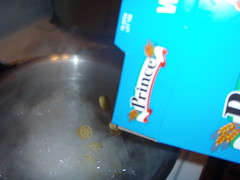
3.Make a roux:
a) Add onions to butter and sauté in a saucepan until the bubbles almost disappear.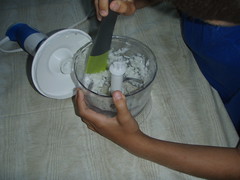
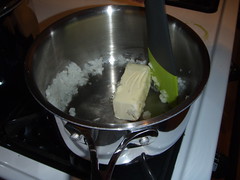

b) Add salt, pepper and flour, whisking or stirring until the mixture is nutty-smelling and thickly combined and slightly golden in color.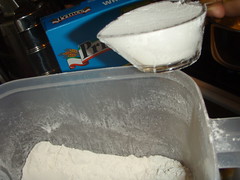
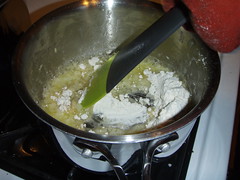

4. Make a Mornay Sauce
c) Add milk and whisk over medium heat until thickened (this will happen when it begins to boil.) Add beer and mix thoroughly.
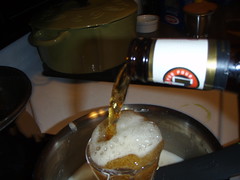
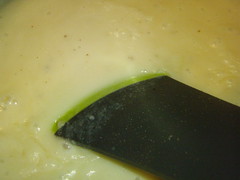
d) Remove from heat and when all boiling has stopped, slowly mix in cheese, whisking until completely melted. I found that the first time I successfully made Mac & Cheese (as an adult, aided by my Grandmother-in-law's Betty Crocker cookbook; all the classier recipes I used failed) the cubed, rather than shredded, cheese was crucial - I think it helps cool your sauce a bit. I've since graduated to shredded cheese:
5. Pour pasta into a large casserole and stir in cheese sauce.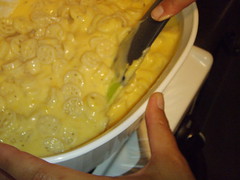
Top with a mixture of panko, parmesan cheese and crushed potato chips or cheddar and brush with butter.
Bake in a 375 degree oven for 20 minutes, or until the sauce bubbles and the topping is browned (don't ask me why it doesn't curdle in the oven, but mine doesn't.)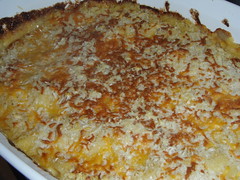
Serves 8.
Sparky's mac and cheese was served with beets he had helped to sow, and peas he'd helped to pick - thus an all-Sparky meal: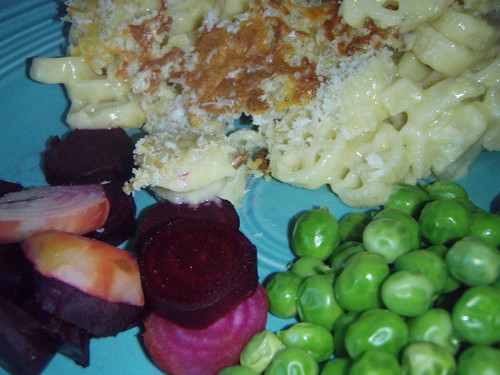
FWIW, I often use Kraft sharp cheddar; I'm sure a better, more aged cheddar would make a tangier sauce (though I agree, it's probably trickier to work with) but generally, I'm making this for an 8-year-old who's fine with the cheaper cheese. We've done this together twice - the first time, we used a 2/3 of a brick of cheddar and 4-5 American cheese slices; this time we used shredded bagged cheddar and 1/3 of a brick of Colby Jack - IMHO, I think the Cheddar/American version had a better texture. Why do cheese sauces break, or separate into lumps and liquid? My guess - because the acids used to solidify the protiens in milk are present in cheese, and activate near the boiling point - you wind up with homemade cottage cheese if you allow a mornay to get too hot without other stabalization.Last edited by Mhays on July 9th, 2008, 1:51 pm, edited 1 time in total.
-
-
Post #22 - July 8th, 2008, 11:53 pmearthlydesire wrote:I make the sauce in the microwave usually -- my mom taught me to make it like that and while I can do it on the stove, it's never burns in the microwave!
Would you post your recipe? I'm always interested in good microwave recipes.
-
-
-
Post #23 - July 9th, 2008, 8:08 ammichelle, the only thing i would suggest about your recipe, is it's better to make the cheese/sauce before cooking the pasta. i boil the water while making my sauce but dont cook the pasta till the sauce is done. there isn't any good reason, IMO, to ever let pasta sit cooling, unsauced. justjoan
-
-
-
Post #24 - July 9th, 2008, 8:26 amYes, indeed - though it doesn't read as such and I should probably change that, I do it simultaneously as long as everything is measured, prepped and ready to go - meaning that you can easily make the sauce in about 8-10 minutes while the pasta is cooking.
I usually do rinse the pasta anyway, so that it cools a little and doesn't come out mushy after going in the oven.
-
-
Post #25 - July 9th, 2008, 8:37 amLAZ said:Would you post your recipe? I'm always interested in good microwave recipes
Wow...posting a recipe for my microwave bechamel. I have to say, it's so instinctive that I simply do it -- you know? So...here's kind of a narrative recipe, if that helps.
You take 1/4 cup of butter and melt it in a large pyrex measuring cup -- i think i use the 4 cup version. That's usually about a minute at high temp (i don't generally deal with changing my microwave's temperature unless i'm defrosting). Then you take 1/4 cup of flour and stir it in very well until you get a paste and then put it back in the microwave for a good minute or 2 -- usually stopping in every minute or so and stirring it back up -- you still want to cook the flour taste out of the butter, just as you would on the stove. The butter/flour roux will sort of puff up so you need to stir it down. Then when it has the right roux-ian consistency, start to pour some of the 2 cups of milk (or other milk product depending on the quality of the sauce you want to make -- i've used half n half and half milk, etc.) that you have reserved for the sauce. i generally will add about half the milk and stir it really well and then put it in the microwave for about 2-3 minutes...take it out and stir it again and add the rest of the milk. Put it back in the microwave for another 3-4 minutes until it gets that "coat the back of your spoon" consistency. Then...i add whatever shredded cheese I've got waiting for the sauce -- stirring it into the hot bechamel -- usually it's a mix of sharp white cheddar, parmesan, occasionally gruyere. It's usually at least 8 plus ounces of cheese -- probably more like 10-12 with other cheeses added. Then...i season it with some salt, pepper and occasionally garlic pepper.
On the garlic front -- my mother will add crushed garlic to the roux stage and then make the sauce from there. I don't like the crushed garlic taste heated in the microwave -- for some reason, i need a stove top for that.
Anyhow...after I add and stir the cheese -- i put it back in the microwave for another minute or so just to incorporate the cheese -- you could lengthen this step if you wanted to but by this time, I generally want to get on with it.
I have probably been pretty generous on timing here -- i think it goes pretty fast like this and the one caveat i would add is that if you dont' watch the roux stage coupled with the first initial milk stage -- it can get so thick that you can't ever recover from it. But that hasn't happened to me in a long time since I pretty much can do this in my sleep.
Hope this is clear, LAZ! Feel free to ask me any questions you need to ask.
What's funny is that if i'm making a sauce with chicken broth instead of milk, i almost ALWAYS do it on th stove. It's basically the same technique with a different liquid.
Silly me.
-
-
-
Post #26 - July 9th, 2008, 6:12 pmVelveeta is the Universal Solvent. 15-20% Velveeta and you can do absolutely any dang thing you want otherwise, and it'll still work. Trust me on this. (Altho' I must admit that I learned it from New York Times and Cook's Illustrated sure as shootin'. So I take no kudos for the recommendation. :^)
GeoSooo, you like wine and are looking for something good to read? Maybe *this* will do the trick!
-
-
-
Post #27 - February 15th, 2009, 6:01 pmProblem: my roux turned into a thick dough like consistency. Is this because I added the flour too quickly? I need it more creamy. The mac n cheese was still tasty but it could've been creamier.
Essentially, I want to recreate Kuma's Corner's mac n cheese. They broil theirs briefly for a crunchy top but they don't bake it. It's all done quickly in a frying pan and broiler I believe (from what I could see over the counter). Any help would be appreciated.
-
-
Post #28 - February 15th, 2009, 6:41 pmI think if your roux is too thick you should just thin it out more with added liquid -- more milk or whatever you're using as the dairy portion of the bechamel. Maybe you should make it more slowly and watch the consistency as you go. It's not something you can just leave on the stove, I think. The butter/flour mix can get really doughy -- but if you slowly add the milk and let it cook for a good amount of time -- you can control the thickness very well. At least that's my experience.
I've also found that you really need to make more sauce than you think you're going to need. I've had way too many mac and cheeses that are far too dry -- so doubling your sauce seems to help a lot on that level.
Martha Stewart's mac and cheese recipe calls for an enormous amount of sauce to a lb of pasta -- but it definitely is the right consistency when you're finished with it.