

Need advice re POLENTA
Need advice re POLENTA
-
-
-
-
-
Need advice re POLENTA
-
Post #1 - March 2nd, 2009, 12:29 pmHaving checked various recipes for polenta, I am wondering ..
I have seen various types of cornmeal in the supermarket (Quaker, most frequently) but quite different brands and packages at hispanic groceries. (Maize?)
........Is there a difference?
Does anyone have a preference for a specific brand or type?
Any other advice on making polenta?
Many thanks in advance
Berns
READ ON .... 12/18/09:
After putting to work a lot of the great advice outlined below, my fav now is:
using a crockpot
substituting 50% of the water with broth and or milk
substituting 50% of the cornmeal with baked mashed sweet potatoes (in this case instead of 2 c of cornmeal I used only 1 cup plus 2 ea med-lage sweet potatoes).
If you really want to lush it up, cut up some fried Italian sausage (turkey or regular) and mix it in before serving or before chlling - if frying off squares.
Bon Appetit!!!
BernsLast edited by berns on December 18th, 2009, 12:09 pm, edited 1 time in total.
-
-
-
Post #2 - March 2nd, 2009, 12:37 pmBasically you want to look for something in which the only ingredient is cornmeal. (Polenta refers both the finished dish, as well as the primary ingredient -- i.e. cornmeal). I usually opt for coarse ground, but sometimes use more finely ground. I avoid the pre-cooked (i.e. instant) cornmeal.
I recently bought some at the Green City Market. Otherwise, Bob's Red Mill is good (it's usually near the flour) as is the stuff in the bulk section at Whole Foods.
I'm sure there is similar stuff in the Mexican food section also. Goya makes coarse ground cornmeal. Note that Masa Harina is cornmeal that is treated with lime and is therefore slightly different than plain cornmeal.
The basic recipe I use to cook it is to simmer 1 cup in polenta in about 3-4 cups of water. You can substitute some of the water with milk. Add generous pinch of salt. Bring to a boil, reduce heat to a simmer, stir constantly, and simmer until the water is absorbed. The more liquid you use, the more tender the polenta will be. (The traditional recipe indicates that you have to keep stirring. I find that you don't really have to do this. A good stir every 5 minutes or so will be fine and keep the polenta from sticking to the bottom of the pot.) When it is ready, add stuff, like grated Parmesan, butter, cayenne, etc.
-
-
-
Post #3 - March 2nd, 2009, 12:47 pmBob's Red Mill is what I use. I would not use anything generically labeled as corn meal. It needs to be a little coarser IMO.i used to milk cows
-
-
Post #4 - March 2nd, 2009, 1:28 pmberns wrote:Any other advice on making polenta?
Just bought polenta Friday, .35c /lb at J.P. Graziano, which Antonius called "best kept secrets of Chicago's Italian community".
Enjoy,
Gary
J.P. Graziano
901-905 Randolph Street
Chicago, Illinois 60607
312-666-4587
312-666-4604
Monday-friday: 7:30 - 3:30
Saturday: 8:00 - 12:00
-
-
Post #5 - March 2nd, 2009, 6:42 pmMy thanks to Darren72 for the detailed response and all of you for putting me on the right track.
Can't wait to try making some Polenta now.
Berns
-
-
Post #6 - March 2nd, 2009, 7:24 pmAnd thanks for the idea - made fried polenta squares for dinner tonight!
-
-
-
Post #7 - March 2nd, 2009, 7:47 pmGlad to help. Report back on how it turned out.
One thing that I forgot to mention: you can also use stock in place of water. You can also add a pinch of sugar if you want to accentuate the sweetness. Polenta is really versatile.
-
-
-
Post #8 - March 2nd, 2009, 11:58 pmRegarding cooking time: not that most people have the time for it on an every day basis but for special occasions and/or really amazing polenta do yourself a favor and cook it for 3 to 4 hours over low steady heat. It's a completely different dish--you get some really lovey roasted/caramelized corn flavors you just never get on a quicker cooking time.
I picked up this trick in Bill Buford's book "Heat." Chapter 14 is more or less completely dedicated to anecdotal stories about cooking polenta. Much is made of the fact that, at Babbo, one of the biggest kitchen sins was forgetting to start the polenta early in the afternoon. Ideally, it was meant to cook for at least 3 or 4 hours by the time dinner service rolled around. Instant quick cooking polenta was on hand only in the event of an emergency, i.e, someone forgetting to start the day's batch early enough.
If you cook it this way, you don't need to stir it very much as it cooks--just add the occasional splash of hot water and give it the occasional stir as you go about the rest of your business in the kitchen. The abbreviated recipe (if you can call it that) from Buford in Heat is as follows:
"Polenta, cooked slowly for three hours, expands to about six times its original volume, so if you're making some for eight people . . . you want to start with about a cup. . . The amount of water doesn't matter, because you're going to add more than is worth measuring: you just want to make sure the water is hot so the cooking is steady. "
Obviously, the ordinary rule of thumb of whisking the cornmeal in quickly when it first goes into the boiling water still applies. The guiding premise to the cooking process from then on is to keep the polenta wet enough so that it looks like bubbling lava while it cooks. I should note, though, that if you add too much water too often, you'll reduce the opportunity for that all important roasting/caramalization magic to happen.
I usually finish mine by folding in a little butter, some parmesan or pecorino cheese and drizzling some good extra virgin olive oil over the top.
I agree with GWiv that Graziano's is the place to get it. Their Italian supplies are fantastic, second to none and a real bargain. I've found their cornmeal to be of a higher quality and better taste than anything else I've used. As a slight aside, lately I've been on a red lentil kick and the lentils they sell there are of unparalleled quality, as are all their beans, really. Jim (the proprietor) really knows his stuff and is incredibly knowledgeable and helpful regarding everything in the store. I usually go in there twice a month expecting to buy one thing and end up walking out with five or ten things. On that note, the last plug I'll put in for Graziano's is the olive oil they've been selling there. It's called Salvati and it's a beautifully intense unfiltered extra virgin olive oil. It's worth the trip all on its own.
-
-
Post #9 - March 3rd, 2009, 10:16 amMrBarossa wrote:do yourself a favor and cook it for 3 to 4 hours over low steady heat
do you think this could be done in a crock pot?
-
-
Post #10 - March 3rd, 2009, 10:30 amMrBarossa wrote:Regarding cooking time: not that most people have the time for it on an every day basis but for special occasions and/or really amazing polenta do yourself a favor and cook it for 3 to 4 hours over low steady heat. It's a completely different dish--you get some really lovey roasted/caramelized corn flavors you just never get on a quicker cooking time.
I too have heard great things about cooking polenta for 4 hours, though I have yet to try it. The one tip I have is that if you have a heat diffuser for your burner, you might want to use it to keep the simmering under control.
-
-
Post #11 - March 3rd, 2009, 2:02 pmsarcon wrote:MrBarossa wrote:do yourself a favor and cook it for 3 to 4 hours over low steady heat
do you think this could be done in a crock pot?
The first question is whether your crock pot gets hot enough to get the water boiling and keep the polenta bubbling in its "lava" stage. If it does, then I don't see any reason why it should be treated differently than any other cooking vessel placed over low steady heat. Certainly that would save you a burner on the stove.
If, however, you're thinking about using the crock pot in the sense of whisking the polenta in, putting a cover on it and walking away for 4 hours (i.e. ordinary crock pot slow cooking), I don't believe that will work. The polenta needs to cook uncovered, water needs to be added periodically and it needs to be stirred occasionally. To the best of my knowledge, you want the process of stirring and adding water to slightly caramelize some of grains at the bottom of the pan to give it that roasty toasty flavor. Stirring reincorporates this goodness into the rest of the polenta and prevents burning/sticking. If you just let it sit unstirred and covered in a crock pot with a lot of water and little or no water evaporating, you're just making polenta "soup" because the grains are fully suspended in water thus negating the opportunity for caramelization that the process affords you. Buford writes about other chemical and structural changes that happen over the course of 4 hours, but I think this aspect is critically important.
Despite the "no fuss" aspect of this recipe, I did find it took a little practice to get it right. The first time I used this method I was afraid of the polenta burning and definitely fussed with it too much by stirring too frequently and adding too much water. I recognized my failure when I tasted the polenta and didn't notice an appreciable difference in flavor over a 20 minute cook time. I've since become more comfortable with what "looks" and feels right and just letting the thing go.
-
-
Post #12 - March 3rd, 2009, 2:43 pmMrBarossa wrote:On that note, the last plug I'll put in for Graziano's is the olive oil they've been selling there. It's called Salvati and it's a beautifully intense unfiltered extra virgin olive oil. It's worth the trip all on its own.
Mr B,
Agree on Salvati, intense, fragrant, liter for $10.95 placing it in the exceptional value category that is a hallmark of Graziano's.
Enjoy,
Gary
-
-
Post #13 - March 3rd, 2009, 4:51 pmMichael Chiarello just today did a "Polenta Party" at the climax of which he poured a two-gallon pot of cooked polenta onto two giant cutting boards set on the dining table. He invited guests to rake a puddle of polenta toward them and add the provided toppings and sides and eat it off the cutting board.
Not saying you need to do it that way, but he provided a detailed polenta recipe, which included putting some masa haring into the coarse-ground polenta meal for a smoother texture.
MikeSuburban gourmand
-
-
Post #14 - March 5th, 2009, 12:25 pmHere is a great side dish recipe for polenta:
http://www.recipe4living.com/Recipe/55854-PolentawithGoatCheeseandPineNuts.aspx
[img]
http://www.recipe4living.com/uploadedim ... ta_190.JPG[/img]
A tasty side dish that really hits the spot.
Ingredients
1 log pre-cooked polenta
1/2 log goat cheese
1 handful pine nuts, toasted
Oil for frying
Directions
Slice polenta into circles about 1/2-inch thick. Place in fry pan with oil and cook for about 30 minutes, turning once. Make sure both sides are brown and crispy. Plate slices and crumble goat cheese on top. Add pine nuts and serve.Hillary
http://chewonthatblog.com <--A Chicago Food Blog!
-
-
Post #15 - September 28th, 2009, 8:21 pmG Wiv wrote:Just bought polenta Friday, .35c /lb at J.P. Graziano, which Antonius called "best kept secrets of Chicago's Italian community".
Picked up a bucks worth of polenta last week and thought I'd take a break from pizza and make polenta, pan fried polenta topped with browned sage butter inspired by KennyZ's sweet potato gnocchi w/browned sage butter
Sage, tomatoes and green pepper grown by MsWiv
Polenta, cooked, cooled, lightly dusted w/flour, pan fried
Served with Omaha strip steak, we are still working thought a gift of Omaha steaks, peppers, tomatoes and polenta topped with sage browned butter.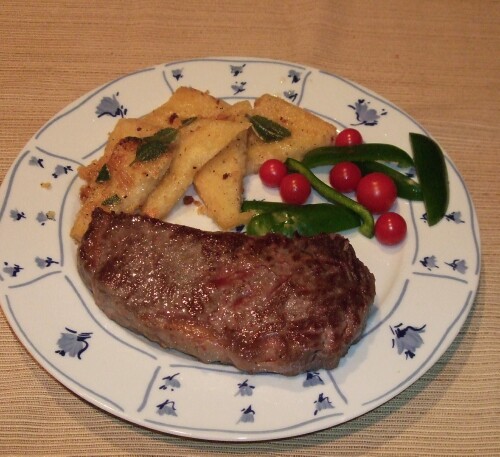
Thanks for the sage brown butter inspiration KennyZ.
Enjoy,
Gary
-
-
Post #16 - September 28th, 2009, 8:31 pmLooks quite good, Gary. I'm especially enamored by the current edition of the green pepper garnish
 ...defended from strong temptations to social ambition by a still stronger taste for tripe and onions." Screwtape in The Screwtape Letters by CS Lewis
Fuckerberg on Food
-
-
Post #17 - October 1st, 2009, 1:50 pmI checked my "Silver Spoon" Italian cookbook and they mentioned the following:
-There are two common types of polenta - fine grain (pale, straw colored Veneto polenta) and large grain (bright, golden yellow Lombard or Piedmontese polenta).
-The fine grain is almost always served "all'onda" - literally "with wave" - think mashed potatoes
-The large grain is almost always firm.
-Both polentas are stirred in a copper pot with a soft wood stick, traditionally over the flames of an open fire.
-Apparently, in today's kitchen, it can be prepared in an electric, copper polenta pot.
-There is a third kind of polenta flour, buckwheat, which is used to make polenta taragna.
One of the best looking polenta dishes in this book is the polenta with shirred eggs. It is exactly as it sounds - polenta with a nice egg on top (yolk oozing over the polenta).
-
-
Post #18 - October 1st, 2009, 2:38 pmG Wiv wrote:pan fried polenta topped
I've pan fried polenta a couple more times from the batch used in the pictures above, not once did it get as crisp/brown as I would like. I've thought about this a bit and my conclusion is I now prefer polenta a little looser, softer, more runny, than I used to and the additional moisture content is detrimental to a crispy exterior.
In the past I have not had a problem getting a crisp exterior, but my base polenta was firmer, more thick oatmeal to runny cream of wheat. From now on I will stick to my newly preferred method of looser polenta as a first night side dish, but leave the surplus to slowly bubble on the stove to firm a bit for next day pan fried or grilled polenta squares.
Enjoy,
Gary
-
-
Post #19 - October 1st, 2009, 3:01 pmG Wiv wrote:G Wiv wrote:pan fried polenta topped
I've pan fried polenta a couple more times from the batch used in the pictures above, not once did it get as crisp/brown as I would like. I've thought about this a bit and my conclusion is I now prefer polenta a little looser, softer, more runny, than I used to and the additional moisture content is detrimental to a crispy exterior.
In the past I have not had a problem getting a crisp exterior, but my base polenta was firmer, more thick oatmeal to runny cream of wheat. From now on I will stick to my newly preferred method of looser plenta as a first night side dish, but leave the surplus to slowly bubble on the stove to firm a bit for next day pan fried or grilled polenta squares.
Enjoy,
Gary
Do you spread the polenta out in a sheet pan and refrigerate it overnight first? That firms it up nicely and prepares it for frying or grilling.
-
-
Post #20 - October 1st, 2009, 3:27 pmaschie30 wrote:Do you spread the polenta out in a sheet pan and refrigerate it overnight first? That firms it up nicely and prepares it for frying or grilling.
Do you put the sheet pan with polenta in the frig uncovered?
I used a metal loaf pan. Polenta was firm, completely chilled through, just a little too moist for a crispy exterior.
-
-
-
Post #21 - October 3rd, 2009, 9:56 amSo can you do "polenta" with regular corn meal, as long as you expect that it will be more runny?Leek
SAVING ONE DOG may not change the world,
but it CHANGES THE WORLD for that one dog.
American Brittany Rescue always needs foster homes. Please think about helping that one dog. http://www.americanbrittanyrescue.org
-
-
-
Post #22 - October 3rd, 2009, 3:41 pmleek wrote:So can you do "polenta" with regular corn meal, as long as you expect that it will be more runny?
I've always made polenta - or perhaps more properly a version of my Southern mother's cornmeal mush, which is close - with regular corn meal. Using corn meal doesn't necessarily make it runny - that would be more a function of the ratio of cornmeal to liquid, and the cooking time. It can firm up nicely in the fridge, to be sliced and fried ...Last edited by nr706 on November 19th, 2009, 11:49 am, edited 1 time in total.
-
-
Post #23 - October 4th, 2009, 2:18 pmG Wiv wrote:aschie30 wrote:Do you spread the polenta out in a sheet pan and refrigerate it overnight first? That firms it up nicely and prepares it for frying or grilling.
Do you put the sheet pan with polenta in the frig uncovered?
I used a metal loaf pan. Polenta was firm, completely chilled through, just a little too moist for a crispy exterior.
Yes- uncovered. I spread the polenta in an oiled 13x9x2 sheet pan (although most of the time it's mounded to one side and doesn't take up the whole pan), so the polenta is never more than 1 3/4" thick. I think the key is that its cold all the way through, which is why the I use a sheet pan. Sounds like you did that though, so it's interesting why yours didn't crisp up.
-
-
Post #24 - November 19th, 2009, 10:57 amLTH,
Tried a new second day polenta trick, Zuni Cafe cookbook suggests slicing in 1-inch thick triangles, brush lightly with oil or butter and bake at 275 for 30-minutes. Worked like a charm, crunchy exterior, light interior, thanks Ms. Rodgers.
Enjoy,
Gary
-
-
Post #25 - November 20th, 2009, 11:40 pmFor grits, I use a rice cooker and Bob's Red Mill Grits.
Way too easy.
It may take a little experimenting to get the consistency you want, and the proportions might change with the same rice cooker for small and large amounts, but the set it and walk away ease is about all I can handle in the morning.
Warning - I just use water and grain in my rice cooker, so I have not noticed this problem, but I have been warned that a rice cooker retains flavor for a few uses, so you might want to think ahead before using the rice cooker for something with a strong flavor.
-
-
Post #26 - November 21st, 2009, 7:29 amleek wrote:So can you do "polenta" with regular corn meal, as long as you expect that it will be more runny?
I do this all the time, too. Joy of Cooking has a polenta recipe that specifically uses cornmeal; you don't get the large grains, but the end result is just as creamy inside/crispy outside (or just creamy, depending on how you do it.) I do find that regular grocery-store cornmeal requires a heavy hand with the seasoning (no idea whether polenta does, too - since I can make it without taking up pantry space with two items, I don't buy it.)
-
-
Post #27 - November 21st, 2009, 2:52 pmI frequent Bari Foods on Grand and May, and they have cornmeal that they bag themselves, as well as the prefab polenta in a tube, large and small sizes. I love pan frying the tube polenta sliced in discs with butter and olive oil. From that point you can add anything - poached egg, ham, cured meats, stewed anything, cheese, tomato sauce, etc. Recently I fried tube polenta in a pan with olive oil until crispy on one side, then flipped them, added a pad of butter to the pan, put a slice of Polish Canadian bacon (thanks Rich's deli) on top and fried the other side until golden. After removing the polenta discs, I threw a handful of baby arugula in the pan, turned off the heat, and stirred them constantly for about 30 seconds, until they looked right. I covered the polenta ham discs with arugula and thinly sliced parmesan, and placed a poached egg on top, seasoned with paprika, black pepper and salt. The whole procedure took about 15 minutes."The life of a repo man is always intense."
-
-
Post #28 - November 21st, 2009, 5:03 pmPolenta is a very easy thing to make. I'm used to making coarse polenta into polenta cakes, firm and set. I believe it's a quart of water, quart of milk, 1/2 # of butter, T of garlic. Bring to a boil and whisk in 3 c polenta. Simmer for 45min-1hr. Then fold in 3 c grated parmesan. Seasons along the way and pour into a dish to cool. There will be enough butter not to stick. Cut and roast to serve.

* I used Roland's polenta in restaurants.
For creamy polenta I simply used more cream, water and butter. I'd use two quarts of cream instead and I'd omit some cheese. I like using coarse polenta for either creamy or firm.GOOD TIMES!
-
-
Post #29 - February 22nd, 2010, 8:43 pmLTH,
Nice crisp on pan fried polenta this evening. Let it continue cooking on low while we were eating dinner yesterday so it would setup firmer in the fridge and pan fried slices in a 3/1 mix of all purpose flour and corn starch. Worked like a charm.
Enjoy,
Gary
-
-
Post #30 - March 11th, 2010, 8:22 amLooking for some direction: I make polenta fairly frequently, and usually make a double batch so that I can fry some up the next day. I've had varying degrees of success with fried polenta and I don't really understand why. Sometimes I get a terrific brown crust, sometimes I don't - and since I have all of you, I figured I wouldn't need to find the patience to control all the variables, Cook's Illustrated-style.
Normally, I make my polenta from cornmeal - one variable is that I add parmesan, which I rarely measure; I assume cheese will give you nice caramelization. This morning, I needed a quick high-protein breakfast (and I wanted to test this idea for later camping trips) so I bought a tube of polenta, fried it up, and topped it with ham and cheese. It got slightly caramelized, not near what I was hoping for - though the spilled cheese was perfectly crispy and brown, so it wasn't an issue of heat.
Anybody have any ideas on how to get a nice crust on your polenta? Here are the variables I've figured may come into play: type of pan (nonstick vs cast iron,) amount of fat, heat of the pan, cheese in the polenta, starting temperature of the polenta.