

The Hungarian Kitchen: Stuffed Kohlrabi (Töltött Karalabé)
The Hungarian Kitchen: Stuffed Kohlrabi (Töltött Karalabé)
-
-
-
-
-
The Hungarian Kitchen: Stuffed Kohlrabi (Töltött Karalabé)
-
Post #1 - March 22nd, 2009, 5:12 pmI have many favorite dishes in Hungarian cuisine, and this ranks on the A-list for me. Perhaps it's a mix of simplicity and sentimentality that make me admire it so. (While I was living in Budapest, my girlfriend-at-the-time's mother would routinely send home a plastic container of stuffed kohlrabi for me to enjoy at home. Nothing like a mother's cooking to endear you to a dish.) I also like the fact that it makes use of a vegetable that is somewhat obscure to most American palates: the kohlrabi.
Kohlrabi is a vegetable I would like to see on more menus. A member of the Brassica family, it has the same tell-tale familiar flavor of cabbage/broccoli/cauliflower common to this family, but it's sweeter and more delicate. The basic idea is similar to many stuffed vegetable dishes found throughout Europe, most commonly in the form of stuffed peppers, cabbage, or grape leaves. In this preparation, the kohlrabi is hollowed out, stuffed with a meat-and-rice mixture, surrounded with the chopped-up insides of the kohlrabi, and cooked on the stove top or baked in an oven until tender. Then, a sour-cream-and-flour slurry (or a milk and roux mixture) is added to the cooked, chopped kohlrabi, thickening and creaming the mixture.
Be sure to choose smaller, more tender kohrabi. They should be 2-3 inches in diameter. The older kohlrabi become quite fibrous, and no amount of cooking can tenderize the stringy, older kohlrabi. The kohlrabi I used for this recipe were more mature than they should have been (about 4 inches in diameter), as those were the only ones available at the market.
Ingredients:
8 young kohlrabi (4 mature kohlrabi are pictured, as that's all I found)
1 pound pork
1 cup cooked white rice
1 medium onion (or 1/2 the gigantic onion I have pictured)
1 cup sour cream
1 egg
dill
butter or pork fat
salt
pepper
2 teaspoons or so flour (not pictured)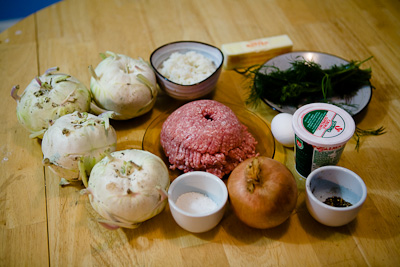
Saute the onions in butter or pork fat until translucent. (I ended up using some unsmoked bacon instead of the butter.)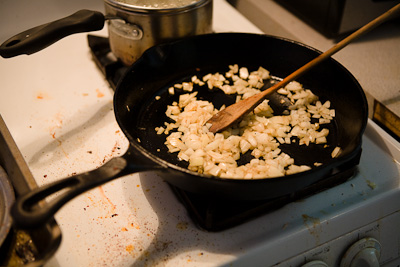
Mix together pork, cooked rice (the ratio is 5:1 by weight, which ends up being about one pound pork to a scant cup cooked rice), salt, pepper, and dill to taste. (I add about a tablespoon of chopped dill. You can also use parsley if you prefer, or even fresh marjoram).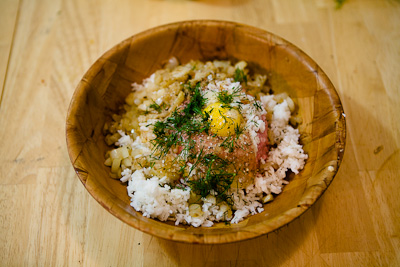
Ball o' meat: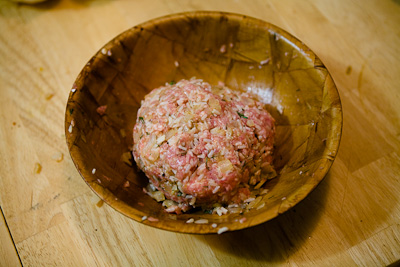
Peel and hollow out the kohlrabi as best you can using whatever tools you're most comfortable with. I used a melon baller. Reserve the scooped-up innards, chop, and set aside.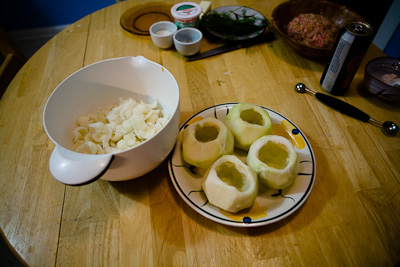
Stuff the kohlrabi with the meat mixture. If you have any left over meat, make them into little meatballs. Put into a covered Dutch oven, roasting pan, whatever you want to use and scatter the reserved, chopped kohlrabi around. (In my case, I laid the stuffed kohlrabi on top of a layer of chopped kohlrabi. Add about a cup or so of water (generally, you want to get the water about 1/3 of the way up the kohlrabi). Generously salt the water.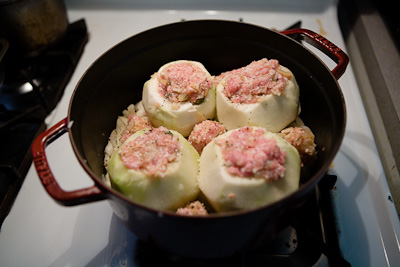
Cook, covered, until tender over a medium-low flame or bake in a 350 degree oven. This usually means about 45 minutes-1 hour. Since I had the older, bigger kohlrabi, this took about twice as long. When tender, remove the kohlrabi from the pot. Take sour cream, add about two teaspoons to one tablespoon of flour, mix thoroughly, and return to mixture: (Mine has a darker color, since the unsmoked bacon I used contained paprika and other seasonings in it. Normally, your mixture will be lighter and greener.)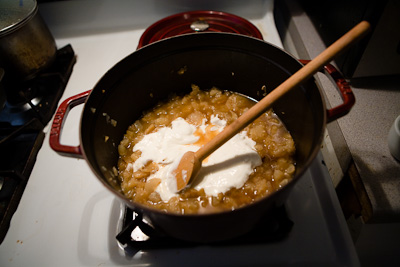
Stir thoroughly and cook until thickened. Return kohlrabi to pot. Cook 5 minutes longer. Serve with dill: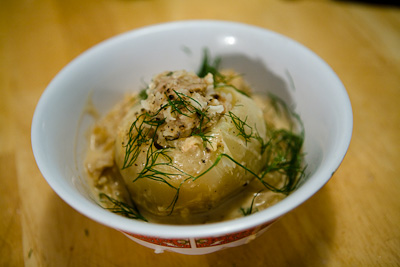
An even easier way of doing this dish to experience the same great flavors without the hassle (and this is what my friend's mother did most of the time), is to skip the hollowing-out part, just finely dice all the kohlrabi, and cook it with meatballs made from the pork-and-rice mixture. What it lacks in presentation, it makes up in flavor. Basically, what your dish becomes at that point is karalabé főzelék (creamed kohlrabi) with meatballs.
Variations: You can stuff with a different type of meat, like veal or chicken. You can use breadcrumbs instead of rice as your binder/stretcher. A light broth or stock can be used instead of water for your cooking liquid. The final thickening can be done with a roux instead of a slurry, and milk instead of sour cream. If you can get your hands on kohlrabi leaves, the chopped leaves (about 4 or 5) can be sprinkled over the dish before it goes into the oven.
-
-
Post #2 - March 22nd, 2009, 6:30 pmHi,
I never thought of stuffing kohlrabi. This is a vegetable my German Grandmother would boil, slice, then serve with a cream sauce.
Thank you for a new approach to this somewhat obscure vegetable.
Regards,Cathy2
"You'll be remembered long after you're dead if you make good gravy, mashed potatoes and biscuits." -- Nathalie Dupree
Facebook, Twitter, Greater Midwest Foodways, Road Food 2012: Podcast
-
-
Post #3 - March 22nd, 2009, 7:16 pmThat's beautiful, Binko! I grow kohlrabi because I love the leaves, they're my very favorite cooking green: they have the staunchness of collard greens, but are lovely and mild-flavored, excellent in soup (they also don't give off any mustard gas while cooking, even if they're overcooked.) Of course, they aren't grown for the leaves, but the bulb - at the end of the season, I'm always a bit pressed to figure out how to use it, this will be a good way to do so!
-
-
-
Post #4 - March 22nd, 2009, 8:19 pmThis is great!! I just 'discovered' kohlrabi through my CSA last summer and I've become quite enamored with it. I've mostly been eating it raw (julienned or finely sliced, kind of like a more substantial cucumber). I've said it about many dishes...can't go adding a pork product. I will have to try it stuffed. I'm also glad to know I can eat the leaves.
-
-
-
Post #5 - March 23rd, 2009, 7:36 amThis looks great. I became a fan of kohlrabi this summer when it kept showing up in my CSA. I had never thought of stuffing it.
-
-
Post #6 - March 23rd, 2009, 10:16 amIt would never have occurred to me to stuff kohlrabi, either. Growing up, my main experiences with kohlrabi were in soups or pickled. While I was researching some variations online, I also came across this German-style recipe for kohlrabi, which has a more spiced stuffing (includes caraway seeds, paprika, tomato paste, dried marjoram, kohlrabi leaves, etc.), so that should give you some more ideas about what you can put inside and stay true to Central European style.
Another vegetable you might not be expecting stuffed that you'll sometime find on Hungarian menus is cauliflower. That one usually gets stuffed with ham & sour cream, sometimes with cheese, but you'll also find it with the pork mixture. It doesn't seem to be quite as popular as stuffed peppers, cabbage, or kohlrabi, though.
