

Wild Boar?
Wild Boar?
-
-
-
-
-
Wild Boar?
-
Post #1 - June 16th, 2009, 11:20 amA friend ordered Wild Boar Cutlets on-line. This is the label from the package she received:
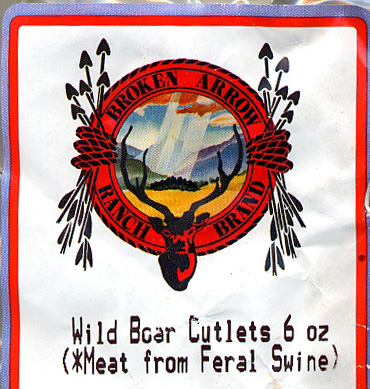
Does anyone have any perspective on whether "feral swine" is really "wild boar?"
Here's the explanation from the company.
(emphasis theirs)Broken Arrow Ranch wrote:Are They Really "Wild"?
Many years ago when we first began harvesting and selling wild boar meat we were asked by the USDA whether the animals we were harvesting were really wild and how could we prove it. Fair question. We gave a lengthy explaination of our harvesting process and how these animals come from area ranchers trying to rid them from their land, but we still felt we had not provided adaquate "proof" of the animals' wild nature. So we made the following proposition to the USDA: When we bring the wild boar in from the field, if an inspector is willing to enter a pen with the animals and remain in there for at least 30 seconds then we will not call it "wild" boar. Yes, our wild boar are truly wild - just ask the inspectors.
-
-
Post #2 - June 16th, 2009, 11:43 amwikipedia:
Domestic pigs quite readily become feral, and feral populations often revert to a similar appearance to wild boar; they can then be difficult to distinguish from natural or introduced true wild boar (with which they also readily interbreed). The characterization of populations as feral pig, escaped domestic pig or wild boar is usually decided by where the animals are encountered and what is known of their history.
One characteristic by which domestic and feral animals are differentiated is their coats. Feral animals almost always have thick, bristly coats ranging in colour from brown through grey to black. A prominent ridge of hair matching the spine is also common, giving rise to the name razorback in the southern United States, where they are common. The tail is usually long and straight. Feral animals tend also to have longer legs than domestic breeds and a longer and narrower head and snout.
-
-
-
Post #3 - June 16th, 2009, 11:45 amAre you asking if "feral swine" and "wild boar" are the same thing? My understanding is that they are the same thing. Here's a page with more information (which referes to both "wild boar" and "wild pig": http://animaldiversity.ummz.umich.edu/s ... crofa.html
I think "pig" is a more general term than "wild boar".Last edited by Darren72 on June 16th, 2009, 12:12 pm, edited 1 time in total.
-
-
-
Post #4 - June 16th, 2009, 12:04 pmI take my wild boar with a grain of salt (and some red wine) here in the States. In France and northern Spain and a few other places in Europe there are populations of native wild boars that live off the primeval rocky land and have bred minimally, if at all, with escaped domestic pigs. Boar hunting is a dangerous endeavor but since wolf populations are down, prey is aplenty and the meat is not that hard to come by or expensive. I ate boar several times in Spain including once at a campfire fresh from the hunt, and it tastes quite different from domestic pig, leaner as one might expect, but also gamier in a good mutton direction rather than a "porky" direction. To me it seemed best served with minimal spice and sauce, spit-roasted or braised in its own juices with some help from olive oil.
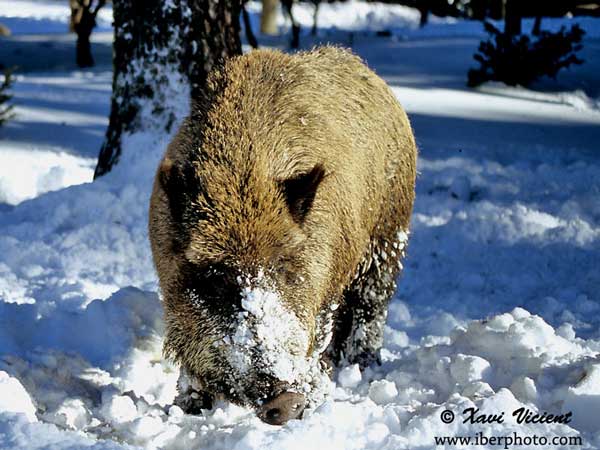
Source: http://www.iberianature.com/material/ph ... scrofa.jpg
Here, including at Gaetano's (where chef does a nice ragu), any US-sourced "wild" boar has been introduced, and not from a breeding pair of primordial Pyrenean stock (you try getting them on a plane or boat), but from free-range farm-raised hybrids. Even in the places that they've re-escaped to the forests and can be hunted (eg Hogzilla in Georgia), you've got feedback-looped pigs, descended from domesticated animals. American wild boar does not taste like European wild boar in my experience. Part of this is because everyone that gets their hands on the meat cooks the living daylights out of it with port, tomato sauce, bacon fat, and everything else in the pantry, but I'm sure most of it is that, while gamey and lean through diet, you're still tasting centuries of human-directed evolution in the Wilbur direction.
The true native porkers in the Americas are the peccaries, which are completely distinct from pigs and don't interbreed. I haven't tasted those. Confusingly, they're also called javelinas - or jabali in Spanish, which is the same term for European wild boar. Haven't eaten a peccary but bet it would be good.
-
-
Post #5 - June 16th, 2009, 12:29 pmRightly or wrongly, I expected meat from an animal that had minimal, if any, interbreeding with domesticated pigs. I grilled it simply, with a light dry rub. If anything, it tasted like beef (or Salisbury Steak, since it had been run through a tenderizer).
-
-
Post #6 - June 16th, 2009, 12:58 pmnr706 wrote:Rightly or wrongly, I expected meat from an animal that had minimal, if any, interbreeding with domesticated pigs. I grilled it simply, with a light dry rub. If anything, it tasted like beef (or Salisbury Steak, since it had been run through a tenderizer).
They ran it through a tenderizer before distribution? Boo. Certainly they're more 'feral swine' experts than we, and I certainly wouldn't want to be charged by a ridgeback any more than a Spanish boar, but everything about the operation seems to be about toning it down.
One telling note: the pigs are brought in live (into the corral) from the "bush," and obviously in some quantity, so they can be slaughtered in controlled UDSA-approved conditions. I'd guess what they're selling are recently (and likely deliberately) "escaped," and not twenty-generation-old loner Hogzillas that have grown their bristles and tusks and game back. This is as much a function, though, of American laws on hunting meat than anything. In Spain, restaurants can (or at least could) serve meat that the proprietors bring back from a hunt (shot or speared in the wild). As we know, the selling of hunted meat doesn't fly here. It's interesting to compare our rules on self-fished (or shrimped / trapped) seafood vs. land meat. Not sure why they trust some shops with waste-feeding ocean bugs and not with wild deer.
-
-
Post #7 - June 16th, 2009, 5:13 pmThe issue on hunted meat is state conservation laws, which outlawed market hunting and impose bag limits.
-
-
Post #8 - June 17th, 2009, 12:07 pmSorry if this drifts a bit, but something I miss from living in Chile is the wild boar paté sold in tins in the grocery store. Does anyone know if there's a place in Chicago that sells something like that?"Your swimming suit matches your eyes, you hold your nose before diving, loving you has made me bananas!"
-
-
Post #9 - June 17th, 2009, 12:27 pmMarketplace on Oakton has quite a few tinned pates in their Polish aisle; I've tried one or two that seemed little better than Spam, but I wonder if there might be a gem in there somewhere: no idea of what provenance the meat is. I'd bet if it exists here, they'll have it - there are quite a few products that come from South America via Eastern Europe (e.g. Dulce De Leche from Argentina with a label in Russian)
-
-
Post #10 - June 17th, 2009, 1:39 pmThis wild boar thing is interesting. Conquistadores brought pigs with them to the Caribbean and Florida, and it's not unlikely that pigs from the Iberian Peninsula started rooting around the Floridian Peninsula as far back as the early 1500's. That's a long time to regress back to the javelinas or whatever. Boar hunting is a big deal in the swamps of southern FL, but I've never tasted it.
http://myfwc.com/WildlifeHabitats/SpeciesInfo_Hog.htm
-
-
Post #11 - June 17th, 2009, 5:44 pmWhen I lived in Texas, I was introduced to deer hunting Texas style by some native Texan friends of mine. We had a hunting lease on a ranch in East Texas near the Louisiana border. The terrain was hilly and sandy soil and large (30 miles across where we were) pine forests. Much of the pine woods was owned by paper companies and they were continually harvested and replanted. These woods were noted for being populated by wild hogs, (domestics which had escaped and reverted to feral); I was actually told not to go in the woods with just a rifle, a large caliber handgun was neccessary in case one encountered a hog in the brush. These hogs were prized as meat during deer season as the meat could be combines with the leaner venison to make a tasty sausage. I have seen them captured in a trap as well as on foot in the woods, and I would not want to cross them, they are big, mean and fast and those tusks are long and sharp. There are ranches in Texas which raise pure bred Boars from European stock and make them available for trophy hunts, but I have no first hand experince of these. In conversation these guys made a definite distinction between wild hogs (domestic, feral) and wild boars ( bred from imported stock).
-
-
Post #12 - March 12th, 2013, 8:07 pmLTH,
In the best deal on a piece of art I've been on the receiving end of, a young gallerist sweetened my purchase of a painting with a wild boar shoulder. It was caught in the Ozarks ~by hand~ by his uncle and apparently put down with a knife. Pretty freakin cool.
So, I'll be entertaining old friends in from out of town this weekend and it seems like a great opportunity to thaw out this impressive piece of meat. But my conundrum is, what to do with it?
My initial reaction is to braise it and cook it down as a ragu, the only way I've had slow cooked boar. But I've got like six lbs. for eight of us and we will be drinking (heavily) so I don't want to stretch it out with any carby pasta or polenta or the like.
I know the flavor and muscle to fat ratio won't mimic pork's but the ideas I've come up with so far are favorite pork-shoulder-recipe facsimiles- boar bo ssam? cochinita pibil de verraco?
Anyone got good ideas for a boar- forward drinking food recipe?
Thanks!
-
-
-
Post #13 - March 12th, 2013, 8:22 pmOh man--if you do Boar Bo Ssam, I demand pictures! And I have a huge cache of banchan recipes for you. Can't wait to see what this thread yields!
This D'Artagnan recipe for drunken Boar looks right up your alley though...decisions, decisions. http://www.dartagnan.com/t50/59100/Wild-Boar.html"Knowledge is knowing a tomato is a fruit; wisdom is not putting it in a fruit salad." Miles Kington
-
-
-
-
Post #14 - March 13th, 2013, 3:02 pmJefe wrote:LTH,
In the best deal on a piece of art I've been on the receiving end of, a young gallerist sweetened my purchase of a painting with a wild boar shoulder. It was caught in the Ozarks ~by hand~ by his uncle and apparently put down with a knife. Pretty freakin cool.
So, I'll be entertaining old friends in from out of town this weekend and it seems like a great opportunity to thaw out this impressive piece of meat. But my conundrum is, what to do with it?
My initial reaction is to braise it and cook it down as a ragu, the only way I've had slow cooked boar. But I've got like six lbs. for eight of us and we will be drinking (heavily) so I don't want to stretch it out with any carby pasta or polenta or the like.
I know the flavor and muscle to fat ratio won't mimic pork's but the ideas I've come up with so far are favorite pork-shoulder-recipe facsimiles- boar bo ssam? cochinita pibil de verraco?
Anyone got good ideas for a boar- forward drinking food recipe?
Thanks!
All I can tell you is what I have eaten, on a trip to Florence a couple of years ago. The wild boar (or cinghiale) was ragu-style with a minimum of tomatoes over tagliatelle. It was almost in the form of shards of pot roast, and it was one of the best meals I had in Italy.
-