

Bistec Para Asar from Harvey's Fresh Market
Bistec Para Asar from Harvey's Fresh Market
-
-
-
-
-
Bistec Para Asar from Harvey's Fresh Market
-
Post #1 - August 24th, 2009, 9:33 amA co-worker buys Bistec Para Asar from Harvey's Fresh Market and grills it. He raves about how good it is. No marinade, just salt and pepper. He says it comes in long thin slices, sort of like bacon.
Harvey's Fresh Market currently has this on sale for $1.99/lb and also calls it USDA choice Thin Sliced Grill Steak.
I'm trying to find out what cut they use that can be so good and cheap! The literal translation means steak to roast(grill) so that's not much of an indication.
Anybody know? I'd call them, but my friend says there is a language issue and I'm currently almost completely deaf anyway.
Harvey Fresh Market
14861 S. Dixie Hwy.
Harvey, IL
(708) 339-2141 - (708) 339-2018
North Avenue Fresh Market
6209 W. North Ave.
Oak Park, IL
(708) 660-1660 - (708) 445-8274"Good stuff, Maynard." Dobie Gillis
-
-
Post #2 - September 9th, 2009, 9:36 amHi -
I've been keeping this in the back of my mind since the question was posed. I keep forgetting to ask the butchers of the markets I go to. Yesterday, I was in one of them, and the counter was kinda slow, so I posed the question in the best spanglish I could. The gentleman did not know what part it was in English, but he pointed at his deltoid region two or three times. He did not know the word in English however. He also twice emphatically commented that it was NOT the shoulder. I will keep trying, I go to several markets where the meat counter folks are spanish speakers and all of them market "Bistec Para Asar." I'm actually gonna go to a different one today. This one intrigues me. I've never bought it. I always go for outer skirt. In looking at it, I would say it LOOKS like thinly sliced top round, or shoulder, but what do I know. Spanish speaking LTH'ers, who go to these joints - a lil help here?
Santander? Familia Foods, Tony's?
Lol - I just used google, and this thread was the first hit.We cannot be friends if you do not know the difference between Mayo and Miracle Whip.
-
-
Post #3 - September 9th, 2009, 10:54 amThat phrase is totally generic (steak for grilling/roasting), so translation probably doesn't help much.
-
-
Post #4 - September 9th, 2009, 11:08 amSeebee, I usually buy skirt steak too, but I noticed that bistec para asar was on sale at my local grocery store and decided to buy a couple pounds of it. I believe it's just thinly sliced round steak. I just grilled them up and served it with tostones and tomato avocado salsa. It's a good cut for Korean bbq, too. Or rouladen.
-
-
Post #5 - September 9th, 2009, 12:20 pmJeffB wrote:That phrase is totally generic (steak for grilling/roasting), so translation probably doesn't help much.
Right. And I'm not sure every place would use the same cut, much like different stores using different selections for "stew meat" or "sandwich steak." But if Harvey's is grillable and succulent without marinade, it must be something decent - well-trimmed round could be right.
The steak I get for grilling at Tony's is the arrachera, which they trim down and can optionally tenderize for you right there. This is traditional flank (bavette) and to my palate does need to be marinated 4-8 hours, but not over multiple nights. It is excellent and usually also $1.99-ish per pound. I hit it with Maggi (or dark soy, which was in a recipe provided by a former landlord from Nayarit), cumin, lime juice, and corn oil and let it sit in the fridge for the workday. Tony's knob onions are the perfect accompaniment.
-
-
Post #6 - September 9th, 2009, 1:23 pmI get that bistec para asar has a literal translation, but wondering if within the Chicagoland Spanish speaking butchers/ grocers, it has a standard cut, like you'd assume it to be "x"
Isn't "arrachera" usually inner skirt and not flank?We cannot be friends if you do not know the difference between Mayo and Miracle Whip.
-
-
-
Post #7 - September 9th, 2009, 1:34 pmThis debate reminds me of Bill Buford's book "Heat." He was relaying his experience as a butcher's apprentice and determined that there was no agreement in Italy as to what different parts of a cow or pig were called and certainly no way to translate any it to English. Sounds like the bistec para asar to me....-Mary
-
-
-
Post #8 - September 9th, 2009, 1:39 pmQuite possibly, but I'm assuming that we have several ppl with limited knowledge discussing this here. That's not a slam on anyone at ALL. I'm including myself as one of the several in that statement.We cannot be friends if you do not know the difference between Mayo and Miracle Whip.
-
-
Post #9 - September 9th, 2009, 1:55 pmNo slam felt. Given some of the recent postings around here, you might be wise to assume chatter without any basis is taking place. But you might trust Don Santander, if not me.
I shop frequently in Spanish-language-first groceries and butchers and have most of my life (though the Cuban and PR meat lingo of FL varies from the largely Mexican terms here in Chicago). I also bounced this off of my irritatingly grammarian (in Spanish and English) mother in law -- a great cook, shopper, and Spanish speaker. The term, as Santander aptly explained by analogy to similarly vague and/or useless English terms like "stew meat" or "ground beef," doesn't appear to connote any particular, recognized butcher's cut.
You might find this link helpful:
http://flavorsofthesun.blogspot.com/sea ... 20de%20Res
There might be a recognized Chicago-hispanic meaning for bistec para asar, but my bet is that any meat counter using that term is looking to keep its options wide open.
-
-
Post #10 - September 9th, 2009, 10:07 pmJeffB wrote:No slam felt. Given some of the recent postings around here, you might be wise to assume chatter without any basis is taking place. But you might trust Don Santander, if not me.
I shop frequently in Spanish-language-first groceries and butchers and have most of my life (though the Cuban and PR meat lingo of FL varies from the largely Mexican terms here in Chicago). I also bounced this off of my irritatingly grammarian (in Spanish and English) mother in law -- a great cook, shopper, and Spanish speaker. The term, as Santander aptly explained by analogy to similarly vague and/or useless English terms like "stew meat" or "ground beef," doesn't appear to connote any particular, recognized butcher's cut.
You might find this link helpful:
http://flavorsofthesun.blogspot.com/sea ... 20de%20Res
There might be a recognized Chicago-hispanic meaning for bistec para asar, but my bet is that any meat counter using that term is looking to keep its options wide open.
None here either. Jeff's usually righer'n I am (broader experience with Latino communities in different regions, I just have Chi-town). If I remember, I'll either bring that chart or just refresh some of my butchery vocabulary (contrast with butchered vocabulary) and try to pinpoint the canonical Chicago asar cut with Tony's; what we really need, and where all of our knowledge is limited, is the story straight from the Harvey's staff.
As to arrachera, my experience is that even your garden variety mid-American butchers don't agree on where the flank ends and the skirt begins, or if the skirt always necessarily equals the plate (not to get into where the short plate begins, and whether the hanger steak just resembles the flank, or actually is part of the flank, depending on what you call the flank). To me, it's all undercow.
What I can tell you is that Tony's arrachera is what I call as flank (meatier, more completely covered with a thin white layer of fat and gristle that has to be trimmed, and a longer, narrower grain to the meat) than skirt, which is in keeping with what the menus translate arrachera to in my travels in Mexico. The best arrachera I ever had was on the beach at Paraiso de la Bonita in the Riviera Maya right after Hurricane Emily. It was translated as "flank," and I wouldn't trade it for all the California wood pigeons and Normandy blue lobsters in the world.
-
-
Post #11 - September 10th, 2009, 7:01 amOk Santander, I think I get what you're saying, and God bless America, I think I've learned something.
The skirt and the flank are attached in some way? Tony's and a few other joints label their skirt steak as Arrachera De Primera because it is the first part of the cut, and the flank is further down the line?
</possibleeurekamomentforseebee>We cannot be friends if you do not know the difference between Mayo and Miracle Whip.
-
-
Post #12 - September 10th, 2009, 12:44 pmJust a random sampling of edible bovine diagrams:


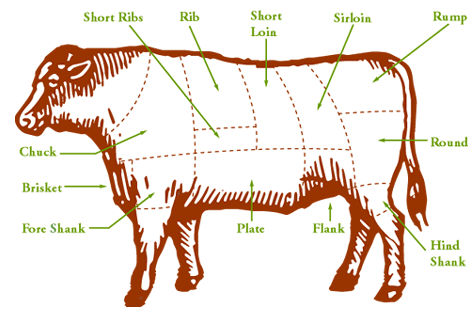
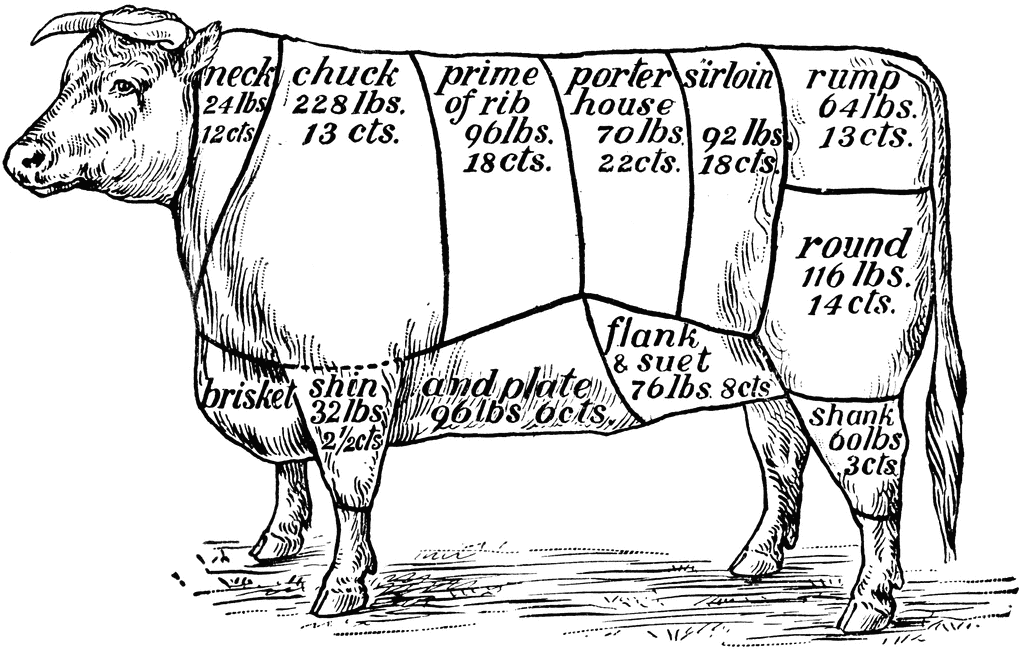

Note that the second puts the skirt in the flank, and the fifth in the plate. Other diagrams don't distinguish between the plate and flank at all; sometimes the skirt is as far forward as the brisket in others.
Now multiply this by eleventy when you search for cortes de res or cortes de vaca or esquema de carne, since they use different terminology in Spain from Mexico, in Mexico from Argentina, and within Mexico from Chiapas to Sonora. I think the arrachera is the part of the cow from which the particular butcher wants to cut it, and I'm sure Harvey's will have a good answer on bistec para asar and arrachera that is valid and meaningful at least as far as their front door. I <heart> cow.
http://guerschberg.com.ar/sitio/wp-cont ... rtes36.jpg
(too big to post)

