

Exploring a Cookbook: "Authentic Mexican", Bayless
Exploring a Cookbook: "Authentic Mexican", Bayless
-
-
-
-
-
-
-
Post #31 - February 20th, 2006, 4:22 amCathy2 wrote:
Under those conditions, how long do you suggest smoking?
Cathy,
About two hours with smoker @ 225F. I use boneless thighs and pull them out when internal temp is ~ 165F.
Bill/SFNM
-
-
-
Post #32 - February 20th, 2006, 7:26 amBill/SFNM wrote:Great posts. Something you might want to consider for a future meal. Instead of steaming the pollo pibil, try smoking them gently if you have a smoker. Enough smoke penetrates the banana leaves to give a great, authentic flavor.
Thanks, Bill. I do indeed have a smoker and that sounds like an excellent idea. Maybe when I attempt a puerco pibil I'll go that route.Cathy2 wrote:The settings and photography almost suggested you were in a restaurant rather than home, which I hope you take as a compliment.
Thanks for your compliments, Cathy. I do indeed take that as a compliment, although petit pois gets most of the credit. (A dimmer switch and a few candles go a long way. )sazerac wrote:I think the use of a stronger (and oiler) fish will stand up to the longer 'cooking' in the acid. Did you find the tilapia a bit tough after the overnight soak. Of course you must choosen the citrus and have adjusted the acidity to get the right doneness.
I was a bit worried about tilapia drying out, so I cubed it slightly larger than Bayless' recommended 3/8" cubes. As a result, the fish was soft, just about medium-rare in the center, but the exterior was drier than I'd prefer. The final soak in the tomato sauce did help that out a bit.sazerac wrote:Was the soup gritty because of the corn (mainly)?
Unrelated, but as far as enjoying the flavour of roasted poblanos go, my favourite is rajas con crema. Strips of roasted poblanos, sauteed onions, hint of garlic, in cream or half&half with stringy melty cheese. I don't know if the Bayless book has the recipe.
Completely because of the corn. The instructions require you to puree the corn with some cooked onions, garlic, a small amount of water, and a touch of cornstarch. Then, strain it through a medium (or medium-large) sieve to remove as much of the grittiness as possible. Straining it twice would be more preferable to me, in hindsight. I strained it once through a slotted colander which did a pretty good job, but a longer blend and a better (proper) sieve would have done a better job. I'm sure when Bayless makes this dish it's smooth as silk. Mine was as smooth as 120-grit sandpaper.
The rajas soup sounds excellent. It is not in this particular Bayless book, but I'll be on the hunt for a recipe.
Again, thank you all for your complements. Sometimes it's more fun to talk about the meal than to actually eat it
Best,
Michael
-
-
Post #33 - February 20th, 2006, 7:34 amMike,
Your thread prodded me into buying the book. I'm looking forward to getting it this week.
The meal looks and I'm sure tasted fantastic.
-
-
Post #34 - February 21st, 2006, 8:51 ameatchicago wrote:Her second dessert was a pineapple-mango upside-down cake
Michael,
Petit pois upside-down cake looks simply incredible, the whole meal wonderful, but the upside-down cake has caused me to crash into the rocks with it's siren like lure.
Enjoy,
Gary
-
-
Post #35 - February 21st, 2006, 1:09 pmI'm a little tardy coming into this post (as per usual). This is a great idea--it reminds of the woman in NY who cooked every single recipe in Julia Child's seminal french cookbook. Anyhow, I am a HUGE fan of this cookbook, my sister gave it to me 12 years ago and in '97 when my husband and I lived for 3 months in Guanajuato, this is the book that came with us. It helped to me with seemingly simple yet elemental things, like how to poach and shred chicken breast, and that helped me create a foundation for cooking Mexican food.
I mainly find myself going back to the Carne Desabrada, great for snacking tacos or a big supper with friends. Already mentioned but I think the Sopa de Trotilla is a sure thing and yes, go with the lard. If you can't do the lard or bacon fat, use butter. Fat gives flavor. The tomatilla sauce is simple and lovely on just about anything.
An aside: I don't know if he got wise and updated the photo, but on my "old" copy, Rick Bayless looks like a totally dorky guy, with a comb-over and these enormous square-framed glasses! He actually looks older in this photo than he does now. It's funny to see a chef reinvent himself so.
Anyhow, keep on keeping on with the book and the cooking and the posts! And remember, there's that amazing cremeria/cheese shop in LV on 26th. Perfect for your sopa de tortilla . . .
buen provecho!
bjt"eating is an agricultural act" wendell berry
-
-
Post #36 - February 21st, 2006, 3:10 pmbjt wrote:This is a great idea--it reminds of the woman in NY who cooked every single recipe in Julia Child's seminal french cookbook.
Thanks, bjt. I'm definitely not going to cook every single recipe in the book. I think I've got maybe 5 - 8 more in me before I move my attention to something else. Still, the thread will still be here and I, or someone else could add to it at any time.
Thanks for the recipe tips. I haven't made anything from the antojito chapter yet, but I'm looking forward to it.
I haven't chosen my next soup yet, but it's a close race between sopa de tortilla and pozole verde.
Best,
Michael
-
-
Post #37 - February 21st, 2006, 4:02 pmEC and petit pois,
your three course dinner looks like it was marvelous! petit pois, you could start a new career as a chocolatier And I love those Mexican corn soups with green chile and crema -- Diana Kennedy's first book has three (I think) different versions of that theme.
EC, could you say a few words about making the achiote paste? When I've made various Yucatecan preparations I always find grinding the achiote to be very frustrating. I have a (former) coffee grinder now achiotized in all crevices, and managed to stain a saucepan from trying to soften the achiote in simmering water. But a few days ago I bought a rectangle of Adelita brand achiote paste at La Chiquita supermarket on Pulaski, which I hope will be much easier to use. It was $1.07 for 3 ounces, I believe.
Also, you mention making the mock bitter orange juice. For the information of anyone inspired to duplicate your dinner, right now is the time of year when the bitter oranges should be available. But the place to look for them is not in Mexican markets (at least the ones where I've asked about them don't seem to be familiar with them). I've seen bitter oranges, though, in La Unica and in La Municipal on Division.
Again, beautiful posts and pictures!
Amata
-
-
Post #38 - February 21st, 2006, 4:51 pmThank you, Amata.
Amata wrote:EC, could you say a few words about making the achiote paste? When I've made various Yucatecan preparations I always find grinding the achiote to be very frustrating. I have a (former) coffee grinder now achiotized in all crevices, and managed to stain a saucepan from trying to soften the achiote in simmering water. But a few days ago I bought a rectangle of Adelita brand achiote paste at La Chiquita supermarket on Pulaski, which I hope will be much easier to use. It was $1.07 for 3 ounces, I believe.
After reading Bayless' notes about grinding achiote seeds, I was very wary about this step. He said to basically forget about a mortar & pestle or a molcajete and just go for the spice griner (burr, preferrably). At Tony's on Elston, I stood in front of the spice section with a bag of seeds in one hand and a bag of ground achiote in the other. I bought the seeds, knowing I could go back for the ground stuff if I needed to.
I only have a blade coffee grinder for spices, and it surprised me by doing a pretty good job, but it did take a couple minutes of spinning, to the point of the device starting to heat up. I was able to clean it all up pretty well with a small brush. I've never heard of the softening trick.
My grinder is the kind with a very deep stainless steel bowl with a plastic cover that fits outside of the bowl. This basically keeps the powder where it belongs. A bit like this one:
http://images.amazon.com/images/P/B0000 ... SS260_.jpg
I'm not sure if I could tell the difference between store-bought achiote paste, pre-ground achiote, and homeground seeds in this dish, but I would imagine a trained palette could. Honestly, the concentration of achiote at this level is not one of my favorite flavors.Amata wrote:Also, you mention making the mock bitter orange juice. For the information of anyone inspired to duplicate your dinner, right now is the time of year when the bitter oranges should be available. But the place to look for them is not in Mexican markets (at least the ones where I've asked about them don't seem to be familiar with them). I've seen bitter oranges, though, in La Unica and in La Municipal on Division.
It's funny that you mention that. I can't remember ever seeing them and in the book he said that they are extremely difficult to find, if not impossible. I asked at Tony's and at Cermak on Kedzie for naranja agria and I was met with blank stares, so I just shrugged it off and figured that Bayless was right, you can't get it. I had a sneaking suspicion that he was wrong.
Best,
Michael
-
-
Post #39 - February 21st, 2006, 6:30 pmeatchicago wrote:I only have a blade coffee grinder for spices, and it surprised me by doing a pretty good job, but it did take a couple minutes of spinning, to the point of the device starting to heat up. I was able to clean it all up pretty well with a small brush.
My trick for cleaning the coffee grinder I use for spices: Grind up a piece of bread.
-
-
Post #40 - February 21st, 2006, 9:10 pmeatchicago wrote:After thawing the banana leaves, I found that nearly every piece was split at the point it was folded.
Banana leaves from Thailand seem to be stronger and less prone to splitting than other (Central American?) varieties. You can get very nice frozen Thai leaves at Thai Grocery, 5014 N Broadway.Amata wrote:For the information of anyone inspired to duplicate your dinner, right now is the time of year when the bitter oranges should be available. But the place to look for them is not in Mexican markets (at least the ones where I've asked about them don't seem to be familiar with them). I've seen bitter oranges, though, in La Unica and in La Municipal on Division.
Bitter oranges are definitely in the markets now. About two weeks ago I picked up a few (89 cents a pound, sign says naranja agria) at La Fruteria, 8909 S Commercial. A great ingredient, try them and you’ll never settle for substitutes. Also at La Fruteria: fresh raw peanuts, kola nuts (three colors, priced accordingly), a terrific red habanero-type chile (hot enough to get anyone’s attention), and of course “pezzel beef.”
Looking forward to the next installment, Michael.Last edited by Rene G on February 27th, 2006, 11:21 pm, edited 1 time in total.
-
-
Post #41 - February 21st, 2006, 10:01 pmCook's Illustrated recommended some years ago to put a couple tablespoons of raw rice in your spice/coffee grinder to clean it while pulverizing. I use that method and often throw the ground rice into the mixture if some thickening is required.
Regards,Cathy2
"You'll be remembered long after you're dead if you make good gravy, mashed potatoes and biscuits." -- Nathalie Dupree
Facebook, Twitter, Greater Midwest Foodways, Road Food 2012: Podcast
-
-
Post #42 - February 27th, 2006, 8:11 pmTacos de Bistec Encebollado
page 135, from the antojitos chapter.
A piece of flank steak in our freezer had reached the point of "eat me or trash me".
petit pois asked, "Can you make tacos with it?"
Claro.
Bistec encebollado is bascially seared meat with a bunch of cooked onions. It's insanely easy to make and a great way to make a meal of any kind of tough or cheap meat. It lends itself well to addtions or interpretations. You can marinate the beef, add more garlic, peppers, whatever works. The key is to sear the meat to just medium rare. While it is resting, cook a lot of onions to a deep brown. Add the garlic, slice the beef, against the grain for skirt or flank steaks, and finish marrying the flavors for a couple minutes. I prefer it over a flour tortilla with a red hot sauce, a little lime, and a beer.
I had made this before ever owning Bayless' book or even knowing the name of the dish. In this case, I added some chiles poblano which rounded out the flavor nicely. A side dish of lemony green beans made it a meal.
This is a nice and easy dish to have in your back pocket for those times you want to use up some meat in the freezer.
tacos de bistec encebollado
Best,
Michael
-
-
Post #43 - March 27th, 2006, 9:00 amBirria de Cordero
I had the idea yesterday morning to try my hand at making birria. I started exploring the neighborhood on foot, in search of a nice hunk of goat. Surprisingly, the first two butchers I stopped in did not have a decent piece on hand. Running shorter and shorter on time (the meat needed to be in the marinade for at least 4 or 5 hours), I decided to purchase a nice looking hunk of lamb shoulder. While I would have preferred goat, I justified my decision thusly:
--Bayless' recipe (the recipe that I am working from) calls for goat or lamb and makes no distinction in either one being more or less authentic or delicious.
--Diana Kennedy's recipe in The Essential Cuisines of Mexico actually calls for a variety of meats, including veal, to my surprise.
--I am willing to wager that more than half the time I have ordered goat in a restaurant in Chicago, I have been served lamb.
So, why birria? As I mentioned earlier in this thread, this is one of those situations where I hoped to gain a better appreciation for a dish that I enjoy. "Learning the process to appreciate the dish" has emerged as a leitmotif for this cookbook exploration. At first glance, this is a deceptively simple recipe: marinate the meat, steam/roast the meat, finish the broth, and serve.
I gathered my lamb, fresh tortillas, a few other ingredients for a guacamole and made my way home to get my mise en place:

The lamb spent almost 5 hours bathed in a thick puree of chiles guajillo, garlic, and spices:

Then it spent three hours standing above water in a dutch oven inside a 325-degree-oven sealed with masa*:

I question the necessity of this step when using a heavy, cast iron dutch oven. That heavy lid wasn't leaking a drop. I sincerely doubt that the masa seal added anything to the steaming process.
Bayless' recipe has one rather surprising final step: Trim the meat of any extra fat and gristle, remove any bones, glaze with some of the reserved chile puree, and bake on a baking sheet for 10 minutes. I'm not sure if I can recall ever eating birria with a "post-roast" glaze.
Finishing the broth required the addition of tomatoes, oregano and salt. This is the point in the process that obviously takes skill and experience. My broth suffered from a variety of issues: too tomatoey, a little too watery, and under-seasoned. I blame the last one on Bayless' recipe which overall contains a very small amount of spice for the amount of meat and broth. Also, the guajillo could use a little balance from another, more aggressive chile, to suit my tastes. (Ms. Kennedy adds chile ancho as well).
This was not the worst birria that I've ever had, but it was far from the best. My wife, who I do not think was in the mood for this dish last night, was decidedly unenthusiastic about the whole thing. I didn't think it was a very bad first attempt.
The completed product, garnished with white onion, cilantro, and lime:

Best,
Michael
*In one of the most staggeringly bone-headed moves I have ever made in my kitchen endeavors, I sealed the dutch oven with masa before I actually put the water in, requiring me to un-seal and do it all over again. It was definitely one of my top 5 kitchen "D'oh!" moments.
Antonius provides more information on cooking birria in this post.
-
-
Post #44 - July 7th, 2006, 1:59 pmFourth of July greeted us with a slightly unexpected out of town guest for dinner. Without any specific plans for the day, I decided to put together a light dinner based on a few Mexican appetizers that we could eat in the backyard while listening to the sounds of neighborhood children blowing thing up.
I made three dishes, two of which are from the Bayless book, both of those being extremely simple to make.
Salpicon de Res Poblano
page 85
This is a very simple shredded beef salad, with potato, chipotle, onion, and avocado, on a bed of romaine lettuce. The beef, flank steak in this case, is braised in a very fragrant broth and left to cool in the same broth, then shredded. The salad is dressed with an apple cider vinaigrette and can be served on a tostada or simply as a salad.

I did not like this preparation. It's very heavy on the potato and vinaigrette. The beef just fell to the background. Next time, I'll probably double the amount of beef and halve the amount of potato and dressing. Plus, I think I cut the beef into chunks that were a little too small, so we didn't really get that "shredded" look. The key to this dish is the canned chipotles and the ripe avocado. If not for those two items, I'd have mostly ignored this dish.
Queso Fundido con Rajas y Chorizo
page 82
This is so easy, so tasty, and so sinful that there should be a warning label on this book. Melted chihuahua cheese covered in rajas (strips of onion and roasted poblano) and chorizo (house-made version from Tony's on Elston), served from the oven still bubbling, wrapped in a warm flour tortilla: can you imagine a better bite of food to wash down with a cold beer on a warm evening?

I served these two dishes with a mock "seviche" made from pre-cooked costco frozen shrimp, fresh lime juice, red onion, cliantro, black pepper, and a touch of olive oil. It worked quite well...

...and it all made a heck of a nice little backyard, semi-impromptu fourth of July dinner.

Best,
Michael
-
-
Post #45 - July 7th, 2006, 4:14 pmQueso Fundido is a daaaaangerous dish, as the red running juices you've portrayed so well in the photo will stain anything, and clog arteries like there's no tomorrow.
While tempting, a microwaved fundido will end up bland and just a pile of goo. That being said, I typically nuke the chihuahua cheese until it's softened only, top with the chorizo, sometimes with fresh-roasted peppers (never used onions), then throw it under the broiler to finish melting and give it a nice crust. The crustiness is essential: like Burt's pizza crust, the carmelization adds a lot to the flavor.What is patriotism, but the love of good things we ate in our childhood?
-- Lin Yutang
-
-
Post #46 - July 7th, 2006, 4:19 pmI have thoroughly enjoyed your posts in this series, Michael.
And, your photos have been stunning.
I hope to see more.
E.M.Last edited by Erik M. on July 7th, 2006, 4:19 pm, edited 1 time in total.
-
-
Post #47 - July 7th, 2006, 4:19 pmJoelF wrote:While tempting, a microwaved fundido will end up bland and just a pile of goo. That being said, I typically nuke the chihuahua cheese until it's softened only, top with the chorizo, sometimes with fresh-roasted peppers (never used onions), then throw it under the broiler to finish melting and give it a nice crust.
This is not too far from the Bayless recipe. The cooking vessel preheats with the oven up to 375. The cheese goes in until it's just melted, add the cooked rajas and chorizo, and go a little longer until it looks done.
Bayless actually calls for using Jack cheese, saying that he has not been too happy with the quality of the packaged Mexican melting cheeses he's found here in the states. Given the variety available, I found this surprising and just went with the chihuahua anyway.
Best,
Michael
-
-
Post #48 - July 7th, 2006, 4:20 pmErik M. wrote:I have thoroughly enjoyed your posts in this series, Michael.
And, your photos have been stunning.
I hope to see more.
Thanks very much, Erik.
I think I've been dancing around the issue for too long now. Next I'll have to crack into the mole chapter.
Best,
Michael
-
-
Post #49 - July 7th, 2006, 5:07 pmMichael:
Bayless' moles are wonderful. I made a non-traditional Thanksgiving dinner of Turkey in Red Mole from his Mexico: One Plate at a Time book. It was good. It was sooooo good that my friend from Guerrero, Mexico ate 1 pint of it with tortillas in one sitting. Then bragged to all his friends that this gringa made mole.
Fry the chiles outside......the process is smoky, to say the least.
We're in the process of cataloging all our books and I'm desperately searching for Bayless' first cookbook (Authentic Mexican). It's here somewhere.....we have about 3,000 books (800 are now cataloged).
Hmmm.....now I'm thinking I have to make a batch of mole paste while the weather's nice!
-
-
Post #50 - August 20th, 2006, 7:42 pmSeasonal cooking with "Authentic Mexican"
Enchiladas Verde
page 154
There is no better way to make use of a large crop of garden-fresh tomatillos and serranos then a fresh salsa verde. There are countless ways to use up this salsa, and knowing my wife is a fan of enchiladas, I chose to familiarize myself with Bayless' recipe for traditional enchiladas verde.
Surprisingly simple, this recipe makes use of the salsa verde from page 42: boiled and pureed tomatillos and serranos with cilantro garlic and onion. The mixture is reduced, re-constituted with chicken stock, and reduced again until thickened. The result is a tangy, slightly spicy salsa.
Chicken poached in water with onions and herbs is shredded and mixed with crema and onion for the enchilada filling. Softened tortillas are filled and covered in the salsa before heading to the oven to re-warm. Bayless writes about how oven-baking enchiladas is not entirely authentic (although he still recommends it). Enchiladas are traditionally prepared from ingredients that are still hot: a fresh tortilla is dipped in hot salsa and filled with warm filling and covered again with the hot salsa.
The enchiladas were garnished with queso anejo and white onion. I found the white meat chicken called for in this recipe to be a big let down, as expected. This recipe seems like a way to use the least desirable part of the chicken, masking its lack of character with a generous portion of bright salsa and tortillas.

Calbacitas al Mojo de Ajo
page 274
As a side dish, another garden-fresh vegetable made up calbacitas en mojo de ajo. While true calbacitas are easily available in my neighborhood, I had fresh zucchini and used them as Bayless described (sweating with salt for 30 minutes prior to cooking). A quick sautee in garlic butter, the zucchini is finished with parsley, lime juice, dried Mexican oregano, and the toasted garlic from the butter. A nice side dish from a cuisine that is short on vegetable sides. Frankly, if you took away the lime juice and Mexican oregano, it tasted distinctly Italian.

All in all, a nice meal, and it felt good to marry garden-fresh, seasonal vegetables with my exploration of this cookbook.
Best,
Michael
-
-
-
Post #51 - November 16th, 2009, 9:00 pmWell, this is actually from Rick Bayless's Mexican Kitchen---
I made Simple Red Mole Enchiladas with chicken for the small household food exchange. As I was making this for a crowd, I added lots of chicken and I wished it was saucier. I've made 'real' mole on 2 occasions and this is definitely "simple" in comparison.
Ingredients for ancho seasoning paste (garlic cloves, ancho chiles, cloves, cumin, oregano, black pepper, not-pictured: 2/3 c chicken stock):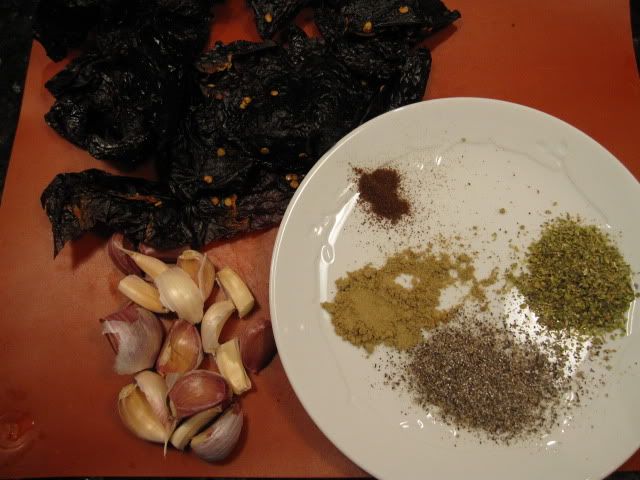
Garlic cloves get roasted, chiles toasted on a hot griddle. Chiles got rehydrated in hot water. Then everything went into a blender, then got strained.
Ingredients for sauce (onions, raisins, canela, roasted tomatoes, toasted bolillo, mexican chocolate, )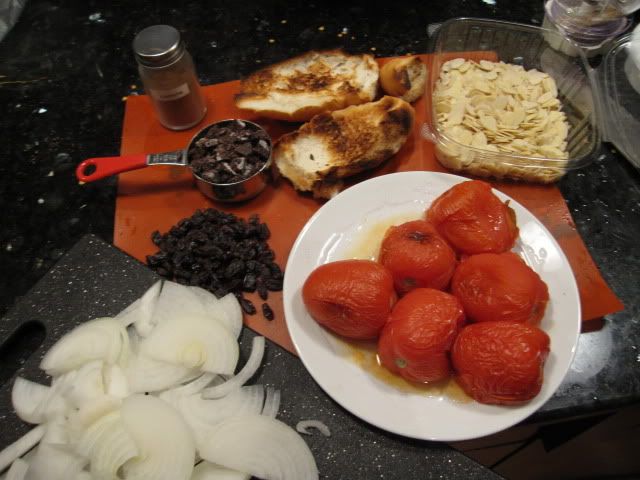
Almonds, onions, raisins get sauteed individually, then a quick pulse in the cuisinart with the tomatoes, 1 c chicken stock and bolillo).
Ancho paste gets sauteed for 5 minutes, almond mixture added with about 4 more cups of stock and everything is simmered 45 minutes. The mixture gets seasoned with a little salt and (very) little sugar (I'm not a fan of sweet mole)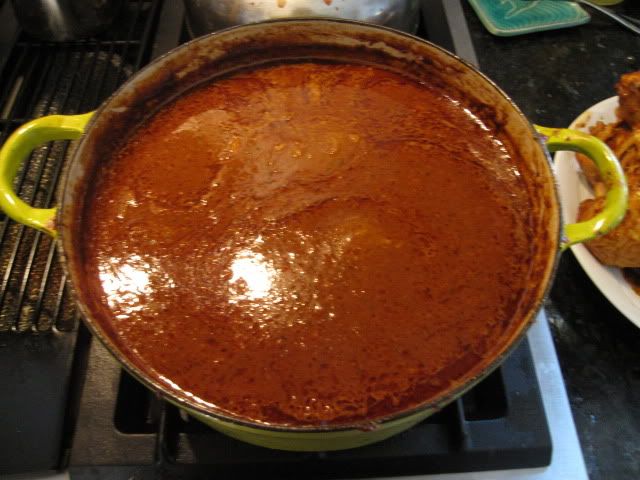
I added chicken breasts, poached in stock, then shredded (next time I'll use thighs)
-


