

Pesto alla Trapanese
Pesto alla Trapanese
-
-
-
-
-
Pesto alla Trapanese
-
Post #1 - October 10th, 2005, 1:03 pmPesto alla Trapanese
©Antonius Volcinus de Montibus, Academia Novi Belgii
Lu saziu nun cridi a lu dijunu.
'He who is sated believeth not he who doth fast.'
A Sicilian proverb.
Having been away from my kitchen and home garden for the better part of two weeks in early September, I missed out on some of the peak season for tomatoes. Since returning home, I’ve been revelling in the late season produce and herbs and doing my utmost to make a lot of dishes that are best with things fresh from the garden. On Wednesday of this past week, after having indulged in the gory, meaty glories of ragù alla Bolognese on Tuesday, I felt a desire to avoid further sins of the flesh and get in touch through fasting with the ascetic within; that ascetic does, in fact, exist and as proof I offer this photo of me taken recently in a café somewhere near the border between Vlaams Brabant and Brabant Wallon, accompanied by my trusty pig, Heliogabulus, where I, like the blessèd Jan van Ruusbroec or the misunderstood Tanchelijn before me, preached abstinence to a group of very attractive young Flemish and Walloon women: Nu merct dese valsche propheten, opdat ghi niet bedroghen en wert...*
Maer wildi u oefenen in die vierde wise met inneger devotien, soe suldi gevoelen inden gronde uwer minnender cracht dat gerinen des heiligen geestes, alse ene levende fonteine met wallenden, uut vloeyenden aderen eweger soeticheit...**
Antonijs predikt bij den Minneboom. / Antoine prêche près de l'Arbre d'Amour.
Antonius preaches by the Love-tree. Brabant, IX.2005
In any event, following the ragù alla Bolognese (link), I felt it appropriate to eschew meat for a day and so considered the options. With the second crop of basil in outstanding condition, one might reasonably be inclined to turn to the old and reliable standby, the magnificent pesto alla Genovese (link). And yet, with the tomato season coming to a close and with a batch of harvested tomatoes calling out for immediate consumption, the Genovese option seemed best left for another day. Of course, a quickly cooked little fresh tomato sauce (link) with basil is always a delight, but then I’ve had that a few times over the past couple of weeks. No, something a little out of the ordinary seemed required for the occasion, something that I had intended to make back before I had gone away and even promised to post on, an alternative pesto (link), namely, the pride of sunny Trapani, u pistu, that is, pesto alla Trapanese.
The core ingredients for pesto alla Trapanese are olive oil, garlic, basil, almonds and fresh tomato, and while one can find many recipes which add to these one or another further strong ingredient, the five listed above strike me as being perfectly balanced in much the way that the five core ingredients of pesto alla Genovese are. And a comparison of the two pesti is instructive: the two share, of course, the olive oil, which serves as the real basis of the sauces, and also garlic and basil, which are obviously key flavouring agents. The almonds, optionally toasted, are directly analogous to the pine nuts or combination of pine nuts and walnuts which are typically used in the pounded sauce of Liguria. So far, we have virtually the same sauce. The difference then lies in the contrast between the fresh and perfectly ripe tomato (which I grate, leaving the seeds but discarding the skin) in the Trapanese and the cheese (pecorino or a mixture of pecorino and parmesan) in the Genovese, both of which add a little sweetness and tang to the mix but otherwise provide rather dissimilar aspects of flavour and texture. And while the cheeses give the Genovese sauce a good measure of salinity, the Trapanese’s tomatoes do not, which means the cook must add a little more salt to the mix than he would in making the Ligurian green sauce.
With regard to the process of preparation, there isn’t much to say: one pounds and grinds together the garlic, some sea salt, the toasted almonds, and some chopped basil in a mortar. When the desired consistency is achieved, I transfer the paste to a bowl containing the grated remnants of a couple of ripe tomatoes, adjust the seasoning for salt, add a little black pepper, and then work in a sufficient quantity of olive oil. This sauce then dresses appropriately (very) al dente spaghetti and the dish can be finished with a generous sprinkling of toasted bread crumbs, as can be seen below.
This is a delicious recipe for pasta on any occasion when the tomatoes and basil are at their freshest and best but on this occasion, it was even a little more delicious, in part because of the extreme contrast between the spaghetti al pesto alla Trapanese and the previous evening's tagliatelle al ragù Bolognese.
But this juxtaposition of two very different pasta dishes inclines me to reflect on the glories of Italian cuisine. Of course, it is in vogue these days to emphasise the regional nature of real Italian cuisine, which is right and proper, but then to do so to the point of virtually denying any existence of a collective and abstract “Italian cuisine” –– as some seem to do –– strikes me as wrong. To be sure, Italian cuisine is very much regionally oriented and the canon of ‘national dishes’ is really just a list of regional all-stars. And yet, aesthetically and philosophically, there are genuinely shared underpinnings to the cooking of all of Italy’s regions. If we look at the two dishes I’ve discussed this past week, one from Western Sicily and the other from the heart of Emilia, one sees clearly the focus and even austerity that guide the Italian imagination and are so lost in American notions of what Italian cooking is.
When we Italians fast, we feast, and when we feast, we do it slowly and soberly.
Antonius 'Aurunculus' Volcinus de Montibus
Rampstad, X.2005
Links to other recipes and cooking notes by this writer: viewtopic.php?p=55649#55649
__________
Notes:
* Jan van Ruusbroec (1293-†1381), known also in English as John Ruysbroek, Vanden XII beghinen W. IV 41: "Now note these false prophets, that ye be not deceived."
**Jan van Ruusbroec, Vanden seven sloten, Chapter XIX. Surius' Latin translation (1552): Porro si in his quatuor modis interna cum devotione exercere nos velimus, in fundo voluntatis seu vis amativae nostrae Sanctispiritus contactum velut fontem vivum aeternae suavitatis venis scatentem, ebullientem atque emanantem sentiemus. H. Rolfson's English translation (1981): "If you wish to exercise yourself in the fourth mode with more interior fervor, you shall experience, at the depths of your faculty of love, the touch of the Holy Spirit as a living fount, with veins of eternal sweetness welling up and flowing out." (p. 182 of the second volume of Opera Omnia (Tielt: Lannoo / Brill: Leiden).Last edited by Antonius on August 14th, 2012, 11:17 am, edited 2 times in total.Alle Nerven exzitiert von dem gewürzten Wein -- Anwandlung von Todesahndungen -- Doppeltgänger --
- aus dem Tagebuch E.T.A. Hoffmanns, 6. Januar 1804.
________
Na sir is na seachain an cath.
-
-
-
Post #2 - October 11th, 2005, 9:31 amWill you adopt me? I may eat a lot, but I don't take up much space.
-
-
-
Post #3 - October 11th, 2005, 10:21 amthaiobsessed wrote:Will you adopt me? I may eat a lot, but I don't take up much space.

Thaiobsessed,
I always welcome the opportunity to exploit cheap labour. If you're willing to work, let's get the paper work started.
As you can see from the following pictures, work in the kitchen (and garden) is expected from even the youngest members of the household. And be forewarned, when the fresh pasta factory and pizzeria opens, work hours will increase significantly!

A
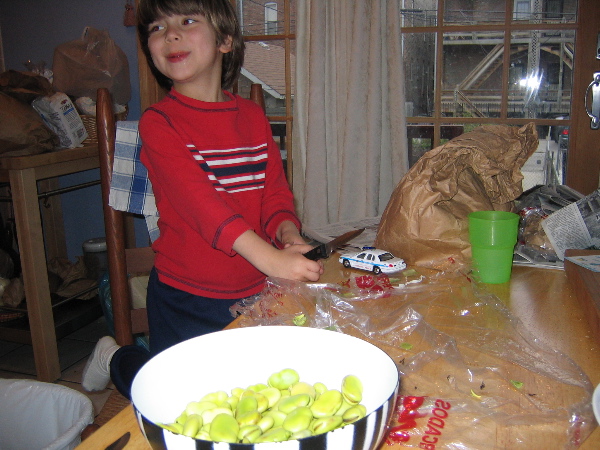
From: Fave Fresche etc. (Fresh Favas) (link)
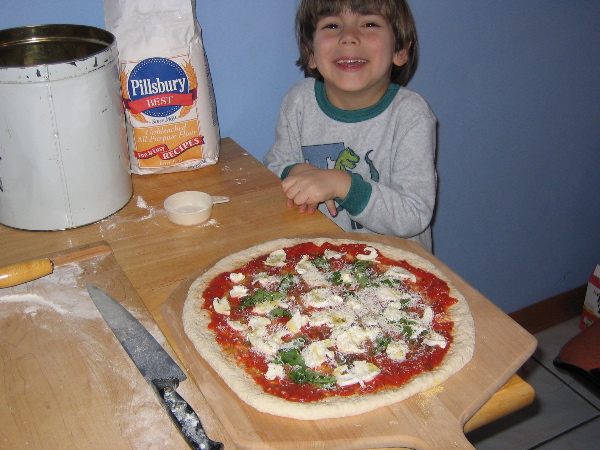
From: Pizza e pasta casalinga: Home-made pizza and pasta (link)
E buon compleanno al mio carissimo figlio, Lucantonio!Alle Nerven exzitiert von dem gewürzten Wein -- Anwandlung von Todesahndungen -- Doppeltgänger --
- aus dem Tagebuch E.T.A. Hoffmanns, 6. Januar 1804.
________
Na sir is na seachain an cath.
-
-
-
Post #4 - October 11th, 2005, 12:06 pmHmm...this worries me a little.
I'm not sure I'm capable of the same high quality of work as this young man. He has produced a fine looking pizza. But, I'm willing to try...
-
-
-
Post #5 - October 11th, 2005, 12:30 pmAntonius--
I have all of these ingredients on hand so I think I will try to make this dish later this week. While such dishes surely allow some flexibility, can you comment on approximate proportions? A quick googling yielded something like:
6 cloves garlic
6 ripe plum tomatoes
1/4 pound (100 g) blanched, peeled almonds
A bunch of basil
Olive oil, salt, and pepper
Is that consistent with your preparation?
Patrick
-
-
Post #6 - October 11th, 2005, 1:12 pmMaple Leaf wrote:6 cloves garlic
6 ripe plum tomatoes
1/4 pound (100 g) blanched, peeled almonds
A bunch of basil
Olive oil, salt, and pepper
Is that consistent with your preparation?
ML:
Unfortunately, recipes such as this I do all by feel and look and so on. It occurred to me the other day that I should pay attention to amounts but ultimately I forgot to do so.
Anyway, I'll assume you're aiming to dress about a pound of pasta (should be long and not thin; regular or thicker spaghetti or else bucatini or perciatelli, which resemble the Sicilian busiate).
For me, that's a lot of garlic for a pound of pasta. One large clove or two mediums would work and for me; the upper limit would be two large cloves; the other day, I think I had one sort of large and one more medium in size. With more than two large cloves, I think the garlic flavour will really start to overwhelm the other elements -- but if you really love the garlic edge, do a bit more. Beyond that, a good, full fistful of fresh basil should do the trick. The amount of almonds sounds good to me, as I like that element to be relatively strongly represented, since it adds a nice texture to the sauce and the flavour of the nuts isn't all that assertive alongside raw garlic and basil. Some recipes call for toasting, some don't; I like them toasted a little. As for the amount of tomatoes, I think I used four or five plum tomatoes, which was all I had on hand that was properly ripe. Most of them were fairly small too, so the volume of tomato (as you can see in the photo) wasn't all that great, but the dish came out nicely to my mind.
Use a good, flavourful olive oil. In pesto alla Genovese, the traditional oil used is the rather mild oil of Liguria but in this dish, I would go with one of those gloriously green oils from Western Sicily, if possible.
I strongly recommend topping the dish off with the toasted (or fried) plain bread crumbs, as they add both a really nice textural aspect and also a nice bit of flavour.
So then, what you list looks pretty much right to me and close to what I used last week, with the exception of the garlic, as noted above.
AntoniusAlle Nerven exzitiert von dem gewürzten Wein -- Anwandlung von Todesahndungen -- Doppeltgänger --
- aus dem Tagebuch E.T.A. Hoffmanns, 6. Januar 1804.
________
Na sir is na seachain an cath.
-
-
Post #7 - October 11th, 2005, 3:56 pmAntonius, thanks for the thread on Pesto alla Trapanese. It's such a simple dish and the taste is out of this world and yet, you don't hear too much about it. I think it's so underrated. If you can get a plate of pasta with (good) Pesto alla Trapanese, you don't need much else.Sal G
Chi cerca trova.
-
-
Post #8 - October 12th, 2005, 12:44 pmTerrasini wrote:Antonius, thanks for the thread on Pesto alla Trapanese. It's such a simple dish and the taste is out of this world and yet, you don't hear too much about it. I think it's so underrated. If you can get a plate of pasta with (good) Pesto alla Trapanese, you don't need much else.
Sal:
You're right on all counts. The other night, when I made this dish, that's all we had for supper. More often than not, we follow the primo-secondo pattern for the evening meal but on this occasion we were just in the mood for indulging in the pasta and this end-of-season fresh sauce.
AAlle Nerven exzitiert von dem gewürzten Wein -- Anwandlung von Todesahndungen -- Doppeltgänger --
- aus dem Tagebuch E.T.A. Hoffmanns, 6. Januar 1804.
________
Na sir is na seachain an cath.
-
-
Post #9 - October 12th, 2005, 9:07 pmIn my continuing culinary education at the Chef Antonious School of Italian Cookery tonight I made Pesto alla Trapanese. Simple, clear, clean flavors, easy to make, delicious to eat.
Grate a few plum tomatoes, leave the seeds, discard the skin.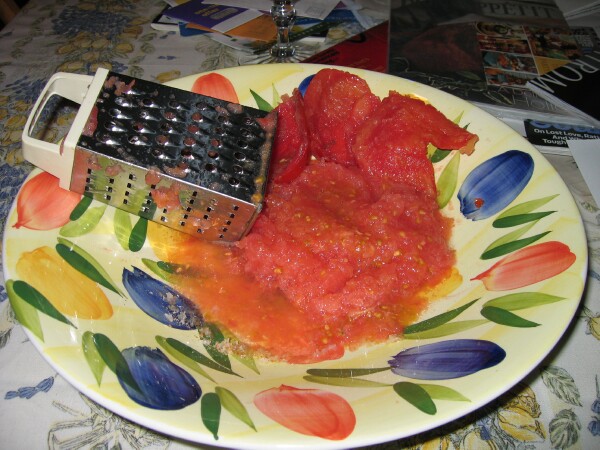
Basil, garlic, sea salt, toasted almonds.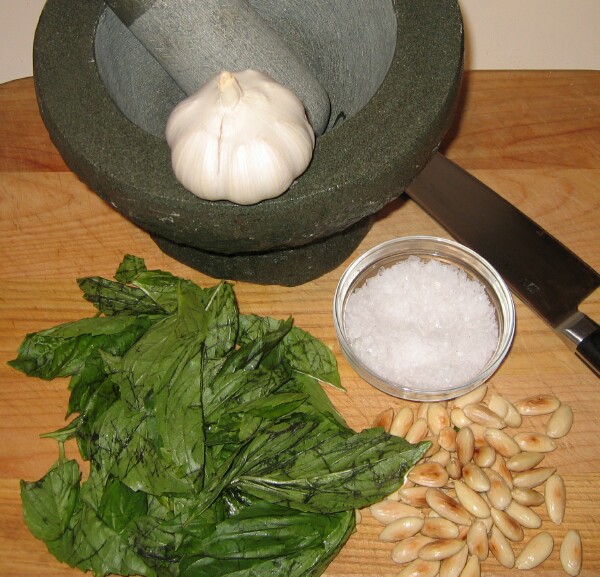
Grind in a mortar and pestle.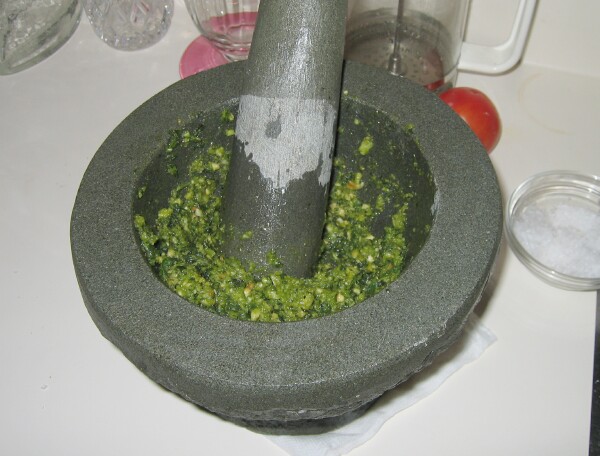
Combine ingredients.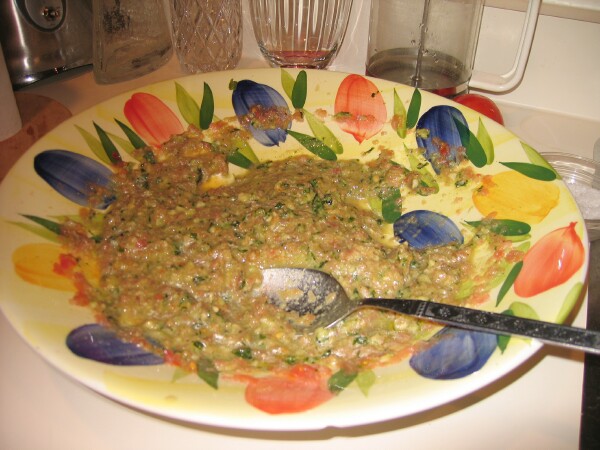
Fry fresh bread crumbs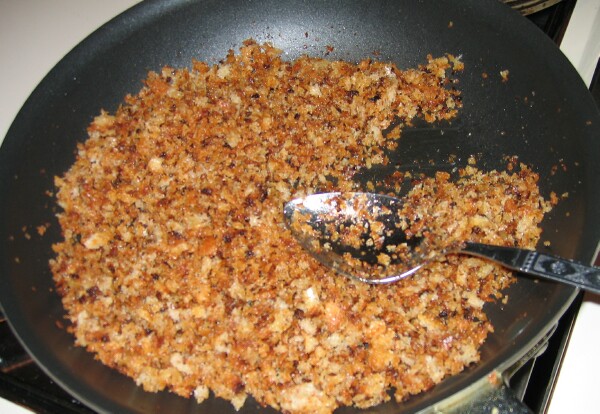
Freshly grate a little pecorino and parmesan to top, which I now realize was a mistake.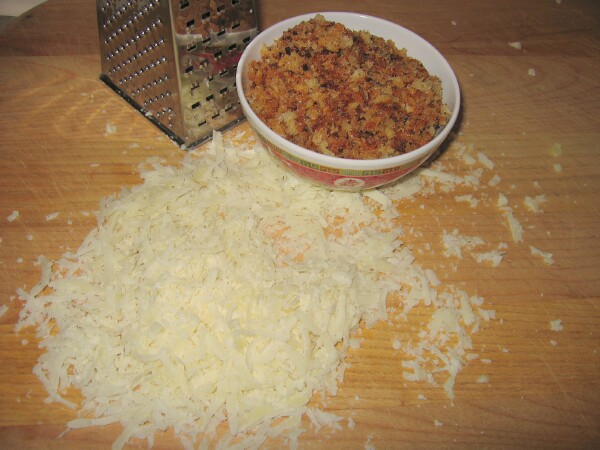
Combine Pesto with bucatini, top with fried bread crumbs and, in my case, a little fresh grated pecorino/parmesan.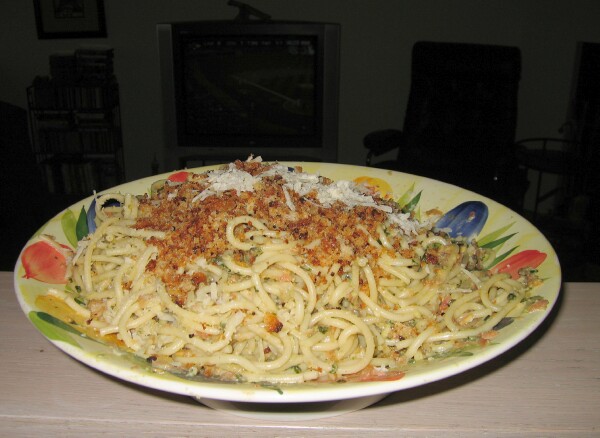
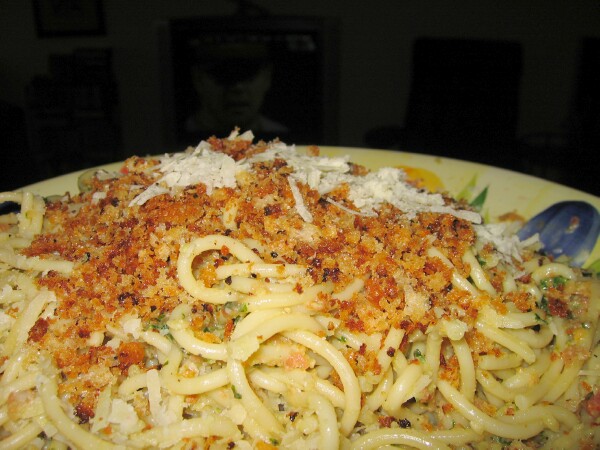
Add a caprese salad and another wonderful meal courtesy of the Chef Antonious School of Italian Cookery.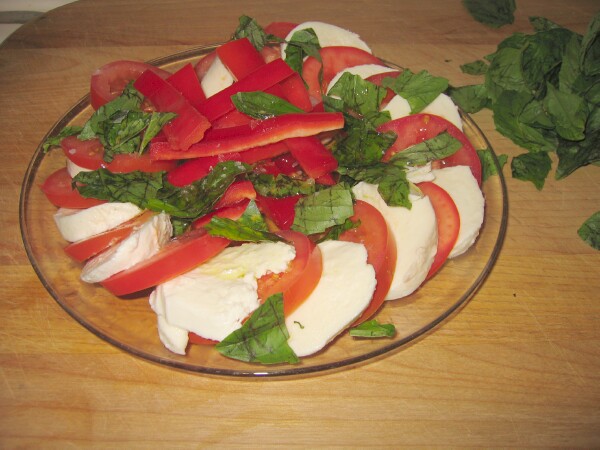
Thank you Professor Antonious.
Enjoy,
Gary
-
-
Post #10 - October 13th, 2005, 8:20 amGary:
You're welcome... and I'm delighted to hear that you tried the recipe and then found it so pleasing!
With regard to the application of cheese at table, I think that's by no means a no-no and I'm sure a fair number of people add some grated cheese of one sort or another. Certainly some of the Italian recipes I've seen for this dish suggest that as an option. Crushed red chile pepper is also sometimes suggested for inclusion in this dish, an option which I find especially attractive.
But the breadcrumbs are a must...
What olive oil are using these days for this sort of dish? When I made mine last week I was (gasp of horror) inexplicably out of Sicilian oil. Luckily, a perfectly delicious bottle of Sitìa from Crete was on hand and filled in most admirably.
AAlle Nerven exzitiert von dem gewürzten Wein -- Anwandlung von Todesahndungen -- Doppeltgänger --
- aus dem Tagebuch E.T.A. Hoffmanns, 6. Januar 1804.
________
Na sir is na seachain an cath.
-
-
Post #11 - October 13th, 2005, 9:06 amAntonious,
Paesano (Sicilian). I've been using Frantoia, but it's become hard to find, and expensive. Paesano, which is unfiltered, is $7 less a bottle than Frantoia and quite good.
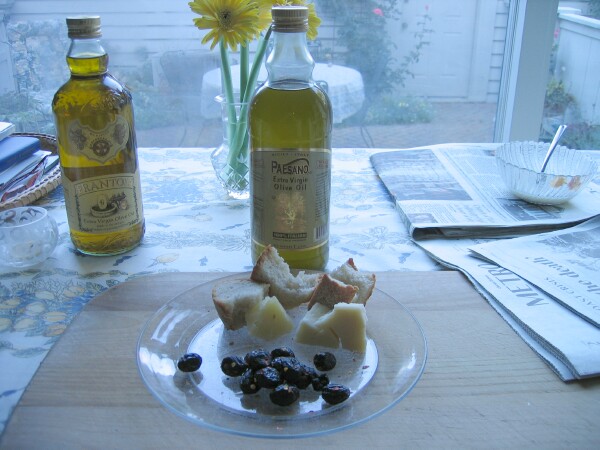
I recently bought a bottle of Tassos organic extra virgin olive oil from Crete at Costco, which I mistakenly though Mr. Barolo recommended in this thread. Mr. B actually recommended Toscano from Italy. I found the Tassos somewhat nondescript.
Antonius wrote:Crushed red chile pepper is also sometimes suggested for inclusion in this dish, an option which I find especially attractive.
I thought about adding crushed red chile, next time out for sure.
Enjoy,
Gary
-
-
Post #12 - October 13th, 2005, 2:17 pmI also made this dish last night, although I did not document the process photographically. Unfortunately, I had much less basil than I thought (probably a quarter of what Gary has shown), so I think the dish lacked a certain brightness of flavor and came to be dominated by the two cloves of garlic I used. I also found I had no spaghetti or bucatini, so I substituted fettucine, which sopped up a lot of the tomato juices (probably due to its large surface area), leaving the overall dish a little dry for my wife's taste. Perhaps I should have added more oil (I was using a Trader Joe's reserve bottle, which purports to be mostly Sicilian, so it seemed appropriate).
Despite the limitations of my mise en place, I enjoyed the dish very much and look forward to experimenting with the proportions further. Thank you for bringing it to our attention, Antonius.
-
-
Post #13 - October 13th, 2005, 2:28 pmMaple Leaf wrote:...leaving the overall dish a little dry for my wife's taste. Perhaps I should have added more oil (I was using a Trader Joe's reserve bottle, which purports to be mostly Sicilian, so it seemed appropriate).
Despite the limitations of my mise en place, I enjoyed the dish very much and look forward to experimenting with the proportions further. Thank you for bringing it to our attention, Antonius.
ML:
Forgive me if I'm saying something you already know but on virtually all occasions that I make pasta, I always save some of the cooking water, just in case noodle and dressing combined ends up with a shortage of the latter. A little splash or two can make quite a difference. And, as you say, more oil can also alleviate the dryness issue. Especially in a dish like this, adding a bit more oil won't hurt (except perhaps the waistline).
I apologise if my vague notes on the proportions were misleading or unclear; for dishes like this I never measure anything except, perhaps, the amount of pasta to be cooked.
AAlle Nerven exzitiert von dem gewürzten Wein -- Anwandlung von Todesahndungen -- Doppeltgänger --
- aus dem Tagebuch E.T.A. Hoffmanns, 6. Januar 1804.
________
Na sir is na seachain an cath.
-
-
-
Post #14 - September 17th, 2006, 5:58 pmArab influence on Sicilian cuisine is indisputable. The extent of Arab influence on Sicilian cuisine is, to put it mildly, subject to some disagreement.
I don’t know enough to know which horse to back, but I do know enough to appreciate the cuisine. Recently, after some serious investigation, I committed to a cookbook, purchasing the estimable Mary Taylor Simeti’s Sicilian Food (originally published in 1989 as Pomp and Sustenance). The book is a wonderful combination of stories, history, and recipes.
Tonight I decided that the time had come to begin with one of the simplest recipes in the book, pesto trapanese, named for the town of Trapani on the far western tip of the island. The Arabs arrived there, historians tell us, around 827. And this dish depends for its essence on ground almonds, an ingredient common to both classical Arabic cooking as well as that of the Italian Renaissance.
Indeed, the ingredient list couldn’t be simpler: garlic, olive oil, salt, almonds, basil, black pepper, and tomatoes. (The oil, courtesy of GWiv, was the LTH Great Olive Oil Tasting champ, Kolymvari, from Crete.)

Ecco tutto, as Fra Antonio—whose living shade casts its penumbra over this entire preparation—might say.
In no time at all I whipped up this deceptively simple little dish and tasted. Madonna mia, what a sauce!

The tomatoes add without being in noticeable. So too the basil: it’s there without taking over or even reminding one of its Genoese cousin. The almonds give the final product a marvelous texture and appearance and lend a truly distinctive flavor. The black pepper, added at the end...the perfect finishing touch. I don’t recite the recipe in any detail because it’s so simple (although the curious may PM me).

The sauce, standing alone, is tangy and pungent without overwhelming the palate. When mixed with the pasta, the sharpness (and I mean that in the best possible way) diminishes. I, personally, prefer the sauce right out of the bowl without the benefit of intercession. But even when reduced in drama, the whole dish is a terrific new way in to Italian cooking.
I enjoyed the pesto immensely and look forward to choosing another recipe!Gypsy Boy
"I am not a glutton--I am an explorer of food." (Erma Bombeck)
-
-
-
Post #15 - September 17th, 2006, 6:11 pmGypsy Boy,
Che bravo! Excellent looking plate of pasta there, though, per my general inclination, I might use a little less of the dressing. Some time back last fall I did an illustrated post on this very dish:
• Pesto alla Trapanese
http://lthforum.com/bb/viewtopic.php?p=46822#46822
I'm rather fond of the picture of me and Heliogabulus at the top of the post. Note too that GWiv added his own very handsomely illustrated post further on in that thread.
Anyway, it is most definitely a very fine dish.
AAlle Nerven exzitiert von dem gewürzten Wein -- Anwandlung von Todesahndungen -- Doppeltgänger --
- aus dem Tagebuch E.T.A. Hoffmanns, 6. Januar 1804.
________
Na sir is na seachain an cath.
-
-
-
Post #16 - September 17th, 2006, 6:21 pmAntonius,
Many thanks, though I find myself embarrassed and humbled by your effort (and post). Shoulda checked first.
However, having failed to do so and having now irrevocably committed myself, I notice that our preparations diverge in one key item: the breadcrumbs at the end. Interestingly, given the exchange with GWiv in your original thread, Lovely Dining Companion urged some freshly grated cheese and I resisted out of a sense of (for lack of a better word), inappropriateness. Or perhaps a fear of gilding the lily. The breadcrumbs are not in Simeti's recipe and while I find their addition intriguing, I wonder whether they are (pardon the intrusion of a lively debate here) "authentic." All I really mean to ask is, would the Trapanese serve it with the breadcrumbs? I suspect what lies behind my question is the fear, for lack of a better word, whether the breadcrumbs will still further moderate the sauce.Gypsy Boy
"I am not a glutton--I am an explorer of food." (Erma Bombeck)
-
-
-
Post #17 - September 17th, 2006, 7:42 pmMy inclination is not to use cheese in this dish but I have seen recipes by Sicilians who call for or allow for the addition of pecorino or caciocavallo at the end. Breadcrumbs are not a 'must' in a general existential way (appy-polly-logies for possibly being misleading in that regard above) but to my mind they add a great textural element and do not upset the balance of flavours in the sauce itself; breadcrumbs are a fairly common addition to this dish (and, of course, to many other Southern Italian pasta dishes). In fact, I've seen recipes in which breadcrumbs take the place of the almonds -- I suspect that that's an old fashioned 'cucina povera' approach where the 'povertà' was especially oppressive. I've also seen some pine nuts added in alongside the almonds. The addition of peperoncino is another possible variant (and one I very much like, though it doesn't work if I'm cooking for Lucantonius). Finally, there are debates about whether or not to toast the almonds...
So, there is a certain amount of room for variation, pretty much all of which makes sense in the overall context of Sicilian and, more broadly, Southern Italian cookery.
AntoniusAlle Nerven exzitiert von dem gewürzten Wein -- Anwandlung von Todesahndungen -- Doppeltgänger --
- aus dem Tagebuch E.T.A. Hoffmanns, 6. Januar 1804.
________
Na sir is na seachain an cath.
-
-
-
Post #18 - September 19th, 2006, 10:43 amThese photos and descriptions were so appealing, I had to try this dish. Unfortunately, I had to take liberties due to time constraints and ingredients on-hand. But the result was one of the best pastas I've ever made - truly a simple dish which is far greater than the sum of its parts. Light, but full of flavor.
I pretty much followed A's procedure with no idea what proportions to use, so I just winged it. Among the "liberties":
- Instead of grated tomatoes, I used some leftover pizza sauce: chopped San Marzano's from my garden, lightly seasoned.
- For the bread crumbs, I had some leftover pizza dough. It uses a sourdough culture, but has only the slightest tang and a rich flavor. I baked up one of the skins and pulverized it in the food processor with some oil and salt. Then I toasted them in the oven. Wow! Best bread crumbs ever!
- I used Neapolitan basil from my garden which is much more potent than the Genovese variety.
- OK, here is where the purists may show me the yellow card: I was very pressed for time so I used the food processor instead of grinding in a mortar.
This dish is a real keeper. Thank you, Antonius.

Bill/SFNM
-
-
-
Post #19 - November 22nd, 2009, 3:35 pmSpaghetti al pomodoro con menta e mandorle
un po' nello spirito del pesto alla trapanese
Pesto alla trapanese is a preparation that really deserves to be made with top quality tomatoes and basil and, at this time of year, those ingredients are generally not available at top quality. Be that as it may, the dish to be described below is not to my mind a version of pasta al pesto rosso but I thought it appropriate to post it here as it is with respect to flavours somewhat in the same spirit, specifically with regard to the use of almonds and also the use of mint, which is sometimes used in preparations of the tomato-almond pesto. I decided to use mint in this dish rather than basil for two reasons: a) I love mint; b) I still, at this late date, have a huge quantity of beautifully tender and delicious mint growing in my garden.
Ingredients for condiment: olio evo (small amount); two salted anchovies, washed; pinch of crushed peperoncino; one medium sized clove of garlic; two medium sized tomatoes, peeled and chopped; black pepper; a few leaves of fresh mint, roughly chopped or torn.
Pasta: spaghetti, preferably of the thicker sort, cooked very much al dente, finished in the pan with the sauce.
Ingredients for finishing: some partly crushed almonds and a small handfull of fresh mint (chopped or torn); splash of highest quality oil.
At table: incanestrato siciliano (opt.).
Here are the central ingredients:
... and the anchovies and peperoncino subfrying in a little oil:
Tomatoes in the pan:
Since I have excellent olio nuovo on hand, I used just a little basic oil (very good olio evo but just my everyday cooking oil) to start the dish, allowing for me to use a nice bit of the delicious and intense new oil for finishing, without rendering the final product excessively oily:
This dish is flavourful enough that no cheese is needed but I did try it with a modest amount of 'ncannestratu grated fresh onto it and, to be honest, the effect was pretty darn nice:
Bon pro',
Antonius
Links to other recipes and cooking notes by this writer: viewtopic.php?p=55649#55649
Alle Nerven exzitiert von dem gewürzten Wein -- Anwandlung von Todesahndungen -- Doppeltgänger --
- aus dem Tagebuch E.T.A. Hoffmanns, 6. Januar 1804.
________
Na sir is na seachain an cath.
-
-
-
Post #20 - November 22nd, 2009, 5:19 pmAiu bisognu d' 'a puisia pi ddiri chiddu ca non si po' ddiri (hope I got that right...)
Beautiful contribution...as always. Many thanks for the update/variation.Gypsy Boy
"I am not a glutton--I am an explorer of food." (Erma Bombeck)
-
-
-
Post #21 - November 22nd, 2009, 6:08 pmGypsy Boy wrote:Aiu bisognu d' 'a puisia pi ddiri chiddu ca non si po' ddiri (hope I got that right...)
Beautiful contribution...as always. Many thanks for the update/variation.
Milli grazi, amicu miu... ben dittu e ben scrittu è... ma si troppu gentili...
Saluti amichevoli da noialtri -- tutta a famigghia -- a te e pure a Eldici (a.k.a. Renata)...
AndogneAlle Nerven exzitiert von dem gewürzten Wein -- Anwandlung von Todesahndungen -- Doppeltgänger --
- aus dem Tagebuch E.T.A. Hoffmanns, 6. Januar 1804.
________
Na sir is na seachain an cath.
-
-
-
Post #22 - November 22nd, 2009, 9:34 pmAlways great to see your posts Antonius!
In pestos and preparations like the last one above, fried or otherwise, do you tend to use Marcona almonds specifically or simply what is at hand?
-
-
-
Post #23 - November 23rd, 2009, 10:21 amsazerac wrote:Always great to see your posts Antonius!
In pestos and preparations like the last one above, fried or otherwise, do you tend to use Marcona almonds specifically or simply what is at hand?
Hey sazerac -
Greetings and thanks...
Good eye on that! Yes, those are Marconas I used in this recipe just above... I have become addicted to the things and have them around all the time now for snacking purposes... And since they're around, I have started experimenting with them in cooking, using them in place of the kinds of almonds I've usually used in the past... I used the Marconas once in a pesto-type preparation -- with mint and fresh sheep's milk cheese (not tomato) -- some time back and it was delicious. If only there weren't so expensive...
AAlle Nerven exzitiert von dem gewürzten Wein -- Anwandlung von Todesahndungen -- Doppeltgänger --
- aus dem Tagebuch E.T.A. Hoffmanns, 6. Januar 1804.
________
Na sir is na seachain an cath.
-
-
-
Post #24 - September 9th, 2013, 11:39 amSurely there are others making this at this time. Perhaps the simplicity of the dish has precluded additional mention and pics here, but I just wanted to bump this up given our most excellent dinner yesterday. Used breadcrumb dusted cauliflower as a side/topping. I thought I was boiling up too much spaghetti but we didn't have any left overs. The child that doesn't normally tomato went for it too!
Grazie, Antonius!
-
-
-
Post #25 - September 10th, 2013, 10:15 amI would like to make this soon. My inclination is not to put all the ingredients together but to make the pesto and tomato separately and add the crushed nuts and toasty bread crumbs and toss them in. I'm afraid of sogginess. I'd also have cheese cause I love it!!!Toria
"I like this place and willingly could waste my time in it" - As You Like It,
W. Shakespeare
-
-
-
Post #26 - September 11th, 2013, 10:04 amI had read Antonius' wonderful recipe a few years back & promptly forgot about it. Now I have to make it, especially after having visited Sicily a couple years ago, but Taormina on the eastern coast, not Trapani on the west. I had thought the pine nuts so prevalent in dishes in eastern Sicily were North African-influenced, but almonds are certainly a staple of Algeria & Morocco as well. Did not see any almonds in Taormina except in the pastries.
-