

I might be a ginius* or casting a new light on the big bird
I might be a ginius* or casting a new light on the big bird
-
-
-
-
-
I might be a ginius* or casting a new light on the big bird
-
Post #1 - November 28th, 2009, 1:05 pmThanksgiving has got to be my favorite holiday of all: not only is it focused on family and a big meal, but the foods of thanksgiving are some of my personal favorites, in particular, turkey.
Now, turkey and I have not always been on speaking terms. My Argentine mother, who could turn a chuck steak into something approaching filet mignon, was hopeless with the big bird. Not surprising, since she came from a culture that once used fowl in its spectator sports - and, yes, our Thanksgiving turkeys invariably had the interior texture of a soccer ball. I thought I didn't like turkey, and restricted myself to the dark meat smothered in as much gravy as I could muster. Then one day I was at a friend's house for dinner; and her Midwestern mother had roasted a turkey just for the heck of it. I'd never tasted anything like it: the breast meat was delicate and toothsome, not the slightly-turkey-flavored asbestos fibers I was used to. The dark meat was slipping gently off the bones, iron-y and delicious. None of it needed gravy, though gravy there was. My epiphany in poultry had to wait until I had my own kitchen and enough guests to help me eat a whole bird, but I never forgot that first non-dessicated bite and resolved to imitate it as soon as possible.
Of course, the issue with turkey is that the breast meat cooks at a different rate than the dark meat: you want to pull the breast at 155 or 160 degrees, but the dark meat is best if cooked to about ten or fifteen degrees higher. There are a million ways that people address this issue, but all of them have their drawbacks: butter doused-cheesecloth or aluminum foil heat shields on the breast leave you with soggy skin; brining requires a dedicated space and container, and spatchcocking or cutting up the bird takes away from that Norman Rockwell moment I really don't want to miss on Thanksgiving day. Generally, my personal method was to cook the turkey to around 160, pull it, serve the perfectly-cooked breast, curse at the pink dark meat, put the dark meat back in the oven, forget it until it was dried out and later, smother it with sauce in some way (apparently David Rosengarten espouses this method, though he probably remembers to pull the dark meat in time) Of course, this method wasn't working for me, and I wished there was a way to separate the breast from the dark meat...but the more I thought about it, the more I realized that I'd have a flat-chested turkey, and no girl wants that. I kept imagining inventing an aperture to replace the ribcage, so you could drape your breast meat over the thighs after they'd finished cooking.
Lately, Fresh Farms has offered very nice smallish every-day sort of turkeys from Rosebud Farms, and as I love the bird, I'd purchase one now and again. A quarter-turkey is about exactly right for a meal for three people, so I'd quarter them, cook one portion, and freeze the remainder. My turkey epiphany had waited for this moment: I suddenly realized that the turkey's torso naturally separated the white and dark meat: the ribcage is attached to the thighs only by some skin and a thin strip of tissue. Even better, the spine of a turkey is unexpectedly easy to snap, just make the turkey do a pas de poisson and keep going until it breaks apart.
Thus, this year, when we got our 14-pound turkey (also from Rosebud Farms, why mess with what you know is good) I treated it this way (note, if you're at all squeamish about raw meat, this may be a good place to stop:)


There's just a little tissue to cut after the spine is snapped; I left the legs trussed together and would recommend tying the drumsticks securely first, as this shape is going to be necessary later. The only way in which this didn't quite work perfectly was that the skin pulled back past the breast and the leg: I think a simple fix would be to stretch the skin down over the gap and pin it in place with old-fashioned trussing pins; I'm guessing it will cook into place. I also cut off the big glob of fat that you find at the neck, cut it into two pieces, and stuffed a piece under the skin on each side of the breast. After this, I dry-brined or kashered both sides, rubbing them well with well-seasoned sea salt until they were completely crusted over, and put back in the fridge, uncovered, until we were ready to cook (you can do it overnight, I did it in the morning and was happy with the result.)

So, I made a little "rack" of leeks and onions, and set my dark meat in the roaster in a 350 degree oven (I figured I wouldn't mess around with the raised and lowered temperatures, though in future I think the skin needs the higher temp to brown) rinsed off the dark meat, and cooked it for 30 minutes with its own thermometer set in the thigh (I just came up with the time randomly, since this was my first effort.)
When the time passed, I rinsed and dried the breast meat, stuffed the cavities with aromatics and herbs (onion, orange, rosemary and thyme) and plunked it down on top; it came together surprisingly easily.
Perhaps the most exciting thing I discovered was that the two separate parts of the turkey were very easy to remove; we thought the dark meat was done too early and were able to pull it without disturbing the breast; after checking it, we replaced it, no harm, no foul. So, when we decided the beast was done (I will admit here, in my zeal to try this method and because of my hatred of overcooked turkey, our turkey was a little underdone - this is easily corrected for, though) we pulled each part and reassembled them on the platter:


It was good. I'll be doing this again next year.
* When Sparky gets 100% on his spelling tests, (as he does often, not surprisingly) he writes "I'm a ginius" in response to the teacher's gold star. The world will be a less charming place when genius finally makes it to the spelling list.
-
-
Post #2 - November 28th, 2009, 1:55 pmGreat idea and one I will definitely be using next year.
PS, I've always thought GENUIS would be a great license plate.I used to think the brain was the most important part of the body. Then I realized who was telling me that.
-
-
-
Post #3 - November 28th, 2009, 2:54 pmWhy didn't anyone ever think of this before?
I have seen Jacques Pepin do something somewhat similar, but not as visually appealing.
Great idea, I look forward to trying this--"Goldie, how many times have I told you guys that I don't want no horsin' around on the airplane?"
-
-
-
Post #4 - November 28th, 2009, 3:33 pm
 Yes, right after I was preening myself on this discovery, this episode of Cooking with Julia and Jaques came on; it's not an entirely new idea. I do like their idea of boning out the dark meat and stuffing it, (and plan to steal it for my frozen turkey quarter.) You're right, Cito - flopping the two separated leg/thighs alongside the breast the way they did doesn't quite make for the same presentation.
In my case, it was kind of amazing how the two parts, whether cooked or uncooked, fit together sort of like a Lego piece. I can't wait to try this again next year and see if the skin will, in point of fact, stretch to cover the armpits - after all, if that turkey got any exercise at all, there should be plenty of skin between the upper and lower torso.
-
-
Post #5 - November 25th, 2010, 8:54 amIf you're crazy and have access to a lab, you might want to cook your turkey [urlhttp://www.cookingissues.com/2010/11/24/happy-thanksgiving-dont-poison-your-family/#comment-9969like this.[/url]
-
-
Post #6 - November 25th, 2010, 9:52 amI'm doing the cut-up bird this year per Julia's recipe. I wanted the extra parts to make stock with. I was surprised how easy it was to cut up....all I needed was a sharp chef's knife. We'll see how it goes.i used to milk cows
-
-
Post #7 - November 25th, 2010, 1:25 pmToo busy to post pictures now, but found that if you cut the skin with the excess on the breast side, you can stretch it and skewer it so that it covers the naked bits. Easy-peasy.
-
-
Post #8 - November 26th, 2010, 8:22 amAnd here are said pictures:

001 by michelehays, on Flickr
002 by michelehays, on Flickr
After roasting, skewers were removed, skin stayed in place nicely. You would never know this year's turkey was in two parts:
047 by michelehays, on Flickr
-
-
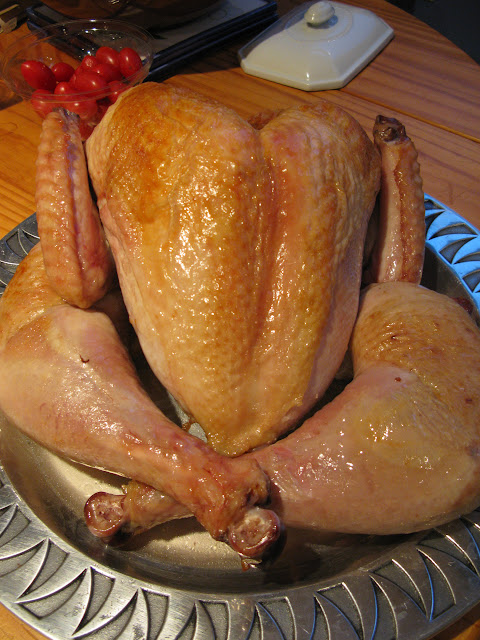
Post #9 - November 26th, 2010, 9:52 amHere's mine. A little pale. I would've put it under the broiler for a few minutes, but people were waiting, etc...oh well. Just threw it on the plate to take a picture. De-boned the thigh before cooking, which worked out great for carving. Pre-brined bird from Whole Foods. $1.79/lb. Tasted pretty good. I think I prefer a non-brined heritage breed.
 i used to milk cows
-
-
Post #10 - November 26th, 2010, 11:09 am" not the slightly-turkey-flavored asbestos fibers I was used to. "
The problem for most is not how you cook a whole turkey but the kind of bird you cook. Frozen adulterated birds are usually dry, hence the 'basting' solution added, which of course adds water weight to the turkey.
Without any of the above gyrations, all I did was to stuff a freshly killed bird, put Al foil around the legs and roast in a 375F oven until an indicated 180F on the leg bone and stuffing about 175F. No problems, easy and more important the white meat was not dry but very moist and tasty as was the leg meat.
These methods I read about are solutions in search of a problem and if the right type of bird is chosen, there is no problem.-Dick
-
-
Post #11 - November 26th, 2010, 12:33 pmBud -- Sometimes the ride is more interesting than the destination.
 i used to milk cows
-
-
Post #12 - November 26th, 2010, 1:13 pmOctarine wrote:Great idea and one I will definitely be using next year.
PS, I've always thought GENUIS would be a great license plate.
Actually, I have a friend who has that license plate."All great change in America begins at the dinner table." Ronald Reagan
http://midwestmaize.wordpress.com
