

Birrieria Reyes de Ocotlán, Pilsen
Birrieria Reyes de Ocotlán, Pilsen
-
-
-
-
-
Birrieria Reyes de Ocotlán, Pilsen
-
Post #1 - May 6th, 2005, 3:14 pmBirrieria Reyes de Ocotlán
For lunch today, Amata and I decided to stop by a place which we have long wanted to visit, namely, the Birrieria Reyes de Ocotlán on 18th Street, a little east of Blue Island, in Pilsen. The burning question at hand was: Can the birria of this little restaurant live up to the hyperbole displayed to all on the sign hanging over the front window?
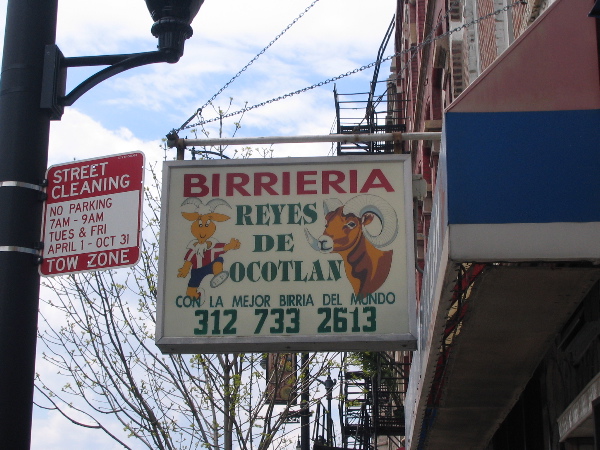
Well, the birria at Reyes de Ocotlán, while perhaps not indisputably the "best in the world," is without doubt really very good. For those who haven't had this dish or don't know anything of it, it is goat (chivo) or mutton (borrego) cooked by roughly the same method as is used in making barbacoa, that is, at least traditionally, baked in an underground pit or otherwise in a very tightly sealed vessel. Bayless refers to this method as "moist roasting."
The flavouring for birria estilo Jalisco (and yea verily, 't is in the State of Jalisco that the town of Ocotlán is located) generally involves chiles guajillo (definitely present in the version we had today), often chiles cascabel, tomato, garlic, oregano, cumin, cloves or cinnamon (today's version had only the latter), some other odds and ends, and often enough some spirit made from maguey, i.e., tequila or pulque; needless to say, there are many variants from within Jalisco itself and others from neighbouring states as well. The meat is smeared with a paste made of the flavouring agents and baked; the juices that run off are collected and form a wonderfully rich broth in which the meat is served. Here's how our platos chicos looked today:

Accompanying the broth and meat at Reyes de Ocotlán are just corn tortillas, halved key limes, toasted chiles de arbol, a delicious and fairly piquant red salsa and, of course, chopped onion and cilantro sprinkled atop the meat.
Beyond birria and its broth, all that is available at Reyes de Ocotlán are tacos of the head and tongue of the goat. Beverages available include run of the mill soft drinks but also horchata. The meats and broth are also available for take-out. A plato chico of birria costs $6.50
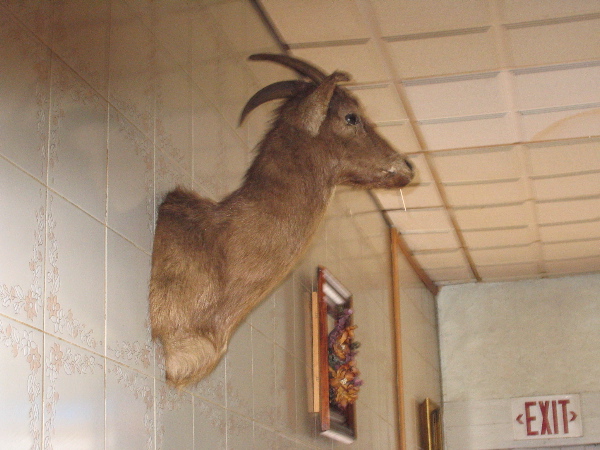
Just as the shops that specialise in carnitas (e.g., Uruapan, Don Pedro) seem necessarily to poke an excessive amount of (to my mind) tasteless fun at the poor creatures who are cooked there, the folks at Reyes de Ocotlán also feel the need to get laughs as well as tasty meat from their goats. See below the stuffed goathead and note carefully the toothpick which festoons his lips:
Reyes de Ocotlán makes very tasty birria estilo de Jalisco. We intend to return there soon.
Antonius
Birrieria Reyes de Ocotlán
1322 West 18th Street
Chicago, Illinois
312-733-2613
"Con la mejor birria de todo el mundo y sus sabrosos taquitos lengua y cabeza."Alle Nerven exzitiert von dem gewürzten Wein -- Anwandlung von Todesahndungen -- Doppeltgänger --
- aus dem Tagebuch E.T.A. Hoffmanns, 6. Januar 1804.
________
Na sir is na seachain an cath.
-
-
Post #2 - May 8th, 2005, 3:40 pmMy understanding is that barbacoa is traditionally roasted (although wrapped in leaves) whereas birria is traditionlly braised. (And, of course, there's also the barbacoa which is a head that's steamed.)
Do you know how they specifically made it there. The birria I had in Chicago was quite soupy like the birria of Guadalajara. Here in Oregon, birria is often soupy, but sometimes seems slow roasted. I think this is often the case at Michoacano restaurants. (We seem highest in Michoacanos.) This is birria de chivo on a huarache at a place here in greater Portland:

btw, I went to this Birrieria while in Chicago and thought it just decent. I like the stuff at Maxwell better:

-
-
Post #3 - May 8th, 2005, 8:30 pmI agree that barbacoa and birria a related but slightly different products. Barbacoa is usually served *almost* dry, that is the meat is moist from the cooking but not otherwise served in liquid. Birria seems to be served in a little to a lot of liquid.
Except:
Years ago (so it seems) GWiv and I spotted this place near Western and 47th. It seems one of the great un-discovered spots in Chicago, because after snapping pics, it seems that no one has ever returned. Gary and I did not eat there at the time, we were on a scouting mission.
Look at it (from the GWiv archive)

Big chunks of roasted goat on offer as birria. Yet, looks like pretty much nothing else found around town as birria or barbacoa. But looks good, no?
Oh, and yea, perhaps the birria at Maxwell Street is some of the best.
RobThink Yiddish, Dress British - Advice of Evil Ronnie to me.
-
-
Post #4 - May 8th, 2005, 9:05 pmVital Information wrote:Years ago (so it seems) GWiv and I spotted this place near Western and 47th.
That’s Birrieria Jalisco at 2462 W 47th St, right? Haven’t been there myself, but don’t they serve the meat with comsome? There’s so much to visit on W 47th, mostly Mexican. The densest concentrations are between Western & California (2400-2800) and especially between Ashland & Damen (1600-2000).
-
-
-
Post #5 - May 8th, 2005, 9:06 pmVital Information wrote:Oh, and yea, perhaps the birria at Maxwell Street is some of the best.Rob
As it happened, I was up before dawn this morning, so went over to Maxwell Street just as the sun was poking up. Most vendors were not open yet, which made the visit somewhat hellish in that the smells of wonderful food were everywhere, but almost none of the food was fully cooked and ready to eat...however, Birrieria Ocotlan was fully operational, so I got a cup of birria, which was outstandingly good as a wake-up beverage. Piquant, but not an over-heated mega-Scoville shock to the stomach, bracing and full of flavor. Just for the sake of form, I queried if the meat was goat or beef and was told, perhaps of course, that it was beef.
Of note: none of the stalls, even those advertising champurrado, actually had champurrado...and I assume, as the mornings get warmer, that there is diminishing demand for this warm drink, so it's not offered.
Hammond"Don't you ever underestimate the power of a female." Bootsy Collins
-
-
-
Post #6 - May 9th, 2005, 2:25 pmBasic Point:
Within Mexican cuisine, birria is regarded as a form of barbacoa, a status which reflects the fact that birria shares the same basic cooking method used to prepare barbacoa: these dishes are, to use Bayless’ term, moist roasted: Birria is not braised and the primary association of barbacoa in Mexican cuisine is not with dry roasting.
*****
Antonius wrote:For those who haven't had this dish or don't know anything of it, it is goat (chivo) or mutton (borrego) cooked by roughly the same method as is used in making barbacoa, that is, at least traditionally, baked in an underground pit or otherwise in a very tightly sealed vessel. Bayless refers to this method as "moist roasting." [emphasis added]extramsg wrote:My understanding is that barbacoa is traditionally roasted (although wrapped in leaves) whereas birria is traditionlly braised. (And, of course, there's also the barbacoa which is a head that's steamed.)
My understanding of the relationship between barbacoa and birria is that traditionally they do indeed involve roughly the selfsame cooking method and, moreover, that to a degree the two terms can be seen as different regional names for analogous (though not identical) dishes. This last point needs to be qualified in the above manner because there are variations along several parameters which do not wholly conform to a simple and neat division between barbacoa on the one hand and birria on the other. Let me elaborate on this point:
Regarding Mexican cuisine(s) as a whole, one can with justification say that birria is a term used in (roughly speaking) West-Central Mexico that refers to a style of meat preparation more generally known across the country as barbacoa; in other words, birria is the regional name for a form of barbacoa that is popular in West-Central Mexico. This term “West-Central Mexico” I happily borrow from Rick Bayless (1987: 22), who uses it as the appellation for one of six basic culinary regions into which he divides Mexico; his divisions are quite well considered (see the footnote, p. 22-3, and the map, p.24) and to my mind highly useful.
In specific connexion to the relationship between barbacoa and birria, Bayless (1987) states the following:R. Bayless wrote: (p. 240-1) “...[K]id plays a role as well in barbacoa, pit cooked meat that has been wrapped in aromatic leaves and set on a rack over simmering broth. In Central Mexico, large open-air restaurants still cook maguey-wrapped lamb in brick pits and serve it with a salsa borracha of pasilla peppers and pulque... But in most areas , the method has evolved away from the pit: In the West-Central states, lamb or kid is chile-marinated and slow-roasted on a rack in a sealed container (birria they call it)...”
(p. 256) “Birria is the West-central cousin of the Central barbacoa –– the special-occasion, pit-cooked lamb in maguey ‘leaves’. And for the most flavourful version of birria, lamb or goat is spread with chile paste and baked tightly covered to roast amd steam in its juices...
While my understanding of the relationship between barbacoa and birria has been in part informed by Bayless’ comments on the subject, I also based my comments in the original post on information gathered from the reading of a wide number of sources in Spanish. From reading of recipes for various dishes called either barbacoa or birria, it has become clear to me that both names can involve pit-roasting or roasting in a sealed vessel on a rack and out of direct contact with any liquid present. To my mind, the requirement that the meat be out of contact with any liquid renders the term “braising” inappropriate as a description of the basic cooking method involved in preparing barbacoa and birria. Note too that the use of maguey leaves is found in recipes bearing both names but also is left out of others. For example, a recipe we have for birria de chivo y de res from the State of Nayarit uses only a chile paste rub and no maguey leaves (so too Bayless’ recipe for birria de chivo o de carnero (1987: 256-7)), whereas recipes for the classic birria estilo Jalisco generally include the use of maguey.
To further support my claim that birria “is goat (chivo) or mutton (borrego) cooked by roughly the same method as is used in making barbacoa” I call attention to the following citations:
_______________________________________
http://www.mexgrocer.com/glossary.html
Barbacoa: Meat cooked in an underground pit, usually wrapped in banana or agave leaves.
Birria Jalisco's barbacoa specialty. Usually made from lamb or goat, or a combination of both.
_______________________________________
http://www.gestialba.com/public/recetas ... astb01.htm
Birria. Especialmente en Jalisco, birria es una especie de barbacoa de chivo, borrego o puerco. Se cocina a vapor, y para ello hay dos métodos. uno, poner hojas de maguey y en la parte inferior de la olla para que el líquido no toque la carne; y el otro, utilizar una rejilla en la olla con el mismo objeto.
_______________________________________
http://www.pulsoslp.com.mx/Impulso/VerA ... &NP=8&rsu=
La barbacoa es eso, un sistema de cocción en el que la carne no tiene contacto directo con el fuego, sólo con el calor de la tierra, sin mezclar líquido alguno que pueda hacerle perder parte de su sustancia y sabor...
...La birria, uno de los platillos más populares en Jalisco, también está hecha con barbacoa de borrego o chivo servida en un caldo de chile y jitomate.
_______________________________________
So then, does this mean I think barbacoa and birria are different names for the same thing or that I think they are prepared in exactly the same way? No. Birria, especially in the very famous style of Jalisco, is cooked in the presence of liquid (but not braised!) and the liquid is ultimately turned into a savoury broth (Spanish consomé) which is then typically (though not necessarily) served with the meat. The greater quantity of liquid present in the roasting pit (or vessel) and the serving of the mean in brodo is not characteristic of many or most recipes or regional varieties of barbacoa BUT there are, I believe, regional “barbacoas” which do involve such broth and, though at the moment, I can’t remember where I’ve seen such a recipe (perhaps it was one from Aguascalientes), I did just come across the following passage from Diana Kennedy’s Recipes from the regional Cooks of Mexico (1978: 118-9):Diana Kennedy wrote:Meat cooked en barbacoa is Sunday food in Mexico, and varies tremendously from region to region. The word barbacoa refers to pit barbecuing; meat cooked on stakes over a wood fire is called carne asada al pastor... There are specialists who dedicate themselves to this pit barbequing, as it takes a great deal of preparation and long cooking. Perhaps the most popularly known barbacoa is that of central Mexico –– the states of Hidalgo, Tlaxcala, and Mexico –– where the unseasoned meat, usually mutton, is cooked in a pit lined with maguey leaves... [b]A metal pan is placed under the meat to collect the juices, which are served separately in small cups as consomé de barbacoa; thick, rich, and tasty, this is almost the best part.
Quite obviously, this dish of central Mexico, despite various differences of details, is in all basic ways prepared like the famous birria of Jalisco in West-Central Mexico.
To sum up: barbacoa and birria both involve roasting in a tightly closed space, either in a pit or a sealed vessel. Both may involve the wrapping of the meat in maguey leaves. Birria is, however, generally roasted in the presence of a certain quantity of liquid which serves as the basis of a broth with which the meat is served. Barbacoa, it seems to me, typically involves the presence of some liquid (often just water, for the moist element of the moist roasting) and may be (regionally) but is not necessarily accompanied by a broth. I would then suggest that these terms can be regarded in the following semantic continuum:
1 *“barbacoa” = dry roasting (aberrant or marginal usage)
2 “barbacoa” = moist roasting, sometimes with broth (normal usage)
3 “birria” = moist roasting, typically with broth (normal usage)
4 *“birria” = braising? (aberrant or marginal usage)
In terms of what is common around Chicagoland, I think one can usually expect barbacoa here to be beef, especially beef head, and to be served with a sauce, whereas birria here is typically mutton or goat and generally –– though not necessarily –– served in broth.
***extramsg wrote:Do you know how they specifically made it there. The birria I had in Chicago was quite soupy like the birria of Guadalajara. Here in Oregon, birria is often soupy, but sometimes seems slow roasted. I think this is often the case at Michoacano restaurants. (We seem highest in Michoacanos.) This is birria de chivo on a huarache at a place here in greater Portland:Vital Information wrote:I agree that barbacoa and birria a related but slightly different products. Barbacoa is usually served *almost* dry, that is the meat is moist from the cooking but not otherwise served in liquid. Birria seems to be served in a little to a lot of liquid.
Except:
Years ago (so it seems) GWiv and I spotted this place near Western and 47th. It seems one of the great un-discovered spots in Chicago, because after snapping pics, it seems that no one has ever returned. Gary and I did not eat there at the time, we were on a scouting mission.
I don’t know exactly how Reyes de Ocotlán cooks its meat but I would guess it is not in an underground pit. Then again, I’ve never seen the backyard behind the building...
With regard to the above comments, it seems to me that there is confusion between the cooking process itself and the method of serving. Birria makers around here offer bowls of broth with meat in them but one can also buy just the “moist roasted” meat separately from the broth, or buy tacos made of the meat as a snack, without indulging in the brothy element.
*****
Finally, for clarity’s sake, I call attention to a not uncommon problem with small Mexican restaurants in Chicagoland...extramsg wrote:btw, I went to this Birrieria while in Chicago and thought it just decent. I like the stuff at Maxwell better:
Note that the place to which extramsg refers, Birrieria (Riveras) Ocotlán (on Cermak, west of Western, no?), is (to my knowledge) in no way affiliated with the restaurant I visited, Birrieria Reyes de Ocotlán. Ocotlán is a large town and it would not be especially surprising that there might be two unrelated birrierias owned by immigrants from there here in Chicago. I just thought that should be said explicitly, since both restaurants’ names feature most prominently the toponym “Ocotlán.” Note too that I don't mean to imply extramsg confused the two places, just that the casual reader of this thread may do so, focussing just on the word "Ocotlán."
I have not had the birria at the Maxwell Street market and, judging from respected opinions voiced on this board, surmise that it is very good and perhaps better than that of Reyes de Ocotlán. But I would be surprised if future comparisons all agreed that it was vastly superior, for the quality of product of the little 18th Street restaurant is quite high. In addition, Reyes de Ocotlán’s product is available seven days a week in an in-door setting, rendering birria pleasure more readily and, depending on ambient weather conditions or diners’ infirmities, more comfortably available.
AntoniusAlle Nerven exzitiert von dem gewürzten Wein -- Anwandlung von Todesahndungen -- Doppeltgänger --
- aus dem Tagebuch E.T.A. Hoffmanns, 6. Januar 1804.
________
Na sir is na seachain an cath.
-
-
Post #7 - May 9th, 2005, 2:54 pmAntonius, thanks for the data.
I still think/maintain that while I have had birria at several places in Chicago, in and out of its consome, I have never had it, or seen it, served so dry as in the above pic, almostlike some Mexican version of Italian beef, no? The above pic surely recalls BBQ or perhaps even carnitas as much as it recalls what one usually thinks of birria.
Now, of course to try!
RobThink Yiddish, Dress British - Advice of Evil Ronnie to me.
-
-
Post #8 - May 9th, 2005, 2:59 pmThanks Antonius.
To be clear, I wasn't suggesting that birrieria I went to was the same. I believe the one I went to was in La Villita.
-
-
Post #9 - May 9th, 2005, 3:22 pmextramsg wrote:Thanks Antonius.
To be clear, I wasn't suggesting that birrieria I went to was the same. I believe the one I went to was in La Villita.
After posting but before you or Rob replied I went back and reread (again) my post; I knew that you didn't mix them up and added a note to reflect that (you likely saw the initally posted pre-edit version).
But to add to the confusion for those who aren't used to these multiple names of little Mexican places, I noticed after posting that the place at the Maxwell Street market mentioned above by David H. also named isBirrieria Ocotlán. Judging from opinions stated, I doubt this is "Riveras" (the place you visited) and wonder whether it might be "Reyes"... Or is it yet a third place run by folks from Ocotlán?
Quizás...
***
Rob:
My guess would be that the drier version you saw was cooked by the usual "moist roasting" method but then finished in the oven to improve the appearance and texture. This finishing with some dry roasting before serving is used by some in Jalisco, something which I know only from a description of the process somewhere in one of the Bayless books.
AAlle Nerven exzitiert von dem gewürzten Wein -- Anwandlung von Todesahndungen -- Doppeltgänger --
- aus dem Tagebuch E.T.A. Hoffmanns, 6. Januar 1804.
________
Na sir is na seachain an cath.
-
-
-
Post #10 - May 9th, 2005, 3:27 pmAntonius wrote:But to add to the confusion for those who aren't used to these multiple names of little Mexican places, I noticed after posting that the place at the Maxwell Street market mentioned above by David H. also named isBirrieria Ocotlán. Judging from opinions stated, I doubt this is "Riveras" (the place you visited) and wonder whether it might be "Reyes"... Or is it yet a third place run by folks from Ocotlán?
A,
I checked the flier I picked up at the Maxwell St. stand. At the top it says in big letters "Birrieria" "Ocotlan" (sic), but at the bottom it says (and I didn't notice this before) "Les invitan Los Reyes de Ocotlan."
Hammond"Don't you ever underestimate the power of a female." Bootsy Collins
-
-
-
Post #11 - May 9th, 2005, 3:32 pmA- That's a lot of good info. FWIW, this came up a few weeks back, and I had linked to a very nice paper, in Spanish, on the history of birria in Jalisco. Part of the premise was that birria is an essentially Jalisciense dish. From what I recall the paper had a very old set of instructions for preparing the feast, including especially the proper arrangement of cuts in the olla, the bottom of which was to be filled with a modest amount of water, with the meat raised above it as you noted. The lid was then to be sealed on with a paste or "masa" of flour and water. Unfortunately, I could not today find the link, which is to the Mexican government's official culture and arts counsel. Birria was presented as distinct from barbacoa, though the statement was more certainly made than was the distinction.
I have made back yard birria a few times, using a very large institutional "olla" purchased from a restaurant supply store on Madison and sealing the lid with the same sort of paste; the ring from my turkey fryer provides the flame. As the whole thing is sealed tight, I don't get too hung up on the lack of carbon here. Pretty darn easy and mostly fool proof.
Becuase the whole process is closed, you end up with quite a lot of liquid (and fat) at the end from the meat. As the now-misplaced article suggested, the consomme can then be further doctored and stretched.
-
-
Post #12 - May 9th, 2005, 3:37 pmHere's the place I had birria from at Maxwell Street Market:

-
-
Post #13 - May 9th, 2005, 3:38 pmDavid Hammond wrote:
I checked the flier I picked up at the Maxwell St. stand. At the top it says in big letters "Birrieria" "Ocotlan" (sic), but at the bottom it says (and I didn't notice this before) "Les invitan Los Reyes de Ocotlan."
Hammond
David:
Muchas gracias!
... So then, I should perhaps emend that final paragraph a little... but I guess I can stand by the claim...Antonius wrote: But I would be surprised if future comparisons all agreed that it was vastly superior, for the quality of product of the little 18th Street restaurant is quite high. In addition, Reyes de Ocotlán’s product is available seven days a week in an in-door setting, rendering birria pleasure more readily and, depending on ambient weather conditions or diners’ infirmities, more comfortably available.

AAlle Nerven exzitiert von dem gewürzten Wein -- Anwandlung von Todesahndungen -- Doppeltgänger --
- aus dem Tagebuch E.T.A. Hoffmanns, 6. Januar 1804.
________
Na sir is na seachain an cath.
-
-
-
Post #14 - May 9th, 2005, 3:43 pmextramsg wrote:Here's the place I had birria from at Maxwell Street Market:
Yep, that's the same place I went.
Hammond"Don't you ever underestimate the power of a female." Bootsy Collins
-
-
-
Post #15 - May 9th, 2005, 6:05 pmThere’s another Birrieria Ocotlan at 8726 S Commercial Av. I had assumed it was related to the one at 3809 W 26th but I’m not certain. This fine fellow is painted on their glass door, gazing across the street at Olamummy African Restaurant and Video Store.

-
-
Post #16 - May 9th, 2005, 11:14 pmIt's off-topic, but all this discussion of displaying the animals which you'll be eating requires me to post a couple pics from Scott's website:
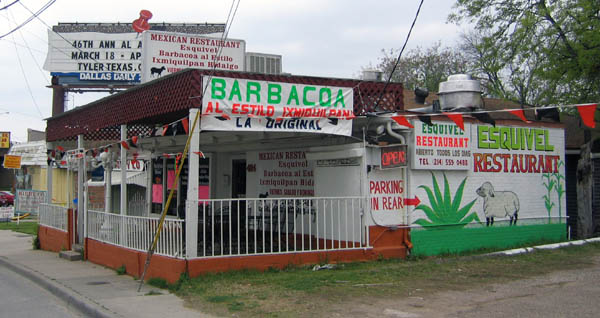 Barbacoa al estilo Ixmiquilpan
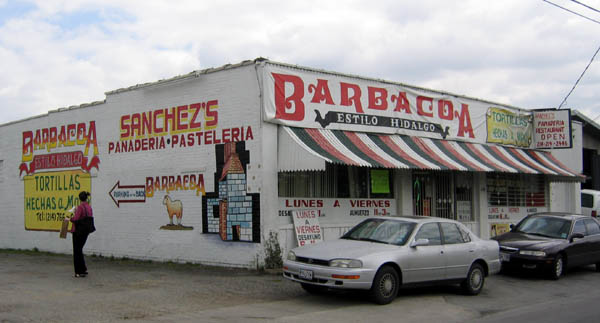 Barbacoa al Estilo Hidalgo
Maybe there wouldn't be so many vegetarians if we got used to seeing the face (even if a cartoon) of what we're eating.
-
-
Post #17 - May 10th, 2005, 4:03 pmI was interested to see that the carniceria on Ashland at approximately Blackhawk (it's a very good store with an excellent taqueria; I'm simply blanking on the name just now; Supermercado Leon, maybe?) has a freshly-painted and very well done mural depicting a maniacal cleaver-waving pig chasing a terrified carnicero. Nearby is a notice that carnitas are available. Looks very much like the classic Harold's Chicken signs, with the animals fighting back.
-
-
-
Post #18 - September 17th, 2005, 1:23 pmThe Wife and I had an opportunity to eat last night at Birrieria Reyes de Ocotlan. We had the birria in broth and in tacos, and it was stupendous. There is something terrifically satisfying about something so simple done so well.
Incidentally, for those of you who may have thought (as I once did), that the name of this place translates as Kings of Ocotlan (which I loved, especially in contrast with the magnificently humble restaurant itself), "Reyes" actually refers to the name of the family that owns the joint (if it were Kings of Ocotlan, I believe it would be "Los Reyes de Ocotlan").
Leaving, I asked Signora Reyes about the brown slabs in the plastic cabinet. Turned out to be membrino guayaba -- I expressed interest, and she tried to turn my attention to the prepackaged varieties (perhaps because they were "fancier") -- I went with the more "home-made" looking version, and it was a very fine and simple way to end a fine and simple meal.
Hammond"Don't you ever underestimate the power of a female." Bootsy Collins
-
-
-
Post #19 - September 18th, 2005, 1:06 amDavid,
As far as I know, "membrillo" (which I take it the owner meant) means quince, and the traditional Spanish dulce/pasta de membrillo was translated in Cuba, Mexico, etc. into pasta de guayaba (and mango and other tropical fruits), since quinces do not grow well in Havana. The classic "dessert" of queso blanco and pasta de membrillo/guava remains typical from Miami to the Malvinas.
Possibly because most Latin Americans north of Montevideo don't know from a quince, some have assumed that "membrillo" identifies the paste itself, regardless of the flavor. To this day, real membrillo paste has a higher status, which becomes apparent at Christmas time -- much the same as turron (nougat) from places such as Alicante and Jijona.
"Membrillo de guayaba" would mean, literally, "guava quince." This is all based on personal experience, not fancy book learning, so I stand to be corrected.
-
-
Post #20 - September 18th, 2005, 7:01 amJeffB wrote:I was interested to see that the carniceria on Ashland at approximately Blackhawk (it's a very good store with an excellent taqueria; I'm simply blanking on the name just now; Supermercado Leon, maybe?)
Jeff,
You thinking of Carnicerias Guanajuato? A group of us stopped there during a 'which is best' La Pasadita taste off a couple of years ago. East side of Ashland La Pasadita was, is, and remains over and above the other two, at least in my opinion.
I typically go to Guanajuato's California Ave branch (at Belmont), which also contains a taqueria and carniceria. The California Ave Guanajuato is next door to a nice little restaurant, Taqueria Traspasada, that serves goat a couple of ways on the weekend, including consomme.
Enjoy,
Gary
Carnicerias Guanajuato
1436 N Ashland
Chicago, IL
773-7725266
La Pasadita Restaurant
(773) 278-0384
1141 N Ashland Ave
Chicago, IL 60622
Taqueria Traspasada
3144 N California
Chicago, IL 60618
773-539-4533.
=x=x=x
Previously posted 11.03
Best La Pasadita on the East side of Ashland, hummmmm, who recently said the East side La Pasadita was the best?
East side LP's carne asada was served right off the grill, gas with flavorizer bars (I asked) and had the slightly charred meaty flavor that, to me, is the essence of a steak taco. The grill man at the East side LP also had a much lighter hand with the adobo than at the other two LP's or, for that matter, Laura or Guanajuato.
Barbacoa at the East LP was very good, soft, flavorful, not greasy, as was the lengua. All LP tacos, all kinds, all stands, were served with a light mix of cliantro and onion, with mildish green salsa either on the taco or side. Horchata was best of the day, still not Maxwell street good, but very acceptable.
LP West side/North had, as has been mentioned, a funky smell, which detracted right off the bat. The carne asada had an overly bright, from msg in either sazon, adobo or both, taste and greasy mouth feel. Lengua was good, barbacoa so-so. Horchata was not good, sticky/gummy mouth feel, overly sweet.
LP West side/South was slightly better than West side/South, but still not very good. Same msg brightness to the meat, same greasy mouth feel, so-so chips and even so-so, if that, black salsa. LP West/South has table service, but it was so disorganized I'd recommend getting the food yourself. Actually, I'd recommend not going there, but to the East side of Ashlsand LP.
We tried a couple of pollo tacos at the West side/South LP, slightly dry white meat, mostly flavorless. Horchata was ok, somewhere between the other two LP's. Lengua was ok, barbacoa not so good.
Taqueria Laura was good, clean interesting space in the back of a grocery, friendly owner, good looking groceries, Tuesday is fresh pork day, and not bad at all carne asada. There was moderate brightness from msg, some flavor from grilling, but the taco suffered from being held, the resulting loss of flavor and texture put Laura's steak taco a number of notches below East side of Ashland LP.
We also had a cecina taco at Laura, griddled dried beef, which was very good. Good beef flavor and slightly salty.
Harry V and I made one last stop at Guanajuato for steak tacos. I am familiar with the Guanajuato at Belmont and California and the Ashland branch is similar. I typically go to the California Guanajuato on the weekend, when there is quite a crowd so the meat is typically not held, but fresh off the grill, not the case today at the Ashland Guanajuato. The meat had a slightly steamed texture, decent flavor, but, again, with a chemically brightness from msg.
Nice grocery though, I bought pork adobado to grill, tortillas and fixings for salsa.
Enjoy,
Gary
La Pasadita Restaurant
(773) 278-0384
1141 N Ashland Ave
Chicago, IL 60622
La Pasadita 1, 2 and 3 on Ashland just South of Division.
Carniceria Y Taqueria Laura
1051 N Ashland Ave
Chicago, IL 60622
773-384-4567
Carnicerias Guanajuato
1436 N Ashland
Chicago, IL
773-7725266
6040 W Diversey
3140 N California
-
-
Post #21 - September 18th, 2005, 8:49 amLong ago there was a discussion on another board in which I recommended the taqueria at the very corner of Blackhawk and Ashland.
In fact, I lived cattycorner across the street for several years. On a good day their al pastor, steak tacos and green sauce were unbeatable. I no longer live in Wicker Park and actually avoid it was much as possible so no chargrilled, beefy goodness for me.
Oh, the CORNER taqueria is named Leon...just a bit further north is the Guanjuato with a taqueria inside which does get majorly packed at lunchtime.
-
-
Post #22 - September 18th, 2005, 9:09 amFor clarification, two great little spots sit almost across Blackhawk form each other on the West side of Ashland. The store with the top-shelf carnitas art is part of the Guanjuato chain and sits to the north. The other, Leon (de Guanjuato, IIRC) is a few door south.
As noted by me and one or two others before, Leon has probably the best pastor in the city (and great carne asada too). No grill at Leon, so the pastor is 100% done on the spit and steak is 100% done on the flame. Our resident TOC star agrees.Last edited by JeffB on September 18th, 2005, 4:06 pm, edited 1 time in total.
-
-
Post #23 - September 18th, 2005, 9:27 amI forgot: there's Leon to the south(on the corner west side), there's Guanjuato(same side just up the block), And, there's a supermercado almost directly opposite Guanajuato to the east. I used to buy beer, pulque, and beef jerky there. About 7 or more years ago they too, had a taqueria which I never tried. They kinda/sorta remodeled and ripped out the kitchen. Perhaps, they've opened it back up? The proprietor of the anonymous supermercado was one of the friendlier grocers along that strip of ocassional outright surliness. He also offered tubs of locally made mole' and sofrito. As I'm remembering, the Guanajuato used to have a vendor stationed outside on Wednesdays with passable green and red tamales. And, near the southern edge of the Kmart/Jewel parkinglot a popular elotes cart took up residence. Once, upon spying my bag of Leon tacos as I was exiting the cramped store, a young woman whispered of an according to her, much, much, better taqueria hidden somewhere to the to the East. In all my walks through my neighborhood I never came across it.
-
-
Post #24 - November 6th, 2005, 9:15 pmMy wife and I were out driving around looking for a place to have a late breakfast, early lunch. Having remembered this post, I decided to drive down 18th street. There is was, Birrieria Reyes de Ocotlan. It's something we had never tried before. It was our lucky day. A parking spot opened up just as we got there.
We went inside and it was packed. After a minute or two we sat down. Everyone in the place seemed to be enjoying their food. We ordered Platos chico of birria, two taco's with goat meat, one taco with the tongue, one taco with the head and a horchata. I actually only wanted two taco's but I was trying out my (bad) Spanish and ended up with four taco's instead. In the end, it paid off because we were able to try everything. The meat and the broth were excellent. It seemed to go well with this chilly autumn day. Try the taco's if you go but don't forget to squeeze a little fresh lime on them. The lime and the meat just go together.
I look forward to going back soon. Try this place.Sal G
Chi cerca trova.
-
-
-
Post #25 - November 6th, 2005, 9:41 pmTerrasini wrote:The lime and the meat just go together.
So true. A squirt of lime with birria, or beef, or chicken is just excellent. The acidic citrus is a perfect complement protein-dense muscle meat.
Hammond"Don't you ever underestimate the power of a female." Bootsy Collins
-
-
-
Post #26 - November 7th, 2005, 12:55 pmTerrasini wrote:My wife and I were out driving around looking for a place to have a late breakfast, early lunch. Having remembered this post, I decided to drive down 18th street. There is was, Birrieria Reyes de Ocotlan. It's something we had never tried before. It was our lucky day...
I look forward to going back soon. Try this place.
Sal:
I'm glad to hear you all got to BRdO and enjoyed it so much. It is a great place. That broth... ...
How was the tongue? I haven't tried it yet.
AntoniusAlle Nerven exzitiert von dem gewürzten Wein -- Anwandlung von Todesahndungen -- Doppeltgänger --
- aus dem Tagebuch E.T.A. Hoffmanns, 6. Januar 1804.
________
Na sir is na seachain an cath.
-
-
Post #27 - November 7th, 2005, 9:31 pmThe tongue had a stronger flavor than the meat and it was soft, like liver. I'm going to have it again the next time I go. Try it.Sal G
Chi cerca trova.
-
-
Post #28 - November 9th, 2005, 1:40 amYour discussion has elevated the subject of Mexican pit-roasting techniques to dizzying heights!
All these years I had thought (& been told) that barbacoa was the meaty parts of steam-roasted beef heads (mostly the "cheeks") and birria was pit-roasted goat which was served with the accompanying juices mixed with chiles.
Thanks for the culinary lesson! Now I have ganas to pick some up this weekend for tacos.
-
-
Post #29 - November 9th, 2005, 5:45 amArtemesia wrote:Your discussion has elevated the subject of Mexican pit-roasting techniques to dizzying heights!
All these years I had thought (& been told) that barbacoa was the meaty parts of steam-roasted beef heads (mostly the "cheeks") and birria was pit-roasted goat which was served with the accompanying juices mixed with chiles.
Thanks for the culinary lesson! Now I have ganas to pick some up this weekend for tacos.
De nada... ofrecido con mucho gusto...
Do check out Birrieria Reyes de Ocotlán...
AntoniusAlle Nerven exzitiert von dem gewürzten Wein -- Anwandlung von Todesahndungen -- Doppeltgänger --
- aus dem Tagebuch E.T.A. Hoffmanns, 6. Januar 1804.
________
Na sir is na seachain an cath.
-
-
-
Post #30 - November 28th, 2005, 1:28 amAfter reading this post a few times with my mouth watering, i decided to make a trip to - Birrieria Reyes de Ocotlán -
I have to say it is honestly my new favorite food. I had it about a week ago and i am constantly thinking about going again. At maxwell street I looked for something similar, but could only find birria tacos, hopefully next sunday i'll find the right place. The soup and spices were just the best compliment to the goat barbacoa, to take it out is a shame.
You say there are places with better spices? I'd love to know where, and I'll make that my next trip out.
Thanks forum!
-