

What's wrong with this bread?
What's wrong with this bread?
-
-
-
-
-
What's wrong with this bread?
-
-
Post #1 - March 15th, 2008, 4:40 pm

This would be sourdough bread. And everything about it was pretty good--not great, but pretty good. A little too dense and I suspect that has to do with my errors, specifically the one noted herewith.
What's with the huge air dome inside? I didn't let it rise three times, per the recipe, but given the small amount it had risen the second time (even after several hours), I decided to skip the third rising. The bake temp was around 400F, if I recall correctly. So am I correct in assuming that I should not have skipped the third rise? Or am I screwing it up elsewhere (too)?Gypsy Boy
"I am not a glutton--I am an explorer of food." (Erma Bombeck)
-
-
-
Post #2 - March 15th, 2008, 4:59 pmDid you knead it enough to develop the gluten? Did your flour have sufficient protein content? I'm sure there are other far more talented bakers here, but those would be the first two things I'd think about.
-
-
-
Post #3 - March 15th, 2008, 5:43 pmWhat "sourdough" leavening did you use? How long did you let it rise? I would try letting it ferment/proof maybe twice as long as you did. I bet you'd get a better crumb and you can then go from to home in on an optimum rising schedule.
Also, how did you shape the bread? That may have something to do with the big internal bubble.
Bill/SFNM
-
-
-
Post #4 - March 15th, 2008, 6:14 pmLooks like the dough formed a thick skin during proofing. While baking, the water vapors got trapped and had nowhere to go. Forming a skin is fine if you want crustier breads, but you'll need to slash the loaves to give steam an escape route.
Try doing the final proof in an airtight environment and scoring the loaf right before baking. This should improve the density of the bread as well since the loaf will be free to expand.
-
-
-
Post #5 - March 16th, 2008, 8:38 amThanks for the responses; great questions all and I'll try to respond.
1. Kneading may well have been one area where I skimped a bit. I kneaded for a while (ten minutes or so) by hand until the dough turned "shiny" for lack of a better word. The flour itself was King Arthur bread flour.
2. The leavening was a sourdough starter that I have used before without difficulty. (It began as a commercial starter purchased from the King Arthur folks and kept now for many months.) Quite sour and, although I replenish it only occasionally, it always shows very active signs of life each time I've done that.
3. As to the actual risings, I don't specifically recall, but based on the recipe and my past practice, I would guess that the first rise was around two to four hours and the second rising closer to the four hour mark.
4. Shaped by hand into a round loaf after another round of kneading.
5. If I understand what you're saying about the skin, I'd be very surprised. I always make it a point to keep the rising loaf covered and pay attention during the process to what things look like. (Not airtight, although I will try that today.) While it is, of course, possible, that particular problem seems less likely to me. On the other hand, as I think back, this was perhaps the first (only?) time that I don't specifically recall scoring the loaf...so you may be precisely right.
I'll be doing this all over again today (and, of course, in the future), so thanks again for all your guidance and help.Gypsy Boy
"I am not a glutton--I am an explorer of food." (Erma Bombeck)
-
-
-
-
Post #6 - July 3rd, 2009, 9:13 pmI don't have a picture, but anyone have any ideas on why my bread comes out a little flat (in shape)? I've been using Peter Reinhart's book (pain a l'ancienne, ciabatta, sourdough) and I'm really happy with the flavor, texture/crumb but the shapes are a little saggy (boule, batard, baguette--doesn't matter, they're all a little flat. How do I fix this? Should I buy a banneton for my boules? I'm trying to restrain myself and not any more gadgets to my collection.
-
-
-
Post #7 - July 4th, 2009, 10:07 amI bought a benneton only because I broke the bowl that I used to get the final rise for a boule. The bread is not flat but not real high either. As my son once said when he made a clay cup for fathers day it wasn't deep but it was wide. The bread is high enough and certainly wide enough. I am planning on buying an oval one as I do find that letting the bread rise this way looks better then free form.
Paulette
-
-
Post #8 - July 5th, 2009, 12:05 pmdon't have a picture, but anyone have any ideas on why my bread comes out a little flat (in shape)? I've been using Peter Reinhart's book (pain a l'ancienne, ciabatta, sourdough) and I'm really happy with the flavor, texture/crumb but the shapes are a little saggy (boule, batard, baguette--doesn't matter, they're all a little flat. How do I fix this? Should I buy a banneton for my boules? I'm trying to restrain myself and not any more gadgets to my collection.
Could be overproofing, leading to not enough oven spring.
-
-
-
Post #9 - July 6th, 2009, 9:29 amkanin wrote:Looks like the dough formed a thick skin during proofing. While baking, the water vapors got trapped and had nowhere to go. Forming a skin is fine if you want crustier breads, but you'll need to slash the loaves to give steam an escape route.
Try doing the final proof in an airtight environment and scoring the loaf right before baking. This should improve the density of the bread as well since the loaf will be free to expand.
Just catching up on this thread now. My thought is the same as kanin's. If you don't optimally score the top of the bread, the steam doesn't have an escape route and you can get the large air pocket.
-
-
-
-
Post #10 - July 6th, 2009, 9:41 amthaiobsessed wrote:I don't have a picture, but anyone have any ideas on why my bread comes out a little flat (in shape)? I've been using Peter Reinhart's book (pain a l'ancienne, ciabatta, sourdough) and I'm really happy with the flavor, texture/crumb but the shapes are a little saggy (boule, batard, baguette--doesn't matter, they're all a little flat. How do I fix this? Should I buy a banneton for my boules? I'm trying to restrain myself and not any more gadgets to my collection.
I found that banneton's make a big difference. Wet doughs (i.e. ones that have a higher ratio of water to flour) can easily sag if not handled properly. A benneton is a good way to help boules retain their shape. Baguettes and batards are harder to work with because you don't have a structure to hold them in place. Are you using linen canvas to create little "valleys" for the baguettes, or using the side of a baking sheet?
As you probably know, some bread doughs are refrigerated before baking. This step is called retarding the dough and the idea is to give the dough time to develop flavor while slowing down the yeast activity. Conventional wisdom is to bring these doughs back to room temperature before baking. However, there is a school of thought that says you should bake bread directly after it comes out of the fridge. One advantage of doing this is that the cold dough is less likely to sag and flatten. You might try it. My experience baking directly out of the fridge is not that positive, however. The dough tends to bake unevenly and sometimes "explodes" out of one side of the load.
In an earlier thread, I posted about a great source that I found for bread equipment at very good prices:
viewtopic.php?f=16&t=19847
Tell the representative the size/weight of your boules and they will help you pick the best sized banneton.
Before buying the bannetons, I used a pasta bowl lined with a clean kitchen towel. This worked fine, but wasn't quite as deep as I would have liked. I don't think you have to have the bannetons to make great bread, but if you plan to bake a lot, might as well buy them.
-
-
-
-
Post #11 - July 6th, 2009, 10:23 amThanks for the replies. I think I am going to break down and by some supplies from SFBI (thanks for that tip Darren72).
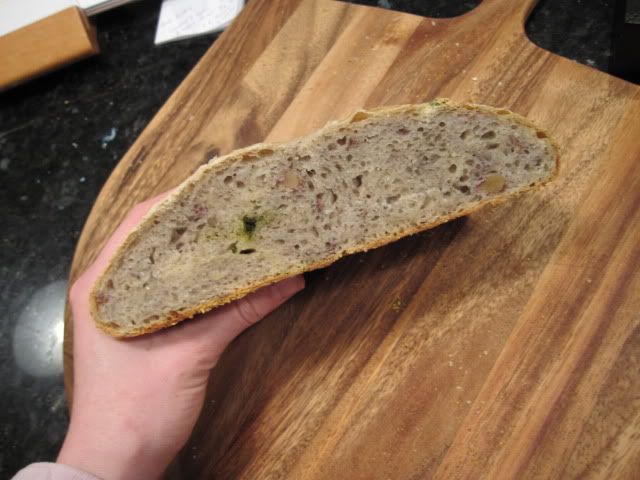
Here is an example of a typical boule (the color looks odd b/c the loaf had walnuts, sage and cheese but the shape is what I usually end up with--broad and flat). I have been using a mixing bowl lined with parchment or the back of a sheet pain for proofing.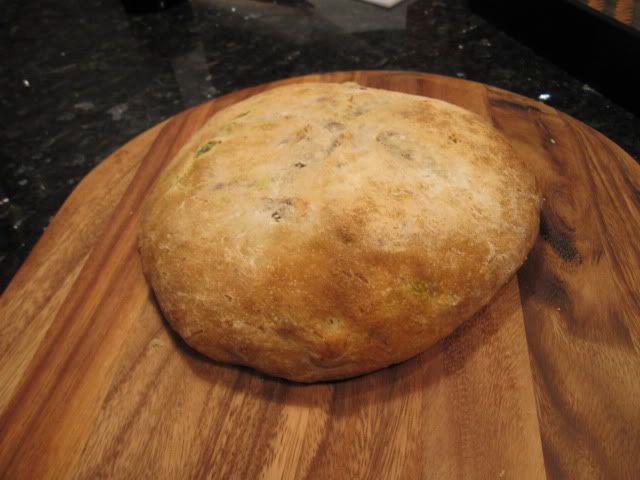
-
-
-
Post #12 - July 6th, 2009, 10:44 amthaiobsessed,
I don't even use a bowl to proof my boules and they don't come out anywhere near that flat.
Everything here was proofed without the aid of any bannetons, bowls, or linen.
http://www.flickr.com/photos/mmchicago/ ... 983701330/
They're not all perfect, but I think I get decent shape.
Are you building up a good amount of surface tension when you're shaping? I find that when I really do a good job shaping (a lot of surface tension, nice tight seam) that the boule holds it's shape best of all.
Best,
Michael
-
-
-
Post #13 - July 6th, 2009, 11:12 amthaiobsessed wrote:Thanks for the replies. I think I am going to break down and by some supplies from SFBI (thanks for that tip Darren72).
Here is an example of a typical boule (the color looks odd b/c the loaf had walnuts, sage and cheese but the shape is what I usually end up with--broad and flat). I have been using a mixing bowl lined with parchment or the back of a sheet pain for proofing.
Your dough may also be a bit too wet.Ms. Ingie
Life is too short, why skip dessert?
-
-
-
Post #14 - July 6th, 2009, 12:21 pmMs. Ingie wrote:Your dough may also be a bit too wet.
That would be my first guess too. I used to add all the water she could hold because that's what the experts were always telling me. Now I know better. I use Reinhart too and sometimes my proportions are way off from his. I dunno if there are typos in the recipe or humidity or what, but I have altered the flour by at least 25% at times.i used to milk cows
-
-
-
Post #15 - July 6th, 2009, 12:39 pmYou want to think of dough as "too wet". Having a dough that has more water relative to flour changes the texture of the bread a lot and also requires that you handle it differently than you otherwise would. But many great breads are made with a large proportion of water - so much so that you can't really kneed it by hand and you need to support the dough much more during the rising periods. These are the doughs that produce incredibly light and airy breads. The picture of the crumb above doesn't suggest to me that the dough is really that wet, though.
Having said that, remember that there is a lot of wiggle room in every dough recipe. A recipe may produce exactly what you want when you use one type of flour. But using a different flour, or making it on an especially humid day, may produce a final bread that you aren't as happy with.
This isn't to say you shouldn't reduce the amount of water in the dough. In the name of experimentation, it might be a good idea to try it.
I like Reinhart's book, but I haven't had a great deal of success with all of his recipes (the wheat bread, for example).
Another thing to remember is that the yeast activity depends a lot on the room temperature in which you are working. Most recipes are written for a room temperature of 70-75 degrees. Are you in this range? I also like Michael's suggestion to make sure you have a nice, tight skin on the bread when you let it rise.
Finally, does it seem like the diameter of the boule stay the same when you put the dough in the oven, so the main issue is that it doesn't rise enough? Usually this means that you've overproofed the dough.
-
-
-
-
Post #16 - July 7th, 2009, 7:10 amThanks for all the suggestions.
I feel like I am getting some oven spring (which I think means that the dough isn't over-proofed, though I could be wrong). I think Michael is probably on the money--I've been very gingerly about shaping the bread. I'm probably not getting enough surface tension. I'm going to try for a really tight seam with the next loaf, and, if that doesn't work, try it with the dough a little drier.
-
-
-
-
Post #17 - July 7th, 2009, 9:46 amYou can measure the height and diameter of the boule when it goes in the oven and when it goes out. That will tell you whether there is much oven spring, whether it is flattening out, etc.
-
-
-
-
Post #18 - July 7th, 2009, 10:29 amFolding wet doughs during proofing can help build structure.
-
-
-
-
Post #19 - September 7th, 2009, 12:30 pmI wanted to report back about some experimentation (and get a little more advice).
So, I think eatchicago hit the nail on the head. I have had much better luck when I increase the surface tension while shaping my boules. I still feel like I'm not sure how to walk the line of more surface tension vs too much handling. I'm definitely getting maximal oven spring these days (by really being strict with myself about NOT over-proofing). My most recent loaves are below (same batch of dough--sourdough from the Peter Reinhart book made with a 90/10 bread flour to rye flour combo). The higher loaf resulted from an overnight rest in the fridge prior to proofing. I still feel like the loaf deflates a little when I (very gingerly) transfer from bowl to parchment on peel. I was really thrilled with the flavor in these loaves. I've been using the San Fran starter from sourdo.com. These loaves with the rye had a nice sourdough tang with a little coarseness/earthiness from the rye.
dough deflates a little with transfer to peel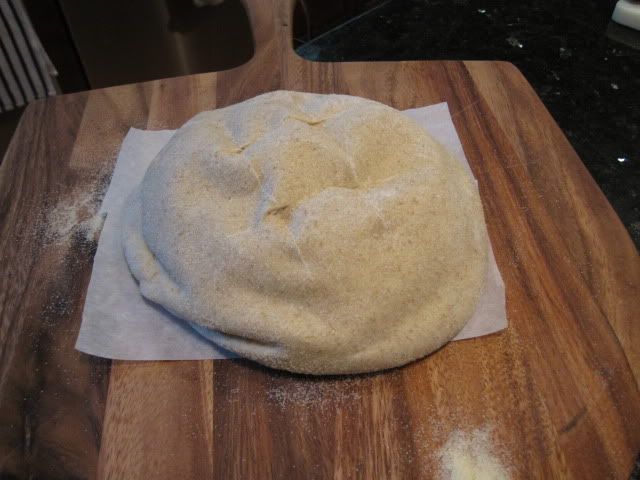
First loaf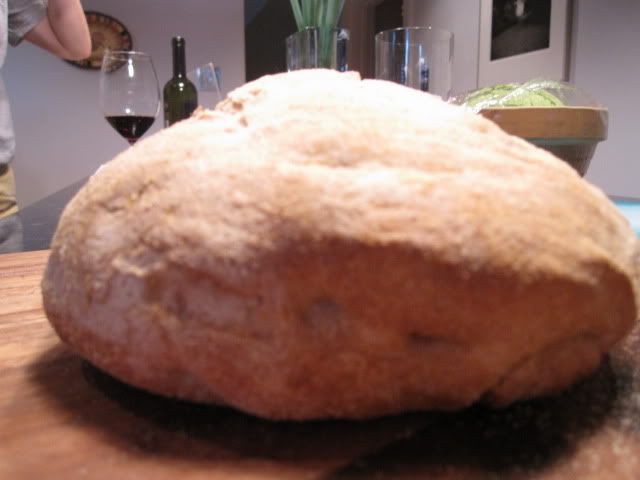
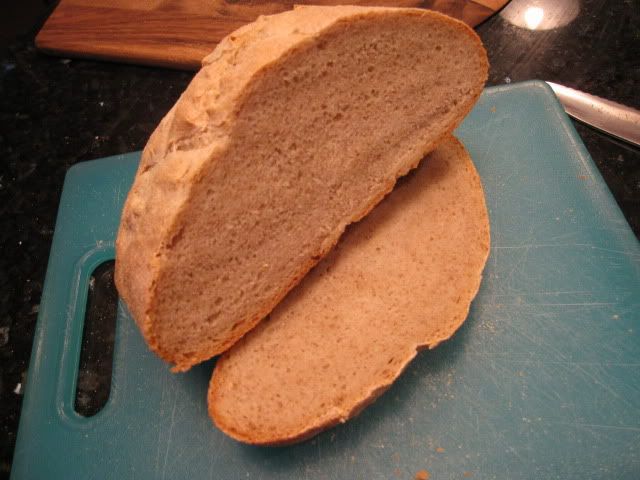
Second loaf (overnight in fridge)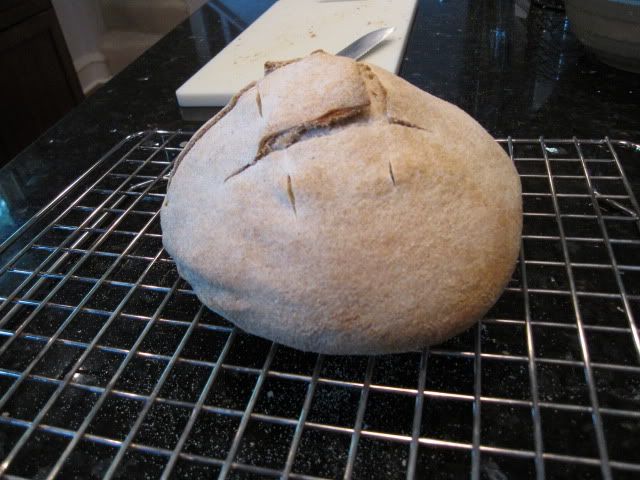
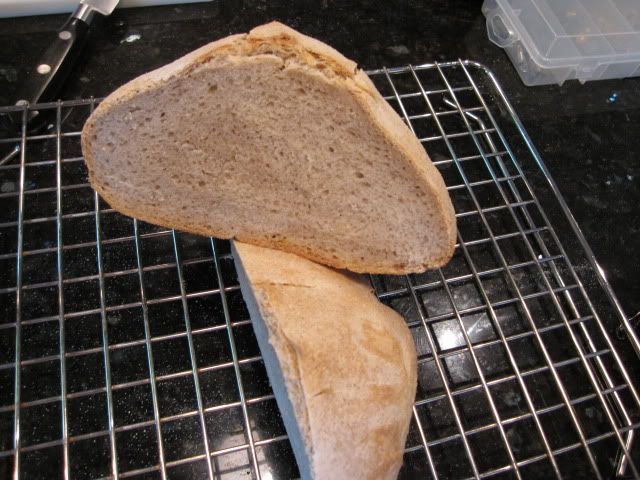
Me to significant other: Darn it, how do I get this bread a little higher? less dense? browner? shinier?
SO: Maybe you should take a bread-making class...
Me: Piffle, I'll post on LTH...
Any ideas on the less dense (just slightly airier) and browner?
-
-
-
-
Post #20 - September 7th, 2009, 12:55 pmHigher hydration + more kneading/folding will get airier crust and stronger gluten structure.
-
-
-
-
Post #21 - September 9th, 2009, 11:57 amThanks Bill,
Should I aim for bread and pizza dough passing the 'window pane test' (i.e when bread is stretched, you get a thin, see-through panel of dough instead of the dough breaking)? I feel like I knead (or use my Kitchenaid with dough hook) way longer than Reinhart recommends to even get close to this. I worry about over-kneading but maybe I should just keep going.
Any opinions on this one?
-
-
-
-
Post #22 - September 9th, 2009, 12:32 pmYou know, for years I used the window-pane test for bread, but no longer do. It is just a convenient, but arbitrary, cue that gluten has developed to a certain point. (This is much like the instruction to allow dough to double - a convenient cue, but one that is often sub-optimal). After a lot of experimentation and trial and error, I prefer the end-result when the dough is usually kneaded well-beyond that point. But your tastes and ingredients and methods differ from mine, so you "knead" to do your own experimentation to figure out what works best for you.
The problem with the KA dough hook is that it can be difficult to get a good kneading action. Until a minimum amount of gluten is formed, the dough is often just pushed and spun around rather than being kneaded. The size of the batch and the speed of the hook have to be just right to get consistent kneading. So you should knead until the dough feels right to you rather than the time Reinhart recommends.
With regard to pizza dough, the conventional wisdom is that it should be kneaded much less than bread, but this will likewise depend on taste, ingredients, method, etc.
Hope this helps.
Bill/SFNM
-
-
-
Post #23 - September 9th, 2009, 1:19 pmthaiobsessed wrote:Thanks Bill,
Should I aim for bread and pizza dough passing the 'window pane test' (i.e when bread is stretched, you get a thin, see-through panel of dough instead of the dough breaking)? I feel like I knead (or use my Kitchenaid with dough hook) way longer than Reinhart recommends to even get close to this. I worry about over-kneading but maybe I should just keep going.
Any opinions on this one?
I have been experimenting with a few recipes in "Bread Baker's Apprentice" using our KitchenAid Artisan mixer. In some cases, the recipe explicitly states that the dough should pass the window pane test, and it is also my experience that Reinhart's recommended times are not enough. In general, I have found that I get better results if I add 1-2 minutes to the kneading time in the recipe.
-
-
-
Post #24 - August 22nd, 2010, 3:18 pmSo, the thread on where to find baguettes in Chicago, along with a recent trip to Montreal where I had consistently excellent baguettes have motivated me to work on baguette baking at home. I've used Reinhart's recipe the last two weekends. The crumb/texture and taste are good, but I can't get a nice crackly crust. I'm following Reinhart's instructions: starting the bread in a 500 degree oven, adding hot water to a pan and spraying the sides of the oven 3x in 30 second intervals at the beginning, then lowering the oven to 450. I've seen online that some people mist the bread directly. Anyone have opinions on this? other suggestions?
Batch 1 (I divided the dough into 1/4ths and ended up with ficelles, basically)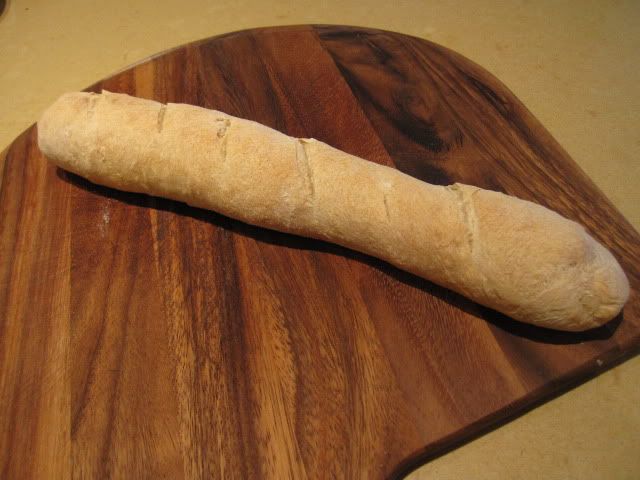
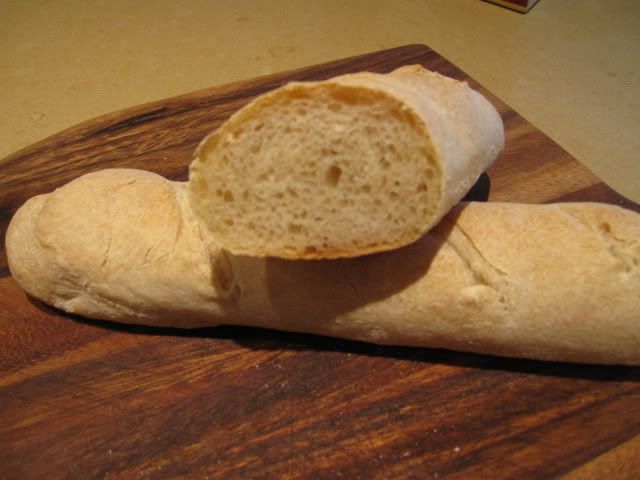
Batch 2 (a little darker but not shiny/crackly)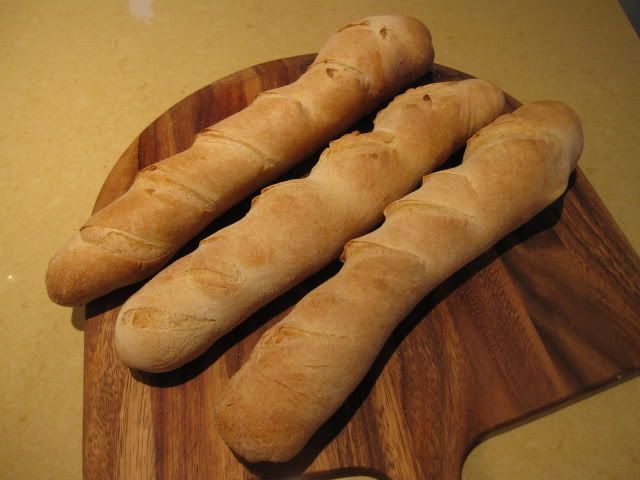
Here's how I want them to look: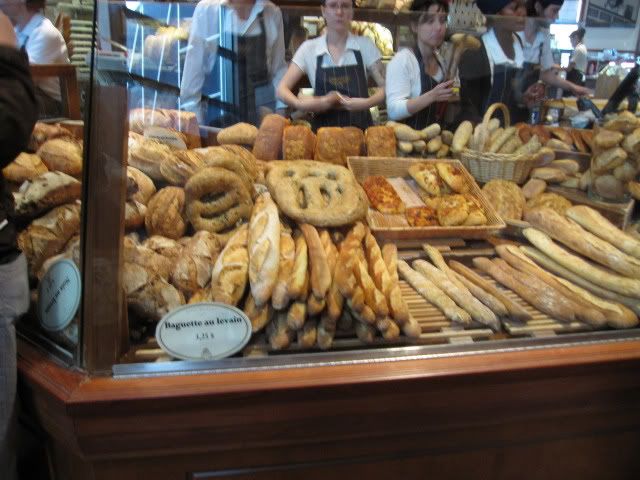
-
-
-
-
Post #25 - August 22nd, 2010, 5:29 pmLooks a little pale. I'd bake it hotter and longer - start @ 550F and then lower to 500F and bake until well-browned.
Although the main purpose of steam is to delay the formation of the crust for maximum oven spring, it also caramelizes surface sugars to assist in the formation of a tender, crispy crust.
Sometimes I leave the loaf in the oven with door ajar for 5-10 minutes after baking if I want an extra crackly crust.
-
-
-
-
Post #26 - August 23rd, 2010, 6:52 amBill/SFNM wrote:Looks a little pale. I'd bake it hotter and longer - start @ 550F and then lower to 500F and bake until well-browned.
Although the main purpose of steam is to delay the formation of the crust for maximum oven spring, it also caramelizes surface sugars to assist in the formation of a tender, crispy crust.
Sometimes I leave the loaf in the oven with door ajar for 5-10 minutes after baking if I want an extra crackly crust
Thanks Bill, I plan to try both suggestions next weekend. One other thought I had--I achieved my best crust when cooking bread in a covered Le Creuset as part of the No Knead Bread instructions. I do have a Le Creuset casserole dish. Is it a terrible idea to try a loaf in the preheated dish, then cover with foil?
-
-
-
Post #27 - August 23rd, 2010, 8:20 amAgreed on the longer on the longer bake. I think the covered LC is a good idea to try, because of the enviroment you are trying to create. Jim Lahey says you need to bake in an oven at 70% humidity for about 2/3 of the total cooking time which is how he came accross the covered casserole method for home bakers.
Jeff
-
-
-
Post #28 - August 23rd, 2010, 7:05 pmjvalentino wrote:Agreed on the longer on the longer bake. I think the covered LC is a good idea to try, because of the enviroment you are trying to create. Jim Lahey says you need to bake in an oven at 70% humidity for about 2/3 of the total cooking time which is how he came accross the covered casserole method for home bakers.
Jeff
I think I'll try at least one loaf in the LC pan this weekend. Thanks Jeff
-
-
-
-
Post #29 - August 29th, 2010, 2:10 pmSo, I did a little baguette experimentation today. I did three loaves at different temperatures and they came out like everything from Goldilocks and the Three Bears (the first was too dark, the second too light, the third, well, pretty nice color). For all three loaves I had a pan with boiling water and I did three 'mists' to the oven walls and lightly misted the loaf itself once. I really liked the taste of these loaves--I used starter to make the pate fermentee, then used instant yeast for the dough to guarantee a first rise in 2 hours.
I did the loaf on the right in a Le Creuset casserole. As you can see, I overestimated the length of the pan and it came out looking like a caterpillar. Also, I wasn't able to cover the pain with a pot lid as planned b/c the bread stuck up too high. I started this at 550, then changed to 500. It came out a little dark (especially the bottom)--I think mainly because the LC pan retains more heat.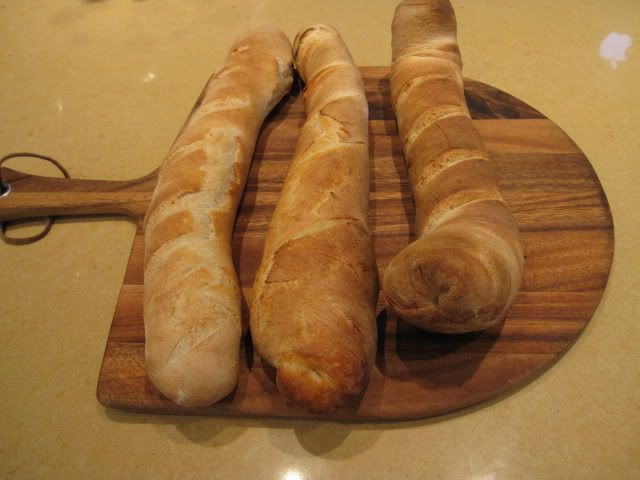
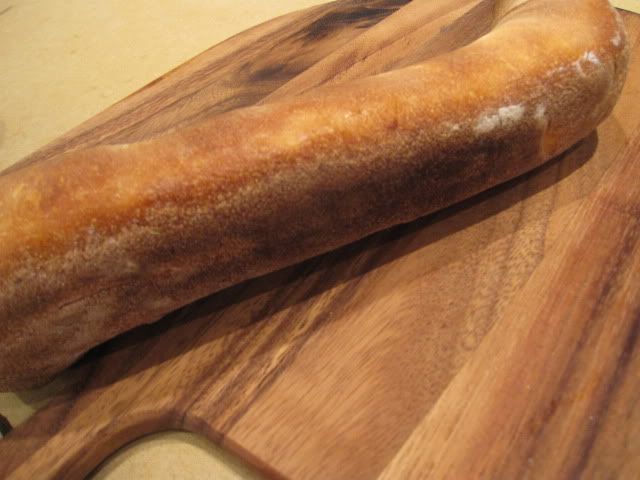
For the loaf on the left, I put the bread on the unglazed quarry tiles I keep in one oven. I started at 500, then lowered the heat to 450 but baked the loaf a little longer than usual. It was better than last week but still a little pale.
For the middle loaf, I started at 550, then decreased to 500, then half-way through, decreased to 450. This was my favorite loaf (though I forgot to score this one until I had popped it in the oven so the shape was a little funny).
Thanks Jeff and Bill for the tips. I think the humidity and higher temps really helped. I'm going to keep playing around with things.
This week's winner: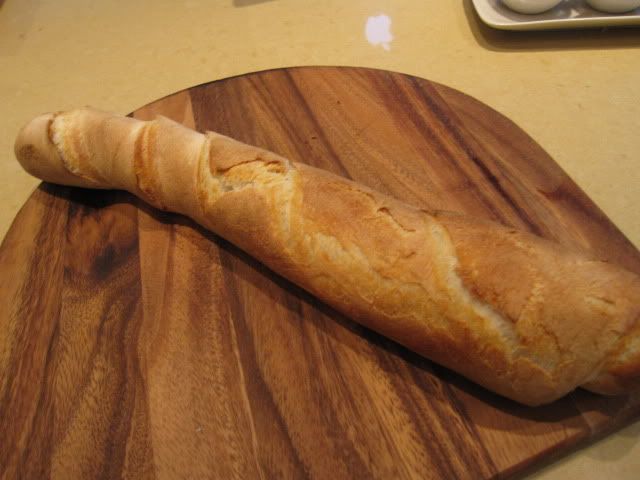
-
-
-
Post #30 - August 29th, 2010, 6:19 pmNIce job on the recent attempts. For the middle loaf (best one IMO), did you bake on quarry tiles and use the same humidification as the first loaf? I too have found that I have to bake at lower temps in the LC for the same reason as you.
If you settle on the second loaf baking regimen, then shaping is probably where you'll see your next leap forward. Then slashing. Should be a fun year.
Jeff