

Trick to cooking asian rice?
Trick to cooking asian rice?
-
-
-
-
-
Trick to cooking asian rice?
-
Post #1 - February 8th, 2005, 1:15 pmI've about given up. When I first moved up to Uptown, I bought a 5lb bag of "sweet rice" (I forget the brand). I have NEVER been able to get it right--always way too much gooey starch in between the grains. Last night my cooking companion was washing it for a good half hour and the water wasn't clear--I didn't want to waste any moer so I just said "to heck with it" and cooked the stuff. Still gooey/sticky.
Is there a trick to doing this relatively quickly? Should I just give up and, authenticity be damned, buy basmati or jasmine rice?Aaron
-
-
Post #2 - February 8th, 2005, 1:26 pmI'm not certain what "sweet rice" is, but my guess is that you purchased short-grain, "glutinous" (I know, there's no gluten in rice) rice prized for its starchy stickiness -- as in the rice used for many Korean or Japanese rice dishes; the stuff eaten in N. Thailand (as in, Sticky Rice); the stuff used for all sorts of Asian deserts; Italian rices such as arborio or carnoli used for risotto; Valencian Spanish rices such as calasparra and bomba, etc.
The sticky rices are generally pricier than other rices, and you'd be hard pressed to keep it from being sticky. Try a less sticky, longer grain rice, like aged jasmine or long-grained rice from a latino store. Of course, the rices you mention, basmati and jasmine, are both Asian.
PS, there was a thread on cooking rice well not too long ago. There are lots of methods that work, but a particularly good way to ensure distinct, intact grains is to toast the rice lightly in some kind of fat before cooking. Zim noted that the Indian technique is very similar to the Cuban style I grew up on.
Or consider a computerized rice cooker. They work.Last edited by JeffB on February 8th, 2005, 1:31 pm, edited 1 time in total.
-
-
Post #3 - February 8th, 2005, 1:31 pmJeff's probably right- it sounds like you picked a short grain, sticky rice. Note that there are different kinds of Jasmine rice-- if you don't want it to be sticky you have to find a long grain variety.
Also, you can control the stickiness to a small degree by how much water you use when cooking it.
-
-
Post #4 - February 8th, 2005, 1:55 pmSweet rice is different from even the regular Japanese/Korean/sushi rice. Sweet rice is much gooier & stickier than the regular rice. What brand was it? After you've rinsed the rice several times, the water should be fairly clear - still a touch cloudy though.
-
-
Post #5 - February 8th, 2005, 2:04 pmThanks for the tips. Sorry about the subject--i realize jasmine and basmati are also Asian but I didn't know what else to say without the bag in front of me. I'll post it when I get home.Aaron
-
-
Post #6 - October 26th, 2010, 10:29 pmHI,
I bought Japanese style rice today at H-Mart. It has the dreaded tag: New rice. This is rice that has been recently harvested with a higher moisture content.
Long ago, I read when rice is new it needs less water. As it ages and dries, you add additional water.
My first encounter with new rice was some years ago. A friend and I bought the same bags of new rice together. A few days later, we reported to each other on the mushiest rice we ever encountered. After some experimentation, we found how to work with this rice.
My default rice preparation is two cups of water to one cup of rice. While I intellectually understand you need to use less water, is there a rule of thumb on quantities of water for new rice?
Regards,Cathy2
"You'll be remembered long after you're dead if you make good gravy, mashed potatoes and biscuits." -- Nathalie Dupree
Facebook, Twitter, Greater Midwest Foodways, Road Food 2012: Podcast
-
-
-
Post #7 - October 27th, 2010, 6:29 amMy Chinese Sister-in-law just sticks her finger into the rice cooker to measure the water. Works every time.
-
-
-
Post #8 - October 27th, 2010, 7:43 ammhill95149 wrote:My Chinese Sister-in-law just sticks her finger into the rice cooker to measure the water. Works every time.
I do that too! Something I guess I picked up from my mom. Rinse 3x, and stick your finger in the water so that the tip just touches the top of the rice. The water should reach the 1st crease of your finger... No idea how scientific this is, but it works every time!
-
-
Post #9 - October 27th, 2010, 8:06 amCrazyC wrote:mhill95149 wrote:My Chinese Sister-in-law just sticks her finger into the rice cooker to measure the water. Works every time.
I do that too! Something I guess I picked up from my mom. Rinse 3x, and stick your finger in the water so that the tip just touches the top of the rice. The water should reach the 1st crease of your finger... No idea how scientific this is, but it works every time!
HI,
Does this apply new rice, too?
I read around where they suggested reducing water by 10 percent for new rice.
Regards,Cathy2
"You'll be remembered long after you're dead if you make good gravy, mashed potatoes and biscuits." -- Nathalie Dupree
Facebook, Twitter, Greater Midwest Foodways, Road Food 2012: Podcast
-
-
Post #10 - October 27th, 2010, 8:57 amI guess it depends on digit length!! I use the same method as described above (definitely picked up from my mother) - stick my index finger in until it touches the top of the rice, but I only let it go 2/3 of the way to the 1st crease. It's never failed me. Works for both short and long-grain rice. I suspect I must subconsciously adjust the amount based on a lifetime of cooking rice...
-
-
Post #11 - October 27th, 2010, 2:42 pmPuppy wrote:I guess it depends on digit length!! I use the same method as described above (definitely picked up from my mother) - stick my index finger in until it touches the top of the rice, but I only let it go 2/3 of the way to the 1st crease. It's never failed me. Works for both short and long-grain rice. I suspect I must subconsciously adjust the amount based on a lifetime of cooking rice...
Well Puppy, we are going to have to compare fingers when we meet!
-
-
Post #12 - October 27th, 2010, 3:52 pmI just measured the spot on my finger where I think I usually have the water up to, and it's ~19-20mm from the tip of my finger. Granted, to be more scientific, I'd have to actually prepare some rice and dip my finger in the water, but I'm still at work...
-
-
Post #13 - October 27th, 2010, 4:51 pmPuppy wrote:I guess it depends on digit length!! I use the same method as described above (definitely picked up from my mother) - stick my index finger in until it touches the top of the rice, but I only let it go 2/3 of the way to the 1st crease. It's never failed me. Works for both short and long-grain rice. I suspect I must subconsciously adjust the amount based on a lifetime of cooking rice...
My decidedly non-Asian self has been struggling with Asian rice for a while, had heard this method and tried it with terrific success. Annoying that it's so easy and I had been making it so difficult.
Not that this helps the OP; I would guess that the problem is the type of rice, as has been noted before. You might try just going with it and making some sticky rice dishes like dumplings or banana rice cakes.
When I buy rice for sushi, I either find one that says "sushi rice" on the label, or Calrose, an American variety that is common. The blog Just Hungry has a lot of info on Japanese rice.
-
-
-
Post #14 - October 28th, 2010, 6:45 amFor glutinous/sticky rice, I've always steamed it. I rinse the rice in the morning and soak it all day, then steam it with the rice spread out over a bamboo steamer until it's translucent. This seems to produce rice with the right amount of 'stickiness' (i.e. not too gummy) You can actually buy sticky rice steamers at many of the Asian grocery stores around Argyle (I'm fairly certain they still have them at Golden Pacific)--I've resisted because I don't want to get in trouble for bringing yet another Asian cooking implement home, although it is tempting...
Sticky rice steamer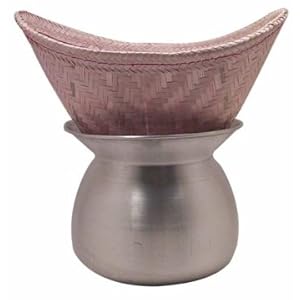
-
-
-
Post #15 - November 1st, 2010, 6:57 am
Article on shinmai/new-harvest rice in Japan Times, including cooking instructions.Cathy2 wrote:Does this apply new rice, too?
-
-
Post #16 - November 1st, 2010, 8:43 amGary,
Thank you! This is very helpful on navigating what to do.
Regards,Cathy2
"You'll be remembered long after you're dead if you make good gravy, mashed potatoes and biscuits." -- Nathalie Dupree
Facebook, Twitter, Greater Midwest Foodways, Road Food 2012: Podcast


