

The Hungarian Kitchen: Brassói aprópecsenye
The Hungarian Kitchen: Brassói aprópecsenye
-
-
-
-
-
The Hungarian Kitchen: Brassói aprópecsenye
-
Post #1 - January 8th, 2011, 1:31 amUp until this point, every Hungarian dish I have detailed starts with the holy trinity of onions, fat, and paprika. This dish, which takes its name after Brasov, a city in Transylvania, incorporates marjoram and garlic as its central flavors. It is usually translated as "Brasov roast" or "Brasov medallions" on English menus. This is a very popular and common dish in Hungary, and it is quite nice especially at the end of a long night of imbibery.
 Once you start heading east and into Transylvania (which is in modern-day Romania), you begin to find less of a reliance on paprika, and more use of herbs and spices like marjoram, thyme, tarragon, bay leaves, juniper, and loveage. From my cursory research on this dish, it appears that there is a lot of argument over what belongs and does not belong in brassói aprópecsenye. The common elements appear to be cubed pork, pan-fried usually in bacon fat and onions, seasoned liberally with garlic. Sometimes it is seasoned only with marjoram, other times with only paprika, and sometimes a combination of the two. As I don't want people to get the idea Hungarian cooking is all paprika, and because I suspect given the name and implied provenance of this dish the marjoram version is closer to the original one, I give you this recipe:
The ingredients: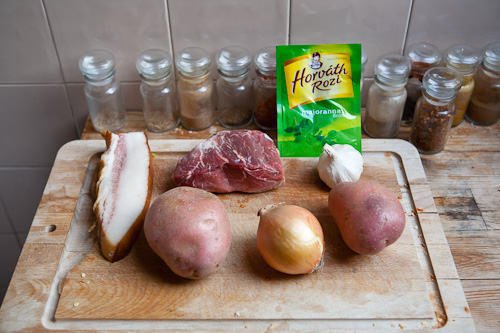
From left, clockwise: Mangalica smoked bacon, 1 pound pork shoulder, marjoram, garlic, 1 yellow onion. two red potateos.
Here is what a cross-section of the Mangalica pork shoulder looks like Observe the wonderful marbling: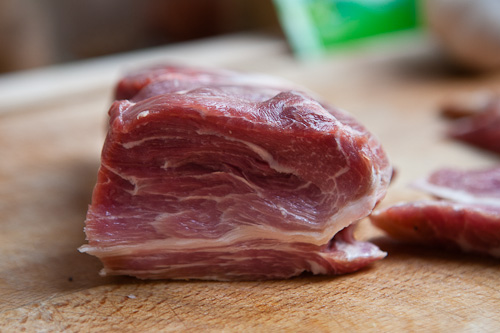
Don't you just want to stick that on the smoker and barbecue it? *drool* Anyhow, you start by frying up a good bit of bacon (I used about half of what was pictured above) and browning a mass of chopped pork shoulder in it: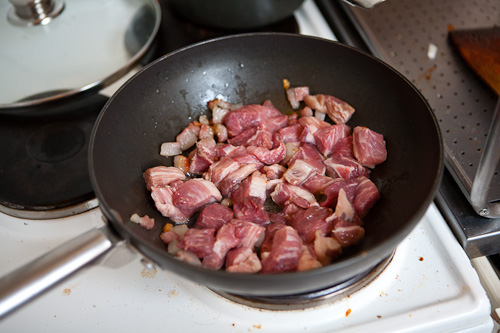
(You probably don't want to crowd the pan like this so you could get better browning. I was in a bit of a hurry so had to do it in one go.) Afterwards, remove the pork shoulder from the pan, and fry up the onions with your bacon: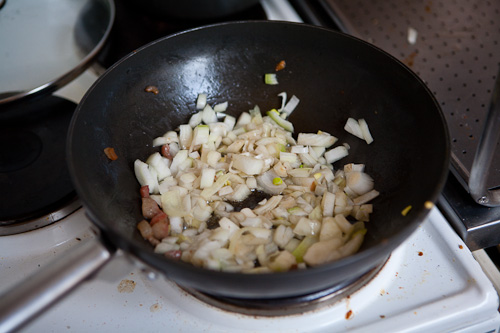
After onions are translucent, add a generous amount of finely chopped garlic (I used 4 cloves for that pound of pork). Let cook for a minute, then reintroduce the meat with marjoram (I used one teaspoon for that amount of meat), salt, and pepper.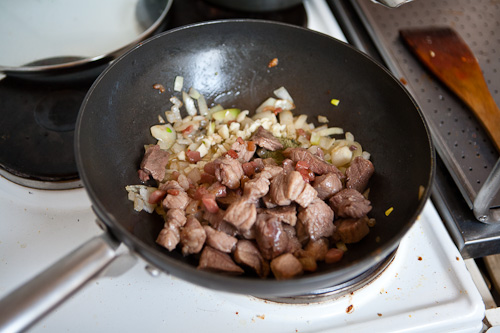
Stir well, and let this fry for a minute. Add about a half cup of water (and if desired, and as I did, add a beef stock cube--shhh, don't tell anyone! It's a common addition), cover, and let braise over low heat for about an hour.
Meanwhile, you're going to fry up some potatoes. Cube your potatoes, and fry them in the fat of your choice. I just used sunflower oil for this, as there's already plenty of bacon going on: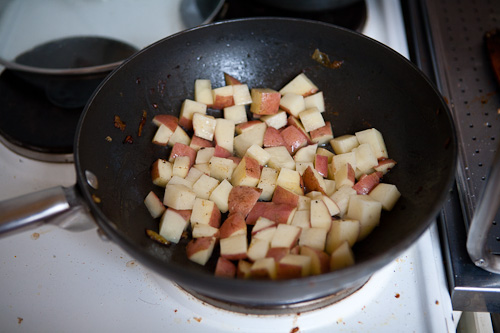
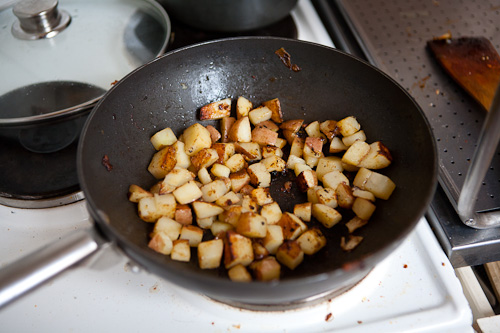
The pork in this dish usually has some bite to it (and often is made with tenderloin instead of shoulder, too), so you don't want to braise it until it begins to fall apart. I find about an hour is good. You should have a bit of natural gravy in your pan from the braised pork. If for some reason you don't, add a little more liquid to the pan. So, about ten minutes before your hour is up, introduce the potatoes back into the meat, mix well, cover, and let cook together. You just want to soften the potatoes up a little bit in this step. Adjust for seasoning (I like to add a good bit of black pepper to mine), plate and serve: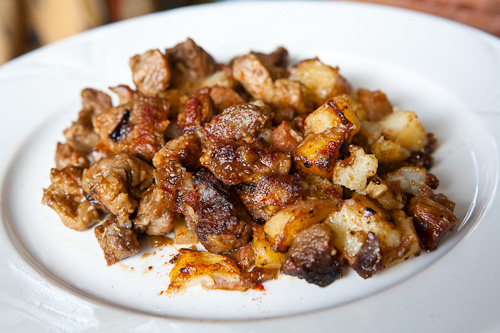
Variations: It's not uncommon to find peas stirred into this dish at the end of cooking time. Also, the addition of marjoram can be supplemented or replaced with an addition of an equal amount of paprika. The meat can be served with mashed potatoes instead of fried potatoes, although the fried potatoes (sometimes simply in the form of french fries) is the serving I'm most familiar with. (Honestly, I've never had it any other way.) I've seen variations that substitute turkey thigh for the pork, but no doubt these would be considered blasphemous in most circles.
-
-
Post #2 - January 9th, 2011, 7:27 amThanks for the recipes/pics, Binko. Years ago when I lived in Hof, Germany I frequented a truckstop diner where the cook was of Hungarian extraction. She made really, really good beef goulash. Not the gummy concoction found in most restaurants in the US. It had a thin, peppery broth with huge hunks of very tender beef and some onion. Usually served with brotchen (a kind of German hard roll) and boiled potatoes on the side.
-
-
Post #3 - January 9th, 2011, 8:00 amMmmm...I was just thinking how glad I am that we don't have any dietary restrictions against pigs in our family...we probably should, especially delicious fatty piggy like that, but we don't.
-
-
Post #4 - January 9th, 2011, 3:25 pmlittle500 wrote:Thanks for the recipes/pics, Binko. Years ago when I lived in Hof, Germany I frequented a truckstop diner where the cook was of Hungarian extraction. She made really, really good beef goulash. Not the gummy concoction found in most restaurants in the US. It had a thin, peppery broth with huge hunks of very tender beef and some onion. Usually served with brotchen (a kind of German hard roll) and boiled potatoes on the side.
I posted a recipe a few years back on Hungarian goulash (pörkölt) that might be up your alley. It sounds like what you are describing.
-
-
Post #5 - January 9th, 2011, 4:06 pmYou're right on, Binko. that looks very much like the goulasch I had in Germany. I failed to mention caraway, but that was incorporated for sure.
-
-
-
Post #6 - January 9th, 2011, 5:19 pmI made this (and the pepper dish you did in your other recent post, minus the sausage) for dinner last night!
I liked it, though I put in a bit too much marjoram (I had fresh, and it's not an exact 1-1. I didn't have the nice Mangalitsa shoulder, but I had a decent pork butt, and it worked.
Thanks for the inspiration!Leek
SAVING ONE DOG may not change the world,
but it CHANGES THE WORLD for that one dog.
American Brittany Rescue always needs foster homes. Please think about helping that one dog. http://www.americanbrittanyrescue.org
-
-
-
Post #7 - January 10th, 2011, 1:36 amGreat to hear you gave the dish a shot! I've never had the dish with fresh marjoram, so I don't know how it would substitute. I got to do a little more research on the marjoram-paprika front in regards to this dish. Last night, I was making Buffalo chicken wings for a couple of friends of mine here in Budapest, and one of them is a chef at a very well-regarded local restaurant called Olimpia. I asked him about paprika in Brassoi, and his opinion was that Brassoi apropecsenye never has paprika. The guests agreed on that point. So add a few more votes to "no paprika" in this dish. As for the meat itself, both tenderloin and shoulder were suggested, but it depended on how you were cooking the dish, with shoulder requiring a braise of an hour or so, and tenderloin being put together almost immediately.