

homemade cheese
homemade cheese
-
-
-
-
-
homemade cheese
-
Post #1 - March 30th, 2005, 7:55 pmAs if I don't have enough to do, I decided to take up cheesemaking and attic ham-aging this year. My bacteria, etc., are on the way, but I couldn't resist a start at the cheese this stormy night.
Here's my queso fresco:

Losing the whey

Ready to refrigerate.
This one is easy. Bring a gallon of whole milk up slowly to 180 degrees, hold it there for a few minutes, then stir in 1/4 cup cider vinegar. Stir until small curds form, then drain the whey. Produces about 1-1/2 lbs.
Pix of cottage cheese, cheddar, mozzarella, Swiss, Cheddar, Gouda, and blue cheese to come. Along with the hams.
Oh. I didn't have any cheesecloth (some is on the way), but I found this great mesh paint strainer at Crafty Beaver hardware and sterilized it before use. It's now draining the whey from some store-bought cottage cheese.
Cheers,
Wade"Remember the Alamo? I do, with the very last swallow."
-
-
Post #2 - March 30th, 2005, 9:28 pmWade,
Your queso fresco gave me cravings for my Pakistani mom's paneer, which she makes in a very similar fashion. The only difference is that she would bring the milk just to the boil and then add some acid (lemon juice, most often) and some salt. For some non-traditional reason -- probably b/c I liked it as a kid -- she also adds a healthy dash of caraway seeds. Mom used to fry slices of the cheese, but I still prefer to eat slices of the cheese raw.
The only time I've had queso fresco raw, it reminded me of a cross between paneer and feta. Simple (in a good way), crumbly and somewhat salty. I'm sure there must be several different shades of this simple, easy-to-make cheese across cultures.
Good luck with your cheese-making!
Zee
-
-
-
Post #3 - March 30th, 2005, 10:53 pmwaderoberts wrote:Pix of cottage cheese, cheddar, mozzarella, Swiss, Cheddar, Gouda, and blue cheese to come. Along with the hams.
Wade,
I am very intrigued by your endeavor.
Are you planning to make Gouda, blue cheese, etc., at home. If so, that is remarkable.
Staying tuned,
Hammond"Don't you ever underestimate the power of a female." Bootsy Collins
-
-
-
Post #4 - March 31st, 2005, 7:16 amHi,
FYI - I buy cheesecloth at fabric stores for around 40 cents a yard.
In my other life in the USSR, I often bought milk which was about to turn bad due to poor handling from source to shop, i.e. no refrigerated transportation.
I would make farmer's cheese or tvork, which is similar or on par to queso fresco. I would gently heat the milk using a double boiler in the same temperature range, though I didn't use a thermometer. Sometimes I would add Kefir to move the process along, which had the same effect as your vinegar. (I sometimes wonder if buttermilk might provide the same boost, though I haven't tried it)
In your finished cheese, could you taste any hint of the vinegar?
I look forward to learning more about your efforts and how they tasted.
Regards,Cathy2
"You'll be remembered long after you're dead if you make good gravy, mashed potatoes and biscuits." -- Nathalie Dupree
Facebook, Twitter, Greater Midwest Foodways, Road Food 2012: Podcast
-
-
Post #5 - March 31st, 2005, 9:01 amThe only time we've made cheese was to create Gulab Jamun -- it was wonderful, but not really worth the effort.
Some time ago, someone bought me a cheese making kit from a science store... I was disappointed to find no flavorings, mold innoculants, rennet or other agents of curd making, just cheesecloth and blocks of wood for pressing, and a book.
-
-
Post #6 - March 31st, 2005, 12:09 pmI've made several batches of cheese - soft and fresh to hard, like parm. (Haven't tried to make a blue cheese or a surface-ripened [e.g. brie] yet.)
Beyond firmness, though, I'm not sure what style to call them. But most have a nice sweet dairy flavor that I like a lot.
Best source of supplies (and kits) that I've found are from New England Cheesemaking Supply
-
-
Post #7 - March 31st, 2005, 5:17 pmTo conflate several philosophies, I think that cooking is part art, part craft, and part science.
I plan to follow recipes and to experiment and improvise, with the usual (rennet, mesophilic and thermophilic cultures) and with buttermillk, kefir, homemade yogurt, citrus and other acids, cheesemaking bacteria, and various forms of penicillium and other cheese molds. I will proudly document the triumphs (and humbly chronicle the failures), in words, images, tips, and recipes.
Cathy2: No hint of vinegar. After sleeping in the 'fridge overnight, it was smooth, slightly sweet, soft, crumbly, and rich: the pure essence of dairyness. A Lithuanian friend said that it reminded her of the homemade soft cheeses of her childhood, and made her want to set out in quest of thick and dense rye bread. Um . . . I was closer to Crafty Beaver than anything else, and the paint-strainer is a keeper. It seems sturdy, long-lived, easy to clean and sterilize, and it has a handy elasticized opening perfect for the right-sized containers for pouring and the draining of whey.
Cheesemaking IS time- and labor-intensive. I am embarking upon this for the same reasons that I make my own sausage and smoke my own meat and jerky (and plan to cure and age my own ham):
Taste
Because I can
I know the ingredients
No additives
The challenge
The fun
The delight of sharing
Some of my ingredients are coming from New England Cheesemaking, and others are coming from Lehman's
No more drives to WI for fresh cheese curds.
Coincidentally, the new issue of Saveur magazine is devoted to cheese. It's delightful.
Cheers,
Wade"Remember the Alamo? I do, with the very last swallow."
-
-
Post #8 - March 31st, 2005, 6:57 pmwaderoberts wrote: I am embarking upon this for the same reasons that I make my own sausage and smoke my own meat and jerky (and plan to cure and age my own ham):
Wade,
Here's a website with a lot of recipes NORTHWEST SMOKING
If you are interested I can provide you with a link to 2 very good sausage lists. Good signal to noise ratio, and not real high traffic. Its at least worth checking out for a while.
-
-
Post #9 - March 31st, 2005, 8:19 pmThanks to the Lithuanian Goddess:
The cheese on Lithuanian rye bread, with peppercorns and cracked red, white, and black pepper.
Cheers,
Wade
 "Remember the Alamo? I do, with the very last swallow."
-
-
-
Post #10 - April 4th, 2005, 2:14 pmwaderoberts wrote:This one is easy. Bring a gallon of whole milk up slowly to 180 degrees, hold it there for a few minutes, then stir in 1/4 cup cider vinegar. Stir until small curds form, then drain the whey. Produces about 1-1/2 lbs.and then waderoberts wrote:I plan to follow recipes and to experiment and improvise, with the usual (rennet, mesophilic and thermophilic cultures) and with buttermillk, kefir, homemade yogurt, citrus and other acids, cheesemaking bacteria, and various forms of penicillium and other cheese molds. I will proudly document the triumphs (and humbly chronicle the failures), in words, images, tips, and recipes.
Cathy2: No hint of vinegar. After sleeping in the 'fridge overnight, it was smooth, slightly sweet, soft, crumbly, and rich: the pure essence of dairyness.
Thanks for posting your foray into home cheesemaking. It is something I'd love to do but am awaiting a larger kitchen... Meanwhile I look forward to your posts especially about the gouda, cheddar, bleu etc.
Some questions and comments:
Did you have to stir for a long time to get the curds to form? Also what milk did you use? Your yield of cheese is quite high.
Are you considering adding half&half or cream to the milk - this would increase the fat content (and sweetness ).
).
Also if you buy citric acid, you could get better yields. Vinegar typically is approx. 5% acid (acetic acid). Citric acid is three times more acidic than acetic acid (simplistic expanation) and you could dissolve it to a concentration of your choice (thereby adding less liquid than with vinegar to the milk). It is available in powder form in pharmacies I think; I don't remember where I picked it up.
Are you planning on making cheese with yogurt? Please do post on your endeavours.
You could try: making a large batch of yogurt, then drain the yogurt to get what I've seen described as "Yogurt cheese" (not a name I find particulaly appealing - also this is not a true 'cheese') , just as with your queso fresco pictured and you further drain - by placing the cheesecloth between layers of newspaper, till the yogurt is a thin paste almost. Then mix in powdered sugar (to your taste) and cardomom powder, you will get a nice dessert - nice garnished with pistachios.
-
-
-
-
Post #11 - April 4th, 2005, 5:05 pmsazerac wrote:Also what milk did you use?
I'm not "waderoberts" but I've had some good success using "Trader Joes Unhomogenized Creamline" milk for queso fresco, haloumi, mozzarella, etc. There has been no need for additives such as calcium chloride with this milk.
Bill/SFNM
-
-
-
Post #12 - February 20th, 2009, 9:12 amI've just read an article about making your own cheese. It looks pretty easy. Anyone tried it? Results?
-
-
-
Post #13 - February 20th, 2009, 9:34 amThere are a couple of threads about making cheese:
viewtopic.php?f=16&t=14406
viewtopic.php?f=16&t=3261-Mary
-
-
-
-
Post #14 - February 20th, 2009, 11:41 amI went through a major cheese-making kick a while back, making all kinds of fresh and aged cheeses. For the most part, I discovered that, even with a lot of effort, I could not come close to reproducing the great cheeses available in the local market. I still regularly make cream cheese http://lthforum.com/bb/viewtopic.php?p=71684#p71684 and sometimes fresh mozzarella, but that is about it.
Bill/SFNM
-
-
-
-
Post #15 - July 2nd, 2011, 8:51 amWe had fun making mozzarella last weekend. I ordered a cheese making kit from New England Cheesemaking Supply Company for a coworker who is a great cook, and of course, had to get one for myself, too.
We used the recipe from cheesemaking.com as well. It was remarkably easy (or maybe we had beginner's luck).
Prep: We used organic, pasteurized milk from Trader Joe's, 1/4 rennet tab, citric acid, thermometer, slotted spoon, etc.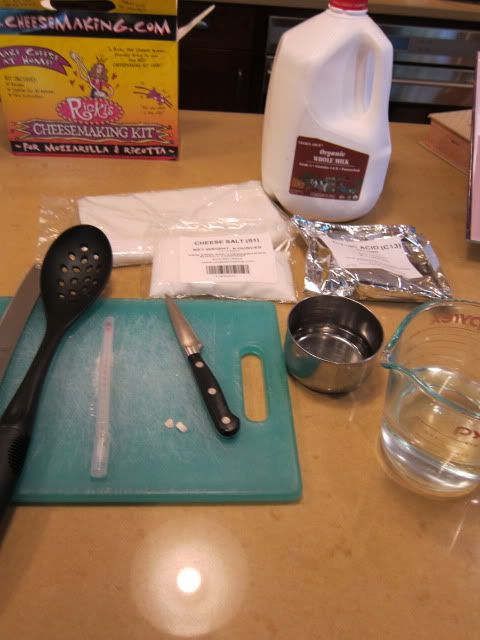
After heating to 90 degrees with citric acid solution, adding rennet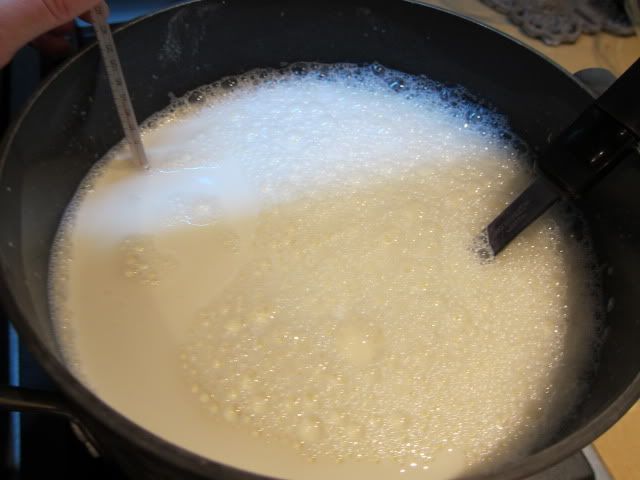
Curds starting to form (we waited longer than the required 3-5 minutes, probably closer to 10)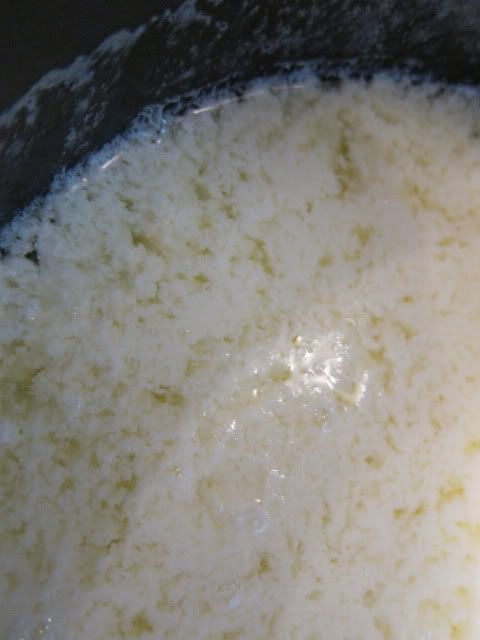
Straining the curds after cutting: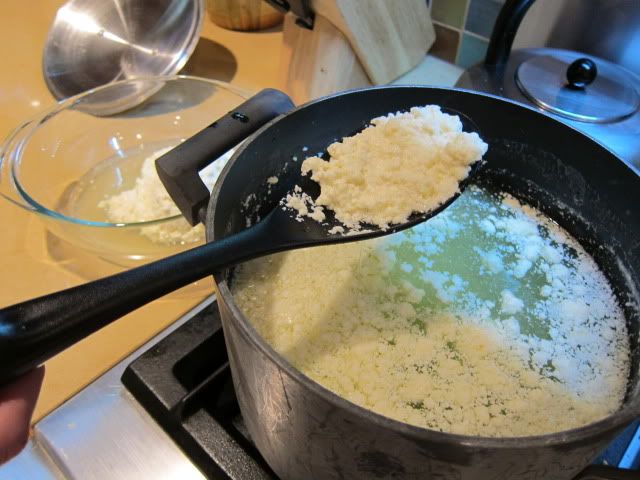
After 2 x 30 second zaps in the microwave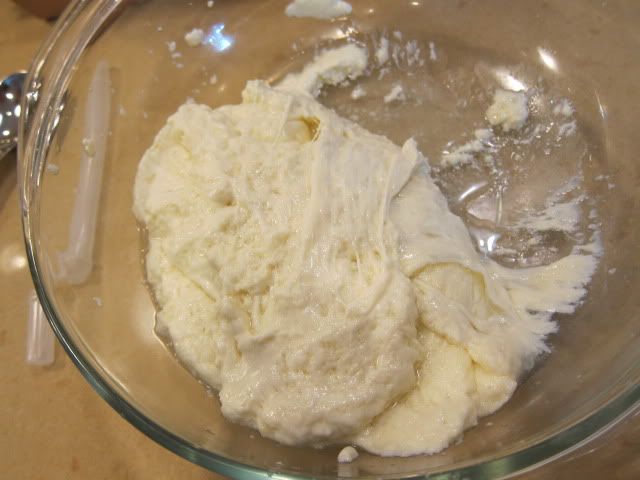
Pulling the cheese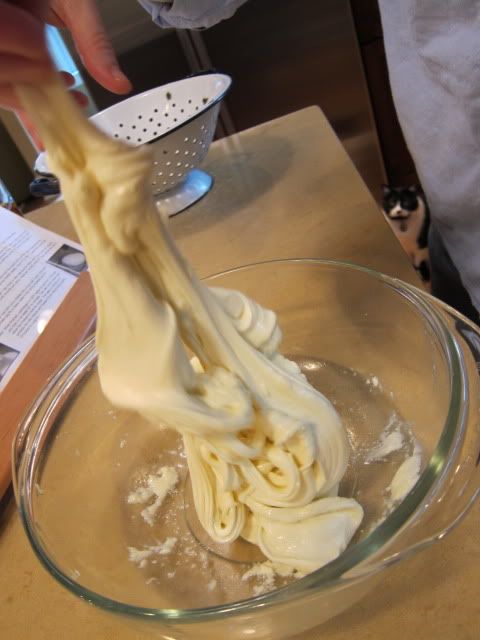
Finished product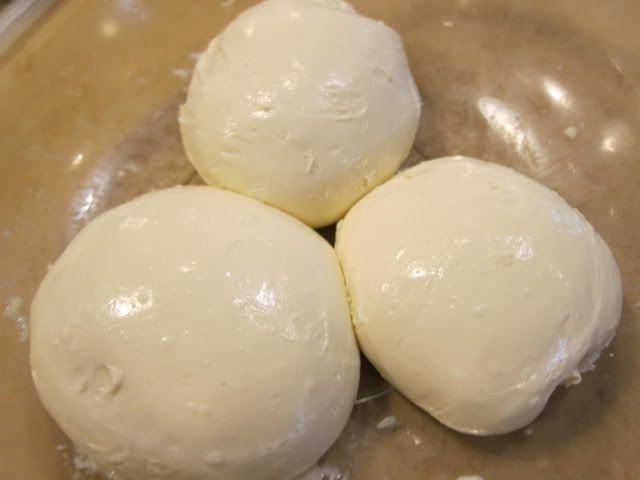
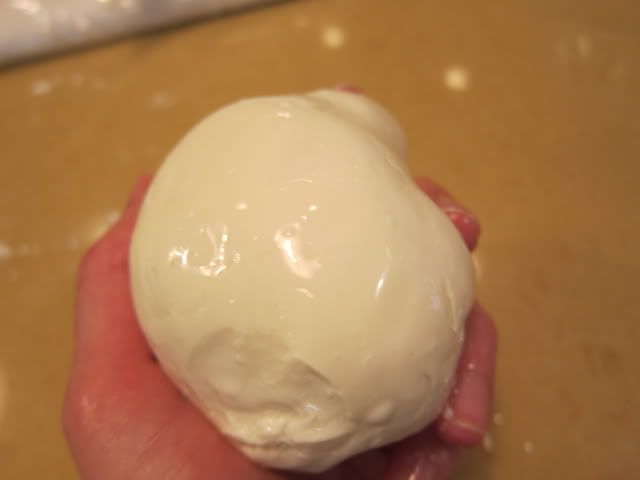
On pizza: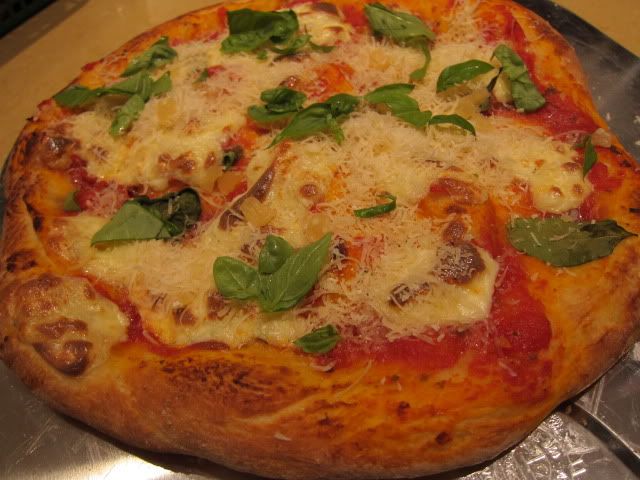
The cheese was terrific. We tried the recipe for pizza dough with whey which was in the booklet included with the cheesemaking kit. I didn't really like it (I should have balked at the required I T of yeast for two pizzas). I'll stick with Peter Reinhart's sourdough recipe. But I'll definitely be making this again.
Next up, I'm going to try this burrata recipe (making the curds rather than buying them). I also got some goat milk (but at $4 a quart at Whole Foods, the cost is a bit prohibitive for lots of goat cheese-making)--can't decide between fresh goat cheese or goat mozzarella.Last edited by thaiobsessed on July 9th, 2011, 5:40 am, edited 2 times in total.
-
-
-
-
Post #16 - July 2nd, 2011, 8:52 amForgot to add, one weird thing that happened with the homemade mozzarella. After a few days in the fridge, it lost it's shape and spread into a sheet. It still tasted great but I'm not sure why that happened? Anyone have any ideas?
-
-
-
-
Post #17 - July 2nd, 2011, 2:17 pmthaiobsessed wrote:... I also got some goat milk (but at $4 a quart at Whole Foods, the cost is a bit prohibitive for lots of goat cheese-making)--can't decide between fresh goat cheese or goat mozzarella.
Make sure the goat milk is not ultrapasteurized-- if it is, it does not work that well for cheese-- the proteins are already partially denatured, so they do not make curd as well. Let me know if WF offers non-ultra milk-- that would be a score.
Jen
P.S. And congratulations on your gorgeous mozz!
-
-
-
-
Post #18 - July 2nd, 2011, 8:09 pmPie-love wrote:Make sure the goat milk is not ultrapasteurized-- if it is, it does not work that well for cheese-- the proteins are already partially denatured, so they do not make curd as well. Let me know if WF offers non-ultra milk-- that would be a score.
Shoot! It is ultrapasteurized. Guess I'm making cajeta instead (I think City Provisions has goat milk but not sure about the pasteurization).
-
-
-
Post #19 - July 8th, 2011, 7:49 amYay! A cheese thread. Has anyone purchased rennet locally, recently? Not online. Our tomatoes are starting to come in so I'm tempted to try and make mozzarella for a caprese, but I don't have time to order it.
-
-
-
Post #20 - July 8th, 2011, 8:06 amjblth wrote:Yay! A cheese thread. Has anyone purchased rennet locally, recently? Not online. Our tomatoes are starting to come in so I'm tempted to try and make mozzarella for a caprese, but I don't have time to order it.
I saw some in the baking aisle at the Lincoln Park Whole Foods the other day. I stared at the rennet while being amazed that they didn't have any instant yeast.
Whole Foods - Lincoln Park
1550 N. Kingsbury Street
Chicago, IL 60642
(312) 587-0648
-
-
-
Post #21 - July 8th, 2011, 8:18 amDarren72 wrote:jblth wrote:Yay! A cheese thread. Has anyone purchased rennet locally, recently? Not online. Our tomatoes are starting to come in so I'm tempted to try and make mozzarella for a caprese, but I don't have time to order it.
I saw some in the baking aisle at the Lincoln Park Whole Foods the other day. I stared at the rennet while being amazed that they didn't have any instant yeast.
Whole Foods - Lincoln Park
1550 N. Kingsbury Street
Chicago, IL 60642
(312) 587-0648
Thank you! I had checked their occasionally over the last couple months, but they never had it. I wonder if it was a supply problem. I'll swing by later today and look again.
Edit: They do have rennet now. Of course I forgot to get citric acid...
-
-
-
Post #22 - July 9th, 2011, 5:40 amWe made "French-style" fresh goat cheese with the kit from New England Cheesemaking Supply. I found pasteurized goat milk at City Provisions (and used the ultrapasteurized stuff from Whole Foods to make Cajeta).
Goat milk: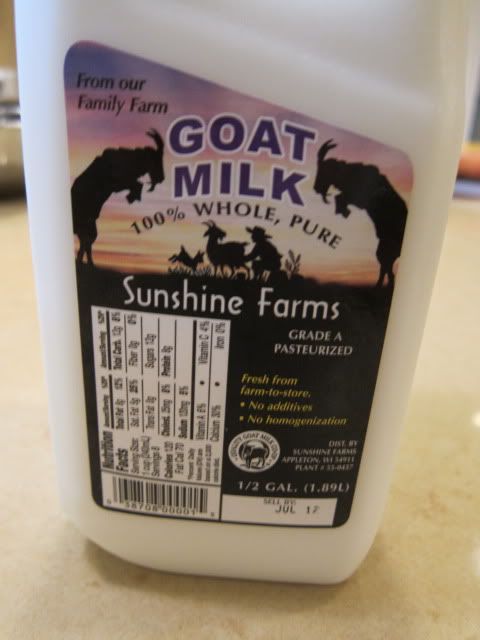
1 quart sterilized skim milk inoculated with starter culture and starting to thicken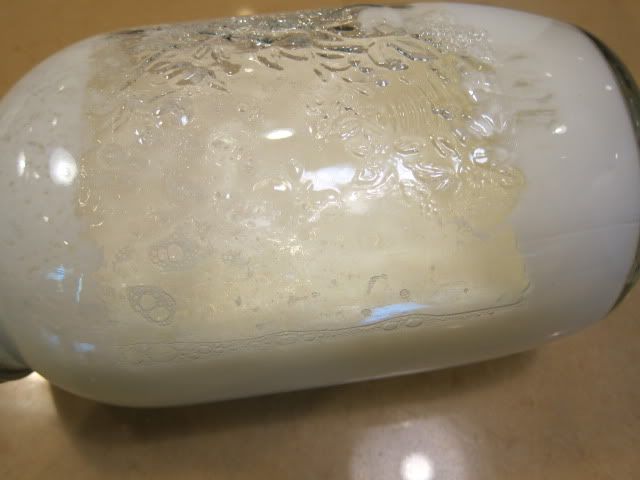
You add starter culture to the goat milk along with diluted rennet (I used 1/4 drop), then put the mixture somewhere warm for 15-24 hours (my oven has a proof feature and maintains an 85 degree temp so I put it in the oven). Once the milk has coagulated, I spooned the curds into the molds.
After about 20 hours: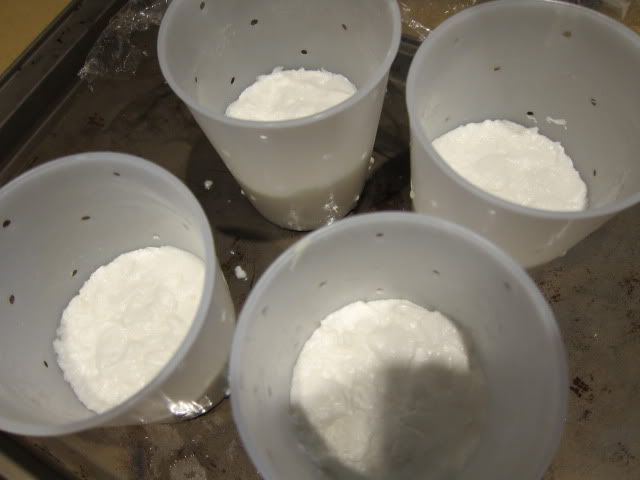
I ended up letting these drain for about 36 hours.
Finished goat cheese (yield from 1/2 gallon of milk)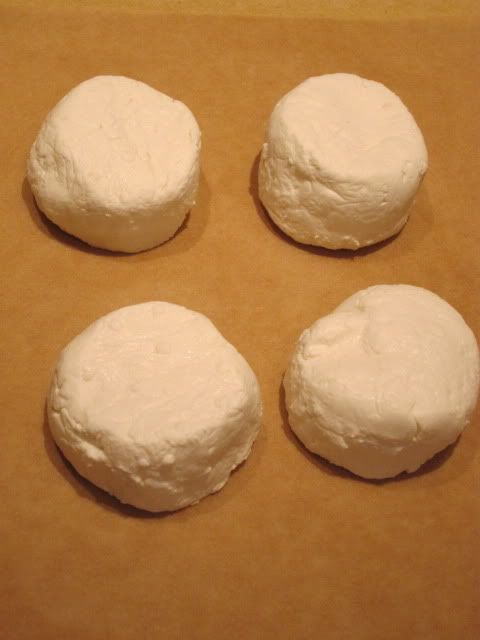
The cheese was a little tangy and a tiny bit sweet--I really like it. We made pasta with corn, chorizo, goat cheese and thai basil last night.
-
-
-
Post #23 - July 10th, 2011, 1:33 pmI'll cross-post here along with the dinner thread, my first burratta -- or any cheese for that matter. The filling was perfect, but I think the mozzarella shell could have been stretched a little more. Making a nice clean purse was difficult, but two of the three were ok. We solved the problem of one breaking by eating it