

Angin Mamiri: Indonesia for the Windycitians!
Angin Mamiri: Indonesia for the Windycitians!
-
-
-
-
-
Angin Mamiri: Indonesia for the Windycitians!
-
Post #1 - June 18th, 2009, 3:37 pm
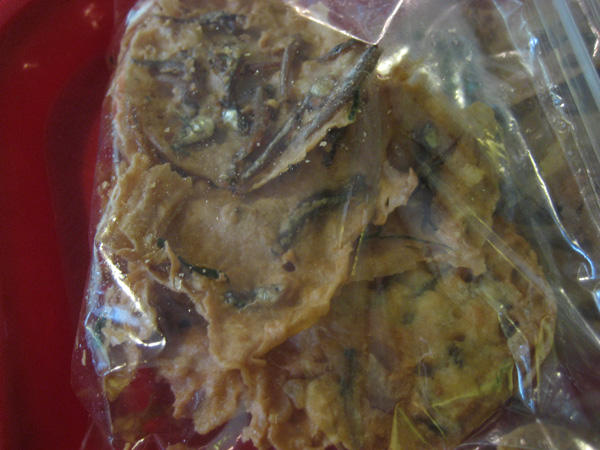
Anchovy crunchies, for snacking on while fighting your way through the media hordes at Angin Mamiri.
A couple of months ago I was taking my kids to a 4-H meeting and I saw a sign on Touhy announcing that a dead Filipino restaurant was about to become an Indonesian restaurant. Cool, I thought, that'll make a nice little discovery on my part...
It is to laugh. The thought of Chicago finally getting a lone Indonesian restaurant again (after the closing of August Moon nearly a decade ago) inspired something of a frenzy in the foodie media community, summed up by this Twitter post a few days ago (I won't say Tweet, I won't) by Mike Sula of the Reader:Foodmedia hordes descending on new Indonesian Angin Mamiri (http://tinyurl.com/q23q65) I was 1 of 3 sched interviews today. Hi @mmxdining
Mmxdining is a writer from Metromix, incidentally. As it happens, though, none of those places have actually put their review up yet that I can find, so it looks like I'll be going first after all, albeit probably only by hours.
Actually, media frenzy was not at all in evidence when I went in about 1:30; the three generations of Indonesian family (older parents, grown daughter, her teenage daughter) were scattered around the dining room doing odd jobs, as if it were their living room. They quickly packed up and got back into customer mode. The menu is relatively short— a few curries, a few noodle dishes, lots of sates— and I had to admit the brevity didn't encourage me, it looked like a menu whose high points would be exhausted quickly. As soon as I asked DeeDee, the grown daughter, what she would recommend, though, she kind of brushed the menu aside and started talking up the special: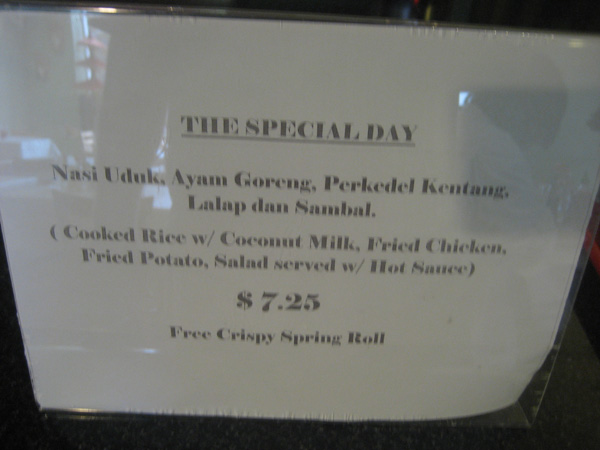
—and more to the point, the fact that they planned to have something special and different every day. The menu was much more of a starting point, she suggested. I wasn't entirely sold by the sound of the special, which looked like fried with a side of more fried, but DeeDee was persuasive, so I went for it and another (fried) appetizer, risole.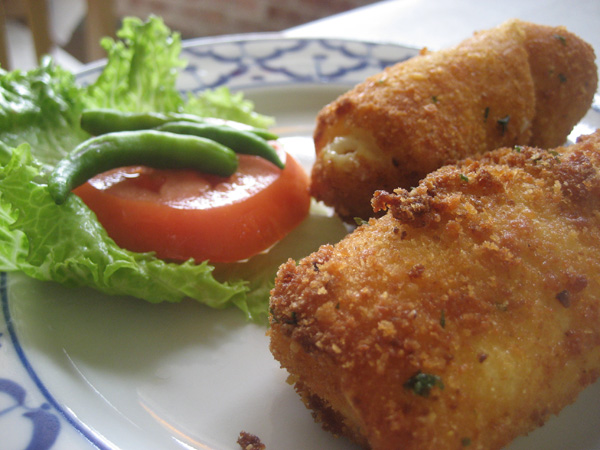
I also tried the one Indonesian drink in the cooler, a very sweet, flowery tea: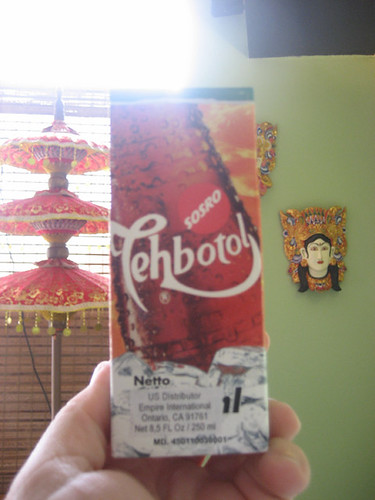
In my limited experience Indonesian is sort of like Thai, but even more comfort-foody. That was certainly the case with the risole, which is sort of like an egg roll crossed with a chicken pot pie, and pretty damn indulgently delightful. The main dish was in the same vein: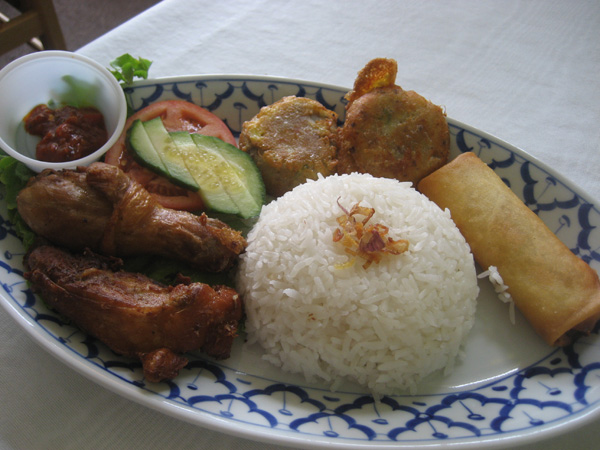
Fried chicken (just about worthy of the Thai fried chicken at Spoon or TAC), potato croquettes (reminiscent of some of those Japanese potato dishes which seem like grandmother food from an alternative universe), and a spring roll, along with some rice topped with, and subtly tasting of, toasted coconut. A lot of fried stuff, but all done with a judicious hand, and the little hot pickle-chutney stuff at the side was tasty. Best of all, it really seemed homemade, and so I asked DeeDee when she came back about who did the cooking. She said her mom, Ida, is the main cook, does it all, even rolling the spring rolls and risole herself. They're starting out with a basic menu but will have new specials all the time; they're also thinking about how to do a rijstaffel, the traditional Indonesian banquet/buffet from Dutch colonial days, probably as a special dinner event using some sort of advance ticket system.
I asked DeeDee if they had had a restaurant before, somewhere else, and she said no, they've lived in Chicago for 25 years, and cooked things for Indonesian festivals, and people always asked where there was an Indonesian restaurant, and for years they said they were going to open one. (The name, incidentally, means "wind" or "breeze," she said.) Now they finally have; and it's a good one with potential to be a very good and culturally important one. Don't just read the food media about it; support it now, and help it grow into what it could be.
Angin Mamiri
2739 W. Touhy
(773) 262-6646
An earlier, stranger experience with Indonesian food.Watch Sky Full of Bacon, the Chicago food HD podcast!
New episode: Soil, Corn, Cows and Cheese
Watch the Reader's James Beard Award-winning Key Ingredient here.
-
-
Post #2 - June 18th, 2009, 3:50 pmI pass the restaurant location a couple of times each weekday, going to/coming from work. I wasn't aware the butcher paper had been taken down and the restaurant opened for business. Without lots of publicity, favorable, it'll likely be a tough go for the restaurant: middle of the Orthodox Jewish community, no off-street parking, the location of prior failed restaurants. Touhy Ave., that part of Touhy, hasn't been kind to Asian restaurants. I'll try to get to the restaurant during the next week, maybe at the weekend. Thanks for the update.
-
-
Post #3 - June 18th, 2009, 6:08 pmYou had me at....Fried chicken (just about worthy of the Thai fried chicken at Spoon or TAC)
-
-
Post #4 - June 18th, 2009, 8:50 pmWhile visiting Amsterdam I experienced great Indonesian food. I had the "Rijstafel" which are small plates, about 10 to 15, of this incredibly tasty food. Can I find this any where in Chicago?
-
-
Post #5 - June 18th, 2009, 9:32 pmMike, the title of this thread makes me very happy. "He's no fun, he fell right over!"
(Unless of course I'm completely off-base, and in that case, never mind!)
ps. Also the existence of this restaurant makes me very happy, I'll be checking it out soon.Anthony Bourdain on Barack Obama: "He's from Chicago, so he knows what good food is."
-
-
Post #6 - June 18th, 2009, 10:19 pmI appreciate the review and look forward to trying some things out at Angin!
I want to point out that there are many dishes characteristic of some regions of Indonesia at restaurants flying other banners (or pan-Asian self-identifications) around the city, including rendang and opor at Miss Asia, roti at Penang, southern-style lumpia at Fish Pond, and various satays and fruit drinks at Joy Yee, and that many Chicago immigrants originating from the modern country don't consider themselves "Indonesian," but rather of a particular island or clan, or, religiously and with some implications for cuisine, Muslim. Indonesia is a sprawling area with thousands and thousands of islands and nearly as many people as the States (it's the fourth largest country by population). While I've been to restaurants billing themselves monolithically as "American" in other countries, we here at LTH know there are significant regional differences in cooking styles and materials (cf barbecue, "I'm from Phoenix...") in a country this big and populated. By this token, I don't particularly crave or miss an Indonesian restaurant the way I do a Portuguese restaurant (which, as excellently outlined recently, has issues of its own), and would advise those curious to seek out specific dishes of interest rather than a whole rather arbitrarily-grouped-together cuisine. You may be surprised what's out there right now in Chicagoland.*
This is not to say that pan-regional restaurants can't be great or useful - I love a restaurant called "African Hut" (!) in Milwaukee, which represents dishes from an area three times the size of Western Europe (and that just from a portion of the continent), I'm recommending Penang (hopefully back to two locations soon?), and I wouldn't have gotten into deep food-thought in the first place without Indian buffets which typically cover Kerala to Kashmir to London in 15 linear feet. A menu at a place like Bandung in Madison can indeed help get the juices flowing. My secondary point here is in fact that it's just as useful (and filling, and sometimes "authentic," whatever that means for you) to look for pan-Asian as it is to look for Indonesian by that name.
*there was a Rijsttafel at a restaurant called Little Amsterdam in Des Plaines, but I believe they've closed. Since this dish series is a colonial invention as Mike points out above, its current absence (which may be worth more inquiries) may have as much to do with Chicago missing Dutch-run and focused restaurants. I don't think Linda at Pannenkoeken can help us on this front (but would love to be proved wrong). I had the rijsttafel experience at Long Pura in Amsterdam and always wish I had more time to explore the Indonesian restaurants there, but posit that (as discussed in the vindaloo thread) you're looking at a different animal when in the formal colonial capital.
-
-
Post #7 - June 18th, 2009, 11:13 pm(Unless of course I'm completely off-base, and in that case, never mind!)
Bet you a case of Bear Whiz beer, you're not off base.
Santander, there are certainly dishes out there (don't some of the Filipino places offer gado gado?) but I suspect you could eat a lot of bad potstickers searching "pan-Asian" restaurants for Indonesian food, unless you have some insight into a particular place being a standout (and hey, then you'd have to find some place on the internet to share that with others! What are the odds?) Anyway, they said there's "no" Indonesian restaurant, so it seems the Indonesian community feels that nothing fits that bill, even if they can find things that vaguely suggest home, the way I eat spicy, greasy biscuits and gravy while wishing for the true, bland and fluffy and barely touched by sausage B&G of my Kansas memories.
(Sula says they're from South Sulawesi, not that that's information that means anything to me in terms of what dishes they are, or are not, likely to have...)Watch Sky Full of Bacon, the Chicago food HD podcast!
New episode: Soil, Corn, Cows and Cheese
Watch the Reader's James Beard Award-winning Key Ingredient here.
-
-
Post #8 - June 19th, 2009, 12:54 amMike G wrote:Anyway, they said there's "no" Indonesian restaurant, so it seems the Indonesian community feels that nothing fits that bill...
(Sula says they're from South Sulawesi, not that that's information that means anything to me in terms of what dishes they are, or are not, likely to have...)
That's promising and exciting, as was your review. The friends I have are from Java (though not Jakarta itself), and I don't know much about Sulawesi other than it having slightly more religious diversity than most of the islands, which made it more interesting to a documentarian I work with. I have no idea if this affects the food and will have to ask. The same way most of us encounter Chinese cuisine first through Cantonese restaurants or buffets (most of the earliest immigrants coming from the first / most thoroughly colonized gateways of southern China like Hong Kong), I'd have guessed most of us in the Far West would know Indonesian through Java (and by extension, Amsterdam), but that's based mostly on scattered comments online and personal / friend anecdotes, and I'd like to learn more about the community in Chicago itself. I do know there are quite a few Indonesian chefs working at pan-Asian restaurants, one of the factors in the items that do pop up at places like Miss Asia.
-
-
Post #9 - June 19th, 2009, 7:17 amSantander wrote:Mike G wrote:Anyway, they said there's "no" Indonesian restaurant, so it seems the Indonesian community feels that nothing fits that bill...
(Sula says they're from South Sulawesi, not that that's information that means anything to me in terms of what dishes they are, or are not, likely to have...)
I don't think the nice folks at Angin Mamiri would object to hearing their menu described as "pan-Indonesian," though they aren't too hung up on regional specifics. Ancestrally, the owner is from South Sulawesi (grew up in Jakarta from age five) and presently the only dish on the menu specifically native to that island is a tripe soup called coto makassar.
-
-
Post #10 - June 19th, 2009, 9:16 amor, religiously and with some implications for cuisine, Muslim
Which the Ruklis are, so no pork and no BYOB, by the way.Watch Sky Full of Bacon, the Chicago food HD podcast!
New episode: Soil, Corn, Cows and Cheese
Watch the Reader's James Beard Award-winning Key Ingredient here.
-
-
-
Post #11 - June 19th, 2009, 11:26 pmWhile visiting Amsterdam I experienced great Indonesian food. I had the "Rijstafel" which are small plates, about 10 to 15, of this incredibly tasty food. Can I find this any where in Chicago?
In a word, no. The closest place to find a Rijstafel ('rice table') presentation is at Bandung in Madison, WI, as mentioned above by Santander. It's not great, but it's there.
-
-
-
Post #12 - June 20th, 2009, 12:23 amSantander wrote:
I want to point out that there are many dishes characteristic of some regions of Indonesia at restaurants flying other banners ... Penang...
Actually, Penang -- at least at their Arlington Heights location -- has a wide range of Indonesian foods, including a lot of stuff I enjoyed in Indonesia. Among the biggest (pleasant) surprises were finding some of the shaved-ice desserts on the menu -- shaved ice sweetened with palm sugar and red beans, with coconut milk and green strips of agar agar. Yum. (And especially good in the summer.) But pretty much all the food words I learned in Indonesia are there on the menu. So if you're out here in the 'burbs, you can enjoy good Indonesian, with a side order of Indian, Chinese, or Malay - the four cultures that create Malaysian society and cuisine.
Nice to have another location for Indonesian, of course, and I hope it does well. I'll wait for things to calm down before I attempt a visit. But I'm glad that I can get beef rendang and nasi goreng out this way, too."All great change in America begins at the dinner table." Ronald Reagan
http://midwestmaize.wordpress.com
-
-
Post #13 - June 21st, 2009, 3:49 pmAngin Mamiri is no more than a 15-minute walk from where I live so I decided to have Sunday dinner there today.
Angin Mamiri
Arriving at approx. 1:15 p.m. there were 14 diners other than myself seated in the restaurant. I was the only non-Asian. A good sign.
Jasmine Iced Tea
As I was perusing the menu I ordered a Jasmine Tea to start things off.
Entrée – Special of the Day
After completing my reading of the menu the waitress returned to the table to take my order and I asked if there were any specials. Yes, she said, there was one special of chicken and curry, which was accompanied by white rice, a small egg roll, a vegetable and a potato fritter. I know almost nothing about Indonesian food so I opted for the special. About 10-minutes following the placement of my order the waitress returned to advise me the special had been changed to beef, with yellow rice; the remaining accompanying items were the same, though. I stuck with the special, as amended ($7.95).
The egg roll was small and I don’t know what was inside, other than some carrot – and there was nothing about it that stood out especially. The perkedel (potato fritter) was nicely, and lightly fried; it consisted of mashed potato some green vegetable and small bits of ground/diced beef. I was impressed by the frying of both the tiny egg roll and the perkedel – it was so delicate and cooked just right. I liked the texture of the perkedel. The vegetable was thin green beans cooked with some chili peppers that were subtle, but yet noticeable - and some diced tofu. The meat – beef – was very tender, possibly marinated before cooking – and charred without having a crispy or tough exterior. The beef was the stand-out of the meal. The yellow rice was composed of jasmine rice cooked in coconut milk and with coriander, turmeric and garlic. This is a heavy rice, maybe a bit too heavy for some folks unaccustomed to it.
Dessert: Es Teler
My waitress suggested Es Teler (pronounced "ice tell-UR") ($4.50) for dessert. Served in a bowl was sliced jackfruit, strips of young coconut meat, cubes of coconut gel, condensed milk, and small diced-shapes of ice cubes. This was an excellent choice for a warm/humid day such as today.
I enjoyed my meal and expect to return to the restaurant. I’m not as ready as others it sounds like may be on the verge of anointing the newly-opened restaurant a GNR but I do welcome the opportunity to patronizing another ‘neighborhood’ restaurant, which joins the small group along Touhy in West Ridge that includes Louie’s Diner and Ben Tre Café.
People arriving by car will have little difficulty finding street parking, metered parking. Some adjacent (and across the street) businesses are shuttered and there’s not much demand for street parking along that particular stretch of Touhy Avenue. Persons wanting to visit the restaurant by public transportation can take advantage of the usually reliable service provide on Pace Route 290, connecting the Howard St. Rapid Transit Station with the Cumberland Rapid Transit Station near O’Hare Airport. Monday through Saturday the CTA provides service via its Route 93 – California – connecting the Davis CTA Rapid Transit/Metra station(s) with the Kimball Ave. CTA Rapid Transit Station.
-
-
Post #14 - June 22nd, 2009, 9:30 amHey Yall.
Took 5 of my lady friends to this place on saturday for lunch. I was the only real meat eater, as well as the only male. I find myself in this position alot, maybe too much? I also figured that at least one of my companions would have a camera but no. No pictures sorry.
We tried out a good portion of the menu that was not chicken/lamb/beef.
The first thing I did in the place was locate the bags of anchovy snack things. They are pricey at 5$ a bag but hot damn are they worth the money. It was what junk food should be, somewhat healthy.
We got the cabbage stuffed tofu that came in a peanut/kecap manis sauce as an appetizer. This dish was a good way to start but nothing really special, and I didnt order it either since it kind of looked to be geared towards vegetarians (I am always weary of asian dishes that seem to replace a meet with tofu).
The next dishes took a little little while to come out but who can complain when the food tastes so fresh to order.
Some say you can judge an Indonesian place by its Gado Gado, and if that is true then Angin Mamiri is one hell of a place. This dish is fresh, beautifully arranged, generously proportioned and full of earthy tasty flavors. It seems as if the cooks (who are South Sulawese as mentioned but also do dishes from other parts of the vast island system of Indonesia) use a lot of decent ingredients, or if they dont they are taking steps to improve their appearence. Everything seemed rather fresh, except maybe the green beans. The eggs were boiled perfectly.
Next I recieved the fried chicken (someone said comprably to TAC Quick's) with rice, egg roll and achar. First: the chicken is a different type of fried chicken than this southeasterner is used to. Not a greasy and juicy, but a tightly crisped and not dry, but not too moist finish. The color is deep, and the seasoning doesnt overpower the meat. Delicious, I would say different than that found at TAC but a prize in its own right. What I really dug was the Achar - indonesian pickle. I wanted to ask for a whole bowl of the stuff. Its a diced mixture of cucumber, carrot and pineapple bits pickled in a vinegar mixture probably with a bit of shrimp paste. Wonderful between bites of expert prepared fried chicken and rice.
We also got the fried tilapia. This was also delicous. This came with rice on a plate much like the one my chicken arrived on. Fried (or broiled.... forget) perfectly and not very greasy. Clean taste and sweet and tangy seasoning. Umm umm good. It was a small fish too, but enough to share. It went great with our next dish....
Nasi Goreng vegetable (Indonesian Fried Rice). Its not a bad idea to get Nasi Goreng with any meal. Again, not very greasy and a pleasure to look at and eat. The color sits somewhere between pink and orange. The veggies are all put through a mandoline and mix well with the shorter than basmati rice (jasmine right?). The rice is redolent but not loaded with spices like say an Indian pullao. The bean sprouts are lightly cooked and dont crunch, in fact everything in the rice melds together so well and has almost the same consistancy. I dont know what to say, it was just great. I ate most of it.
Being with 5 women I knew a dessert was on the horizon, yup, fried plantains for the ladies and Es Teller for myself. I had never had plantains like that. They exuded fruityness. The only thing I can remember having like that are maybe... yams in Georgia. But these were lightly battered unlike southern yams, and didnt need syrup. So delicious and like everything else we knew it was prepared fresh.
At this point I made a boo boo and asked for the Es Teller in a to-go-able cup. I dint know it otherwise came in a bowl and not with ice? Anyways, the ice was a mild annoyance but not enough so to stop me from eating the whole cup in like 3 minutes. The jackfruit tastes fresh (though I dint ask) the coconut shards are refreshing and the aloe jello is funky party time. This is all in a chilled, thin coconut sweet juice. I know I will be thinking of this concoction in my dreams, and when I am sweating in the 100 degree weather of Atlanta later this summer. I cant think of a better way to cool off, eat some healthy fruit, and finish a meal than with an Es Teller.
I can only imagine that our beautiful, friendly, patient waitress got a huge kick out of us all, especially watching me absolutly devour some of the food here with rage/pleasure.
We received excellent service (okay, we were the only ones there but still!) and enjoyed super friendly atmosphere which made the half hour drive from logan square so worth it.
Hell, the food alone was enough though.
I would nominate this place for one of those GNR things dude was talking about.
Im going back for some Sate and Rendeng with some meat eating people though.
Peace.
-
-
Post #15 - June 22nd, 2009, 11:46 amTurns out the owner of the place is Muhammad Rukli (from South Sulawesi), he caters a lot of events that serves Indonesian food (like the chinatown fest and some other neighborhood festivals)
I got an email from him (I got a hold of his name when i was planning the LTH Indonesian party several years ago but ultimately chose another couple to do it), and it looks like his specialties include coto makassar (spice beef tripe soup), buras (sticky coconut rice wrapped in banana leaves).
Can't wait to try it!
-
-
-
Post #16 - June 22nd, 2009, 3:33 pmI went for lunch this afternoon. While a couple of the dishes we tried were pretty good, nothing really made me want to come back for more. Our lovely waitress, Katrina, said that the place is owned by an absentee owner who is an official at the Indonesian embassy, so I assume the food is quite authentic. I guess Indonesian is just one of those cuisines that doesn't suit my palate. I will say that the staff was so nice, that I might return just for the interaction (and the home made hot sauce).Steve Z.
“Only the pure in heart can make a good soup.”
― Ludwig van Beethoven
-
-
-
Post #17 - June 23rd, 2009, 12:46 pmGeez - a lot of folks have made their way to Angin Mamiri over the past few days! My wife and I took our toddler daughter there on Saturday, for an early dinner; I mention our daughter because, in addition to taking very good care of us adults, the staff simply could not have been sweeter to her. A genuine welcome from everyone within view greeted us as soon as we walked in.
The food itself was certainly good enough to bring us back, but we were hoping for a little more . . . something. We tried the risole, which was tasty but reminded us most of a lightly battered-and-fried chicken pot pie. The beef rendang was good, with a few layers of very nice flavor, but I'm sorry to say that about a third of the pieces of beef were pretty dried-out (I'm guessing they were from the outer edges of the cut of meat). We went for the main special -- I don't remember the name, but it was basically a bowl of egg and rice noodles with kingfish cakes, tofu, and cucumber resting in a pool of brothy sauce; it was light and refreshing, but pretty one-dimensional and very sweet (tossing in a little Sriracha helped immensely, waking up some of the other flavors hidden by the sweetness). For dessert, we also had the jackfruit with ice and grated coconut -- especially refreshing on that warm evening.
Overall, the portion size of the servings was not particularly generous when compared to, say, Vietnamese restaurants we frequent. On the other hand, they seemed completely fair for the price when compared to restaurants that feature the cuisine of Indonesia and Malaysia. Other than a smattering of restaurants over the years and a two-week honeymoon in Bali, we have relatively little experience with Indonesian cuisine, so I'm not sure about what's "authentic," but just a little more visual complexity on the plate would have made the meal more memorable (more herbs? other colorful edibles?).
As we told the family upon leaving, we'll definitely be back. We want to try a wide range of dishes over a few more visits. There is definite potential in the kitchen at Angin Mamiri, and the warmth of the family alone makes us want to see it succeed.
-
-
-
Post #18 - July 22nd, 2009, 5:33 amWe’d been looking forward to dinner here ever since we heard about it. While we’re hardly experts in the cuisine, we’ve both had more than our share of Indonesian (both here and abroad) and were excited that a true Indonesian place had finally opened.
We arrived at about six on a Saturday evening and found ourselves to be only the third table. By the time we left about an hour or so later, every table in the house was occupied. Glad to see it. The room is pleasant, in a sparsely decorated sort of way, with about a dozen tables (mostly twos and fours). As described in Mike Sula’s helpful piece in The Reader, it’s a family operation in every way, with all the pluses and minuses that entails. The menu is small and features eight appetizers and about the same number of entrees, the latter divided among different categories such as noodles, curries, rice, sates/satays, and so forth. There are also a couple soups and two salads.
We tried to order a variety, both standards and something less familiar. To open, two appetizers: jalangkote and tahu isi. The former, looking for all the world like an empanada, is called a chicken puff and is a simple pastry stuffed with clear noodles, celery, carrot, and onion. Though supposedly served with vinegar and hot sauce, ours wasn’t and we didn’t notice the omission until reading the menu again later. Tahu isi is ground chicken, ground shrimp, and the omnipresent “spices” all stuffed into tofu. Both were very hot (temperature-wise), clearly made with very fresh ingredients, and very lightly seasoned. The Lovely Dining Companion and I made use of the bottle of sriracha on the table. (No, the two tiny green peppers accompanying the tahu isi were not, to my great surprise, hot.) While both were pleasant—I guess that’s called damning with faint praise—I wouldn't repeat either order on a return visit.
Jalangkote
Tahu isi
LDC and I both ordered classic Indonesian dishes, sate ayam (chicken satay) for her and beef rendang for me. Both were very good, though a bit on the small side. LDC’s sate had three skewers and she chose to have it served with lontong, a common Indonesian form of serving rice. After being steamed, the rice is cooled, compressed into blocks, steamed a second time, and then cut into smallish (about one square inch) cubes; it is served cold. Hot rice isn’t the one of the world’s more flavorful dishes, though it unquestionably does contribute something. Lontong, by virtue of its double steaming and cold serving temperature, seems to have pretty much all of its flavor squeezed out. We debated the reason why it would be prepared this way and found that although it complements food much the same way regular steamed rice does, that it seemed a bit less attractive to us. (We couldn’t really come up with an answer except for the thought that it might be a better—as in longer term—means of storage for rice that’s been cooked or as a convenient tool for sopping up sauce on a plate.)
Sate ayam with lontong
Beef rendang
The sate was unusual in being less peanut-y than most versions you’ll find in the United States. There was a wonderful depth of flavor and a quite unusual flavor profile that nicely balanced sweet and savory. Again, unlike most versions available in the U.S., it was not cloyingly sweet and we were simply unable to identify the secret ingredients (our server—one of the daughters—smilingly declined our invitation to share the secret). We need to return to sample the other sates (beef and lamb) and see whether the sauces changes with the meat. My beef rendang was pretty much exactly what I expected (again, smaller portion size notwithstanding). Beef slow-cooked to the falling-apart stage in coconut milk and “Indonesian spices.” Enjoyable, repeatable, and probably as “exotic” as most non-adventurous eaters would be willing to try. For the more adventurous, though, it lacks much that’s not expectable. (For the curious, those are fried onions atop the rice (brambang goreng), a classic Indonesian garnish. Plain and unadulterated--nothing added except, possibly, salt.)
To accompany, I chose the sole Indonesian libation available, a jasmine tea presented in a juice box with a glass of ice. (See the illustration in Mike G’s initial post in this thread.) It is labeled “jasmine tea” on the box’s ingredients but I confess not to ordinarily be a fan of jasmine teas. This was a clear and vibrant exception: the tea was distinctly and distinctively jasmine, not the attenuated, somewhat off flavors that I’m accustomed to. Quite pleasant.
For the more unusual, I decided to add a bowl of coto makassar, a soup of small chunks of beef and tripe, served with buras (rice steamed in a banana leaf). The bowl was about one-third the size (or perhaps slightly larger) than the bowls of pho one can expect at Tank Noodle on Argyle. One adds lime, the rice, and a homemade soybean sauce to the soup (a la Vietnamese soups) to transform an otherwise fairly ordinary dish into something much more enjoyable. The rice absorbs a fair amount of flavor from the banana leaf and, together with the lime, added an attractive piquancy to the dish. The beef was not otherwise seasoned, the tripe cut into tiny (quarter-inch) cubes that never quite left all their chewiness behind. What set the dish apart was the homemade sambal, or “soybean sauce.” When asked, neither of the daughters knew the name (they had to return to mom in the kitchen) and it took a bit of rooting around on the internet to discover the name and makeup of this particular sambal (Indonesian for sauce, of which Indonesian cuisine has a plethora). The name is sambal tauco (the “c” is pronounced like a “j”).
Coto makassar with sambal tauco
Buras
It is based on salted yellow soybeans (known as tauco) that are added to a paste of shallots or onion, garlic and green chilies. Add in tamarind, palm sugar, oil, and coconut milk. Some cooks add lemongrass while others add ginger. I suspect that these are primarily regional variations but simply don’t know the cuisine well enough to say for certain. Oh, and sometimes even more salt. It is meant to be stirred into the soup: taken straight it is sour, salty, slightly bitter, and altogether unpleasant. It was served in a small portion—perhaps two tablespoons. Added to the soup, it adds multiple dimensions, including a nice note of tanginess, salt, and depth.
We tried es teller for dessert. The description reads thus: “young coconut, avocado, coconut gel, jackfruit topped with vanilla syrup and condensed milk.” It’s served with shaved ice in a smallish sundae glass and is quite refreshing and enjoyable.
Es teller
There are a number of other enticing-sounding dishes on the menu (although they have a website, there is virtually nothing on it yet). There are a number of classics, like nasi goreng (listed as “fried rice” with chicken, beef, salted fish, or vegetables) and gado-gado (a salad of sorts with long beans, carrots, bean sprouts, watercress, and cucumber) as well as a meatball dish (bakso angin mamiri) and a barbecued tilapia (!) (ikan bakar angin mamiri. For those unfamiliar with the cuisine, it resembles Thai and Vietnamese a fair amount but, given its location, there are clearly some other intriguing influences (Malaysian, Filipino, etc.) Thus, you can find fish cakes, lumpia (something I ordinarily think of as exclusively Filipino) and shrimp crackers.
Finally, as a few posters have noted, there are $5 baggies on the front counter with two different snacks: a savory peanut “brittle” (rempeyek kacang, I believe) and an anchovy thingy (perhaps kacang goreng dengan teri?—not sure ‘cause we didn’t get it). I opted for the former since LDC isn’t an anchovy fan. Turns out, she wasn’t a fan of the peanut item either. Spanish peanuts, in a batter matrix of some sort, nicely spiced and reminiscent of nothing so much as a beer snack.
We enjoyed our meal but thought it a touch overpriced given portion sizes ($35.50 for the above). We will return, I think, but not for more than one or two visits. At that point, I think we’ll have tried every dish we want to try. We wish them well but the food simply isn’t either intriguing enough or so terrifically prepared that I see more than a few more visits. I believe that this is partly a function of the menu: there are enough choices for those completely unfamiliar with cuisine but once past the curries and sates, there isn’t much choice. We understand that it's family run and that they are trying to establish an audience and a familiarity with Indonesian flavors and spice combinations to people largely (I presume) without experience of the cuisine. But I wonder how often the coto makassar is really ordered (though I’d be pleased to find out my suspicions are wrong). (I should note that Mike G’s observation about specials in the initial post seemed not in evidence during our visit. Although, in fairness, we didn’t think to ask, no specials were advertised and none mentioned.) As enjoyable as the beef rendang and the sate were, they were neither of them renditions that I’m particularly eager to have again. I was glad for the chance to have them, was reasonably pleased with the result, but simply didn’t find either dish compelling. This is, if you will, the other side of home cooking: good, solid examples but not enough to build a successful restaurant around.
2739 West Touhy Ave.
773-262-6646
Tuesday - Sunday 11am-9:30pm
Monday (closed)Gypsy Boy
"I am not a glutton--I am an explorer of food." (Erma Bombeck)
-
-
-
-
Post #19 - September 26th, 2009, 9:03 pmHello!
I am thrilled to see such an interest in Indonesian cuisine, rijsttafel in particular. I am also happy to say that anyone searching for an authentic Indo-Dutch rijsttafel here in Chicago has just found their answer; "The Rice Table" (www.thericetable.com).
We are a mother and son catering company based out of Chicago offering a traditional rijstaffel experience many of you may know if you have ever had the pleasure of dining while in the Netherlands. We facilitate parties anywhere from 8-10 people and upwards of 100+. Please visit our website to learn more about us and see our menu (which is only about a third of the recipes in our repritoire).
Also take a moment to sign up for our newsletter. Here we keep you up to date with our "Rice Table" food tastings/open houses which we hold every 2-3 months, as well as other events and festivals you can find us. We hope hope to cook for you all soon! Thank you.
Chris Reed
The Rice Table
--- Here is a link to our family recipe for Ayam Djahe, "Gingered Chicken". A very simple recipe and crowd favorite. ---
*Substitute whole chicken cut into 8 pieces for the boneless chicken thighs for a more robust and authentic flavor!
http://www.chicagoreader.com/TheBlog/ar ... ayam-djahe
-
-
-
-
Post #20 - September 26th, 2009, 11:22 pmTheRiceTable wrote:Hello!
I am thrilled to see such an interest in Indonesian cuisine, rijsttafel in particular. I am also happy to say that anyone searching for an authentic Indo-Dutch rijsttafel here in Chicago has just found their answer; "The Rice Table" (http://www.thericetable.com).
We are a mother and son catering company based out of Chicago offering a traditional rijstaffel experience many of you may know if you have ever had the pleasure of dining while in the Netherlands. We facilitate parties anywhere from 8-10 people and upwards of 100+. Please visit our website to learn more about us and see our menu (which is only about a third of the recipes in our repritoire).
Also take a moment to sign up for our newsletter. Here we keep you up to date with our "Rice Table" food tastings/open houses which we hold every 2-3 months, as well as other events and festivals you can find us. We hope hope to cook for you all soon! Thank you.
Chris Reed
The Rice Table
--- Here is a link to our family recipe for Ayam Djahe, "Gingered Chicken". A very simple recipe and crowd favorite. ---
*Substitute whole chicken cut into 8 pieces for the boneless chicken thighs for a more robust and authentic flavor!
http://www.chicagoreader.com/TheBlog/ar ... ayam-djahe
Chris,
The Wife and I enjoyed the rijstaffel at Sip on Thursday night. Question: is tempeh in any way a usual element in the contemporary rijstaffel? (PS. I like the tempeh you made and had seconds --which I'm not sure I've ever done with tempeh before.)"Don't you ever underestimate the power of a female." Bootsy Collins
-
-
-
-
Post #21 - June 29th, 2010, 8:41 pmA little bump for Angin Mamiri:
My first impressions were very positive. I haven't had mee goreng, a stir-fried noodle dish with egg and vegetables, since I lived in Southeast Asia and have been craving it lately. Angin Mamiri is the only place in Chicago that has it, so off I went.
I also ordered a chicken curry, a fried beef and egg appetizer and picked up a small box of homemade layer cake slices at the counter (not all for me).
The chicken curry was mild, flavored with lemongrass and thickened with coconut milk. Fortunately, it was not over the top rich, and was far from sweet, two things that make me loath 99% of the coconut-based curries one finds in Chicagoloand Thai places. Another plus, the chicken was actually stewed in the broth, bone-in, not just added in slices (again, as at most if not all Thai places in Chicago). Nothing revolutionary, but very homey and satisfying.
The fried beef and egg appetizer was something like a samosa or eggroll. Someone upthread mentioned a deft hand with the fryer, I agree wholeheartedly. I also recieved a wonderful, powerfully funky fermented bean and what has to be balacan (shrimp paste) sauce on the side. Not sure what it was meant for, but I enjoyed dipping my spoon into it as a side for everything. I haven't had anything this funky since living in Phnom Penh.
The star of the show, Mr. Dynamite (while we're talking funk) however was the mee goreng. Greasy lo mein and pad khee mao step aside, this are some good noodles. Eggs, veggies, shallots, fried garlic, perfect. No wok hay, but hey, this is Chicago, not Bali.
Runner-up goes to the layer cake, which for someone who doesn't know shit about layer cakes was very impressive. They are so even and there is so many of them! Dotted with raisins, moist, evocative of banana bread and pound cake, definitely house made, I can't wait to have them with some coffee manana.
The proprietor said that business has been a bit jeckyl and hyde lately and that they were thinking of moving to a place with more foot traffic when their lease is up. Probably a good idea as I hope this places thrives. It may not be a revelation, but for those who know the flavors, its good comfort food."By the fig, the olive..." Surat Al-Teen, Mecca 95:1"
-
-
-
-
Post #22 - August 19th, 2011, 3:31 pmThe Evanston Lunch Group dined here back in October 2009. I enjoyed the food and always intended to make a return visit, but their location (at California and Touhy) never seemed to be on my route to or from anywhere.
Now there's a "For Rent" sign in the window, and their phone has been "temporarily" disconnected.
A message on Facebook says, in part, "Angin Mamiri's lease at our current location has expired and we will be closed for business for the time being. Our new location and re-opening has yet to be decided.""Life is a combination of magic and pasta." -- Federico Fellini
"You're not going to like it in Chicago. The wind comes howling in from the lake. And there's practically no opera season at all--and the Lord only knows whether they've ever heard of lobster Newburg." --Charles Foster Kane, Citizen Kane.
-
-
-
Post #23 - August 19th, 2011, 4:58 pmDamn.
-
-
Post #24 - September 9th, 2011, 4:05 pmYes, a real shame. One of the largest cities in the country, and no Indonesian restaurant. (or is there one I don't know of??)
-
-
Post #25 - September 9th, 2011, 4:38 pmhttp://www.thericetable.com/events.php
Coincidentally, this was just sent to me by an Indonesian friend of mine this am. Says it's open Thurs-Sun and it's in my hood."In pursuit of joys untasted"
from Giuseppe Verdi's La Traviata
-
-
Post #26 - September 10th, 2011, 1:52 pmthis looks like indonesian by way of holland. but I am going to try it out, looks like a good option