

Next - Sicily
Next - Sicily
-
-
-
-
-
Next - Sicily
-
Post #1 - June 8th, 2012, 11:48 am(Is it possible there's not yet a dedicated Sicily thread?)
I had dinner at Next - Sicily last night. I'm still mulling over the meal and will post some longer thoughts and photos soon. My quick impressions:
* Having previously eaten at Alinea and Childhood, plus a few of the small bites at Aviary, this is the most un-Grant Achatz-like meal I've experienced. Stated differently: Dave Beran seems to be securely in the driver's seat here. The servers mentioned his name several times, but I don't recall them mentioned Achatz's name even once during the meal.
* Somewhere I saw a quote about the Sicily menu being a different experience for a kitchen that's so accustomed to plating with tweezers. Be prepared for larger portions served family style. That said, it's not an overly heavy meal and I felt I ate just the right amount of food. (That's tough for me to say when facing a platter of delicious food...my willpower is sometimes week.)
* I haven't been to Sicily and don't have much experience with Sicilian wine, so I can't speak to the authenticity of the dishes. I really enjoyed the standard wine pairing (a Prosecco cocktail, two white wines during the starter and seafood courses, a red during the meat course and a beautiful dessert wine to finish). A lot of grape names I don't recognize, but I'm now curious and will have to pick up some Sicilian wines next time I'm wine shopping.
* Speaking with one of the servers, this menu is clearly still a work in progress. I think he said that one dish was making it's debut last night and a second had some significant modifications. I ate at Childhood midway through and my impression is that the menu had stabilized at that point. I'll be curious how Sicily continues to evolve.
* There was nothing on the menu that felt like a complete failure, I was "eh" about a couple dishes and would be hard-pressed to pick a favorite among the 4 or 5 dishes I thought were the best. That said, when I look back on 2012, I'd be surprised if a Sicily dish lands on my list of the best dishes I've eaten during the year.
-
-
Post #2 - June 8th, 2012, 2:11 pmPictures of the night...
A note is waiting at your table when you arrive.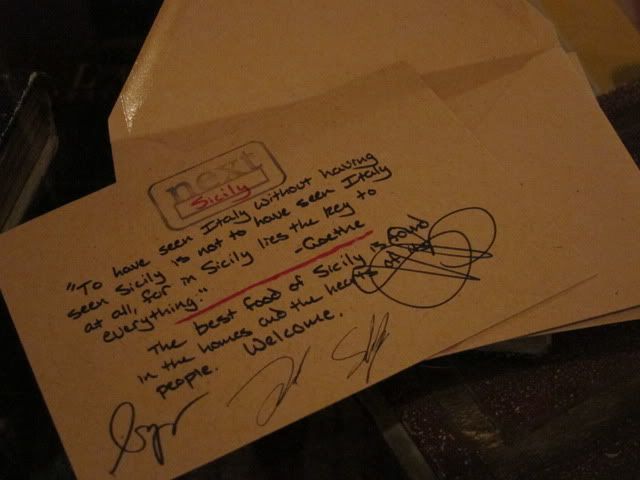
You're then treated to a Prosecco-based apéritif.
Four starters quickly follow:
Panelle (amazingly delicate chickpea fritters)
Caponata (their version includes a little chocolate...I'm not a caponata expert nor judge of authenticity, but I could have licked the bowl)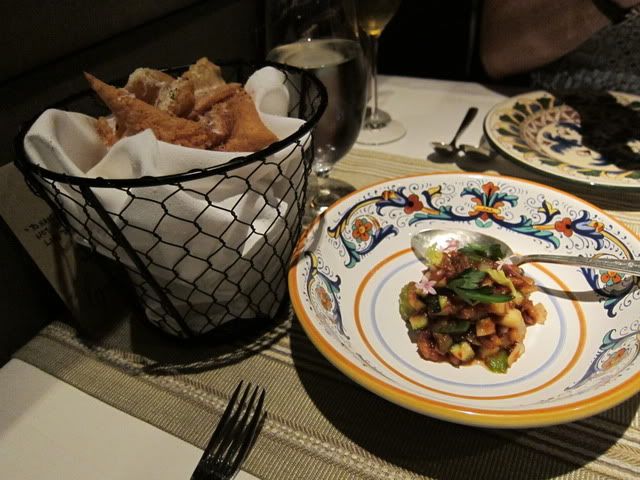
Carciofi alle brace (grilled artichoke halves)
Arancia (rice balls stuffed with lamb tongue...amazing)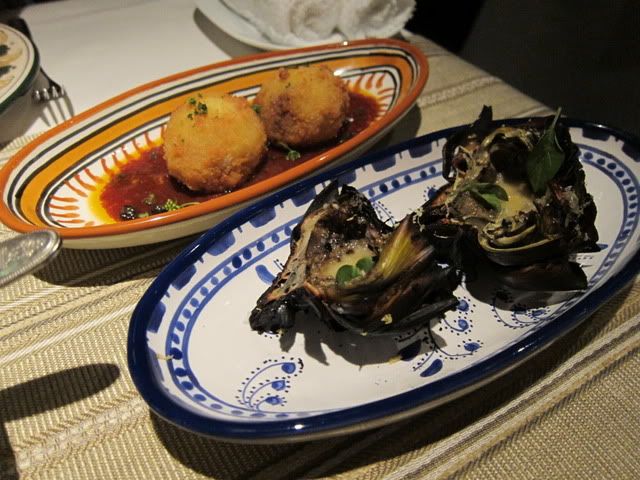
Next you're onto the pasta courses, both of which came individually plated.
Bucatini con Bottarga (I am a sucker for thicker pastas and this one rocked)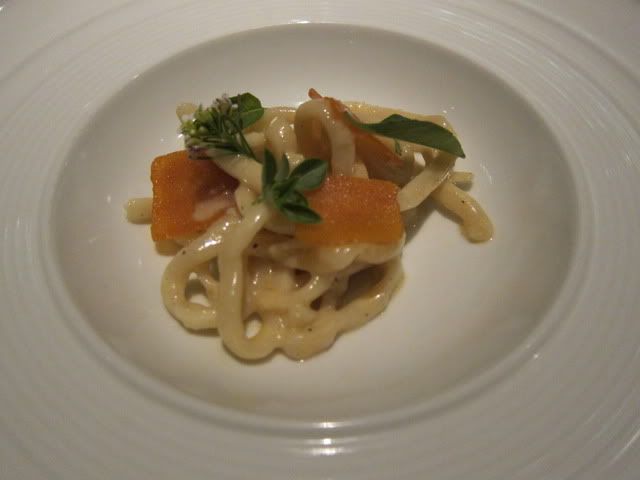
Gemelli con le Sarde (also with fried fennel fronds and bread crumbs...another winner though I slightly prefer the bucatini)
From there we moved to a heavier entrees.
First came the Pesce Spada con di Ceci (grilled swordfish topped with roast garlic and a mint pesto). This dish was one of my "eh" dishes. I'm not a huge fan of swordfish and we were both a little puzzled by the garlic, which was not roasted enough that you could squeeze it onto the fish. But the mint pesto was delicious.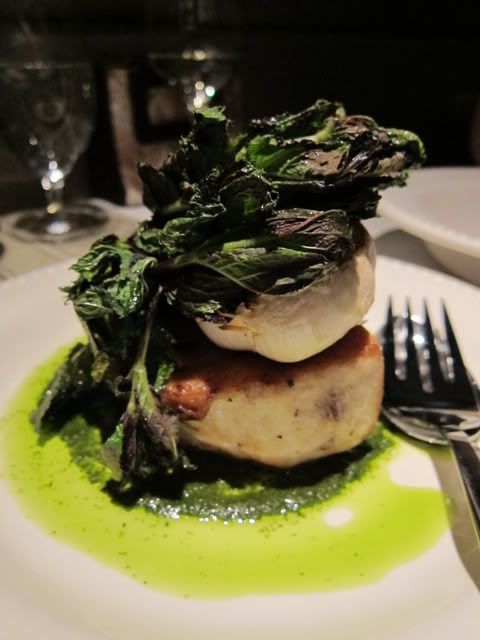
The swordfish was served with a side of chickpeas and romanesco, and a bowl of extra mint pesto. (I could have poured mint pesto on everything. This side was one of my favorites, and the pesto was a perfect addition.)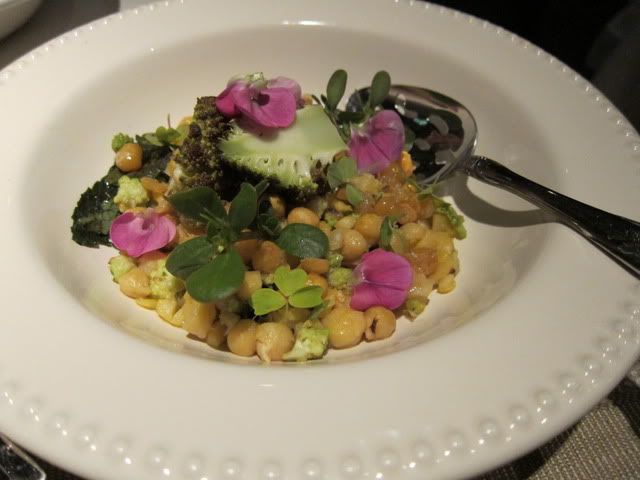
Then came the Spalla di Maiale Brasato (roast pork shoulder with a spicy tomato sauce and lemon). Another one of my favs, and I only regret I was getting full and couldn't eat much. I wonder, would they have packed the leftovers in a doggy bag for me? I never would have thought about using lemon on this dish, but it was the perfect addition.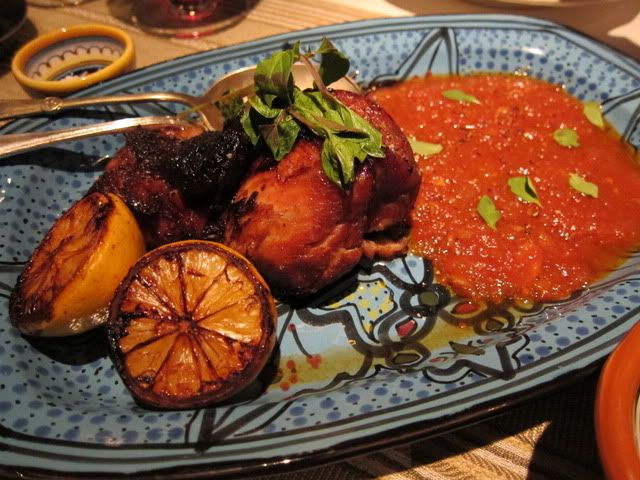
The side dish with the pork was the new dish of the night. Fried zucchini, shaved asparagus, grilled tomatoes and a stuffed, fried squash blossom. Another "eh" dish for me. I wish they'd included two squash blossoms so we each could have had one.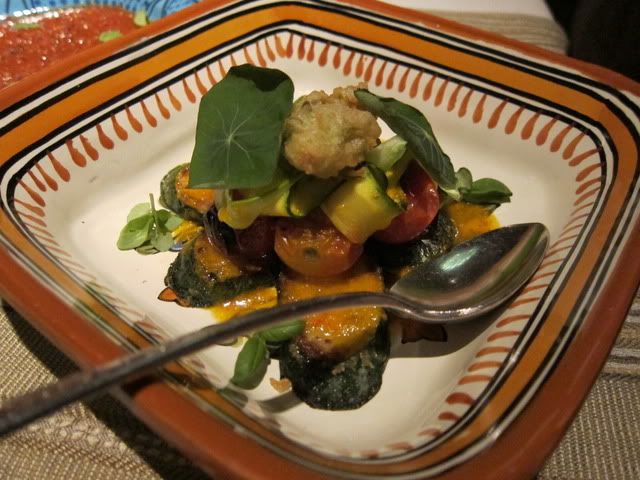
Next was a palette cleanser--Granita di Arance Rosse (blood orange granita). Between this and the Ginger drink served at Aviary, I'm beginning to think that their next venture should be a shaved ice cart, preferably one that's permanently parked outside my front door during the summer month. Delicious!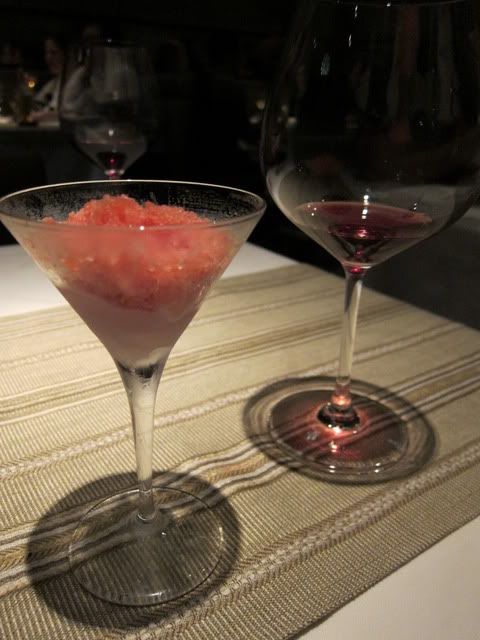
Finally we wound down the meal with desserts, including this beautiful cake with a sponge base, ricotta filling and marzipan top, accompanied by whipped cream, a perfectly candied walnut, pistachio, candied kumquat and strawberry. I failed to take a picture of the entire "show cake" they bring for you to see before the individual slices were delivered. My only disappointment: The show cake had cherries and whole candied kumquats, which were missing from the individual slices. But our server was kind enough to bring us a bowl with two candied kumquats. (Cherries appeared on the next plate of sweets.)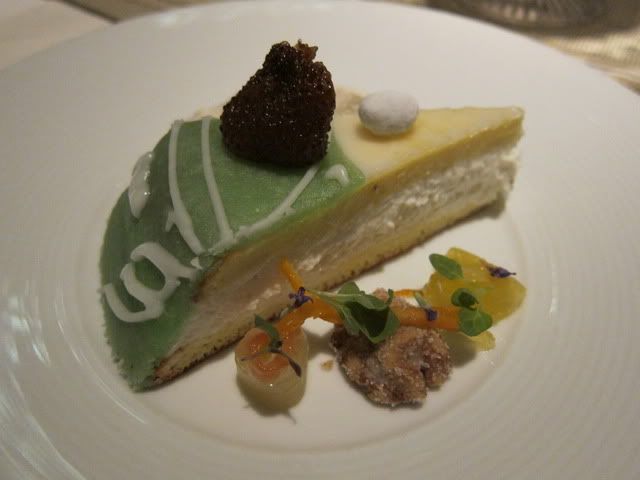
We also got a little plate of sweets -- cannoli (unlike any I've ever tasted, but deliciously light), fried ravioli and cubbaita di giugiulena (sesame candy).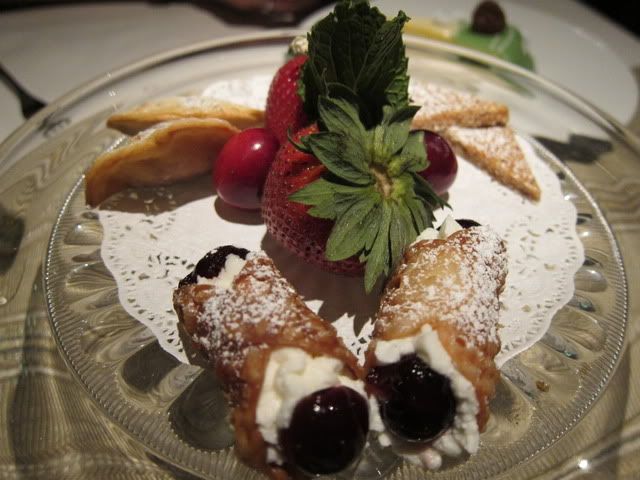
-
-
Post #3 - June 8th, 2012, 8:13 pmChgoeditor- I've been anticipating the first reviews of this Next menu more than any other so far, so thanks for the write up and pics.Logan: Come on, everybody, wang chung tonight! What? Everybody, wang chung tonight! Wang chung, or I'll kick your ass!
-
-
Post #4 - June 8th, 2012, 9:11 pmPlease, Next, I too crave this heartfood of the people of Sicily. Sing it to me through Goethe! Plate it merrily! I have sold the Antonello - claim my lire. Nun vom Mittagsessen ans Fenster! auf die Straße!
Serio, I appreciate the report. That nothing has ever made me want to run to Gaetano's faster, and then Confession, and then Freddy's, and then the Taste of Melrose, I feel alive, and am grateful. I wonder if this is how Nguyen Thi Thanh would have reacted to the antepenultimate menu. Fino a pagina sei, amici.
-
-
-
Post #5 - June 9th, 2012, 6:09 amLooks quite fine, probably tastes better! I visited Sicily a little more than a year ago & tasted authentic caponata, arancia, ricotta-stuffed squash blossom, blood orange, cannoli & granita--all incredible--and the chef has offered what appears to be a representative sampling of Siciliano cuisine, with of course his little twist on things. The bucatini & artichoke courses appear more Roman than Sicilian (which is heavy to fish, vegetables, fruits, nuts & sweet pastries) but for balance I certainly understand. I may have to fire in on one of those same night Facebook deals if it works into my schedule.
-
-
-
-
Post #6 - June 9th, 2012, 2:00 pmThanks for the report and pics! We've got tix for this coming week and I hope to be able to supplement your useful report with another data point or two.Gypsy Boy
"I am not a glutton--I am an explorer of food." (Erma Bombeck)
-
-
-
Post #7 - June 10th, 2012, 4:54 pmWe have two seats at our four top on Saturday, 6/16 at 5:45 with standard wine pairings if anyone is interested - you'd be joining my wife and I. Let me know!
-
-
Post #8 - June 10th, 2012, 11:34 pmJust returned from the 10p serving and found Sicily to be a study in inconsistency, unfortunately with a lot of the bad overshadowing the good.
The good:
- the first course "appetizer plates" with the artichokes, arancini, caponata were all stellar. The artichoke especially was as good as any I've ever had and the caponata was beautifully done
- the swordfish with mint pesto was perfectly cooked and a great piece of fish. Mint pesto was a perfect compliment and the only real 'transformative' dish of the night which made me feel like I was sitting out side on a dock of the amalfi coast. The chickpeas/romanesco side dish was superb as well and the texture made for a really enjoyable contrast
- blood orange granita was a great and tasty palate cleanser after the heavy pork
- the service was perfect as always. Great, friendly, laid back waitstaff - couldnt ask for anything more
The bad:
- as I said, we were the 10p seating and when we got there the valet was out of tickets so he told me to just park my car across the street and I gladly obliged. But when I got out, he still charged me the regular valet price. To park my own car?? On an otherwise empty stretch of Fulton Market? C'mon.
- My only other time dining at Next was during Paris 1906 and I remember it being a little hot/stuffy inside. Tonight was no different. I didnt wear a coat but it was still hot enough inside to sweat (just a little) and be uncomfortable. I know it was a particularly hot Chicago day but at this price range, the temp really shouldnt be an issue
- my bucatini was SUPER undercooked. Like, noodles getting caught in my molars undercooked. I enjoy pasta cooked al dente, which I think was the idea here, but this was more al buca di beppo. The flavors were otherwise enjoyable, but the pasta itself was just terrible.
- our braised pork was a microcosm of the evening as I had bites of it that were impossibly tender, flavorful, and beautifully cooked. Unfortunately, that was overshadowed by it being the single fattiest cut of pork I've ever had. Now, dont get me wrong - I'm a man who enjoys his pork fat. But about 40% our our piece was just inedible. Really a shame considering how good the other 60% was.
I have nothing but the utmost respect for the folks at Next and the ambitiousness of the cuisine and ideas they offer. The appetizer and swordfish courses prove the talent level in the kitchen and I consider Paris 1906 to be one of the better meals I've eaten in Chicago. I realize this incarnation has only been open just over a week and there'll always be some kinks to work out early - but its disappointing to drop a couple hundred dollars on a meal and come away with that experience due to being lucky enough to be one of the first to go.
-
-
Post #9 - June 11th, 2012, 9:03 pm@Commbrkdwn
It seems to me that if you had a piece of pork that was nearly half inedible you have some sort of responsibility--both to yourself and to the restaurant--to say something to one of your numerous servers (who you admitted were phenomenal). The same goes for the undercooked bucatini. If you don't give the restaurant the opportunity to correct their mistake and merely complain about it on an online forum, you lose some of your right to critique the sub-par elements of the meal.
-
-
-
Post #10 - June 11th, 2012, 9:48 pmjrgordon13 wrote:@Commbrkdwn
It seems to me that if you had a piece of pork that was nearly half inedible you have some sort of responsibility--both to yourself and to the restaurant--to say something to one of your numerous servers (who you admitted were phenomenal). The same goes for the undercooked bucatini. If you don't give the restaurant the opportunity to correct their mistake and merely complain about it on an online forum, you lose some of your right to critique the sub-par elements of the meal.
FWIW, with so many courses it is kind of hard for them to "correct their mistakes" as a guest in their restaurant at this price point, one expects things to be right the first time they serve a dish. Complaining would in some respects throw off the meal for ones dining companions (waiting while they bring another version of the same course for you) And, eating halfway thru a course to find that 60% of the course is fatty beyond expectations is not typically when I want to be sending a plate back to the kitchen. How are they going to really make the disgruntled diner whole? It's a bought and paid for months in advance dinner with really few options for compensation other than sending out a course only served to the "kitchen table" (which seems to be how they handle it)
So, I disagree with you that "lose some of your right to critique" such a dinner.
-
-
-
Post #11 - June 12th, 2012, 6:18 am@mhill95149
All good points. I suppose you might be at least partially right. I totally agree that the courses *ought* to be flawless at this price range. Of course, we all expect at least some bumps early on in the menu transition. Undercooked pasta is merely an execution error in the kitchen, while a fatty piece of pork is likely a mistake of a prep cook. Nonetheless, my point was just that as a high-paying customer you have every right to a perfect experience and that the restaurant is obligated to that--even if it means bringing out a new (or additional) course.
-
-
Post #12 - June 12th, 2012, 8:20 amI definitely struggled with this while there. On one hand, I'm sure you're right - they would want to know about the errors in execution and perhaps they would have fixed it if I'd said something. But on the other, it really felt awkward to be at a restaurant like this and have to say something about undercooked pasta. How do you explain to a waiter who was just waxing on about a dehydrated strip of fish and other fancy ingredients that your pasta wasnt even cooked through? Everything had been so flawless at Paris 1906 that I wasn't even sure at first if it was intended to be that way.
In any event, the idea of my silence at the restaurant stripping me of my rights to post a somewhat negative review on a message board for posting restaurant reviews is pretty laughable.
-
-
-
Post #13 - June 12th, 2012, 8:34 amI was bleeding from a lovely little cut caused by one of their "utensil" creations at Paris 1906 and they didn't do a damn thing--it wasn't in the script full of cute banter. And, yes, I let them know, although I didn't make a big deal out of it. I felt like the orchestration of service for Paris was stressful for both the diner and the staff--and, consequently, haven't been back since it would seem likely to repeat with every rotation. But others may disagree and if they enjoy the experience, it's all good. Just not my thing. And I have no problem writing about it, whether I told them or not--it's for the readers here to factor in whether my experience is of interest or concern for them."Knowledge is knowing a tomato is a fruit; wisdom is not putting it in a fruit salad." Miles Kington
-
-
-
Post #14 - June 12th, 2012, 11:17 amI haven't cooked pork shoulder in the past (nor eaten it), but I assume it's a piece that's fairly tough/fatty to begin with, where it's slow cooked, allowing the fat to help break down and tenderize the meat.
I also got an all-fat piece of meat at Sicily, but simply set it aside and helped myself to a different part of the meat. We didn't finish the dish (it was fantastic, we were just getting full), so it didn't seem complaint-worthy to me. Had we wanted to clean the plate and instead found that a good percentage of the dish was pure fat, I might have said something.
-
-
Post #15 - June 12th, 2012, 11:19 amAre you guys sure undercooked pasta and fatty pork isn't just the Achatz/Beran interpretation of Sicilian cuisine?
I encourage you to post these criticism on the facebook page. I'm in need of a laugh today as everyone comes out and calls you a hater who doesn't understand the cuisine.
But seriously, I agree with you boudreaulicious... orchestration of service was indeed stressful for all parties, but I'm surprised to hear what happened to you. I spilled a dime size drop of red wine and they replaced the entire tablecloth when I was there for Paris.
-
-
-
Post #16 - June 12th, 2012, 11:32 amAha--THAT must've been my mistake--I didn't bleed on their linens
 "Knowledge is knowing a tomato is a fruit; wisdom is not putting it in a fruit salad." Miles Kington
-
-
-
Post #17 - June 12th, 2012, 11:46 amTCK wrote:Are you guys sure undercooked pasta and fatty pork isn't just the Achatz/Beran interpretation of Sicilian cuisine?
I know this is a joke, but in all honesty, it really was my first thought ...."maybe they meant to do this?"chgoeditor wrote:I also got an all-fat piece of meat at Sicily, but simply set it aside and helped myself to a different part of the meat. We didn't finish the dish (it was fantastic, we were just getting full), so it didn't seem complaint-worthy to me. Had we wanted to clean the plate and instead found that a good percentage of the dish was pure fat, I might have said something.
Pretty much exactly what happened with me. I was getting full as it was and didnt think it worth it to complain
-
-
Post #18 - June 12th, 2012, 5:12 pmAny data on the duration of the meal? I've found at past cycles dinner tends to run around 3 hours, is Sicily on track with that? Thanks in advance, we have reservations tomorrow night and we're hoping to have cocktails at the Office after if time allows."Baseball is like church. Many attend. Few understand." Leo Durocher
-
-
Post #19 - June 12th, 2012, 7:03 pmUrsiform wrote:Any data on the duration of the meal? I've found at past cycles dinner tends to run around 3 hours, is Sicily on track with that? Thanks in advance, we have reservations tomorrow night and we're hoping to have cocktails at the Office after if time allows.
3 hours or thereabouts, though at some point I completely lost track of time. We had an 8:45 reservation and we lingered over drinks after dinner, but I could have sworn we went to Aviary at about midnight. But somehow I didn't get home until 2 am and we only had one drink at Aviary. It's the Next:Aviary time vortex, I guess.
-
-
Post #20 - June 12th, 2012, 7:36 pmchgoeditor wrote: It's the Next:Aviary time vortex, I guess.
Isn't that the truth! Precisely why I inquired, time has a way of slipping away there. Thanks for the information!"Baseball is like church. Many attend. Few understand." Leo Durocher
-
-
Post #21 - June 13th, 2012, 11:46 amUrsiform wrote:chgoeditor wrote: It's the Next:Aviary time vortex, I guess.
Isn't that the truth! Precisely why I inquired, time has a way of slipping away there. Thanks for the information!
I will say that Sicily wasn't (for me) as drunken of a meal as Childhood. They still leave bottles on the table (and as we lingered after dinner, were more than happy to pour me another glass of a wine we'd had earlier in the night), but I felt sober when I got home from Sicily. With Childhood, I could hardly walk straight.
-
-
Post #22 - June 14th, 2012, 2:36 pmMy thoughts:
1. Also uncomfortably hot. It was a 95 degree day, though.
2. Agree on the swordfish; best dish of the night.
3. I really liked the pork shoulder. It was a rich cut, but I thought it was set off well by the tomato sauce and Meyer lemon. No inedibly fatty parts on mine.
4. I thought the rice/goat rillettes appetizer needed more a textural contrast to stand out. You have to find some way to make "goat tongue/fat fried-rice ball" less of a slog through fat. The sauce wasn't enough.
5. I was surprised by how much I enjoyed the cake, but I thought the sesame cookie/strawberry ravioli/cannoli were all mediocre. Low point of the meal.
6. Loved both the pasta courses, especially the anchovy dish.
Our meal was about 2.5 hrs. Generous portions of both food and wine. Good service, but I think the staff were thrown off by not being in complete control of the experience since dishes were often family style. Plates/glasses could've been cleared a bit more smoothly. I loved the meal, but I wasn't wowed. The staff did ask about which dishes I thought didn't work, so the menu may evolve throughout the season.
-
-
-
Post #23 - June 15th, 2012, 6:12 pmThe aim, we are told, is for you to feel as if you’re in someone’s home. To that end, the meal is served family-style on rustic-looking plates. A lot of effort—no surprise—has gone into creating the illusion, or perhaps I should more accurately say, the context: everything from the particular choice of music to the serving ware to the choice of the dishes themselves. One could fault them missing this or that item but doing so misses the point. This is Next’s take on Sicily and it is no more “right” or “authentic” than anyone else’s. (The Lovely Dining Companion made the very sage observation that all of the hullaballoo about “authenticity” when Next did Thai is almost wholly missing this time.) This is “a” take on Sicily, not “the” take. Indeed, at several points during the presentations, the servers were careful to note that there are many different versions of the dish being presented throughout the island. This one you’re about to get takes from some, takes from others, and creates its own version. Since that is what any good cook in Sicily would do—taking from the past, from the present, from what’s fresh and what’s good and serving this today and that tomorrow—the whole meal felt very down home and comfortable…as if, indeed, you were in someone’s home.
To the meal: well, actually, to the “welcome.” There is an envelope awaiting as you are seated.
Nice sentiments, nice note. But who on earth are the people who signed it? We had to ask, finally (having incorrectly guessed that it was Grant, Nick, and Dave). It’s Dave, Bradley (the manager), and John (our server). Use whatever signature flourishes you wish, but you might consider identifying yourselves, guys.
Now, then. On to the meal which, of course, begins with a selection of four antipasti, served simultaneously:
Panelle (chick-pea fritters): these were served about room temperature. Unfortunately, despite their placing them in a dryer of some sort to remove excess moisture, more than a few of the fritters were soggy. That said, they’re addictive. Sprinkled with a bit of grated parmigiano (?) cheese, who doesn’t like a nice fritter?
The caponata was unlike any version I’ve had but nonetheless appealing for that. It started with the eggplant that is ubiquitous in virtually every variation to be found and went from there: prominent was the celery and the agrodolce (sweet/sour) “dressing.” A very “fresh” tasting caponata—which is not a word I would ordinarily associate with that dish and indeed, might find somehow off-putting. In the event, it worked. The sauce was rich and strong and the textures and flavors all came together beautifully.
Carciofi alle brace. Alle brace means cooked in the embers. And these showed it: the serving platter contained the bottom portion of several blackened artichokes. Prepared quite simply with a good olive oil and not much else (maybe a touch of garlic, a touch of mint), this plate sang. Although instructed to spoon out the hearts and surrounding goo with a spoon, it was easiest and most efficient to grab them in your paws and gnaw away. Rich, very artichoke-y, delicious. There’s a reason we eat with our hands. Our only regret: there wasn’t more “meat” in each artichoke. (Wet washcloths are available for the mess you’ve made of yourself.)
Arancine filled with lamb’s tongue. Eat these first, while they’re hot. The server didn’t suggest it (surprisingly) and I didn’t process what was in front of me quickly enough. So by the time I worked my way down the table, they were warm but not hot. And that may have influenced my take: good but not great. The lamb tongue was wonderful, falling-apart tender—and not at all lamb-y (which may be good or not, depending upon your personal predilections). Hotter would have been good; my fault. A greater depth of flavors would have been welcomed, as well; we both found it a little one-noteish.
Accompany the antipasti was an intriguing aperitivo: prosecco with a touch of Averna amaro (a sweet bitters from Sicily) and some chamomile. I wouldn’t have missed the chamomile, but I enjoyed the drink and it worked better than I anticipated with this assortment of dishes. (For more on the wine, ya gotta read to the end.)
On to the primi
Bucatini con bottarga. Had it before, hated it. Not this time. Dried, pressed tuna (or gray mullet—they mentioned both) roe which is usually grated onto the dish. Here, instead of being grated, they shaved several slices of surprisingly unfishy (relatively speaking) orange stuff onto the pasta. I thought the sauce itself fairly delicate and so it benefitted by the amping up it got from the bottarga. A pleasant enough dish but not particularly a hit for either of us.
Gemelli con le Sarde. A lovely interlude with a small fist of pasta atop which was draped—looking for all the world as if on a catafalque—a beautiful sardine. (From Portgual?! What? They don’t fish for sardines near Sicily?) The name of the pasta, we were informed, is the Italian word for twins, a strand of pasta being twisted round itself. Lovely image. The un-fishiest sardine I may ever have had. I don’t know what they do to it—soak it in milk for a day?—but it was mild, just firm enough, tasty without being overpowering. The flavor (or relative lack) worked beautifully with the pasta and its accompaniments, including three kinds of fennel (if I recall correctly), including some fried fennel “chips” and lacy fennel fronds perched gently atop the whole. The server made a point to note that this pasta was made differently from what preceded by the addition of egg white and white wine; the intention was a softer pasta, the better to absorb the sauce and work with the fish. A fascinating point.
Pesce Spada con di ceci Presentation began with a small bowl of mint pesto. Next arrived the serving platters: swordfish on one large plate, ceci (garbanzo beans/chickpeas) and stuff on the other. The swordfish, a trifle overcooked in my opinion (not an opinion my Lovely Dining Companion shared), topped with a wrapped bouquet of wild mint and half a wonderfully roasted head of garlic. A grilled halved Meyer lemon to the side. The wild mint (not for eating; I tried) helped keep the swordfish moist (just barely), the roasted garlic brought sweetness, and the lemon (a happy discovery at a staff meal, to hear our server explain its presence) brought much needed acid. It’s a little surprising that they originally thought (to judge from our server’s explanation) to serve the lemon as a garnish without intending its use. And even a bit more surprising that they would have considered leaving it out. The fish—which I hasten to add was lovely—would have benefitted by a trifle less cooking time.
The accompaniment involved ceci again, this time in the company of romanesco (in the words of the server, a love child of cauliflower and broccoli) plus assorted flowers, herbs, etc. The romanesco sopped up the flavors and my greatest regret was that there wasn’t more of it.
Spalla di Maiale Brasato Though I noted others’ experiences with this course, we got a good-sized hunk o’meat and only some fat. The rich tomato sauce was a delight, cut by a liberal use of capers (their second appearance of the night, having first lent their unique acid to the caponata). A small corner of the pork was overdone and dryish, but there was still plenty of meat to sate our gluttony. Indeed, more than enough meat for the two of us (though I suspect it might have been a bit too small a portion had my companion had a heartier appetite. The Lovely Dining Companion is the love of my life and a superb dining companion, but one doesn’t look at her and think: “hearty eater”!) (We were also a little puzzled by the tiny bowl of sea salt; to our palates, in any event, nothing needed any seasoning whatsoever. And certainly not salt.)
Alongside, a platter loaded with zucchini, roasted cherry tomatoes, shaved asparagus, fried squash blossom, nasturtiums…and more. A wonderful array of veggies done in a variety of styles from raw to fried. Textures, sweet to bitter, peppery to juicy—it was all there!
The first of (ahem) several plates’ worth of pork and fixin’s
Granita di Arance Rosse For those who have been to Alinea, think yuzu snow. That consistency. Little tiny frozen grains of nice bitter orange—one of my personal favorite flavors in the world. A highly appropriate selection given our locale this time and a wonderful palate cleanser.
Cassata for show
Cassata for eating
The whole cake was brought for show-and-tell and then the server returns with smallish slices. Wonderful as it was, I wouldn’t call it superb and part of me couldn’t help wondering what Natalie would have done with this. Her personality and behavior to the side, she is one extremely talented baker and I’d have probably died and gone to heaven with her cassata. There was a distinct home-iness in the presentation. Not over the top…just exactly what you might imagine you’d get at the home of a talented and proud home baker. (As perhaps a better indication of my thoughts, I made numerous, unsuccessful, efforts to sweet-talk various people into bringing me a second slice.)
Cannoli, ravioli fritti, cubbaita di Giugiulena
Tiny cannoli with cherries, amareno I’d guess. The cannoli itself was on the thin side and very brittle. The filling, just on the right side of sweet. Barely. A personal thing; I’d take Natalie’s (as if). Fried ravioli were unexceptional. Sesame seed brittle likewise. (Fascinating riff on the name, by the way, here. I do appreciate the effort and thought behind the selection but the execution just didn’t wow me. Happier with the cassata.
Service: a bit less polished than we’ve become accustomed to. Although John, our primary server, was terrific and knew his stuff inside out, there were some missteps and presentation flubs. Nothing whatsoever serious and we chalk it up to dining early in this menu. The wine server, in particular, seemed a bundle of nerves through the first several courses. And more than a few times, we had to wave someone over to ask what things were on the plate. We’ve gone from a detailed inventory (El Bulli) to a general notion (Sicily). Something in between would be nice. But don’t just present a course, name some of the components, and depart. (This happened with our sardine course. We liked the story and explanation about the pasta but don’t you think we might be curious about this dead fish atop my pasta? At the very least what kind of fish it is?)
There was much more time between courses—at least at our table. Not a complaint: it let us recover from what had preceded and readjust for what was to come. And after El Bulli, where a course appeared every time you blinked, it was quite a drastic change.
A few words on the wine pairings
I had the "regular," not the "reserve," pairings. I was very much looking forward to a night of Sicilian wines. In a word, quite disappointing. I didn’t care at all for the wine served with the bucatini, a 2010 Tasca d'Almerita 'Regaleali.' A blend of Inzolia, Grecanico, and Catarratto. I don’t know enough about the blend or the varietals to comment more except to observe that the wine had no character. Little acid, less body. It neither complemented the pasta, nor highlighted any of the components of the dish. It was a quaffing white in the worst way: absolutely nothing objectionable, meaning—at least to me—absolutely nothing distinctive. You can pick this up for $10 retail and—sincere apologies to all the great examples of highly worthwhile $10 wines that do exist—it tasted like it.
A possible explanation lies in the fact that this is the winery (our server explained) which is owned by the brother(s?) of the woman who advised Next on the menu: Anna Tasca Lanza (her daughter did the narration on the intro videotape for this iteration). She runs a well-known cooking school in Sicily, has written some excellent cookbooks, and has a deep knowledge about Sicilian food. Whether she had any influence or not—and I want to be very careful here to make clear that I have no idea (though it’s perhaps not coincidental that she blurbs for the wines on her website)—with so many great Sicilian wines available, this bhoice was a mistake. It is the greater pity that it served as the wine to accompany both pasta courses.
When I commented on the absence of varietals, our server seemed to suggest that, at least in the case of the (solitary) red of the evening, the DOCG appellation was the driver. In other words, they were intent on serving something with the DOCG appellation. In the event, at least to my palate, that meant sacrificing quality or variety. The red (a 2010 Planeta Cerasuolo di Vittoria, served with the roast pork), was a blend of nero d’avola and frappato (think syrah and merlot, or gamay). The somewhat confusing explanation I got said that the DOCG appellation required (!) that no more than 60% of the blend be nero d’avola. Okay. Why not just serve a stellar example of nero d’avola then? The hell with DOCG. Cheaper nero d’avola tends to be more what it seems they were looking for than high-end bottles, which are typically too “big.” In the event, it was a reasonable pairing that was completely perfectly adequate. My complaint? I think they could have found a far better match. I understand not wanting a heavier red for this course (the server mentioned that they even looked at some rosés, a not surprising statement since there are some stellar ones out there) but I simply do not believe that they couldn't find a better match.
Fairness demands kudos, however, for the 2008 Planeta Passito di Noto—a dessert wine made entirely from moscato bianco. The grapes are harvested early and dried for six weeks before crushing. A slight orange blush, a palette of summer flavors, and just enough acid to make a perfect complement to the desserts.
Also: a word about the non-alcoholic pairings. Sadly, the Lovely Dining Companion—who was quite taken with almost all the pairings for Next/El Bulli—was not a fan of more than, perhaps, one this time. Luck of the draw? Maybe. Can’t hit all winners all the time. Still, it was disappointing—particularly since she loved the dinner—that there were hardly any concoctions that she felt similarly about.
So: what did we think? LDC puts it close to the top of all the meals we’ve had at Next. I put it down a ways. We both enjoyed it and there is no question that the food was largely excellent. Just different takes on the evening, I guess, when all is said and done. Maybe LDC was more primed for it; maybe I was more primed for Paris 1906—still probably the best meal I’ve ever had, bar none. Whatever the reason or explanation, we both enjoyed ourselves and we both enjoyed the food. And at the end of the evening, that’s really what it’s all about, isn’t it?Gypsy Boy
"I am not a glutton--I am an explorer of food." (Erma Bombeck)
-
-
-
Post #24 - June 18th, 2012, 8:30 amWent to Next last night.
I've been to each menu except El Bulli because I just can't enjoy dinners that are so expensive and stuffy and finicky like that. For me, Next is at its best when it is an Antidote to Alinea, not a mirror to it.
I've never had a bad meal at Next, but some meals were noticeably better than others. Thai was the clear last place entry, and it remains so after dining last night.
Childhood was fun and delicious, but the courses weren't well paced or even well arranged. I was too stuffed to eat most of the contents of the lunchbox, and couldn't even look at the campfire. And I do just get tired of that tricksy bullshit, you know? A man craves a nice piece of meat that just looks like a nice piece of meat.
For me, Paris has been the paragon of what Next is capable of. A fantastic, intricately thought out and coursed meal the likes of which I simply cannot otherwise get in Chicago. Sicily matched it perfectly. They reproduced everything I loved about Paris but with a Sicilian flavor. I cannot decide if I liked Paris or Sicily better.
I didn't experience any of the inconsistency that others on this board have mentioned. My pasta could have been more al dente, is the only criticism of the evening. You got a fatty piece of pork? Leave it on the fucking plate and grab a meatier piece. You served yourself. Next time don't take all the fat for the whole table onto one plate. Give the fat to someone who wants it. It sucks that you got a plate of food that you didn't think was balanced fat:meat, but you are the one who plated it! You have to take some responsibility when serving yourself to figure out the contents of the center dish and distribute accordingly. Kudos to Next for serving a nice fatty crispy skin-on piece of pork.
A word on the wines: I have felt that the first white they have served at every menu I have been to has been EXTREMELY mild. I am sure they do this because they think it's a good match to the delicate fish courses they are served with. Nevertheless, I am always a bit disappointed on this count. That said, the first time I really felt it was justified is pairing it with that bottarga course. I LOVED the bottarga, which had a very gentle floral subtly-fishy effect on the dish. I can see how that wine pairing made sense. It really let the bottarga shine through. Still doesn't make it a memorable wine though... The red they served with the pork was GREAT.
So maybe not perfect in every way, but as good as any meal I've had at Next. I don't know what justified the $20 per person wine pairing price jump since Paris, but the meal itself is tied for first place with Paris for me.
-
-
Post #25 - June 18th, 2012, 1:32 pmPSA - another round of tickets just went up for sale on the Next website."Baseball is like church. Many attend. Few understand." Leo Durocher
-
-
Post #26 - June 18th, 2012, 10:48 pmfranklincampo wrote: You got a fatty piece of pork? Leave it on the fucking plate and grab a meatier piece. You served yourself. Next time don't take all the fat for the whole table onto one plate. Give the fat to someone who wants it. It sucks that you got a plate of food that you didn't think was balanced fat:meat, but you are the one who plated it! You have to take some responsibility when serving yourself to figure out the contents of the center dish and distribute accordingly. Kudos to Next for serving a nice fatty crispy skin-on piece of pork.
Sweet rant. My meal was a table for 2, so its not like I had a giant pig in front of me and a bevy of different cuts to choose from. My wife and I each took equal(ish) sized portions, both of us noticing in disgust that a large portion of our plate was straight fat. Also, were I dining in a larger group, I'd think it pretty dickish to take my mostly fatty piece and just put it back on the center dish and then taking meat away from someone else.
But Kudos to you for serving a nice fatty crispy skin-on piece of stupid post.
-
-
Post #27 - June 18th, 2012, 11:12 pmEasy there, folks. I get worked up about pork fat as much as the next guy, but it's getting a little hot in here. Tone it down, please.
-
-
Post #28 - June 18th, 2012, 11:32 pmI am not a big fan of "Gastrotainment". I prefer to eat at my own pace and in my own style rather than be part of a foodcentric play (a whole new meaning for the phrase "dinner theater"). I do understand the concept and appreciate the tremendous work that goes into scripting these meals. That said, that swordfish dish looks just amazing, from an artistic POV. I hope it was as much fun to eat as it is to look at.
-
-
Post #29 - June 24th, 2012, 2:01 pmAte at the Kitchen Table at Next Sicily - some brief thoughts on the 3 1/2 hour dinner....
You get a seafood course at the kitchen table only, it was perhaps my favorite of the evening....the single best octopus (in sweet and sour) I have ever eaten. There was also a cured tuna, mussels in a red pepper sauce, shrimp with watermelon, and clams with fennel. I believe the waiter described this as a "seafood attack."
You also get a Gnocchi con Bottarga during the pasta course which was exceptional.
It's funny - a friend of mine is Italian and I once attended a family dinner in his house. Taking the lead of everyone else, I filled my plate with pasta and dug in.....I did not realize there were two more savory courses and two rounds of dessert! This was that kind of dinner - by this point, I was getting full and these weren't even entrees!
The pork - two gigantic hunks of meat. About half of it was fat, but as I said - gigantic. By this point, most of the group was getting physically uncomfortable from all the food, the staff noticed this offered to wrap it up to take home. We took them up on it - leftovers from Next....why not? The leftovers weigh a total of 36 ounces - that's with six people digging into it.
Cheese plate was also a kitchen table exclusive - if I'm not mistaken one ricotta and four types of pecorino, the chef explained they wanted more of a variety but this was basically the best they could do on short notice.
One member of our group did the non-alcoholic pairing - I didn't take notes or anything, but I enjoyed almost every single one of her beverages more than the wine (there was a Brunello that was awesome though). Now, how they "paired" I don't know, but flavor wise I left convinced that if we get into Kyoto, I'm going non-alcoholic pairing without question.
This was our third Next visit - we also hit up el Bulli and Paris 1906. Can't really compare it to el Bulli, but I enjoyed everything more than Paris. I can also safely say I have never felt more full in my entire life after this meal. This is the first Next meal that I've said I would return to if we could score a same night table - I very well may go for it towards the end.
-
-
Post #30 - July 1st, 2012, 6:55 amDined at Sicily the other night for the first time after having previously attended Paris and Childhood.
While it is difficult to compare menus, my wife and I decided that we'd probably put Sicily below Paris and above Childhood. Paris was a rare mix of incredible flavor, perfect execution, and wonderful wine pairings. Childhood, for us, while incredibly innovative and conceptually unique, lacked the depth of flavor for which we were hoping. Nonetheless, we have enjoyed all of our experiences at Next and will continue to keep trying to get tickets for future menus.
Here are some thoughts about the menu.
Highlights:
-Pork Shoulder: By far, the pork shoulder was the best thing I ate all night. The flavor of the falling-apart, juicy shoulder was phenomenal, and the accompanying tomato sauce was just as good. The portion was huge, and by that point in the meal we were pretty stuffed. But, we all went back for seconds. Not too fatty at all. Of course, it was pork shoulder, so you expect a fat cap. I would eat this every week--no questions asked.
-Antipasti: The first antipasti course was also very solid. While the chickpea fritters were a bit ho-hum, the caponata, fried risotto, and artichokes were phenomenal. The caponata was a perfect mixture of contrasting tastes and textures (sweet, sour, crunchy, soft). The lamb tongue inside the fried risotto was flavorful and moist. Plus, who doesn't like fried risotto?! The artichoke was perhaps the biggest surprise of the night. The smoky, soft heart was stellar. I could have eaten 4 or 5 of these.
-Sardine pasta: The sardine pasta was also quite good. While the sardine I had was quite pungent, the mild sauce along with the currants and pine nuts mellowed it out nicely. The pasta was perfectly cooked.
-Blood Orange Granita: Along with the artichoke, the granita was the other great surprise of the night. It was so simple, but it was delicious. Plus, its place in the course of the meal was perfect. Just as I was feeling stuffed after eating two servings of the pork shoulder, the granita was like a breath of fresh air allowing me to push on through to the end of the meal. I will definitely be making this at home.
-Cassata: The cassata was lovely. Not too sweet; not too rich. It was delicately balanced and wonderfully flavored. It blew the rest of the desserts out of the water.
Lowlights:
-Service: Perhaps the biggest lowlight of our Sicily experience was the service, which was almost shockingly bad. Servers were running into each other by our table, and the meal, overall, just felt out of sync. We waited quite a long time in between courses, which compared to the rapid pace of Childhood was a bit welcome. However, after finishing the antipasti course we waited 45 minutes for the next course, which was lukewarm upon arrival. The service was definitely the most disappointing part of our experience. Granted, every restaurant can have off-nights, so maybe we just came on one of those nights.
-Bottarga Pasta: As mentioned above, the bottarga pasta arrived 45 minutes after we finished our first course. So, excited (and hungry!) to dive into the second course, I was really disappointed to have a lukewarm pasta with almost raw noodles. I really like pasta al dente, but mine wasn't even close. The flavor of the bottarga was nice; it was the perfect amount of saltiness. Had the dish been warm and cooked through, I imagine I would have liked it a lot more.
-Reserve Wine Pairings: Everyone in our party was a little disappointed by the reserve wine pairings. For twice the price of the standard pairings, the wines were unremarkable. The prosecco cocktail to start the meal was nice, and the dessert wine was unique, but the two whites (or were there three? I don't even remember they were so unremarkable...and I wasn't drunk!) and the red were at best average. The wines did pair decently well with the courses, which was nice. But they just weren't anything special--especially for the price.
-Swordfish/Chickpeas: The swordfish and chickpea dish just didn't work for me. The chickpeas were overly bitter, and I'm not a huge fan of swordfish. It was, to Next's credit, cooked perfectly. I tried every combination of swordfish, sauce, and vegetable to try to find something that worked, but I just couldn't. So maybe this was just my own throwaway dish for not liking the flavors. The execution was perfect, but it just didn't do it for me.
-Vegetables with Pork: Finally, the vegetables served with the pork weren't the greatest. For whatever reason, it felt like I was already served the dish earlier in the meal, both in terms of the components and the flavors. Maybe the pork was just so good that the vegetables were overshadowed. I'll be interested to see what this dish evolves into as the produce starts coming on heavy in Chicago in late July and August.
All in all, we were satisfied with our Sicily experience. Some elements were wonderful, and some needed some work. Overall, it was a terrific meal and, more than that, a unique experience. I told my wife that if they served a three course lunch of the antipasti, the pork, and the cassata, I'd eat there every week. Those were, for me, the most shining moments of the meal.Last edited by jrgordon13 on July 8th, 2012, 6:19 am, edited 1 time in total.