

Lao Yunnan
Lao Yunnan
-
-
-
-
-
Lao Yunnan
-
Post #1 - May 23rd, 2012, 11:07 pm

5.18.2012
5.23.2012
Quick month.
Seebee's faves made the cut. Same chef, same wonderful smiling front of house.
Bitter melon, anyone?
Tony sent us the dry chili chicken specially, like Lao You Ju's (cayenne and vinegar, almost Frank's-profile) only without the french fries, fantastic, and dreamed of upcoming northerly Lao 18 (on Hubbard) and possibly a separate Beijing duck service restaurant nearby on Michigan. We joked he'd have 18 just in Chinatown soon (though the reference is the address), and he said it really would probably be the 18th-ish opening he'd be involved in for his whole career.
Lao Yun Nan (Yunnan)
2109 S China Pl
312.326.9966
-
-
Post #2 - May 24th, 2012, 3:55 pmI'd always thought "Yunnan" was an alternate spelling of "Hunan". Not so?As a mattra-fact, Pie Face, you are beginning to look almost human. - Barbara Bennett
-
-
-
-
-
Post #4 - May 24th, 2012, 8:27 pmWhat is the primary difference between Yunnanese and Hunanese food? Essentially, what is distinctive about Yunnanese food?
-
-
-
Post #5 - May 24th, 2012, 9:39 pmfropones wrote:What is the primary difference between Yunnanese and Hunanese food? Essentially, what is distinctive about Yunnanese food?
Yunnan is a mountainous borderlands in the southwest, with many diverse minorities, so it's hard to generalize. Yunan restaurant cuisine often focuses on mushrooms, numbing spices, lots of fresh herbs, duck, and sometimes dishes with milk cheeses in addition to tofu. Casseroles, rustic pancakes, fragrant teas, ham (see recent notes on "Asian prosciutto"), and bone-in meats abound.
The fellow talking to blur-Tony above lived in Kunming, and reminds me that Yunan borders Myanmar, Laos, and Vietnam, and almost gets to Bangladesh, so there are some (perhaps) unexpected spices and ingredients like curry flavors, pineapple, and lemongrass soups, but they didn't seem to pop up much at Spring World, and we didn't exhaustively go through the new menu last night.
Hunan is culinarily to me like an Umbria or Extremadura - (vast oversimplification alert) wonderfully simple stick-to-your-ribs agrarian food, sometimes cooked with local beer, lots of fatty pork, regional game, braises, simpler chili heat and actual pepper flavor rather than numbing, preserved condiments, colorful, mixed crisp-fried items, something folks in the capitals may idealize as pastoral and nostalgic, but sophisticated and bountiful in its own right.
Most of the chefs plying the trades of both regions in American kitchens have passed through serious modern training in classical (and post-colonial) schools and hotels in the metropolises, and here the Hu menus sample liberally from all regions, so it's hard to say what is most purely Yunnan or Hunan (others who have spent actual ground-time in either province will certainly chime in). What I can tell you is that you should not miss the Yunnanese ribs, beef pancake, and mushroom hot pot / stir-fry carryovers from Spring World to Lao Yunnan, nor the Chairman Mao's pork belly, chilis with black bean sauce, or jade tofu at Lao Hunan.
-
-
Post #6 - May 24th, 2012, 9:39 pmAs it happens, I have just returned from a trip to Western Yunnan, including Kunming, Dali, Lijiang and Shangri-La.
These areas are home to several of China's minority groups; the Tibetans, Naxi, Bai and Yi are all represented there. I understand that the Miao people also live in Yunnan, but in the south and east. Ingredients are driven by the terrain, with higher elevations bordering Tibet favoring yak, barley, cheese, and air-dried ham. The Yi people traditionally live in forested areas, and forage for mushrooms, tender pine needles, fiddleheads, and other forest greens. There is an excellent article in Saveur's September, 2011 issue about mushroom hunting and mushroom hotpot in Yunnan. The Naxi tend canola fields and orchards in the valleys of Yunnan, where the weather is spring-like year-round- hence the name, "Spring World". Favas, lettuce root, potatoes, and an assortment of vegetables all find their way into the traditional Naxi hotpot, which features organ meats. The soup is eaten with salty tofu and hot pepper.
I have several posts in the works on this trip, and I promise recipes. In the meantime, get ahold of a copy of "Beyond the Great Wall" - a non-Han Chinese cookbook- and read it! Or check out Lao Yunnan and report back.Man : I can't understand how a poet like you can eat that stuff.
T. S. Eliot: Ah, but you're not a poet.
-
-
Post #7 - August 19th, 2012, 12:36 pmMade my way to Chinatown after playing tourist yesterday (Hilton overnight, Millenium Park, Air Show.) Late lunch ended up in Armour Square, and when in that version of Rome, I do as the people who eat shredded chicken in house spicy vinegar do. (Forgive my sad attempt at trying to be clever.) Anyway, the chicekn I wanted was not listed on the menu, but I just figured it had a new name. At Spring World, it was labeled "House shredded Chicken In Spicy Vinegar," and if you ordered it using the exact words from the menu, they never had any idea what you were referring to, so the point method was needed. AT Lao Yunnan, I had to try and explain. It was mildly frustrating. I also think the other servers were snickering at the conversation I was having with the server I was trying to order from. (I asked for pan fried noodle with chicken, with additional broccoli. She flat out said "no." Then she told me chicken with broccoli is a different dish. I then asked again for broccoli with my pan fried noodle with chicken. NO. Can't do that. I gave up on that one.) But anyway, after trying to explain that I was looking for the shredded chicken dish in the spicy sauce for a little while, her eyes lit up when I said "cold." She then said it is now called "Famous Chicken in spicy sauce."
And off we went.
If this is the new /improved version, I like the original better.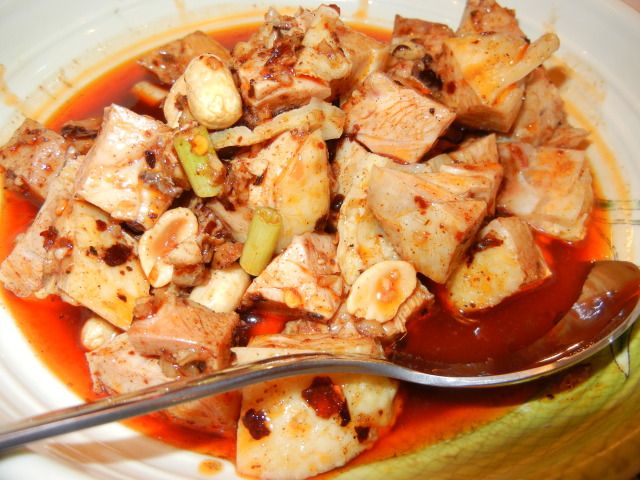
This version had the same craveworthy chili oil, but there was a good amount of fresh ginger slivered in, and also, a bunch of peanuts. That was ok, BUT, the chicken was just chopped BONE-IN chunks. We were picking bone shrapnel out of our mouths. Not a big deal to me, but I just REALLY preferred the old version - no bones, and the chicken was in shreds. I'm not saying we didn't eat the HELL out of it: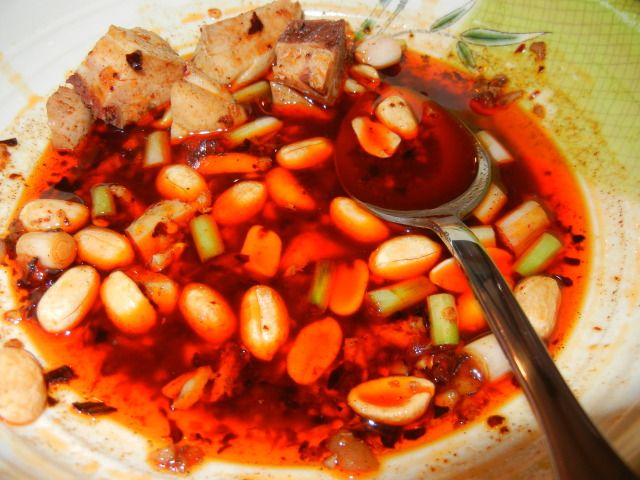
The Yunannese Spare Ribs SPicy Style were still DA BOMB. A little more chilified than I last remembered. Just as addictive: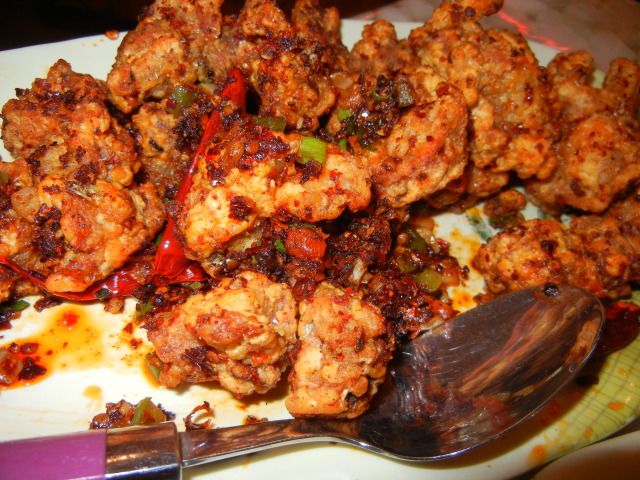
We rounded the meal out with the aformentioned Pan fried rice noode with chicken (it's chow fun noodles,) chengdu dumplings, pot stickers (never again-these were fat and plump, and nicely chewy, but the filling was far too SWEET - blech,)
Decent meal, decent value. I hope I just ordered the wrong thing with the chicken though. Any thoughts?We cannot be friends if you do not know the difference between Mayo and Miracle Whip.
-
-
-
Post #8 - August 19th, 2012, 1:50 pmseebee wrote:Decent meal, decent value. I hope I just ordered the wrong thing with the chicken though. Any thoughts?
I was here last week with a group of 10 and kind of felt the same way. Several people in our group lamented the absence of dishes formerly on Spring World's menu and new versions of others that they didn't feel were as good as their predecessors. I thought our meal was solid but didn't really know which dishes were Yunnanese and which were general 'Lao Empire' greatest hits. I definitely enjoyed the Yunnan Ribs pictured in your post and a few other dishes. We had a Chinese speaker with us and even she had to negotiate hard for us to get certain things we wanted. I hope this place becomes more distinctively Yunnanese as time goes on.
=R=By protecting others, you save yourself. If you only think of yourself, you'll only destroy yourself. --Kambei Shimada
Every human interaction is an opportunity for disappointment --RS
There's a horse loose in a hospital --JM
That don't impress me much --Shania Twain
-
-
-
-
Post #9 - August 20th, 2012, 1:09 pmseebee wrote:
This version had the same craveworthy chili oil, but there was a good amount of fresh ginger slivered in, and also, a bunch of peanuts. That was ok, BUT, the chicken was just chopped BONE-IN chunks. We were picking bone shrapnel out of our mouths. Not a big deal to me, but I just REALLY preferred the old version - no bones, and the chicken was in shreds. I'm not saying we didn't eat the HELL out of it:
FWIW, my understanding is that the bone-in chunks and the shredded versions of this dish are actually completely different preparations/dishes, not variations of the same dish. I've seen both appear on the same Szechuan menus in NYC. I realize that Lao Yunnan strives for Yunanese, but given Tony's predilection to including Szechuan dishes on every menu he touches (expect to see dry chili chicken on his latest venture, Lao Hamburger), I wouldn't be surprised if this was an altogether different (albeit with similar ingredients) Szechuan dish - or a Yunanese analog thereof."By the fig, the olive..." Surat Al-Teen, Mecca 95:1"
-
-
-
-
Post #10 - August 20th, 2012, 1:11 pmAlso, as much as I like Tony's places, I'm sad to see Spring World go. It was one of my favorite spots in Chinatown. I appreciate that the new place is striving to preserve some of Spring World's dishes, but given Tony's tendencies to homogenize his menus across the board, I'm not terribly hopeful. The world (Chicago) really doesn't need any more chicken crack."By the fig, the olive..." Surat Al-Teen, Mecca 95:1"
-
-
-
Post #11 - May 18th, 2013, 9:34 amDon't know how active this thread is, but had dinner at Lao Yunnan last night and was so disappointed I felt compelled to add to the conversation here. For some background, Spring World used to be one of my favorite Chinese places (particularly before the renovation). They'd been through some changes in chefs even before Emperor Hu took over, but most of the dishes remained pretty consistent. And I always liked the waitstaff. I went there last night for the first time since the name (and management) change. I was only with one friend, so only ordered three things - the lamb and fish casserole, eggplant with pork and my all-time favorite, home-style chicken with rice cakes. The lamb and fish was serviceable - not nearly as flavorful as it used to be (and missing the underlying bed of glass noodles), but then that had changed during the Spring World days after they changed cooks. The eggplant was distinctly sub-par - barely cooked, a bit stringy, and sliced into rounds rather than strips. It's a simple dish, I'm not sure how they managed to mess it up. The chicken with rice cakes was a complete embarrassment. The rice cakes were stale - very stale. Instead of being chewy they were like wood chips. And part of the appeal of this dish is that the chicken and rice cakes are almost indistinguishable until you bite into them - and even sometimes after you bite into them. In this version the chicken pieces were large and irregular and were battered and fried in a way very reminiscent of that 'crack' chicken that folks seem to refer to a lot on this board. It seemed that the entire point had been missed; it was a completely different dish, and not a good one at that. I was also a little disappointed not to recognize any of the waitstaff, though the waitresses there were efficient enough, if not particularly friendly.
Spring World was such a wonderful and unique place, I was really hoping that it would have retained a bit more of its menu (and character) after the take-over. I doubt if I'll be making any return visits, though. It was a sad day for me when Sun Wah went from being a Chinese restaurant to being a 'foodie playground' (though the food there is still great - maybe even better than it was before it moved around the corner). With the demise of Spring World my two favorite restaurants in Chicago have been altered beyond recognition. I suppose there's something inevitable about it.