

Next - Kyoto
Next - Kyoto
-
-
-
-
-
Next - Kyoto
-
Post #1 - August 30th, 2012, 4:25 pmTeaser video is up, new menu starts September 15th.
http://chicagoist.com/2012/08/30/teaser ... kes_us.php"Baseball is like church. Many attend. Few understand." Leo Durocher
-
-
Post #2 - August 30th, 2012, 4:37 pmAtmospheric. But what are they feeding us? I can't quite detect the chronos. New Wave? Punk?
-
-
Post #3 - August 30th, 2012, 5:05 pmThey've said it's a kaiseki meal, which is very structured.
In an interview with Eater, Andrew Zimmern said he'd visited and they'll be "a charcoal-roasted fish course."
Chef Beran has been posting photos to twitter of fried kabocha squash, live abalone, and ayu fish.
My guess is that they are aligning fairly closely with tradition given Chef Beran's complaints on Twitter about how many rules there are for kaiseki.
-
-
-
Post #4 - September 14th, 2012, 4:45 pmTickets are on sale right now! Just bought a Kitchen Table for 12/1.
-
-
-
-
Post #5 - September 14th, 2012, 4:49 pmfropones wrote:Tickets are on sale right now! Just bought a Kitchen Table for 12/1.
Looks like they're already gone.
-
-
-
Post #6 - September 14th, 2012, 11:37 pmStill a few now ... 12:38AM
I'm passing since there are only 4 tops etc avail for dates I can manage ... ah well.
-
-
Post #7 - September 15th, 2012, 9:41 amThe menu has been posted to Twitter (spoilers):
http://pic.twitter.com/EFmVWQp3
-
-
Post #8 - September 15th, 2012, 11:17 pmEnjoyed an anniversary dinner at next tonight. Just got back so apoligies for the hazy recap. Lots and lots and lots of saki. Seriously, there was a point were i had full glasses of japanese weiss beer, 2 kinds of saki and shochu sitting on the table awaiting my mouth.
Some standouts: corn tea, hazelnut tofu, fresh water eel, shrimp legs, sashimi course, watermelon fish, fried fish bones, corn pudding.
A couple elements I couldn't handle: braised abalone, abalone liver & sea grapes, bottarga, figs and soy milk reduction.
The kobe beef in miso broth was very rich and salty. Cut of beef was very chewy.
Overall, I left full and elated. Service was on point and like I said, lots of pouring and leaving of bottles on the table for re-pours. If it wasn't my anniversary night (wink wink) I could have left quite pickled.
First and definitely not last time at Next.
Jeff
BTW, new Sandwich Kings Sunday mornings 10:00am!Anything worth doing is worth overdoing
-
-
Post #9 - September 19th, 2012, 4:36 pmI have been trying for a while to get into NEXT, and everytime I try it ends up being Sold Out, etc. Anyone know where I can get tickets the easiest?? Your help would be truly appreciated!
Kyle
-
-
Post #10 - September 19th, 2012, 6:00 pmIf you weren't successful getting tickets when they launched the menu, I think your best option is to stalk the Facebook page and make an attempt for next day tickets. The only time I've ever randomly seen tickets on the Next site was before season tickets went on sale last February. They'd been very unclear about how they would release the tickets and I'd go to the Next site several times a day. At one point in mid-January, they extended the Childhood menu for a couple extra weeks beyond the original run and if you were lucky enough to be goofing around you had a relatively good shot at those tickets (they were available for hours vs. minutes). Other than some weird extra release of tickets, though, I think your best bet is trying your luck with Facebook. At least last year, they'd usually release available seats in the early afternoon.
-
-
Post #11 - September 19th, 2012, 7:57 pmI also celebrated my anniversary at Next this last weekend. By pure luck, snagged tickets for opening night!
The albalone liver was the only thing I regretted eating
My favorite and most memorable were the sashimi and the chestnut tofu Christina~~
-
-
Post #12 - September 19th, 2012, 9:15 pmXpi6tiva wrote:I also celebrated my anniversary at Next this last weekend. By pure luck, snagged tickets for opening night!
The albalone liver was the only thing I regretted eating
My favorite and most memorable were the sashimi and the chestnut tofu
Right!? Eating that liver was like taking a saltwater roundhouse to the tastebuds. I felt beat the hell up for a good 5-7 minutes.Anything worth doing is worth overdoing
-
-
Post #13 - September 20th, 2012, 2:19 pmJust set Next's website as your homepage and every time you open a new browser window it will come up and you will see if they're selling tickets or not. I've never missed a menu by doing this.
-
-
Post #14 - September 22nd, 2012, 11:55 pmcheffjeff wrote:Xpi6tiva wrote:I also celebrated my anniversary at Next this last weekend. By pure luck, snagged tickets for opening night!
The albalone liver was the only thing I regretted eating
My favorite and most memorable were the sashimi and the chestnut tofu
Right!? Eating that liver was like taking a saltwater roundhouse to the tastebuds. I felt beat the hell up for a good 5-7 minutes.
They told us that it contained something with a tingly spiciness similar to Sichuan peppercorns, but I can't remember what it was. They said it was unusual or rare, but my menu doesn't list it. It was some kind of tree bud maybe?
I really appreciated the Warabimochi, as that is really very hard to make and I've never seen it in a restaurant before in the US. They used real wasabi as well.
Ayu AKA sweetfish was another delicacy I had only read about and it definitely lived up to its name, being a bit sweet and a little buttery.- melissa
-
-
Post #15 - September 30th, 2012, 8:47 amAll -
Not sure if this is the correct place to post, but bought tickets for the 10th and am now unable to go. Would anyone be interested in swapping?? It is a four top with standard wine pairings.
Was looking to swap for the following dates:
Oct 1, 3, 4, 8, 9, 11, 15, 16, 17, 18
Nov 4-9 (any day in there)
I realize it is a long shot but wanted to try anyway.
PM me if this could work for you.
J.R.
-
-
Post #16 - September 30th, 2012, 1:11 pmmgmcewen wrote:
They told us that it contained something with a tingly spiciness similar to Sichuan peppercorns, but I can't remember what it was. They said it was unusual or rare, but my menu doesn't list it. It was some kind of tree bud maybe?
I really appreciated the Warabimochi, as that is really very hard to make and I've never seen it in a restaurant before in the US. They used real wasabi as well.
The tingly spiciness may have come from sansho... Also warabimochi is not hard to make. I made it a few weeks ago, actually. The mochi flour may be more difficult to find in the US, but making it basically involves cooking the flour with water in a pot and dumping it into cold water (optional) or directly into a dish of kinako powder
-
-
Post #17 - September 30th, 2012, 1:43 pmCrazyC wrote:mgmcewen wrote:
They told us that it contained something with a tingly spiciness similar to Sichuan peppercorns, but I can't remember what it was. They said it was unusual or rare, but my menu doesn't list it. It was some kind of tree bud maybe?
I really appreciated the Warabimochi, as that is really very hard to make and I've never seen it in a restaurant before in the US. They used real wasabi as well.
The tingly spiciness may have come from sansho... Also warabimochi is not hard to make. I made it a few weeks ago, actually. The mochi flour may be more difficult to find in the US, but making it basically involves cooking the flour with water in a pot and dumping it into cold water (optional) or directly into a dish of kinako powder
Mochiko flour is easier to find than corn syrup here in Honolulu Also easier to find than many common fruits and vegetables, but that's another story...
Anyway, if it can't be found anywhere within a reasonable distance back in Chicago, mochiko flour is available from amazon.com.
-
-
Post #18 - September 30th, 2012, 1:55 pmucjames wrote:Mochiko flour is easier to find than corn syrup here in Honolulu Also easier to find than many common fruits and vegetables, but that's another story...
Anyway, if it can't be found anywhere within a reasonable distance back in Chicago, mochiko flour is available from amazon.com.
Warabimochiko is different from mochiko though. Although most of what is for sale in Japan is not pure warabi mochiko (too expensive). Modern day warabi mochi is made of part warabi, potato and tapioca flour.
Mochi cooks up white while warabimochi cooks up a little translucent. I also find that warabimochi has more of a "jelly" like feel to it...
-
-
Post #19 - October 8th, 2012, 10:38 amAll -
I have a 4 top for this Wednesday I am unable to use. Standard wine pairings and a 9:45 seating.
UPDATE (12:25PM Wed) - Tickets are sold. Thank you LTH!Last edited by jpeac2 on October 10th, 2012, 11:25 am, edited 1 time in total.
-
-
Post #20 - October 8th, 2012, 12:32 pmWrite here and/or PM the moderators if / once the opportunity has been taken and we'll update or remove this sequence.
Matt
for the moderators
-
-
Post #21 - October 8th, 2012, 12:37 pmWish I could go as I actually had a kaiseki meal in Kyoto. One of the most memorable meals of my life."In pursuit of joys untasted"
from Giuseppe Verdi's La Traviata
-
-
Post #22 - October 13th, 2012, 5:25 pmI went to Next's Kyoto menu last night and there were definitely ups and downs.
I loved the corn husk tea to start, and the first course of chestnut tofu with apple miso butter and diced gala apples. Some of my other favorite courses included the corn pudding with trout caviar as part of the fall scene and the main course of wagyu beef in a red miso broth with vegetables and white rice. I normally detest white rice and prefer brown or black, but this was some of the best white rice I've had in years.
I also really loved the grilled ayu fish course, which includes the rest of the head, skeleton and tail deep fried to be eaten like a chip. Our waiter informed us that ayu season will be over in a week and they will change the fish for this course. I believe he said they were changing to a river trout but I could be wrong.
However, several of the courses really didn't work for me. Both the maple dashi and the matsutake chawanmushi courses were far too salty. I also really didn't care for the abalone course (but perhaps I just don't care for the texture and taste of abalone). I was not terribly impressed with the sashimi either.
I ordered the non-alcoholic drink pairings and loved them. My favorite drink of the night was an apple cider with barley tea and a touch of licorice that accompanied the main course of wagyu beef, miso broth, pickled veggies and rice. I really enjoyed the sweet potato juice; rice milk, honeydew, buckwheat honey and wasabi drink, and yuzu, pear, dulse seaweed and bibb lettuce juice as well.
The most interesting course of the night may have been the last dessert course with a warabi brown sugar mochi and a bitter matcha green tea. I was surprised by how well the two complemented each other.
-
-
Post #23 - October 13th, 2012, 7:00 pmThere's restaurants devoted to ayu. A small mild river fish that looks like a sardine but is more reminiscent of perch, you twist the head between your fingers and pull the skeleton out in one piece. One restauarant that I went to was on the banks of a river that they're caught in. Prepared in numerous ways, grilled over wood, steeped in sake etc... when the season is over, they close. Was told that they don't travel well and is why they're not imported, but that was 10 yrs ago."In pursuit of joys untasted"
from Giuseppe Verdi's La Traviata
-
-
-
Post #24 - October 14th, 2012, 3:37 pmautumn colors
without a pot
of red-brown soup
Basho (1644-1694)
Kaiseki originated centuries ago as a cuisine to accompany the drinking of tea (hence, chanoyu kaiseki). Eventually, a companion cuisine grew up (in the eighteenth and early nineteenth centuries) to be served in restaurants to accompany the drinking of sake: ryori-ya kaiseki. To distinguish their version, those who offered the tea kaiseki started to use the characters for "breast stone," referring to a common practice among monks of using warmed stones to sooth hunger pangs. Although the rules governing kaiseki ryori are the least restrictive applicable to the various kinds of kaiseki, they nevertheless do exist and, among other things, prescribe a fairly distinct set and order of courses. Chef Beran largely followed the traditional order of courses but it’s worth noting that his kaiseki is not a traditional (dare I say “authentic” one). The kaiseki at Next is a kaiseki through the eyes and based on the experience of Dave Beran and Grant Achatz. It is heavily informed by Japanese tradition and practice, but it’s still their take. There are touches in almost every course, no matter how Japanese, that echo something of autumn in the Midwest. That’s neither good nor bad, that’s simply what the meal is. You have to accept the premise and we did. Gladly.
Welcome scroll
The Lovely Dining Companion unwrapped and unrolled the welcome message: an explanation of the origin of kaiseki and the Next approach to Kyoto in autumn. One paragraph, I think, bears excerpting:
“Kaiseki layers the literal, hidden, and subconscious representations of nature and humanity in food in order to transport the diner. These allusions, rooted in tradition, can be as simple as a texture or color, or more complex to evoke memories of a poem, holiday, or moment in history.”
Hay (table decoration and ingredient)
Corn husk tea
Tea? From corn husks? It turns out that corn husks in the right hands can yield a very flavorful, lovely, tea. It had a smoky flavor, tasted unmistakably of corn, and brought to mind the (Midwestern) fall harvest. The intention was to ignite the dried hay that doubled as a table decoration. Unfortunately, our firebug brought her portable torch to bear, barely lit the hay, and disappeared. The fire, such as it was, ended in a few seconds and so little of the hay was lit that we got zero smoke. A pity that she didn’t wait around long enough to ensure that the intention was fulfilled.
Chestnut, apple, white miso
In this single course, the kitchen introduces Japan, kaiseki, autumn, and the Midwest. There are elements of each and each manages to complement the other elements wonderfully. The colors are right, the flavors taste of fall, and it manages to deliver fall in Kyoto and fall in the Midwest.
Japanese maple forest
Try as I might (and I took many pictures), I couldn’t really capture the stunning-ness of this presentation. Maple leaves (from a maple tree farmer who’s friends with Chef Beran) are brought in weekly and sorted through in the kitchen. Over the course of the evening, maple leaves (both American and Japanese) and maple as a flavor would reappear from time to time, emphasizing through sight and smell and even taste the fall theme. Here, the floor of the maple forest was littered with food: seafood. As you can see from some of the pictures, we had everything from shrimp to lotus root chips to pickled turnip wrapped in nori (and then rewrapped in duck “prosciutto”). There was uni dipping sauce for the chips. There were fresh shrimp and dried, skewered shrimp shells as well.
Phil Vettel noted in the Tribune that this was a “hassun” tray but then said nothing further about what that means. Doing so might have helped people understand what the course was about. “Hassun” is usually the second course in a kaiseki meal (which it was here) and its function is to illustrate or fix the season, often doing so by creating a miniature natural landscape and presented on a wooden tray. There are different approaches: some include sushi and other small tidbits; others represent different kinds of food: game, vegetables, seafood, fried foods.
Some elements of the whole
Shrimp, bottarga, pickled turnip
Pickled turnip, nori, duck “prosciutto”
Lotus root chips on uni shell
Two things I’ll confess I didn’t get: the liberal use of lengthy strings of carrot (draped in the middle) and the bottarga. For the contribution it made to fall color, carrot makes eminent sense. But it seems that there could have been a more…dare I say “sensible”…use of the carrot than lots of strings just thrown on in the middle. I don’t know: sculptured carrot trees. Something else. The strings detracted from an otherwise stunning presentation. And I didn’t understand the use of bottarga (sprinkled with soy salt). I really enjoyed it—even more than its appearance in the Sicily menu. But I’ve never associated bottarga with Japan. Am I missing something?
Sudachi with corn custard and trout roe
I perused some blogs and other sites that reviewed the meal in order to fill in my notes on a couple ingredients. And was (perhaps unreasonably) surprised to see the list of items named instead of sudachi. (Apparently, based on others’ photographs, the kitchen has also used yuzu—but not lemons.) The hollowed-out, dark green fruit filled with (corn) custard and topped with roe was sudachi. (It’s got a lemon/mandarin flavor and is closely related to yuzu and kabosu; the three form the basis for ponzu sauce.) In the event, the custard was lovely. Virtually every item on the tray contributed to the autumn theme either through seasonality of the ingredient, flavor associations and, especially, color.
Sashimi (madai, salmon, kampachi)
Yet again, Next demonstrated their ability to create a stunning presentation. Over the course of the various menus we’ve had, this has become a true hallmark of Next. The presentations are nothing if not painstaking and meticulous. But more than mere technical brilliance, they reflect a care and an insight in composing a presentation that is pleasing to the eye and extraordinary in the thoughtfulness it reflects. This isn’t simply about putting things together artfully. Presentations at Next show a respect for ingredients, a knowledge and flair for composition, and a talent for marrying sight with insight.
This is not a complex course—there are very few ingredients. And yet everything about it was perfect: exquisite fish, extremely fresh, so rich it was almost “oily,” and offered in a truly stunning presentation, each slice wrapped around another to create a ball. As you ate, you unraveled the ball to disclose the next layer. (The dipping sauces were tamari—why not shoyu?—and a wasabi-based sauce.)
Abalone three ways
Wow! For a small course, this was packed with flavors, textures, colors…just an enormous variety of things displayed in a gorgeous natural setting: an abalone shell. To begin from the back, slices of lightly braised abalone fanned out. This was just short of being a little too chewy and the flavor was complex, rich, and only slightly of the sea. In the front, the abalone liver tasting, well, livery-y: dense, mineraly, somewhat dry…. But the dry-ness of the liver was offset by both the sea grapes and the raw jade tiger abalone mixed with sea lettuce, an algae that the abalone itself eats. Sea grapes are the fruit of a plant that thrives on the shore and is related, of all things, to buckwheat. They look like grapes and are really no more than a thin sac filled with juice. I didn’t notice a strong flavor—although there was a slight fruity sweetness—but, with so much else going on, that wasn’t necessarily a bad thing. The leafy sprig is kinome and it is supposed to have the same effect as Sichuan peppercorns, a tingling, slight numbing, with a suggestion of mint. That shouldn’t be a surprise because these are the leaves of the prickly ash whose fruit is, you guess it, Sichuan peppercorns.
Maple dashi with anago
A controversial dish for some. Maple is not a Japanese flavor. And so it bears repeating, I think, that this is not Kyoto in a classical, Japanese kaiseki. This is a kaiseki through the eyes and mind of Chef Beran. It is informed by Japanese tradition and practice, but it is not—and cannot be judged by—what you would eat in Kyoto. This is the Midwest and, if such a thing existed, this would be the quintessential Midwest kaiseki. Autumn in Kyoto is similar to autumn in the Midwest. But just as their sights and smells and tastes and textures involve similarities, there are sights and smells and tastes and textures that are evocative of autumn here. Like maple. And so they came up with a dashi (stock)—one of the absolute fundamentals of Japanese cooking—and flavored it with maple. Not strongly of maple. And not sweet. And, I think to the surprise of both the LDC and me, a hit. Absolutely wonderful. Not only not traditional but probably objectionable to a Japanese purist. But who cares? That’s not who this meal was designed by or for.
In the soup was a small piece of anago, or saltwater eel (as distinct from unagi). Light, fresh-tasting, sweet, a little soft-textured.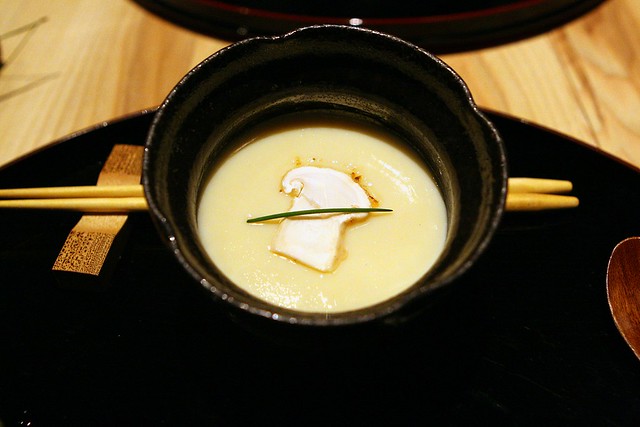
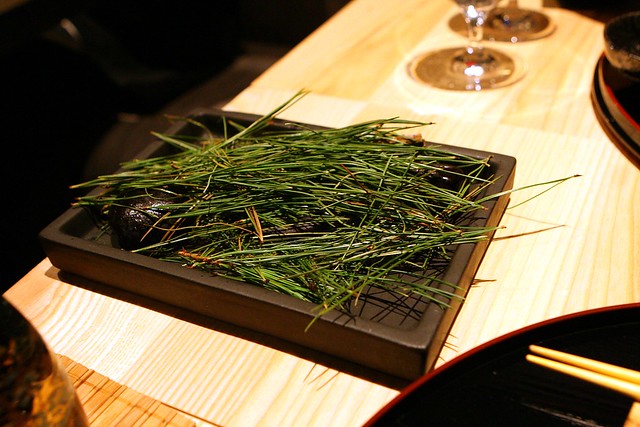
Chawanmushi and pine
Chawanmushi is not only a classic of Japanese cooking but it is a classic dish for the mushimono (steamed) course in any kaiseki. The savory custard is traditionally presented precisely as it was here: with a thin slice of matsutake (a fall mushroom) laid atop. We both found the custard a little firmer than usual, but this is a textural preference only. The flavor was spot on and this was a lovely interlude.
The “side dish” of pine needles was, in theory, offered warm, the better to promote the pine scent. As with the hay, I got nothing. Truly, I did not notice any pine scent at all. A loss for me, I guess, though I don’t quite know what the house could have done to make it better. The LDC insists that she smelled it; who knows…maybe her smeller is more sensitive than mine.

Ayu
The ayu season is brief. Since it is the focus of the course, we count ourselves quite lucky. Indeed, so brief is the season that some diners are already receiving trout instead of ayu. In fact, when the LDC was presented, post-meal, with her souvenir menu, it said trout, not ayu. I note that slip-up only to emphasize that we had our meal as this extraordinary, exquisite fish is disappearing for the season. Ayu is sometimes called sweetfish and for good reason. But the texture and taste (both of which are remarkable and both of which I’ll get to in a moment) have to take a backseat to the nearly unbelievable story of how the fish gets to the table. Ayu can be caught by any of several methods, but the most amazing is the traditional method: cormorant fishing (ukai). Here, the fishermen use cormorants specially trained to catch the ayu, store it in their crop and then and deliver it—alive—to the fishermen. Next presented the ayu in the traditional manner, skewered to display it as if still swimming. The taste of this fish is like nothing I’ve ever had: distinctly sweet (for fish), unexpectedly luscious in the mouth. I’ve been groping for a metaphor since we had it and the best I can do is this: what it’s like to take a mouthful of cotton candy. Firm for just a moment yet instantly yielding. “Cottony” in the best possible way. Accompanying the fish, two dipping sauces: a shiso emulsion and a cured, whipped egg-yolk sauce.
Chrysanthemum, eggplant
Tempura. Once again, the classic dish for the agemono (fried food) course. Again, the LDC and I agreed: too crispy, though she was more open to it than I was. Tempura is a very personal thing and there are many styles. We can only presume that the kitchen intended to create a batter this crispy but neither of us enjoyed it as much as we might have. Purely personal taste, though.

Soup
Pickles
Soup, pickles, and steamed white rice. A classic (yet again) combination and a course signaling the end of the kaiseki. The soup was luscious (there’s that word again). Heavy on umami (a miso broth), savory with a great depth of flavor. It’s worth noting that the soup contained about four or five quite thick slices of wagyu beef, cooked rare (and which continued to cook a bit in the hot broth). Excellent beef contributing to the richness of the soup and the more appreciated for the complete lack of other meat in the meal. (The white bits looking like cottage cheese or feta were not tofu but egg white!) The vegetables were pickled in a way we rarely see: not by using vinegar but by salting and pressing or salting and aging. The flavor of such pickles is significantly different from sour pickles, although there is a sourness from the fermenting that comes with age. In every case, though, both the LDC and I found it a sourness that was off-putting. I should emphasize, again, though, that this is a personal predilection, a taste preference, not an issue of quality. The combination is classic because the elements marry so well; since the pickles were a challenge for us, the whole worked less well for us than it might, but the soup was undeniably wonderful.
Roasted fig, yuba, blueberries
The dessert course in a kaiseki will often feature seasonal fruit and so we have figs, otherwise not an expected presence in a Japanese kaiseki. (Since blueberries are out of season, I can’t explain their presence other than to suggest that Chef Beran found the combination with the figs more compelling than we did. We enjoyed them but didn’t necessarily think that the pairing was striking.) Yuba is made by boiling soy milk and skimming the skin that forms on the surface. In this case, that was dried and then fried, resulting in the caramel-colored chip.
Warabi mochi
Mochi refers generally to little balls or cakes made of glutinous rice flour that has been pounded incessantly (ask your friends of Japanese descent about New Year’s) then molded into the proper shape. The process is known as mochitsuki and you can still see it done, not only in some families but even in social or communal groups. (The LDC and I have taken part a couple times at a communal celebration for New Year’s at Christ Church in Rogers Park, a congregation founded primarily by families who found their way to Chicago after being released from internment camps in World War II.) Mochi is slightly sweeten and sometimes filled with an, a sweet azuki bean paste. The consistency of mochi is a little tough to describe…think chewy in a good way. Warabi mochi is a kind of mochi made not from glutinous rice but from bracken (a kind of fern) starch and dipped in sweetened toasted kinako (soy flour). It’s not true mochi but that’s splitting hairs. This was pretty authentic; the consistency was not quite right but it is nevertheless a hell of an accomplishment for a bunch of white boys (kidding, kidding).
Matcha
The ultimate course, literally and figuratively. The tea of the famous tea ceremony. Finely, finely ground and whipped until frothy. Bitter. But also absolutely essential. I found the Next version a little watery (I was duly impressed by the version I’d had a couple weeks earlier at Kajitsu, in New York, written up here). The LDC was less critical. She enjoyed it.


Servingware
I took these pictures because they represent to me the focus and dedication of this restaurant: these (and other) items were gorgeous. The effort to find them and to obtain them demonstrates Next’s commitment to each menu—to finding the precisely right dish or bowl or implement to match with the ingredient or the course.
I had the sake pairings. My evening began with a welcome cocktail of sake, yuzu juice (a Japanese citrus tasting like a cross between grapefruit and mandarin orange), gerwurztraminer grape juice, and shochu. Delightful. I won’t go through each sake (there were four), the beer (a remarkable brew created from heirloom ingredients dating back centuries) and shochu. Suffice to say, it was probably one of the best pairings sets I’ve ever had anywhere, of anything. Superb and chosen with inordinate care. The LDC had the non-alcoholic pairings and was likewise extremely happy. The ingredients of the various non-alcoholic drinks were chosen so as to feature a Japanese ingredient or item in nearly every drink. Thus, various drinks included green tea, white soy, ginger, barley, and even wasabi! (It would have been nice, for those so inclined, to choose the simple option of having green tea with dinner, though.) We’ve found, over the course of different meals at Next, that the pairings (both alcoholic and non-alcoholic) vary more than we would have expected in their “success.” Not these two: smash hits on both counts.
One other note: there seems to have been some turnover in servers. We missed a number of regulars and the new folks we had seemed a little nervous. Nothing major but several smaller things that will probably disappear as they settle in. We were quite touched when one of our regular servers came out from the back (he’d apparently been working the kitchen table) to say he’d seen us and wanted to say hello. A nice touch and one reason we’re so fond of the staff in general.
We had, as I hope this makes clear, a wonderful meal. We enjoyed our time and were only a wee bit disappointed to find that we were gone in under three hours. One of our shortest evenings at Next—but also one of the most successful.Gypsy Boy
"I am not a glutton--I am an explorer of food." (Erma Bombeck)
-
-
-
-
Post #25 - October 14th, 2012, 4:03 pmGypsy Boy wrote:I had the sake pairings. My evening began with a welcome cocktail of sake, yuzu juice (a Japanese citrus tasting like a cross between grapefruit and mandarin orange), gerwurztraminer grape juice, and shochu. Delightful. I won’t go through each sake (there were four), the beer (a remarkable brew created from heirloom ingredients dating back centuries) and shochu. Suffice to say, it was probably one of the best pairings sets I’ve ever had anywhere, of anything. Superb and chosen with inordinate care. The LDC had the non-alcoholic pairings and was likewise extremely happy. The ingredients of the various non-alcoholic drinks were chosen so as to feature a Japanese ingredient or item in nearly every drink. Thus, various drinks included green tea, white soy, ginger, barley, and even wasabi! (It would have been nice, for those so inclined, to choose the simple option of having green tea with dinner, though.) We’ve found, over the course of different meals at Next, that the pairings (both alcoholic and non-alcoholic) vary more than we would have expected in their “success.” Not these two: smash hits on both counts.
Thanks for this. Since I want to keep an element of surprise for my meal in December I just skipped down to the end of your review and was glad to see this. I've been deliberating over whether or not to get the pairing. Although I'm not exactly certain how it works since I have the kitchen table so I'm not sure that the mixed pairing is an option.
-
-
-
-
Post #26 - October 14th, 2012, 7:48 pmGreat review and photos Gypsy Boy, thanks for posting this!
Twitter: @Goof_2
-
-
-
Post #27 - October 15th, 2012, 10:38 amI was not very impressed with my meal last week. Perhaps it was the high expectations; perhaps the fact that I’ve had other more delicious kaiseki meals before; perhaps the idea of finally going to Next overwhelmed me; or perhaps it was just a really, really late meal.
The cons:
• Very bold, intense flavors all-around. There really wasn’t much subtlety, and I would have preferred some softer flavors.
• Salty, heavy, fried things: A collection of mostly leaves were obscured from taste due to the heaviness… even shiso was barely recognizable. I do realize that they did use a milder form of shiso that I am used to, but it was barely discernable from the other items in the dish. The eggplant was the only item in this dish (aside from the fresh oyster leaf) I enjoyed, with great texture and flavor.
• Wagyu beef had a great smoky overtone, but was incredibly chewy.
• The texture and taste of the roasted figs really threw me off, and I’m not sure that the soy reduction, or concord grapes added much to the dish.
The pros:
• Oyster leaf! I found a site to order a bunch from Oregon. It’s incredible how much brininess can be in a plant. http://shop.gourmetsweetbotanicals.com/ ... erLeaf.htm) -50 leaves for $10
• Michael Carlson’s brother works there. Throughout the entire meal I thought that one of the waitstaff looked extremely familiar and in the end I asked, and he revealed that he indeed was his brother.
• Sashimi was wonderful. The amber jack and madai were heavenly as well as the accompanying sauces: a mild shiso and a tamari.
• The second dish, which set the tone of the autumn meal and resembled a mini forest scene, was gorgeous.
• The yuzu cocktail was very balanced.
• Service was wonderful, as expected.
• The picked turnip wrapped in Duck was crunchy, salty and silky.
• Corn Husk Tea was sweet and smoky.
• The slaw accompanying the chestnut tofu was divine.
Overall, while I’m not disappointed that I went, I feel as though I don’t absolutely need to return, to any incarnation of Next. I was slightly worried that Japanese food would be completely spoiled for me as I had just been to Katsu a few weeks prior and was expecting amazing things from Next- Kyoto, but I guess that fear was unjustified.
-
-
Post #28 - October 15th, 2012, 1:36 pmI have one seat available at my 2top this Sunday 10/21 at 7:15. It's cover price: $185.97, which includes non-alcoholic pairings. Pairings can be upgraded at the restaurant if desired. Email me if interested: bar_jeff at yahoo dot com
EDIT: This has been sold. ThanksLast edited by jbar on October 17th, 2012, 1:47 pm, edited 1 time in total.
-
-
-
Post #30 - October 16th, 2012, 6:48 pmGB, still working through your terrific review, but to a couple of points of personal interest to me, salted, dried fish roe, alla bottarga is a very traditional Japanese ingredient, though I'm not sure about the traditional Italian sources (mullet and tuna) in Japan. From the excellent SavoryJapan site:
Kazunoko
This rare delicacy, literally translated as “many children,” is required eating during Oshogatsu, the New Year’s Day celebration. Historically, this unique and pricey herring roe symbolized fertility and prosperity, and no wonder: A single herring ovary can contain as many as 100,000 eggs! The golden-colored roe has a crunchy and rubbery texture similar to tobiko, but the tiny eggs are clumped together instead of separated. Kazunoko can also be found attached to kelp on both sides, on which herring traditionally lay their eggs (which I prefer, because the deep green kombu, perfectly coated on both sides with golden roe, is a visual miracle when cut into slices). Most of the world’s kazunoko is harvested in Alaska and Canada and consumed in Japan. The price is steep, at $25 or more per pound, which adds to its special allure.
This "rare" ingredient is available at places as humble but "authentic" as Matsuya right now.