

Sukhadia Update
Sukhadia Update
-
-
-
-
-
Sukhadia Update
-
Post #1 - June 22nd, 2004, 8:35 amThe other day, as I was stuffing myself with samosa chat, bhel puri and other things from the recently re-opened Sukhadia Sweet Shop on da'Bomb, I mentioned to the Condiment Queen my growing belief that Indian-Pakistani-Bangladeshi (shall we call it Sub-Continental?) food was the world's greatest. Yes, there is no truffled Bresse chicken which some foodies will argue is the greatest treatment of food and the reason behind France's superiority, nor is there (is there?) any Michelin starred restaurants in India, Pakistan, or Bangladesh, another standard for cuisine greatness. But I measure my cuisines (to the extent I do) on quantity over quality. I love Sub-Continental food because there is so much of it. I mean so many kinds of it. Just compare the assortment of food at Sukhadia to say, Wiener Circle.
Sukhadia is one of several snack or "chat" shops on da'Bomb. Chat shops come in two varieties based on the religion of their owners. Muslim owned shops, like Tahoora Sweets, feature plenty of meat, for instance you can get your samosas filled with ground beef. Hindu owned shops fill you up with grains and vegetables. Sukhadia is the latter. The grains include small cakes made of corn flour and chickpea flour, buttery pancakes stuffed with vegetables (parantha's), puffy fried bread with sides, puri, and crunchy grains drenched in sauces, bhel puri. Vegetables are mainly spicy chick peas and sauteed potatoes. Since everything is really cheap, you can try a lot. Order as in a Mexican bakery. As to knowing what things are, ask, the people behind the counter will explain, and when in doubt, just point to the food displayed behind the counters or on the color menu.
Sukhadia closed for about 6 months. I believe they took over a small store next door. They used the extra space to move the open kitchen towards the back and spread out the tables. They made the place a bit more spacious, but there are still not that many tables--hence the sign advising 20 minute total per table, and the chaotic ordering system remains. It took 4 attempts to get our chai.
The gradients between da'Bomb chat shops may be subtle, but ordering aside, Sukhadia has no glaring problems. Now, it is possible to get some bad tea on da'Bomb. Zam-Zam's was so terrible we tossed it out, wasting the 75 cents. That's for another post.
Sukhadia Sweets
2559 W Devon Avenue
Chicago
(773) 338-5400
-
-
Post #2 - June 22nd, 2004, 10:09 amVital Information wrote: I mentioned to the Condiment Queen my growing belief that Indian-Pakistani-Bangladeshi (shall we call it Sub-Continental?) food was the world's greatest.
Comrade, I think "South Asian" is current officially approved term.I mean so many kinds of it. Just compare the assortment of food at Sukhadia to say, Wiener Circle.
VI:
I agree, the South Asian (I'm feeling quite pc today!) cuisines are without doubt great... varied, sophisticated etc. etc. But is it fair to compare little tiny France, with it's paltry 50 million or so inhabitants with the very large and massively populated area of South Asia? Still not even approaching that scale would be, say, France and Spain and Italy put together... Now that's a fairer competition, no?
Anyway, I'm probably too Eurocentric... But I love Indian food and enjoyed your report despite myself...
AAlle Nerven exzitiert von dem gewürzten Wein -- Anwandlung von Todesahndungen -- Doppeltgänger --
- aus dem Tagebuch E.T.A. Hoffmanns, 6. Januar 1804.
________
Na sir is na seachain an cath.
-
-
Post #3 - June 22nd, 2004, 10:19 amSouth Asian sounds too broad, does it not. I mean is not Hong Kong South Asia, or at least Hunan state in China.
Anyways, I agree with you, that the states now comprised of Sri Lanka, India, Pakistan and Bangladesh encompass a huge swath of "nations" or distinct peoples. The question, from a foodie perspective, are the foods of all these nations intrinsically similar, the way, say that food from Italy and France are not. Or are they?
rg
-
-
Post #4 - June 22nd, 2004, 10:50 amSouth Asian sounds too broad, does it not. I mean is not Hong Kong South Asia, or at least Hunan state in China.
Generally I believe "South Asia" refers to India/Pakistan/Bangladesh/etc.
"East Asia" is more accurate (though not entirely geographically) for China, Hong Kong, Japan, Korea, Taiwan, etc, and "Southeast Asia" covers Cambodia, Thailand, Vietnam, Philippines, Singapore, etc.
-
-
Post #5 - June 22nd, 2004, 11:10 amI agree that South Asia sounds broad but I was corrected a couple years back for having used 'sub-continent' and gently informed that that was now felt in some circles to be vaguely pejorative... (I think that that might be a little over-sensitive but it's not for me to say how people feel about these things)... Anyway, I was told that at least in certain circles, some folks object to 'sub-continent' and prefer 'South Asian'... Hong Kong is then in East Asia and inbetween lies Southeast Asia...
I don't really know enough to generalise much about South Asian / Sub-continental cuisine... From what I do know, there do seem to be lots of common threads and there surely is a sort of culinary dialect-continuum from, say, the northwest up by Afghanistan and Kashmir on down to the extreme south of India...
But that's also the case with France and Italy... with the qualification that there are, due to similar climates and resources, certain stronger affinities between Provence and Liguria on the one hand and Southern Italy on the other than there are between the geographically closer Emilia-Romagna and Southern Italy... And in many respects, in part on account of similar resources but also on account of some historical contacts, there are some strong similarities between the rich cuisines of northern Italy and those of northern and eastern France...
To my mind, the big division in Europe follows the old beer/wine line... By that, I mean, back in the Middle Ages, when Belgium was still part of wine country (they still drink plenty but don't produce it any more). Belgium, northernmost France, Alsace, southern Germany, Austria are mixed in drink and in some ways in cuisines, but they together form a big border zone. Except now at the level of 'national' restaurant cuisines, there has never been a border between Italy and France.
But perhaps, going along with what you say, one doesn't find the kind of culinary distance in South Asia that one sees in comparing the regional cuisines from the far ends of the Italian/French continuum (e.g., between the regional cuisines of Normandy or Brabant or Alsace with those of Apulia or Campania or Sicily. But how do the cuisines of, say Kashmir and southernmost India or Sri Lanka compare? I only have rather vague knowledge about those... There are certainly some big differences but maybe there are also some clear and basic things that they share, be it by ingredients or methods...
AAlle Nerven exzitiert von dem gewürzten Wein -- Anwandlung von Todesahndungen -- Doppeltgänger --
- aus dem Tagebuch E.T.A. Hoffmanns, 6. Januar 1804.
________
Na sir is na seachain an cath.
-
-
Post #6 - June 22nd, 2004, 6:08 pmAntonius wrote:I agree that South Asia sounds broad but I was corrected a couple years back for having used 'sub-continent' and gently informed that that was now felt in some circles to be vaguely pejorative... (I think that that might be a little over-sensitive but it's not for me to say how people feel about these things)... Anyway, I was told that at least in certain circles, some folks object to 'sub-continent' and prefer 'South Asian'... Hong Kong is then in East Asia and inbetween lies Southeast Asia...
Of course they were being over-sensitive. But then you probably spoke to
the left-wing Poli-Sci types, who are over-sensitive about pretty much
everything It is entirely true that they, as a result, always use "South Asian"
(thus I had to take "The Politics of South Asia" in college, and spend a lot of
time arguing with the professor, suggesting that his leftist opinions about
modern day India were entirely incorrect But Ive rarely if ever seen any
actual Indians or Pakistanis refer to themselves as "South Asians", really,
outside of the Poli Sci department. When Indians complain that their cricket
team rarely wins elsewhere, they usually say "its been 15 years since we
won outside the subcontinent" - never "why dont we beat anyone other
than damned South Asians?". AnywayBut perhaps, going along with what you say, one doesn't find the kind of culinary distance in South Asia that one sees in comparing the regional cuisines from the far ends of the Italian/French continuum (e.g., between the regional cuisines of Normandy or Brabant or Alsace with those of Apulia or Campania or Sicily. But how do the cuisines of, say Kashmir and southernmost India or Sri Lanka compare? I only have rather vague knowledge about those... There are certainly some big differences but maybe there are also some clear and basic things that they share, be it by ingredients or methods...
I know far less about European cuisine than you do, obviously (and probably more
about "subcontinental"). Maybe because of that, my views are the opposite of
yours
If you compare the cuisine of, say, Pakistan (North-West) to that of, say,
Tamil Nadu (South-East).. there is no comparison at all. None. Not in any
way, not in type of food, not in language, not in culture. They are as alien
to each other (or were, in the old days) as it is possible to be. I mean, in
the South-East, people use a language in which the written script goes,
like English, from Left to Right. But in the North-West an entirely different
language in used (with a totally different origination), and the scrip used
for writing goes from Right to Left! In the NW people eat meat, and lots of
it - in the SE they eat no meat at all, of any kind. Heck, in the NW most
people wil nod their heads if they want to say "yes" - in the SE a lot of
people will nod their heads if they want to say "no"
Note, this is an extreme example - Pakistan, compared to Tamil Nadu. Pakistan
is heavily meat-oriented - goat and beef (and some lamb too). Grilled
kababs, neharis, biryanis etc. Punjab has sauces that are heavily
cream-based for their foods.
Tamil Nadu, OTOH, is heavily vegetarian - almost entirely. They do idlis and
dosas and the like - with no meat, ever. Their sauces are not cream-based
either - they are lighter, often can be spicier. They will often do rice in
Tamil Nadu, a staple food - but the staple is "curd-rice", very simply rice
mixed with curds. In the NW they would not dream of having rice in that
way - it *has* to have sauce poured onto it, usually a meat-dish cooked
in a cream-based sauce. Or else the rice will have meat already in it
(a pulao, a biryani). No curd at all.
Often, in European cuisines, the ingredients might be somewhat simlar, but
cooked in many different ways. In the subcontinent a lot of the time the
ingredients themselves are completely different - there are large regions in
which no meat of any kind is consumed, and other regions where meat is the
staple food. Even within the meat-eating-areas - there are areas in which only
meat other than beef is consumed, and other meat-eating areas in which
beef is the staple. In the Hindu-North there is a fair amount of meat eaten,
but only in the form of goat and lamb with no beef of any kind. In the Muslim
NW and even Mid-North, Beef is a staple (in Neharis, kababs etc). In the Hindu
South the majority might be vegetarians, who will eat nothing but vegetables -
in the Hindu East there are vegetarians who will eat nothing but vegetables... and
some fish (because, you know, the Fish is the Vegetable of the Sea
These, of course, are the "major categories" - that is, differences in
ingredients. Even with the same ingredients food is prepared differently
in different parts, obviously. Vegetables are cream-based up north,
not so down south. There are rotis and parathas eaten up north, and
rice in grain form only; down south it is dosas and idlis (rice cakes,
basically). And by "South" I mean Tamil Nadu here - because in another
part of the South (Kerala), they eat food sort of like Tamil Nadu, but they
are also coastal and so eat fish and meat. But their fish and meat is
nothing like the North's fish and meat - they eat dosas like Tamil Nadu
does, but with fish/meat-stews sometimes. Or cooked with pepper
base, coconut base (not cream based like up North). And then there is
Goa, sort of South-West - which cooks like Portugal on an acid trip
(Portuguese dishes, but with fiery spices that they wouldnt dream
of using in Portugal).
Anyway. IMHO there is a much greater variety in subcontinental cuisine
than in European (or "Old European" - if you add in Poland and Hungary
and Russia and Ukraine and all the rest, the equation changes. But then
thats not surprising, really - the subcontinent probably has twice the
population of Old Europe, double the languages and cultures, and at
least double the religious differences and conflicts. Which is important -
because when religious differences still play such a big role in life,
the "old style" cuisines are retained and there is far less dilution. Thus
people are not vegetarian by choice, but by birth and religion - and so
they will not indulge in the odd burger/biryani once in a while. If they want
variety in their daily food (and who doesnt?), it will have to come from
other vegetarian dishes. This probably promotes more regional
differences and distinctive cuisines - far more than Western Europe has
done for a long long time now, in some ways. A religion and language
(and sometimes even racial) barrier in the subcontinent is far more than
just a language/regional barrier that has historically existed in Old
Europe IMHO, thus promoting a greater variety of cuisine.
c8w
-
-
Post #7 - June 22nd, 2004, 6:47 pmYup!
Although, I'd add that the food of the sub-continent is also heavily affected by the over-population and related poverty. Essentially, my theory goes, if you have only a bit of food, make it as tasty as possible. But the need to feed so many, and as you note, without resorting to animal products, does force one to broaden one's larder.
rg
-
-
Post #8 - June 22nd, 2004, 7:02 pmc8w,
I think we could learn quite a bit about sub-continental food from you. I hope you will consider joining us at a restaurant of your choice to educate us more.
Two years ago, I knew nothing of Thai cuisine until I followed our friends here on their rounds. Actually what little I knew involved a whole fish, lots of chilies and my feeble attempts to drown my pain in too much water and not enough rice. I left the restaurant starved, bloated and tearful, not exactly a ringing endorsement!
I look forward to whenever the occasion arises.
Regards,Cathy2
"You'll be remembered long after you're dead if you make good gravy, mashed potatoes and biscuits." -- Nathalie Dupree
Facebook, Twitter, Greater Midwest Foodways, Road Food 2012: Podcast
-
-
Post #9 - June 22nd, 2004, 8:46 pmWow! What an education from c8w. It reminds me that 30 years ago I would have said that Chinese food is all alike--rice based, predominately vegetable stir fries, very little use of wheat or lamb, not highly spiced. Then I went to my first Mandarin restaurant, and bought Joyce Chen's first book, and began my education.
My favorite statistic about India's diversity is that there are 20 languages spoken by more than a million people each.
-
-
Post #10 - June 22nd, 2004, 9:35 pmAntonius wrote:There are certainly some big differences but maybe there are also some clear and basic things that they share, be it by ingredients or methods...
Clearly I qualified my statements too much in order not to sound overly argumentative and ended up being not subtle but just misunderstood.
My first point was to say that I believe it is fundamentally absurd to compare the cuisines of South Asia/the Subcontinent to the cuisine(s) of France. These are simply not comparable entities. And since VI said 'quantity counts', of course poor little France comes up short.
With regard to the Subcontinent, I plead ignorance (perhaps a little excessively) and am always more than willing to defer to those who know more. But the excessively politely expressed subtext to what I said so opaquely was that there are surely massive differences between Kashmiri food and the food made by South Tamils or the Sinhalese. It seems to me absurd to talk simply of Subcontinental cuisine as if it is one thing, especially if one is going to chop up Europe into equally absurdly isolated bits. From my perspective, as stated above, there is no border between French and Italian regional cuisines. They are intimately linked in various ways. Similar situations obtain surely in the Subcontinent but in such a large area, can we really talk about it all as one thing? The cooking oils, the spices, the flesh preferences, the common vegetables, all differ vastly and sufficiently so that the contrast between the cuisines of Peshawar and Madras surely exceed those between Picardy and the Provincia di Matera.
Now, I repeat the indirect question: are there some basics that bind Subcontinental cuisine together so that it makes any sense whatsoever to speak of it as an entity to be compared with the cuisine of France? Toasting spices in oil? Flat breads? Rice? That's something, but not much...
Again, I think I certainly was too subtle (and opaque) in saying what I said and perhaps also misread a wee bit. To sum up: my reaction was to the notion of "Subcontinental cuisine," the existence of which I am willing to listen to arguments for, but find for the moment an excessively broad category. To divvy Western Europe up, moreover, into hermetically sealed little isolates but then treat all of South Asia as a variagate monolith, is silly and surely wrong.
Thanks to C8W for expressing better and with such deeper knowledge what I tried to say so obscurely.
AAlle Nerven exzitiert von dem gewürzten Wein -- Anwandlung von Todesahndungen -- Doppeltgänger --
- aus dem Tagebuch E.T.A. Hoffmanns, 6. Januar 1804.
________
Na sir is na seachain an cath.
-
-
Post #11 - July 2nd, 2004, 6:52 amgreat post by c8w,
I think what a lot of people not from the subcontinent forget is that prior to 60 years ago, india was not a unified country but a collection of separate kingdoms with very different histories, cultures in some cases climates and concommitantly cuisines. these regional differences continue more so in india (which I focus on because I know it more than the other areas) than maybe anywhere else in the world, possibly because of poverty and lack of the type of mobility seen elsewhere on the planet.
when I was visiting andhra earlier this year, I spoke to some many villagers, who even in this day and age had not traveled 150 miles from their village (even though we could watch big momma's family dubbed in telegu on their satellite tv) and who still ate what they could produce or purchase unrefrigerated at their local marketplace, where for example because of lack of refrigeration techniques, leafy greens are only available for purchase before 7 am otherwise they would dry out in the heat.
fwiw,
sukhadia is in a nicer space, and their ordering system is slightly less chaotic, though the menu is exactly the same and i don't think even with the space they added any tables, just spaced them out a little more.
-
-
Post #12 - July 10th, 2004, 5:12 pmPerhaps someone can chime in on the political correctness/geographical aptness of the term "desi." I work with a lot of indians, pakistanis, and the odd bangladeshi, and it was they who suggested this word to me. Apparently it refers to both Indian and Pakistani cultures at least. I polled them (my co-workers) individually trying to determine the probity of the term. One of the senior partners at my firm is Indian and it wouldn't do to offend the boss.
 Last edited by titus wong on July 15th, 2004, 10:05 am, edited 1 time in total.
-
-
Post #13 - July 13th, 2004, 9:15 amTitus,
I don't think you'll offend anyone with "desi" but its mostly used by one indian to describe another of indian origin, basically it means one from the homeland
here's a short dictionary entry
http://encyclopedia.thefreedictionary.com/Desi
-
-
Post #14 - July 13th, 2004, 9:32 amI think one other reason that European food seems less different is that, remember, it's had a couple of centuries of the hotel and restaurant trade to even the differences out and spread influences around. I think if you went back 250 years and had English roast beef and boiled baby with Captain Jack Aubrey and Stephen Maturin, and then made a stop in Hungary or Finland afterwards, you would have found the food considerably more different, indeed, as few points in common between Scandinavian lutefisk, a Marseilles bouillabaise and a Magyar goulash as there are between the subcontinental cuisines c8w describes.
-
-
Post #15 - July 13th, 2004, 11:50 amzim wrote:Titus,
I don't think you'll offend anyone with "desi" but its mostly used by one indian to describe another of indian origin <snip>
Hmm...point of clarification...so it would be inaccurate to include anything of Pakistani or Bangladeshi origin as "desi?"
-
-
Post #16 - July 15th, 2004, 8:36 amTitus,
Desi is used by Pakistanis and Bangladeshis as well (desi is sometimes spelled pronounced deshi, and you can see it in the country name). An example of its use among Pakistanis can be seen at http://www.desicookbook.com
-
-
Post #17 - July 15th, 2004, 9:48 amSo, would it be inappropriate to refer to the cuisine of the South Asian region, or for that matter, restaurants offering both Indian and Pakistani dishes as being Desi? (Of course, if an establishment advertises itself as Indian then it's only proper to refer to its offerings as Indian). How would one describe the polyglot culture of Devon? Is it Desi? Another way of posing this question: is Desi an appropriate catch-all term much the same way "South Asian" is?
I'm still a little confused since you stipulated that "desi" is "mostly used by by one indian to describe another of indian origin." When Jason (Ligament) describes Ghareeb Nawaz as "Indo-pak," would Desi be an appropriate substitute?
I'm sorry to belabor this topic, but I would really like to know. At the back of my mind as well, I'm wary of slighting bangladeshis and pakistanis by lumping their culture with indians. Thanks very much for any insight.
Lastly zim, I would really like a recommendation from you for any "under the radar" good restaurant on Devon. I'm still working up the courage to visit Sukhadia mentioned in VI's original post, and brave its arcane ordering system. However, do you have a favorite place that would cater to a person of modest means (think college/medical student)? A one line reco from you would be great; I don't want to commit you to writing a tome.
Have tried Hema's (underwhelmed), Ghareeb Nawaz (mediocre, but bloody cheap), Tiffin (good), and Kanval (may no longer exist). I haven't visited Bhabi's Kitchen yet due to uninspired initial reviews but recent reports seem to indicate an improvement.
Thanks, zim!
-
-
Post #18 - July 16th, 2004, 11:00 amhey titus,
sorry about the confusion - yeah, "desi" can be used as a catch-all subcontinental phrase, it was just my innate chauvinism showing up using "indian" in the last post.
btw, the ordering system at sukhadia isn't really all that arcane, you just step up to the cash register, tell the older guy there what you'd like (though you kinda have to know what you do want - I usually go with chole puri or samosa chaat (I wonder how VI "discovered" that?). They bring the food out on the side of the counter, motioning to you or just saying the name of the dish that's ready, and after you're done you go up and tell the guy what you had, and pay.
In terms of "under the radar", I've posted about lots of places on devon for various stuff on chowhound, but you should remember that most of the time I go to devon I'm in the company of either one or two vegetarians so i don't get a chance to hit the the more meat oriented places as much and none of the cheap spots real recently. In the veg friendly category the chaat places are your best bet and are pretty cheap. Alternatively, you can hit sizzle india which has both veg and non-veg for a pretty nice lunch buffet
A little while ago I had a nice dal/lamb dish at pakwan, just N of the strip, the three intialed guy has alleged in the past that bismillah on ridge had the best 2.99 chicken biryani, but frankly that place changes hands so often that I'm not sure you can really expect consistency. I've always loved the smell in khan's bbq (across from hema's), more so than the food, but since smell is such a big part of taste, i've kind of enjoyed eating there.
on a final somewhat unrelated note, King Sweets now serves a version of scheer chai, the kashmiri salty tea. My mom was kinda shocked when I brought her a cup the other day, its not entirely authentic as they seem to have put both sugar and salt in it, but it was passable, and about the only version I've seen on devon. If you order it, don't be put off by the color - its supposed to be pinkish. I wouldn't say its for everyone, but most folks who've spent any considerable time in Kashmir grow to love it and miss it here
-
-
Post #19 - July 16th, 2004, 11:05 amZim-- That King Sweets tea is almost more like soup than a beverage, which I like. When I had it the other day, there was not even the slightest hint of sweetness to it, though sugar packets were offered on the side. The counter man was mystified that a non-Desi like me would want to try it.
-
-
Post #20 - July 16th, 2004, 11:20 amJeffB wrote:Zim-- That King Sweets tea is almost more like soup than a beverage, which I like. When I had it the other day, there was not even the slightest hint of sweetness to it, though sugar packets were offered on the side. The counter man was mystified that a non-Desi like me would want to try it.
A while back, DougK made the comment about Chowhound, that he had found his tribe. When you read that JeffB response to Zim, well you know how true it is. On point, relevant, understood.
Easily has to go into the LTH Hall of Fame.
Rob
-
-
Post #21 - July 21st, 2004, 7:46 amJeffB wrote:Zim-- That King Sweets tea is almost more like soup than a beverage, which I like. When I had it the other day, there was not even the slightest hint of sweetness to it, though sugar packets were offered on the side. The counter man was mystified that a non-Desi like me would want to try it.
JeffB,
he was pretty surprised that even an americanized Desi like me wanted it, by the sugar comment I was not indicating that it was sweet, but that there was a counteracting force to the salt, I'm also pretty sure that leaf in question wasn't really sheer chai
anyway I found a pretty traditional recipe for http://koshursaal.tripod.com/recipe/sheer_chai.html sheer chai, it's quite often eaten with a crisp flat bread for dipping into the tea
-
-
Post #22 - October 28th, 2004, 3:11 pmUntil recently, I have been addicted to Sukhadia. Had to go there at least once a week. Some of the most divine chickpeas with the chole puri (I've never eaten the puri bread - instead had it with pauv bhaji buns), tasty pauv bhaji (mashed spicy vegetables with toasted hamburger buns), good bhel phuri )mix of crunchy stuff with chutneys) and a good samosa chat (veg samosas with chutneys), my new fave. Also, tasty tea except 9 times out of 10 I order the tea and it takes forever and I have to remind them to make it for me. Their jalebi is also good, altho I am more of a savoury than sweet eater especially with SE Asian desserts. Lately, however, my loyalty has been tested by Amrit Ganga, a new place a little west on Da'Bomb. I haven't made as thorough a headway into their menu, but their samosa chat, bhel phuri and pauv bhaji give Sukhadia a run for their money for certain. They add chickpeas to their samosa chat mixture which I really like. Their items are also just a tiny touch cheaper than Sukhadia. I also think the inside is a bit nicer - there is a tropical (?) feel with fake thatched roof booths and bamboo walls, and a fountain with a large statue of a Hindu divinity (Shiva? there are snakes on his head). A bit more atmospheric than Sukhadia which kind of feels like an ice cream store inside to me, altho is perfectly pleasant.
I'd love to hear more on 1) people's thoughts on best current chat shops and 2) explanations of some of the menu items (particularly savouries). I want to branch out from my tried and true favorites as listed above and would welcome recommendations.
-
-
Post #23 - October 28th, 2004, 4:09 pmI've never eaten savory at Amrit Ganga, but I dropped by there with a friend whose sweet tooth demanded a sampling. It was late and they were closing up shop but a young - ish (20s) boy and girl were running the show at the front counter. Incredibly friendly and impressed with my friends knowledge of sub-continental sugary delicacies. I definitely give them favorable marks over Sukhadia on service and friendliness. At the risk of caving in to the stereotypes, it may have been the first time I had a truly pleasant customer service experience at an Indian joint on Devon. Bhabi's has since provided second and third such experiences.
Regarding the decor, didn't it used to be a Chinese restaurant?
rien
-
-
Post #24 - October 29th, 2004, 8:08 amNot sure about what Amrit Ganga used to be. I could see it being Chinese in a past life. I also thought they were much friendlier than Sukhadia - and faster. Not that anyone has been rude at Sukhadia - more just neutral. What sweets did you try? I can't seem to get past jalebi into new territory that I like. I tried a whole bunch of things at Ambala a while back. There was something else that had a very flaky almost dry texture that kind of fell apart in your mouth and tasted like peanut butter. that I liked. The other items were rough going for me. I took it home and it languished on my kitchen counter. Same thing happened with a box of treats from Sukhadia.
I had been wanting to try Rajbhog - I had purchased some really good pistachio khulfi there in a quart. It was really excellent. I then bought more at Kamdar and was so disappointed - not nearly as tasty and had some strange spicy in it that I wasn't pleased with. But, when I went back a couple weeks later, Rajbhog was gone. I was quite sad about this - the gentleman had seemed very friendly and now I can't find any chat shops that sell khulfi by the quart and I'm scared to try Kamdar's b/c the stuff isn't cheap and I ended up throwing it out. What a waste! Whole family tried it and no one liked it.
-
-
Post #25 - November 17th, 2004, 11:09 amI'm a little confused by the last remarks about sukhadia (though I agree that there ordering system is a little chaotic and leaves something to be desired, something I wish they would have remedied in the redesign of the place) - they've always had chick peas/chole in their samosa chaat - which has been pretty much my default order there for a while.
While amrit ganga IS a little cheaper than sukhadia, the food didn't really too much for me, especially on the savory side, and they don't have those nice jalapeno/carrot pickles that sukhadia does.
in terms of what it used be, it was briefly an outpost of an indian-chinese place out in schaumburg - hot wok village. The devon location was called manchow, if you're interested in that I posted about some time ago on CH.
-
-
Post #26 - April 15th, 2007, 6:38 amLTH,
Been on a bit of a halwa puri kick of late and yesterday, being Saturday, I thought I'd try Sukhadia's, where it's a weekend special. Frankly, I thought Sukhadia's halwa puri weak, smallish oily deflated puri, surprisingly neutral chana and bland wheat colored halwa,* no achar (pickle), small portions served on flimsy cheap Styrofoam plates and, to boot, $4, which is a dollar more than Ghareeb Nawaz's tasty belly filling version. Or, for that matter, Shan and Tahoora. I also had chili pakora, one deep-fried medium size Anaheim chili coated with neutral flavored chickpea flour for $1.50.
On a more positive note, I finally snapped a picture of one of my favorite snacks on Devon, Khaman, moist savory cornmeal cakes strewn with jalapeno slivers. I've asked both Zim and Sazerac more than once about this, but I can never remember the name and/or describe it in enough detail for them to recognize.
Khaman from Kamdar Plaza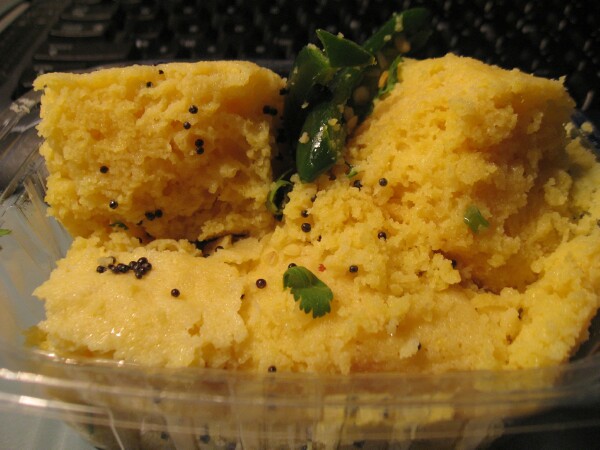
Enjoy,
Gary
*Yes, I know, halwa is semolina and wheat color is it's natural color, it was not the lack of coloring I had issue with, but lack of flavor
Kamdar Plaza
2646 W Devon Avenue
Chicago, Chicago, IL 60659
773-338-8100
Sukhadia's
2559 W Devon Ave
Chicago, IL 60659
773-338-5400
Tahoora
2326 W Devon Ave
Chicago, IL 60659
773-743-7272
Ghareeb Nawaz
2032 W. Devon Avenue,
Chicago, IL
773-761-5300
Shan
5060-A N. Sheridan Rd
Chicago, IL. 60640
773-769-4961
-
-
-
Post #27 - April 15th, 2007, 7:34 amG Wiv wrote:On a more positive note, I finally snapped a picture of one of my favorite snacks on Devon, Khaman, moist savory cornmeal cakes strewn with jalapeno slivers. I've asked both Zim and Sazerac more than once about this, but I can never remember the name and/or describe it in enough detail for them to recognize.
Khaman from Kamdar Plaza
G Wiv, that's khaman dhokla. Dhokla is a very popular Gujrathi snack and there are various types, though the khaman dhokla you've pictured is probably the most well known. It is made by steaming (usually on a steel plate) a batter of seasoned chick-pea flour or besan (not cornmeal, the color probably threw you off) - slightly fermented with yogurt, and/or helped with a bit of Na bicarbonate. Following steaming, hot oil tempered with mustard seeds, chili, cilantro is poured over it. It is fairly easy to make at home. (try searching for khaman dhokla or simply dhokla).
here are some (none of which I've tried):
KHAMAN DHOKLA by Tarla Dalal (TD is a well-known Indian cookbook author; that site has other dhokla recipes too)
Gujarati Series: Infused Khatta-Meetha Khaman Dhokla - blog (khatta-meetha means sour-sweet).
-
-
-
Post #28 - April 15th, 2007, 7:44 amsazerac wrote:It is made by steaming (usually on a steel plate) a batter of seasoned chick-pea flour or besan (not cornmeal, the color probably threw you off)
Sazerac,
Both color and texture, it has a slightly granular cornmeal mouth-feel. I guess that's the reason neither you or Zim ever knew what I was describing, I was way off base.*
Thanks for the info. By the way, weather is getting nice in Chicago, good time for a visit.
Enjoy,
Gary
*And not for the first time
-
-
Post #29 - April 15th, 2007, 9:52 amHad out-of-towners and hit Devon yesterday; we usually visit Sukhadia post-meal and post-window shopping as they have one of the best dessert deals anywhere: 5 pieces of your choosing from the enormous sweets case for $4; even though they were hopping they gave us some direction.
Some of that stuff is out of this world.
-
-
Post #30 - April 16th, 2007, 9:18 amHey Gary, I'm glad you figured out what that was, I'm a big fan of kamdar's dokla and have mentioned it a few timesthough without a picture (and maybe with not enough specificity for it to be clear that i was speaking of the same thing)
in fact I have some for lunch with me today.