

Ragù alla Bolognese
Ragù alla Bolognese
-
-
-
-
-
Ragù alla Bolognese
-
Post #1 - October 6th, 2005, 4:05 pmRagù alla Bolognese
I was amused to see that the featured article in this week’s Good Eating section of the Chicago Tribune was devoted to the topic of ragù alla Bolognese; the reason I was amused was that coincidentally I had just made this dish the day before (Tuesday), under the inspiration of a series of photos I had just seen on an Italian website to make the dish and document the process for the archives. All in all, I think the article, written by Geoff Dougherty, good, though I think it could well have been better, especially with regard to the discussion of the process of making the dish itself. Happily, the author researched his topic fairly well and certainly perpetrates no egregious transgressions; his own comments are based on a field trip to Italy and he offers further comments stemming from discussions of the topic he had with some people on both sides of the Atlantic; his textural research seems to be limited to Kasper’s Splendid Table (and that’s a fine book) but perhaps there was simply no room in the piece for him to refer to other works he had consulted – I’m sure the word limit he faced was a challenge.
There are a few infelicities, such as the reference to the very old city of Ferrara as a “village,” which I find quite an amazing gaffe and one which bespeaks a real cultural misunderstanding of what the term ‘city’ means in all of Europe. Less grave are the repeated misspellings of the name of a well-known restaurant in Oakland, California, Oliveto (misspelt as Olivetto in the article), which should have been caught.
***
It’s now a good bit more than a year since I wrote a longish post on ragù alla Bolognese (link). Rereading that post now, I think there’s one point I need to comment on: I should have said the minimum cooking time for the simmering stage should be about two hours, which leaves the overall time of preparation close to three hours, if one adds in the preparations of the mis-en-place and the absolutely necessary long and slow cooking of the battuto or soffritto. That said, I think the overall quality improves with longer cooking and for ragù alla Bolognese three hours of simmering is better than two and four better than three, though the rate of improvement slows down as one proceeds, I think. Going beyond four hours of simmering will probably yield some further improvement (especially under certain conditions) but generally not any more improvement than letting the ragù rest off the heat for a time, something suggested by one of the Italian chefs mentioned in the Tribune piece.*
When I made ragù alla Bolognese the other day, I stayed very much within the parameters of the traditional, beginning with a garlic-less battuto, cooked very slowly and for a long time, i.e., close to a half hour.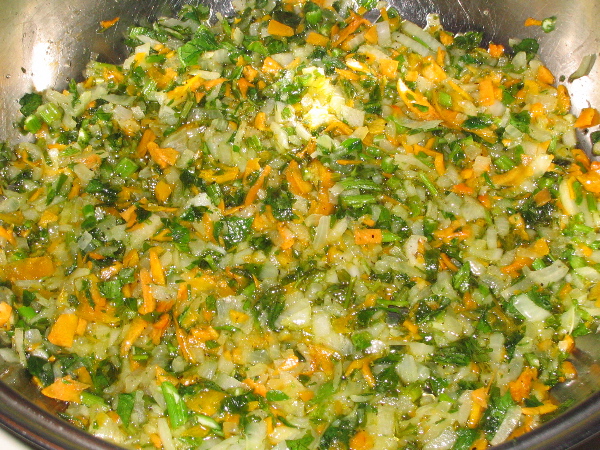
Some of the cooks cited in the Tribune article call for deep (and in one case, repeated) browning of the meat and generally speaking, that’s a good thing. But I feel deep browning in this dish hurts the texture and with regard to the flavour, I think having only very light browning from slow cooking results in a more delicate flavour and one which is very distinctive. This is one of those points where there is considerable variation and thus where one has room to personalise without leaving aside tradition (though no browning at all and charring do strike me as not acceptable extremes). In the following picture, the meat has just been added to the soffritto and is being broken up.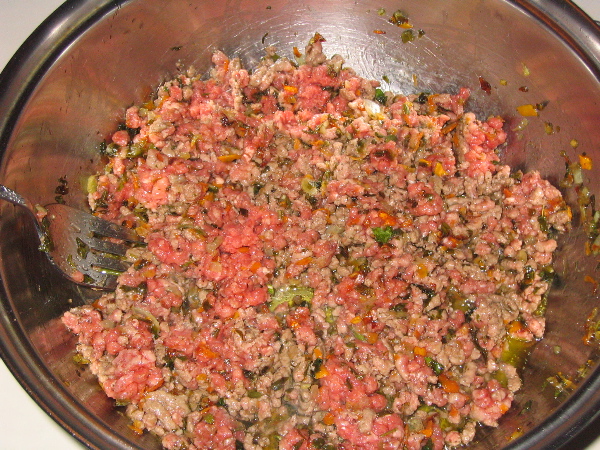
Ragù alla Bolognese is not a tomato sauce with meat; it is a meat sauce flavoured with small amounts of several vegetables, one of which is tomato (to paraphrase Kasper). That said, when on Tuesday morning I went to look at the bowl of fresh tomatoes I have in the kitchen, I found that a couple of especially nice ones were starting to develop trouble spots. True, I believe, to the sort of traditions that underlie all of Italy’s regional cuisines, I was not going to waste those tomatoes, so on this occasion I happily used the fresh tomatoes (grated, discarding all skin but leaving in the seeds) and, all in all, a little more tomato than I normally would.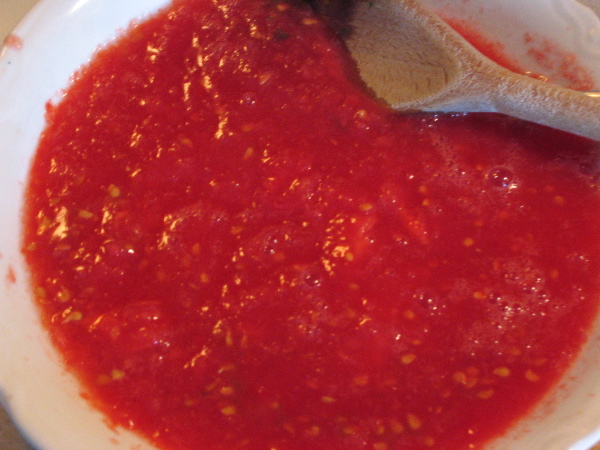
I simmered the ragù for about four hours or so, so the total preparation time was about five hours. Unmentioned in most discussions of ragù alla Bolognese is what I consider the key to making an elegant and completely digestible final product: skimming. I assiduously skim off the fat that the long, slow cooking allows to pool at the top. From this pot, I removed between 1/3 and 1/2 a cup of fat, saving calories, plaque on the arteries and losing really nothing in flavour, as a certain amount of fat inevitably remains.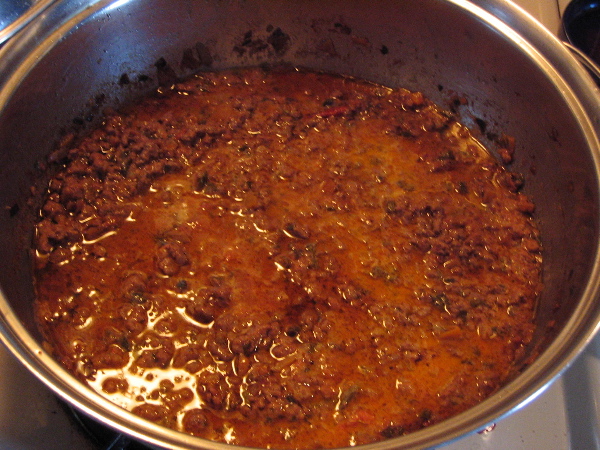
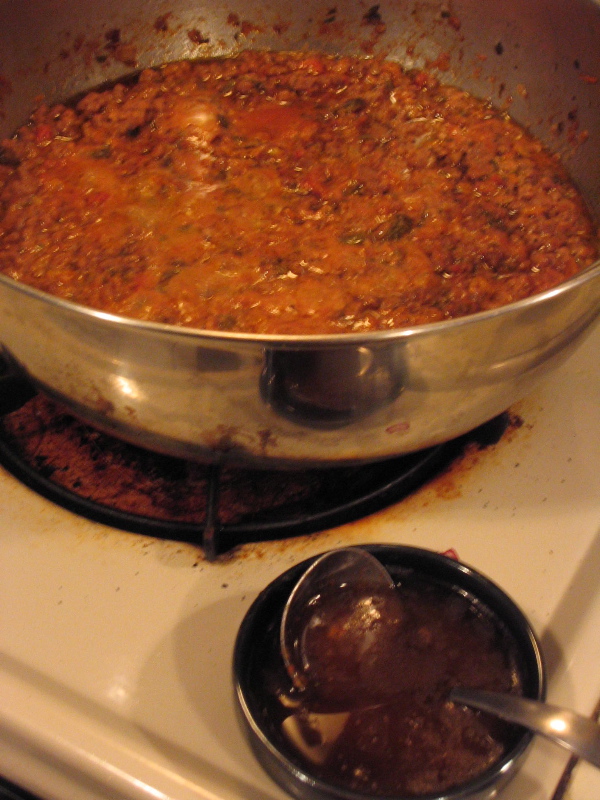
As is traditional, I gradually added doses of whole milk in the later stages of simmering. I did not, however, finish the dish with cream, in part because I didn’t have any on hand and in part because I wanted to keep things a little bit on the lighter side. Instead, just before adding the tagliatelle to the pan with the ragù, I stirred into the ragù a tablespoon of smooth, high quality, whole-milk ricotta -- not canonical but not bad either.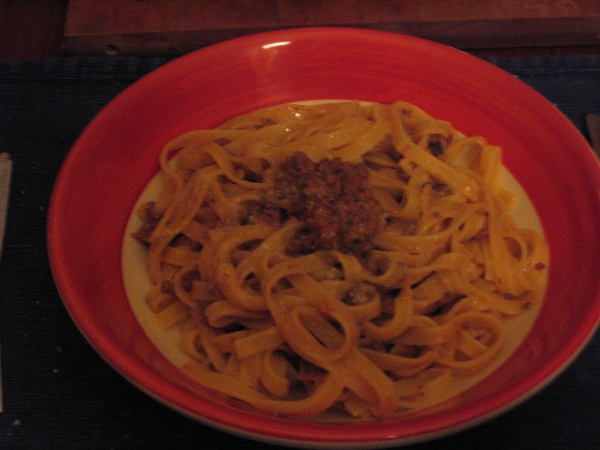
To my mind, the above dish has a reasonable ratio of ragù to noodles and I was in this regard shocked by the photo in the Tribune of a plate of (what looked to be) spaghetti with ragù from Chicago’s great Italian restaurant, Spiaggia, in which the pasta looked to be a minor addition to a bowl of meat. Perhaps the restaurant is making a necessary concession to local expectations and that is certainly understandable, if also lamentable for those who like a more traditional approach.
Ragù alla Bolognese is without doubt one of the great dishes of Italian – one could even say of European – cuisine, but badly executed and completely wrongly conceived versions abound. In some cases too, one crosses paths with something bearing the name ragù alla Bolognese which is a ragù and is very good but, alas, is not ragù alla Bolognese. This sort of profligate use of a traditional term is regrettable, not only because it gives many people the impression that ragù alla Bolognese is a poorly defined meat sauce but also because it robs other, traditional and excellent ragù preparations from getting their just due. There are certainly aspects of ragù alla Bolognese which traditionally allow for variation and beyond that one always has the right to prepare food according to one's own personal preferences, but ragù alla Bolognese is, in essence, a simple and concomitantly elegant and delicious dish. As I often find myself saying about traditional Italian dishes, it is well worth the effort to seek out or make for oneself a very traditional version before trying to customise it, for the traditional approach is hard to beat.**
Antonius
* In the post from last June, my comment on overcooking of tomato sauces sounds to be intended to apply to ragù alla Bolognese and I think I was thinking of two things at once and phrased my statement poorly, perhaps because I had just been discussing versions that include pomodori pelati. In any event, overcooking of genuine tomato sauces or Southern Italian style ragù in which a lot of tomato is used is quite possible and can be, in my view, very bad at times. But ragù alla Bolognese is, of course, not a tomato sauce and the tomato element it contains is quite small. In simmering ragù alla Bolognese, again, I think a minimum of two hours and preferably three or four hours is the way to go.
** I strongly recommend the book by fellow New Netherlander (Jersey-side) Lynne Rossetto Kasper, The Splendid Table, for her discussion of the dish and more generally for her presentation of the cuisine of Emilia Romagna.Last edited by Antonius on October 6th, 2005, 4:27 pm, edited 1 time in total.Alle Nerven exzitiert von dem gewürzten Wein -- Anwandlung von Todesahndungen -- Doppeltgänger --
- aus dem Tagebuch E.T.A. Hoffmanns, 6. Januar 1804.
________
Na sir is na seachain an cath.
-
-
Post #2 - October 6th, 2005, 4:24 pmAntonius--
That looks absolutely marvelous. I have only tried to make Ragu on a couple of occasions and it never turned our very well, but both of these attempts predated my visit to Bologna, so I didn't really have a good sense of what I was aiming for, either.
I have always enjoyed the Ragù alla Bolognese served at Merlo, which I have tried at both the Lincoln Ave. and Maple St. locations. It is very similar to the versions I tried in Bologna, a near emulsion of tomato in oil/fat from the meat, with little flecks of meat clinging to the strands of fresh egg pasta. The amount of sauce is about the same as you show in your picture.
Your mention of Ferrara, which we visited on the same (honeymoon) trip that brought us to Bologna, brings back memories of their delicious cappellacci di zucca--a kind of sweet pumpkin stuffed pasta--which would be especially delicious this time of year.
Merlo Ristorante
2638 N Lincoln Ave, Chicago, 60614 - (773) 529-0747
6 W Maple St, Chicago, 60610 - (312) 335-8200
-
-
Post #3 - October 6th, 2005, 4:38 pmWhat I thought was especially interesting in the article, certainly a new one for me, was the notion that ragu is made from ground skirt steak. I'm a big eater of skirt steaks, but I never thought to have one ground, let alone use it in sauce.Think Yiddish, Dress British - Advice of Evil Ronnie to me.
-
-
Post #4 - October 6th, 2005, 7:33 pmAntonius -
I agree with you about the browning (or lack thereof) of the meat. I've always been taught not to brown the beef in a bolognese. The tips you have outlined in the other thread pretty much reflect the way I make my ragu. For me, an important point in making a good, rich, and flavorful sauce has always been using good quality pancetta or prosciutto, as well as the addition of two finely chopped chicken livers. The livers add a certain extra richness to the sauce, which I think is desirable.
-
-
Post #5 - October 6th, 2005, 8:49 pmAntonius wrote:Ragù alla Bolognese is not a tomato sauce with meat; it is a meat sauce flavoured with small amounts of several vegetables, one of which is tomato (to paraphrase Kasper).
This is an eye-opening, strikingly important point to me. My level of appreciation and understanding of this sauce increased significantly after reading this statement.Vital Information wrote:What I thought was especially interesting in the article, certainly a new one for me, was the notion that ragu is made from ground skirt steak. I'm a big eater of skirt steaks, but I never thought to have one ground, let alone use it in sauce.
I too am a big, nay, a huge eater of skirt steaks. I have never once in my life considered grinding one either.
Best,
Michael
-
-
-
Post #6 - October 6th, 2005, 10:20 pmAntonius,
Thanks for the informative post (and for an ealier pointer to the previous one). Having no idea what 'real' ragù alla Bolognese should taste like (and not knowing which restaurant to trust as a benchmark), I've tried many versions, deferring to ones in books by Romagnioli and Bugialli. Somewhat recently I caught a Lidia Bastianich episode where she made it, and used milk. I don't remember if the books mentioned milk (it has been a while since I looked at them), but I do remember the mention of livers (not mentioned by Bastianich).
Binko wrote:For me, an important point in making a good, rich, and flavorful sauce has always been using good quality pancetta or prosciutto, as well as the addition of two finely chopped chicken livers. The livers add a certain extra richness to the sauce, which I think is desirable.
However, a version I made that wasn't particularly memorable (possibly I did a number of things incorrectly) - I think mainly because I used too much liver and it wasn't very finely chopped. The end product had many bits of liver that were dry from the long cooking. Other than reducing (or not adding) the liver, when in the cooking process would you suggest the livers be added? Can they be sauteed, cooked separately, chopped fine and then added?
The use of pancetta or prosciutto is mainly for the flavorful fat, right? I remember using prosciutto fat trimmings (which I got for the asking), but didn't think it did much, being lost in the meatiness.
And one last question (for now) - would freezing ragù alla Bolognese bar me from asking more questions?
-
-
-
Post #7 - October 6th, 2005, 10:34 pmsazerac wrote:And one last question (for now) - would freezing ragù alla Bolognese bar me from asking more questions?
I often double or triple a bolognese recipe and freeze the excess, since the process, start to finish, is fairly time consuming. While the sauce certainly loses a little in the freezing, it nonetheless makes for quite a satisfying--and easy--meal when reheated. I don't add the dairy component before freezing.
-
-
Post #8 - October 6th, 2005, 10:39 pmOf course, if one has the willpower to cook a ragu all day but then not eat it the same day, one can refrigerate the meal overnight, removing most of the fat in one greasy orange disk. This is a purely hypothetical proposition, because no single dish smells more appetizing than a ragu.
But it is true that ragu, like its Spanish cousin picadillo, only improves with rest as the flavors meld and mellow.
I like to go with a blend of pork and beef, with a little cured pork product.
It is worth noting that the true picadillo recipe, rarely followed anymore, calls for a combination of ground beef, ground pork and jamon molido. Coincidence?
-
-
Post #9 - October 7th, 2005, 7:34 amJeffB wrote:But it is true that ragu, like its Spanish cousin picadillo, only improves with rest as the flavors meld and mellow.
As well as chili, many hearty soups, Indian curries, pretty much any situation where spices and long-cooked meat need to combine. They're always better the next day. I'll let some Alton Brown wanna-be explain about crystallizing fats or absorption of liquids or relaxing muscle fibers or something.What is patriotism, but the love of good things we ate in our childhood?
-- Lin Yutang
-
-
Post #10 - October 7th, 2005, 8:20 amHowever, a version I made that wasn't particularly memorable (possibly I did a number of things incorrectly) - I think mainly because I used too much liver and it wasn't very finely chopped. The end product had many bits of liver that were dry from the long cooking. Other than reducing (or not adding) the liver, when in the cooking process would you suggest the livers be added? Can they be sauteed, cooked separately, chopped fine and then added?
This is what I do: I very very finely chop the two chicken livers, until they're almost paste-like in consistency. I add them in after the beef—the way I make it, I don't brown the heck out of the meat. I gently put it in the pan and cook it until gray-ish and broken up, but not deep brown. I think it makes for a more delicate flavor. Towards the end of this time, I add the chicken livers, cook 'em for maybe a minute, then add the white wine. Cook down. Add milk. Cook down. Add tomato-broth mixture, simmer for hours.
The flavor of the chicken livers should not be dominant, and you shouldn't be feeling chunks of them as you're eating your ragu. In fact, unless you're really sensitive to the taste of liver, it should be pretty much indiscernible, just adding an accent to the predeominant beef flavor.
Actually, this recipe is based on a recipe from Saveur Magazine. They had an article on homemade lasagna, and these two old ladies in Italy who taught a cooking class that featured this dish. It's the most fantastic lasagna I've ever made (with a bechamel- *ahem* besciamella-based white layer), and the bolognese recipe included with it has become my default bolognese. If anyone needs the exact measurement, I can dig up the issue, but the link to Antonius's earlier thread pretty much covers it all.
As for the pancetta or prosciutto -- yes, that's basically for flavorful fat, but I tend to use pieces that do have a decent amount of meat on it, too. I've used cheap domestic prosciutto and more expensive imported prosciutto, and I can taste the difference. Don't skimp on the prosciutto, and use good quality, flavorful cuts of beef. I never tried using ground skirt steak, but I might just give it a shot. I must admit, I've never been able to make a bolognese as good as the ones I made while living in Europe, and I'm sure the quality or type of beef I'm using is the main culprit. Here, I generally use chuck, because it's more flavorful than sirloin (to me, at least), but it still doesn't have that intense beefiness I would get from European ground beef. *shrug* Je ne sais pas.
-
-
Post #11 - October 7th, 2005, 8:50 amHi Antonius--
Your post inspired me to dig out my copy of Kasper's Splendid Table and leaf through her section on ragu. It is perhaps worth mentioning, to drive home your point that ragu is most definitely not a tomato sauce, that most of her recipes call for no actual tomatoes at all, but just two tablespoons of double concentrated tomato paste, which is consistent with my memories of ragu as a sort of tomato-infused meat suspension. I suspect you may have achieved a similar result through long cooking of your two tomatoes.
Patrick
-
-
Post #12 - October 7th, 2005, 10:14 amSazerac:
Of course, chicken livers are accepted as being a possible, non-heretical (as it were) addition, but I don't use them. Perhaps it's a question of achieving maximal focus (and, in ways not related to chicken livers, also differentiation from other dishes) but I like to make ragù alla Bolognese in such a way that the central flavour is that of the gently cooked beef; all else that goes in the pan is intended as a complement to that, including the pancetta and wine and the vegetables, etc. (In this connexion, let me say that it is one of only two dishes I make that involve ground meat as sauce or in a sauce, something which I generally dislike intensely in the ways it is usually used.) As a second meat to add I think my preferred choice is ground pork, which will up the sweetness in a nice way, though I find the flavour of the gently handled beef really nicely balanced in its own right.
Incidentally, Lynne Rossetto Kasper, mentioned above, says that her preferred cut of beef -- preferred even to skirt steak -- is the hanging tender (surely to be found in the meat cooler of your local Dominick's and Jewel, no?).
The basic fat in which the soffritto is gently fried is traditionally pork fat. The fat from pancetta or prosciutto is favoured these days but I am certain that in times past lard was used in many households. Nowadays, lard is used less and less in Italy as it is here. If you wish to reduce the level of animal fat in the dish, you can replace the pancetta fat partially or wholly with olive oil and, while you will be straying from canonical orthodoxy, you might live a little longer; obviously, there is a real change in flavour with this substitution, but the result is still delicious.
Freezing always takes a little bit away from food, be it flavour or texture or whatever, but I would guess it would work as well with a ragù as it ever can. But I confess, I can't remember if I've ever done it. I typically make enough for two meals; one the day of cooking and one a couple of days later, perhaps in a baked application.
***
Maple Leaf:
The ultimate effect of tomato paste -- or to my mind better still, stratto, which is available around here -- is different from that of peeled tomato pulp. But the latter is used by some folks I regard with the greatest respect (e.g., Bugialli). In my case the other day, I decided to use the fresh tomatoes because I have lots and won't let them go to waste (more on this anon elsewhere). I did end up with a little bit more than I would normally use but it was still a fairly small amount of tomato, as can be seen from the photo of the late stage of simmering.
***
Binko:
Good that you mention lasagne with real ragù alla Bolognese and besciamella; with freshly made noodles it is a sublime dish, for the other elements alongside the ragù and the additional baking process further brings out the key flavours of slow cooked meat and the accompanying dairy element. A kosher nighmare, perhaps, but quite heavenly.
***
JeffB:
Now you've got me thinking I need to make yet another caloric, meaty dish... Lent better get here soon... Nevertheless, thanks for calling attention to the similarity to picadillo.
AntoniusAlle Nerven exzitiert von dem gewürzten Wein -- Anwandlung von Todesahndungen -- Doppeltgänger --
- aus dem Tagebuch E.T.A. Hoffmanns, 6. Januar 1804.
________
Na sir is na seachain an cath.
-
-
Post #13 - October 7th, 2005, 10:37 amAntonius wrote:Binko:
Good that you mention lasagne with real ragù alla Bolognese and besciamella; with freshly made noodles it is a sublime dish, for the other elements alongside the ragù and the additional baking process further brings out the key flavours of slow cooked meat and the accompanying dairy element. A kosher nighmare, perhaps, but quite heavenly.
I agree, it is sublime. I always make my own spinach lasagna noodles. Why not? It's suprisingly easy and the extra effort goes a long way. I wonder how the ricotta-based lasagnas became the predominant form in America. It seems the other way around across the pond. Personally, I prefer the besciamella lasagnas, although they all have their place.
As for the chicken livers, personally, I don't think it distracts from the central focus of the meat flavor, but instead complements it, if not intensifies it even, but your mileage may vary.
-
-
Post #14 - October 7th, 2005, 10:51 amBinko wrote: I wonder how the ricotta-based lasagnas became the predominant form in America. It seems the other way around across the pond. Personally, I prefer the besciamella lasagnas, although they all have their place.
!!!
Not that I think the way lasagne are made generally in the States is something that's all that interesting, the general form that lasagne took here has obviously to do with the provenance of the vast majority of the immigrants from Italy, who were from the South. As with most things, the Americanised version has lost touch with many or most of the essential qualities of the original thing, but made properly, Southern Italian style lasagne are in my opinion no less delicious than the Bolognese counterpart.
I'd add too that while Southern Italian food (as well as Northern Italian, though that less broadly) is widely abused in these United States, Northern Italian food (as well as Southern Italian, though that less broadly) is similarly abused in Northern Europe, though I must also add that the level of abuse in Europe has dropped dramatically in recent years. I suppose that is also true in this country, a result of the obvious trends...
AntoniusAlle Nerven exzitiert von dem gewürzten Wein -- Anwandlung von Todesahndungen -- Doppeltgänger --
- aus dem Tagebuch E.T.A. Hoffmanns, 6. Januar 1804.
________
Na sir is na seachain an cath.
-
-
Post #15 - October 7th, 2005, 11:08 amAntonius wrote:!!!
... A footnote about why Southern style here and Northern Style there being 'expansive'... The culinary conquest of Northern Europe and other parts of that continent belongs largely to recent decades and so the spread of Northern Italian cuisine there parallels and coincides to a considerable degree with the spread of Northern Italian cuisine here. So in the States, the first introduction of lasagne was accomplished by means of the immigration of Southern Italians. Massive immigration of Southern Italian in Northern Europe didn't happen (except in very limited areas, e.g., mine country in Limburg and Liège in Belgium, etc.).
Twenty five years ago, sure, there were Italian restaurants in most if not all cities in Northern Europe (and surely more featuring Northern Italian cuisine than here in those days), but the presence of Italian food there has exploded since then. Heck, just about every café in the Low Countries that serves food seems to serve a sort of bolognese dish of some sort.
AntoniusAlle Nerven exzitiert von dem gewürzten Wein -- Anwandlung von Todesahndungen -- Doppeltgänger --
- aus dem Tagebuch E.T.A. Hoffmanns, 6. Januar 1804.
________
Na sir is na seachain an cath.
-
-
Post #16 - October 7th, 2005, 12:16 pmAntonious,
What is your opinion on using duck?
I noticed that it was mentioned in the article.Authorized time shifting let the genie out of the bottle....
-
-
Post #17 - October 7th, 2005, 12:35 pmdelk wrote:Antonious,
What is your opinion on using duck?
I noticed that it was mentioned in the article.
I can't remember what's said about the use of duck in the article but there are traditional recipes for ragù-style treatments of duck which share a lot of characteristics with ragù alla Bolognese, i.e., use of a base of pancetta and a battuto (often garlic-less), wine, limited amount of tomato, etc. The overall effect will be rather different as the meats are but certainly good. Duck-based sauces or ragù are traditional with pappardelle (broad fresh egg noodles) in various places in Central and Northern Italy and ones I've had over there have been really delicious.
I have made such a duck-ragoût myself but now that you mention it, I haven't done so in quite a long time. That sounds like a nice idea for one of the up-and-coming cool fall Sundays.
AntoniusAlle Nerven exzitiert von dem gewürzten Wein -- Anwandlung von Todesahndungen -- Doppeltgänger --
- aus dem Tagebuch E.T.A. Hoffmanns, 6. Januar 1804.
________
Na sir is na seachain an cath.
-
-
Post #18 - October 10th, 2005, 6:18 pmAfter salivating over this thread for a few days, and stuck in north Jersey again, I went to the stalwart Eccola (Rich4's fave), and ordered Spaghetti Bolognese.
The good: meaty flavor, excellently-flavored parmesan sprinkled on top, perfectly al dente noodles (I thought they were a bit too chewy at the start, but by the third bite they were perfect).
The not-so-good: in violation of Antonius' dictum, there was enough ragu on my pasta for about five to ten servings. Way too much tomato and too little fat -- it tasted very good, but it's not the silky meaty essence pictured above. Top that with a waitress that ignored me, and then refills my iced tea twice at $2/8oz without letting me know that was the policy, and it spoiled the meal (I know that refilled soft drinks is a chain-resto bit, but this is iced freakin' tea in little bitty glasses).
I guess I'll have to make my own, and somehow get my family to understand that you're not supposed to serve 1/3lb meat per serving.What is patriotism, but the love of good things we ate in our childhood?
-- Lin Yutang
-
-
Post #19 - October 10th, 2005, 6:40 pmThat and the served it on spaghetti. I thought that was limited to public schools in England.
-
-
Post #20 - January 19th, 2007, 6:24 amI'm a fan of Sandwich of the Day, not so much for tips on delicious sandwiches, but the outright innovative absurdity of many of the combinations.
I have a feeling Antonius is not going to be happy with today's Bolomayo (#206) Cold bolognese sauce mixed with mayo on lightly toasted white bread. 
Enjoy,
Gary
-
-
Post #21 - March 12th, 2007, 8:20 amBrowsing through my freezer for some protein to cook up, I came upon a couple pounds of ground pork that made me think of a simple ragu ala bolognese for dinner. I already had the veggies and appropriate liquid, all I needed to do was pick up some fresh pasta while I was out running a couple errands.
So, I made a very tasty all-pork ragu, using a couple tips from Antonius' original post. I skipped the garlic; doing so I think makes the aromatic flavors more delicate and allowed the carrot's natural sweetness to really shine. I was also careful not to let the meat brown, ensuring a soft-textured ragu. Finally, I made a point of skimming fat a couple times during simmering, taking out about a third-cup of fat. There was still plenty left for flavor and texture, but the ragu was not at all oily as it often is in restaurants.
Skimming the fat is an important point here and my biggest educational takeaway from last night's dinner.
One thing that I did differently than the recipe above: I went very, very light on tomato, using only a couple tablespoons of good concentrated tomato paste. I was going for a slightly pink ragu which I think I accomplished.
I used whole milk and white table wine as the liquid component and simmered everything for about two hours before adding the ragu and undercooked noodles to a skillet.
The final product was clearly missing a note from the single-dimension of using 100% pork. (I don't believe all-pork is likely a common preparation for this ragu). But I thought it turned out rather well.
Add a tiny bit of grated parmigiano reggiano and a green salad and we had a great dinner from very inexpensive ingredients.
Best,
Michael
-
-
Post #22 - March 16th, 2007, 9:40 pmSeveral years back I tried making a ragù with a mixture of lamb and pork and found it so delicious that I almost always make it that way now. I always make a huge pot and freeze it in quart ziplocks (about 1 lb each).
My recipe is certainly not true Bolognese as I do use garlic in my battuto, chicken stock (not beef), red wine (not white), and a bit more tomato than a standard Bolognese. I usually use 3 lbs ground lamb, 3 lbs ground pork and 1/2 to 3/4 lb of diced pancetta and one 28 oz can of tomatoes. The lamb stands up to the use of red wine quite nicely.
So, if you are up for trying a ragù with a strong flavor, give lamb a try.
(I've tried buffalo + pork too and that didn't work out so well)
-
-
-
Post #23 - October 9th, 2008, 11:24 amThought I'd revive this post. I just made a big batch of bolognese for a friend's birthday (fairly traditional though I do use garlic in the battuto plus a mixture of pork and lamb).
I wanted to see if anyone knew of a place to buy fresh tagliatelle or papparadelle to pair this with (preferably on the north side of the city thougth I'd drive a little if needed)
Thanks!
-
-
-
Post #24 - October 10th, 2008, 3:27 pmThat looks delicious - thanks for the photos!Hillary
http://chewonthatblog.com <--A Chicago Food Blog!
-
-
Post #25 - October 10th, 2008, 3:56 pmThat looks so good. I've made this in a similar way. I am always surprised that it contains milk which slightly goes against my senses being used to southern Italian sauces. I love a lightly sauced dish of fettucine or tagliatelle.Toria
"I like this place and willingly could waste my time in it" - As You Like It,
W. Shakespeare
-
-
Post #26 - October 10th, 2008, 8:07 pmThough others have told me that this defies tradition, I learned it from the Bolognese restaurant owner for whom I worked, and I think the result is marvelous: add a small, whole cinnamon stick to the sauce as it simmers....defended from strong temptations to social ambition by a still stronger taste for tripe and onions." Screwtape in The Screwtape Letters by CS Lewis
Fuckerberg on Food
-
-
-
Post #27 - October 10th, 2008, 8:14 pmKennyz wrote:Though others have told me that this defies tradition, I learned it from the Bolognese restaurant owner for whom I worked, and I think the result is marvelous: add a small, whole cinnamon stick to the sauce as it simmers.
That's a very Mediterranean touch. My wife makes her Grandmother's Greek spaghetti sauce recipe, which calls for both cinnamon and cloves.Steve Z.
“Only the pure in heart can make a good soup.”
― Ludwig van Beethoven
-
-
-
-
Post #28 - January 11th, 2011, 11:23 amWe made lasagne with ragu "alla Bolognese" (o.k, we added some garlic and made a few non-traditional substitutes), bechamel, parm. and fresh egg pasta noodles. We had to start the ragu in two pots since we were making a big vat (stockpiling food for a family member getting ready to have surgery, plus of course some for us). I used a combination of Jim Graziano's advice (guanciale instead of pancetta), Antonius's recipe (including a long, slow cook for the soffrito and lots of fat skimming) and Marcella Hazan's recipe. It was a generous half-day's worth of work but it turned out great.
Simmering the ragu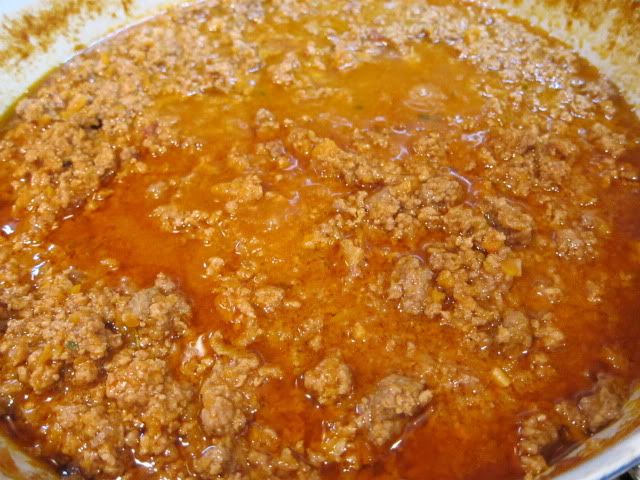
Pasta sheets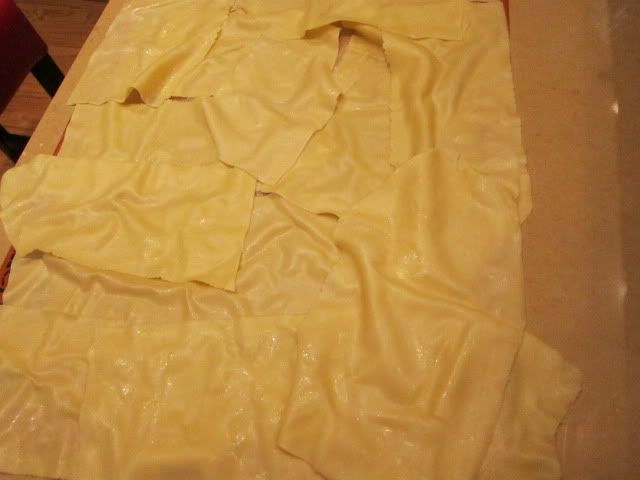
During Assembly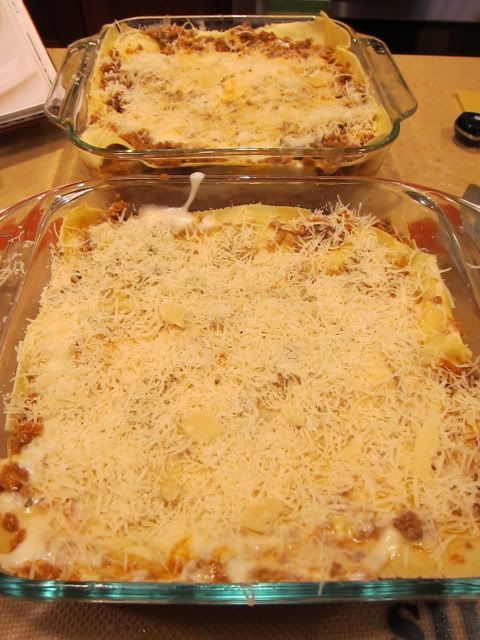
Finished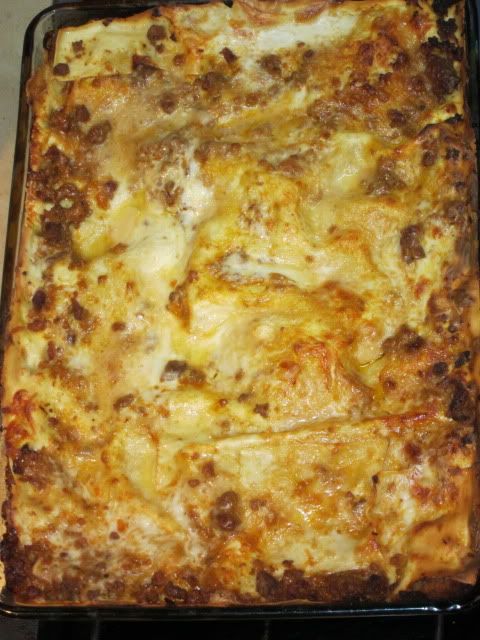
On the plate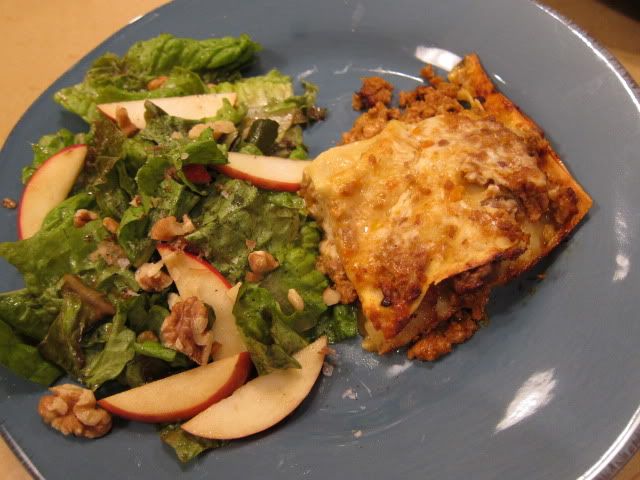
-