

Takashi
Takashi
-
-
-
-
-
-
-
Post #61 - June 22nd, 2010, 8:01 pmSix of us dined at Takashi this past weekend for dinner and we just loved it. We arrived separately and I thought the FOH could have been a little more welcoming, but service throughout dinner was very good. I also appreciated dining at a restaurant in Chicago where six people can hear everyone at the table speaking.
But what I really loved about this place was the excellent food. I can't recall every item and their online menu does not appear to be up to date. That being said, we enjoyed some very fine dishes including a scallop and octopus sashimi with soba noodles (I think), beef tartare, and house-made tofu with accompaniments.
We also had the softshell crab which was served with lardons, white grits and a beautifully poached egg. This might have been the only non-Asian preparation of the evening, but it was quite good and the crab was so crisp, meaty and delicious. The pork belly, which I had tasted at a Food and Wine Magazine event some time ago, was as excellent as I remembered. The duck was delicious and pretty moist although I think it was a little closer to medium than medium rare.
My absolute favorite dish of the night was the sauteed scallops with soba gnocchi which was just perfect - rich, buttery, and I could go on and on about this dish. I thought it was sensational and easily one of the best dishes I've tasted in years. We also had a skate dish and a barramundi and while I cannot recall much about the flavors, I can tell you that both were outstanding.
I thought desserts were decent, but none really stood out. My favorite was a rice pudding with rhubarb, but even that dish lacked the zip I typically love in rhubarb. Nonetheless, I really loved the food at Takashi (pre-dessert) and look forward to returning.
-
-
-
-
Post #62 - January 2nd, 2011, 8:51 pmNot sure if anyone else noticed, but since... oh maybe September?.... the noodles have been a Sunday dinner option as well. We went tonight, and it was great. A cold night, hot satisfying broth and noodles. They have quite a few small plate options for appetizers, cold and hot, and we really enjoyed our meal. I had the Soba, DH had the Udon. We shared some gyoza, a seaweed salad, and edamame. Everything seems like it's made with care. Everything we ate was excellent, and service was great as well.Leek
SAVING ONE DOG may not change the world,
but it CHANGES THE WORLD for that one dog.
American Brittany Rescue always needs foster homes. Please think about helping that one dog. http://www.americanbrittanyrescue.org
-
-
-
Post #63 - January 2nd, 2011, 10:27 pmWord on the street is that Takashi has extended its "Noodle Sundays" that were just a brunch thing into Supper as well. But just on Sundays, I think. This is the weather to go and check it out, it will make you wish we had out own Japan-town.
bjt"eating is an agricultural act" wendell berry
-
-
Post #64 - January 7th, 2011, 11:44 amMy fiancee and I went to Takashi for an early dinner on Tuesday, and I was very happy with my dinner. We started out with a tapas sized fried calamari with mustard-miso sauce. The actual frying of the calamari wasn't the best I've seen, however the sauce was very tasty. My problem with the frying was that while it was light, which I enjoy, it was also falling off the calamari or light here and there, which was a bit disheartening. Still for 5 dollars for a small appetizer, we were pleased.
We then had our main courses, which for me was the Chicken in Clay Pot, which is one of their standby dishes. I really enjoyed the yuzu sauce and the accompanying shimeji mushrooms, and the chicken was cooked perfectly.
My fiancee had potato wrapped salmon with curried cauliflower puree, which she really enjoyed as well, and seemed more inventive than mine.
All in all, we were very impressed and will be returning, and felt that for a 1 Michelin star restaurant, it was a great price (around 60 with tip for two entrees and a small appetizer).
-
-
-
Post #65 - November 13th, 2011, 10:44 amThis was a celebration dinner and, although I am pleased that the Lovely Dining Companion professed herself very happy with her food and her evening, I was much less enchanted. (Our table was not particularly well-suited to photography with the small camera I happened to bring, so no particularly useful pics resulted.) I started with a honey lavender martini that proved absolutely and unqualifiedly lovely. I am not a particular fan of gin, but from time to time will venture to try something new and this was a delight: perfectly balanced, every flavor available and nothing overwhelming. Strong but not tasting of gin particularly.
LDC began with sauteed scallops and soba gnocchi ("dressed" with a celery root/parmesan foam that complemented the scallops nicely). Though I agree with her that the gnocchi did not taste noticeably of soba (buckwheat), the dish was beautifully presented and delicious. We both enjoyed it very much. My app was somewhat less successful: a couple quenelles of a very creamy chicken liver mousse, two smallish slices of adequate country pate, and a couple slices of La Quercia prosciutto. I have never been a fan of this particular prosciutto and, in the event, would have preferred more of the pate. The mousse was accompanied by pickled veggies and toast points (though I always am curious when the kitchen seems to toast various unrelated pieces of bread; I guess I'm too anal for this dish: I prefer my toasts to look like they all came from the same place). I had no issue with pickled cauliflower, but found the choice of pickled beets--which I happen to like in other contexts--to be the wrong choice for an accompaniment. The mousse and the pate were okay but not anything particularly special. If I went back, I'd order something else.
LDC chose salmon done three ways for her entree: seared, smoked, and in croquettes (a particularly and peculiarly Japanese way of doing salmon). She loved each preparation. I am not, as it happens, a particular fan of salmon, but she insisted I try the smoked salmon and I will concur here: you could taste the hickory. Smokey, firm, yet retaining enough moistness to be a delight. Just a lovely piece of fish and very well done. (This particular entree is not on the online menu and I didn't take notes, so I can't describe the accompaniments.) Suffice to say, that the salmon aficionado was very very pleased with her choice. I ordered skate, seared and served atop a bed of braised red cabbage. Accompanied by butternut squash agnolotti and with a cider-caper reduction. The agnolotti were very nice, the reduction didn't particularly strike me as cider-caper; I thought I got more of a lemon note than anything else. The agnolotti were very good, the cabbage acceptable, and the skate, well-cooked but yet again, nothing particularly noteworthy.
For dessert, LDC chose a very well-flavored mango sorbet and I had a pumpkin pine nut cake with a butterscotch cookie and cream cheese ice cream. I suppose my feeling about my dessert is best exemplified by my thought that the cream cheese ice cream was terrific. There was nothing "wrong" with the cake except I didn't get much pumpkin flavor and it just didn't seem to succeed. Fine, without being any better than that. I should, however, note one other item that stood out for me. I order espresso from time to time after dinner and have accustomed myself to getting espresso made by people who either don't like what they're doing, don't know what they're doing, or don't care what they're doing. Good espresso after dinner is, sadly, a very rare thing. I was hardly expecting much given my reaction to dinner. But, lo and behold, this was noteworthy espresso. I'd return to the restaurant just to enjoy it again. Unfortunately, given my feelings about dinner, that's not likely. I liked my dinner well enough but nothing really stood out. I thought the room (we ate upstairs) a bit spartan for my tastes, but mostly, I guess, I was disappointed with the food. Bread was baguette (fair, at best) and multigrain (better but nothing I'd buy for the house). Service was competent or a little better than that, but again, nothing special.
The lowlight of the evening was something that I have not (fortunately) encountered before: a table of four or five young friends who had their camera phones and were constantly taking pictures of the food, each other, the food, and each other. With flash. I finally got tired of it and mentioned it to our server who had the manager speak with them. She then came over to our table, apologized, and explained that they were on their last course so the pictures were pretty much done. I thought that an odd way of explaining things and then, as soon as she left, realized what it meant: that the pictures would and did continue. And continue. They were on their last course so, the message was, they'd be leaving soon. Either she didn't explain about the flash to them or asked them to keep it to a minimum. I don't know. I do know that I walked downstairs to ask her to address this again. She seemed a little miffed that I would persist and told me again that they were on their last course--as if that explained everything. Being the lovable contrarian I am, I dug in my heels and explained what I had thought was already patently clear: this is intrusive and it is annoying. The only thing more annoying was that the manager didn't seem to want to deal with it. I explained that we had brought our own camera and always make it a point not to use flash. Her attitude, which I still don't understand, was that since they were almost finished, I should live with it. Sorry, I don't buy that. When everyone has to have a picture of everyone and everything, pictures are almost constant. Given my less-than-enthralled feeling about dinner, this no doubt contributed to my overall less-than-positive impression.
I'm very pleased that LDC had a great time because it was mostly a celebratory dinner for her. But I don't see returning.Gypsy Boy
"I am not a glutton--I am an explorer of food." (Erma Bombeck)
-
-
-
-
Post #66 - December 5th, 2011, 12:04 amAbout a month ago, on November 8 to be exact, I made my maiden voyage to Takashi, after my friend incite -- a maven of online deal sites -- invited me to share in the spoils of his savvy. I don't remember the exact details of the Groupon but it was a very good deal, through which we each had the 5-course tasting with wine pairings for an aggressively low price. We also supplemented our meal with a couple of additional courses that, after reading/hearing about, sounded like they were must-tries. While the meal wasn't flawless, it was really fine . . .
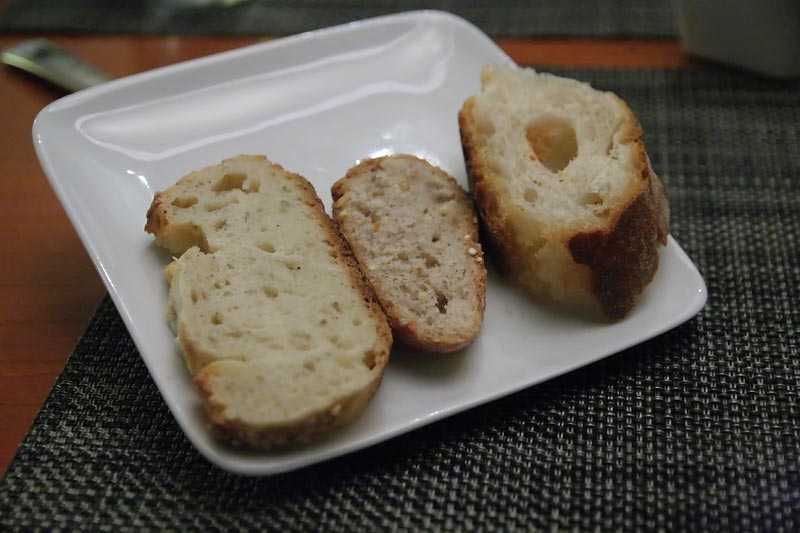
Bread Service (butter not pictured)
Not a great start because the bread was a bit dried out but it was tasty. I think my impression of the meal would have been even more favorable if this had just been omitted entirely. It was a lousy first impression, which was, fortunately, soon forgiven.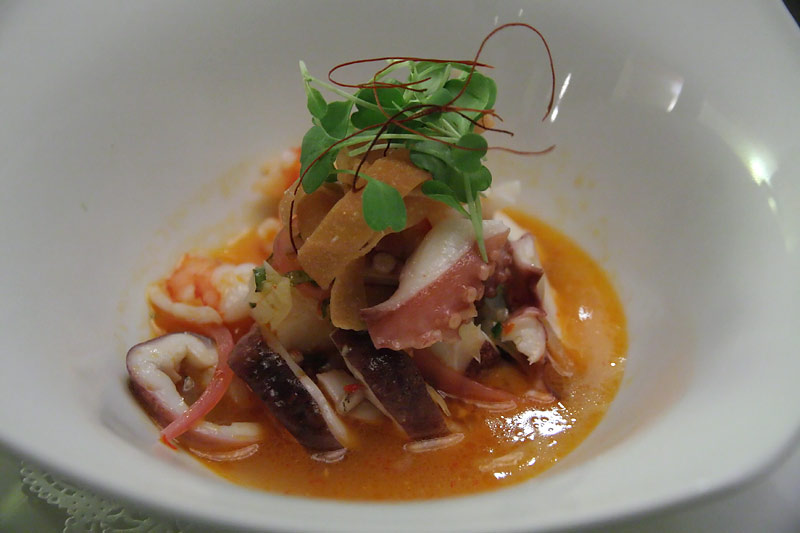
Ceviche of Shrimp, Squid, Hokkaido Scallops, Octopus | cherry tomato, cucumber, fennel, red onion, yuzu-ceviche sauce
Pairing: Mas Fi Brut Cava, Penedes, Spain, 2009
I thought this was a spectacular course. The seafood tasted very fresh -- it had a great, meaty-but-not-chewy texture -- and I loved the acidic yuzu-based sauce.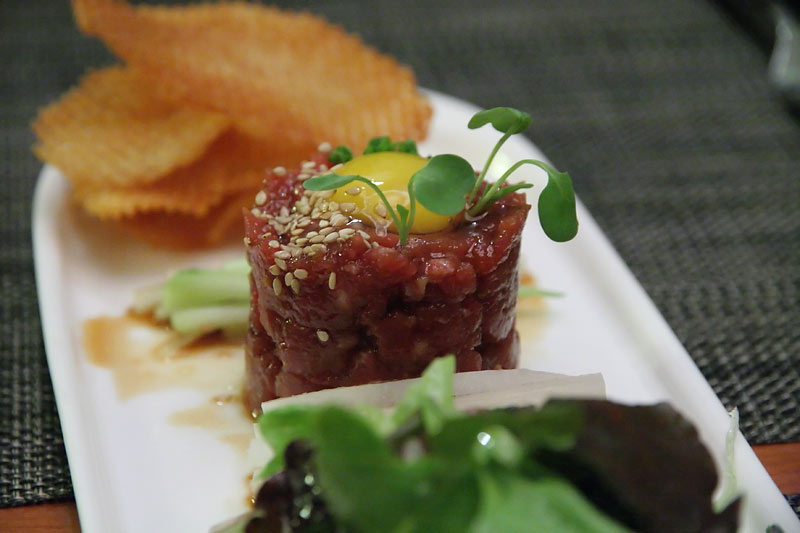
Soy-Sesame Beef Tartare | Asian pear, quail egg, crispy gaufrette potato (supplemental course)
I'd heard good things about this preparation and really wanted to try it. It was definitely worth the splurge. It was rich, unctuous and tasty. The kitchen was a bit heavy-handed with the toasted sesame oil but it was a successful rendition.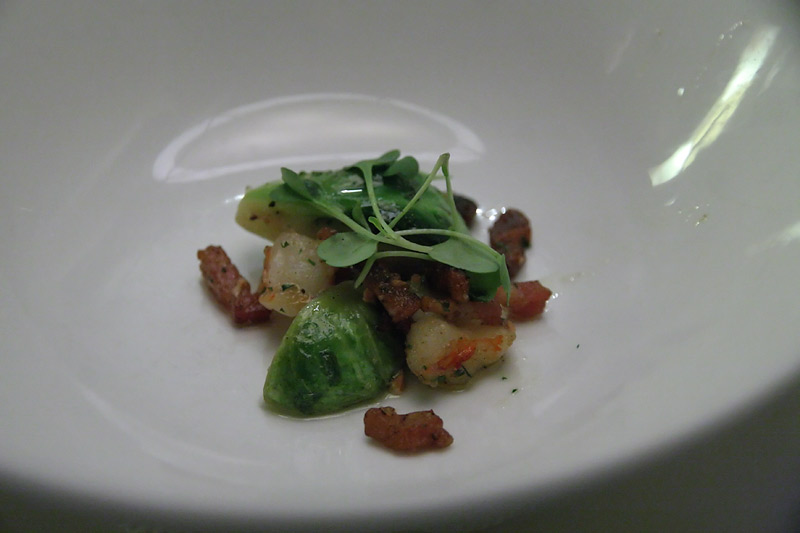
The foundation of our soup course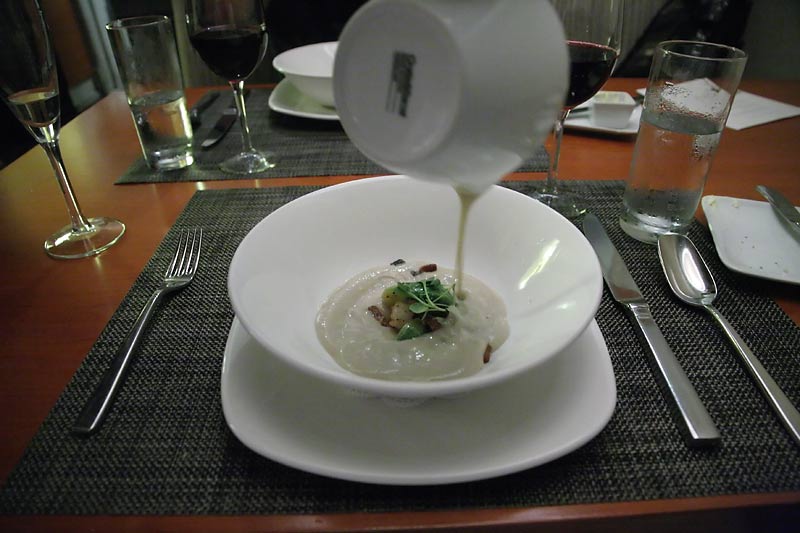
Soup, decanted tableside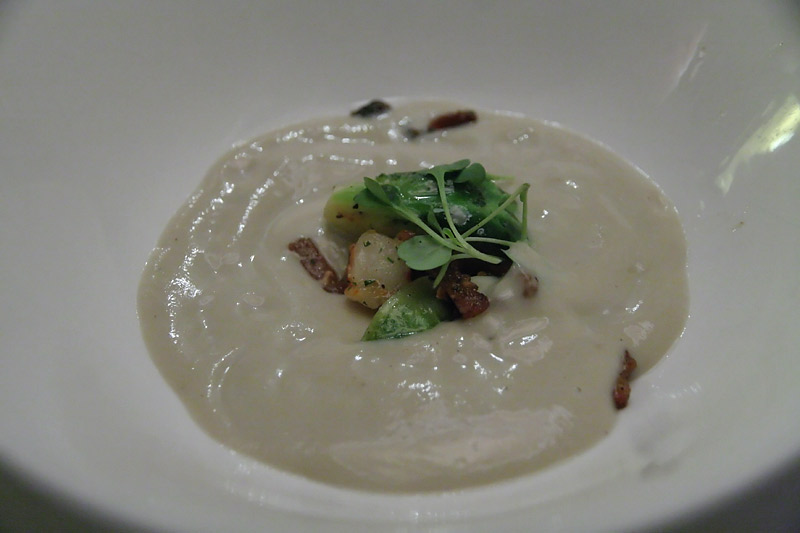
Jerusalem Artichoke Soup | grilled shrimp, brussels sprouts, almond, bacon
Pairing: Resso Rosso, Catalunya, Spain, 2009
This soup was terrific. I loved the thick, creamy base and thought the other components shone brightly too. It really made sense to decant it at the table because it allowed those other components to be at their best.
Soy-Ginger Caramel Pork Belly | pickled daikon salad, steamed buns (supplemental course)
This is another one I'd heard good things about. The belly was very tasty, and the texture was sticky and tender. It was a bit on the sweet side for me but there was no delay in finishing it.

Sauteed Maine Scallops & Soba Gnocchi | trumpet royale, celery root-parmesan foam
Pairing: Heinz Eifle "Shrine" Riesling, Pfalz, Germany, 2009
Unlike Gypsy Boy, who posted about this dish above, I really could taste the soba in my gnocchi but unfortunately, they were really mushy. That and a tiny bit of grit in one of the scallops did not spoil the dish for me. The scallops were seared nicely and had a great flavor, as did the foam.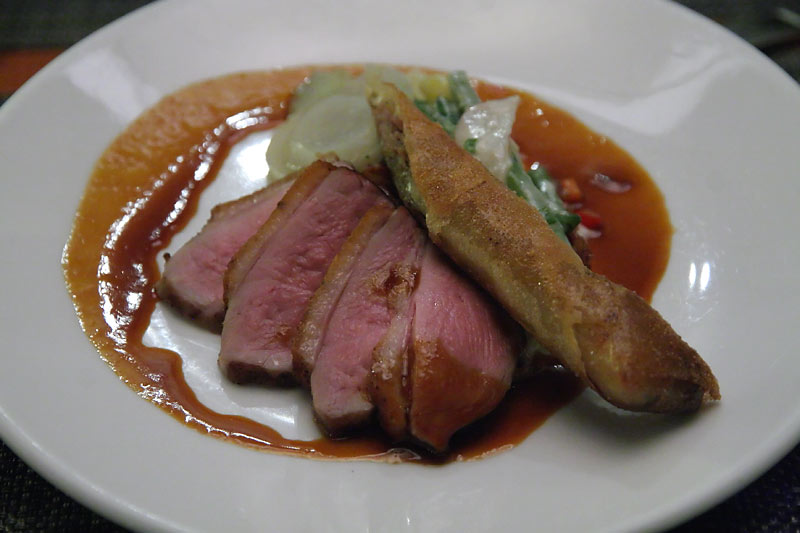
Roasted Indiana Duck Breast | duck rillette roll, baby turnips, green bean salad
Pairing: La Fiera Montepulciano, D'Abruzzo, Italy, 2009
This duck course was great. The meat was nicely cooked, deeply flavorful and tender. The supremely crispy rillette roll was really delicious, too.
Valrhona Chocolate Macadamia Nut Cake | bittersweet ganache, orange, vanilla ice cream
Pairing: Dom De La Tour Vieille, Banyuls Reserva
I'm not normally a huge fan of fruit and chocolate together but all the components in this course were so spot on, it was a pleasure to eat. I thought the Valrhona chocolate cake was exceptional.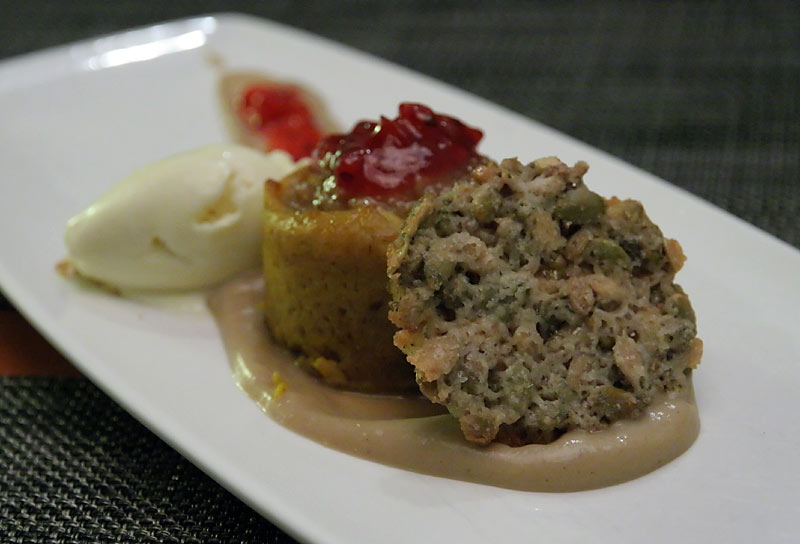
Pumpkin Pine Nut Cake | butterscotch pudding, red currant compote, cream cheese ice cream (extra course, gratis)
The kitchen sent this final dessert out for us. I was pretty full but really enjoyed it, especially the crispy cookie in the foreground and the ultra-decadant cream cheese ice cream.
I cannot believe it took me this long to finally get to Takashi, and I have incite to thank for getting me in there. Now that I've been, I look forward to returning. The Sunday Noodles menu looks particularly enticing.
=R=By protecting others, you save yourself. If you only think of yourself, you'll only destroy yourself. --Kambei Shimada
Every human interaction is an opportunity for disappointment --RS
There's a horse loose in a hospital --JM
That don't impress me much --Shania Twain
-
-
-
Post #67 - December 13th, 2011, 10:50 pmMy girlfriend and I had a rather disappointing experience here tonight, also attending for the Groupon menu.
I was quite looking forward to the seafood ceviche that ronnie had, but it was replaced on the tasting menu with a raw salmon dish. It was very good but not outstanding, and certainly nothing special. This was followed up by the sauteed Maine scallops & soba gnocchi dish pictured above. That dish was outstanding and my favorite of the evening.
Next came the pork belly. Again, it was quite good (I especially liked the spicy mustard), but I have had better executed pork belly several other restaurants, and a better version of almost this exact dish at Saigon Sisters.
Our fourth course was the duck, also pictured above. It was cooked well and not bad; the rillette roll was divine. The sample menu on the Groupon listed this dish, but accompanied by foie gras which I again felt was a bit of a downgrade.
For dessert, we had the chocolate macadamia nut cake with the oranges. It was good, but I felt the oranges were out of place. The ice cream and nest/praline thing were my favorite part here.
All in all, the food was quite good, but neither of us was blown away with anything. The changes to the menu from the sample menu were also fine and somewhat common with Groupons, but all of the changes felt like downgrades to me. I'm also a huge fan of Japanese food and didn't feel there was very much Japanese about the meal at all.
The service, while competent, was very unfriendly and kind of off-putting. None of the staff seemed like they wanted to be there and they were all rather curt and brusque. To put a capper on our bad service experience, the Groupon we used included the wine pairings ronnie mentioned. I was not up for alcohol tonight, so I declined the pairings and asked for tea instead. The tea was excellent, but I was surprised to see they charged us $4 for it. Sure, it was only $4 and I couldn't really complain since it wasn't included as part of the Groupon, but they saved on the wine they certainly didn't have to charge for the tea. Or they could have done something else special for us. They did something special for the table next to us instead, sending them a bonus dessert (they were also Groupon customers, timed with us). I guess we just got unlucky, as we weren't complaining and even went out of our way to be friendly and chat with the waitress since she seemed to be hating her job so much.
All in all, the food was good but not great, and given the number of options in the city, I doubt we'll be back for some time, if at all.
-
-
-
Post #68 - December 13th, 2011, 11:17 pmTambreet wrote:My girlfriend and I had a rather disappointing experience here tonight, also attending for the Groupon menu.
I was quite looking forward to the seafood ceviche that ronnie had, but it was replaced on the tasting menu with a raw salmon dish. It was very good but not outstanding, and certainly nothing special. This was followed up by the sauteed Maine scallops & soba gnocchi dish pictured above. That dish was outstanding and my favorite of the evening.
Next came the pork belly. Again, it was quite good (I especially liked the spicy mustard), but I have had better executed pork belly several other restaurants, and a better version of almost this exact dish at Saigon Sisters.
Our fourth course was the duck, also pictured above. It was cooked well and not bad; the rillette roll was divine. The sample menu on the Groupon listed this dish, but accompanied by foie gras which I again felt was a bit of a downgrade.
For dessert, we had the chocolate macadamia nut cake with the oranges. It was good, but I felt the oranges were out of place. The ice cream and nest/praline thing were my favorite part here.
All in all, the food was quite good, but neither of us was blown away with anything. The changes to the menu from the sample menu were also fine and somewhat common with Groupons, but all of the changes felt like downgrades to me. I'm also a huge fan of Japanese food and didn't feel there was very much Japanese about the meal at all.
The service, while competent, was very unfriendly and kind of off-putting. None of the staff seemed like they wanted to be there and they were all rather curt and brusque. To put a capper on our bad service experience, the Groupon we used included the wine pairings ronnie mentioned. I was not up for alcohol tonight, so I declined the pairings and asked for tea instead. The tea was excellent, but I was surprised to see they charged us $4 for it. Sure, it was only $4 and I couldn't really complain since it wasn't included as part of the Groupon, but they saved on the wine they certainly didn't have to charge for the tea. Or they could have done something else special for us. They did something special for the table next to us instead, sending them a bonus dessert (they were also Groupon customers, timed with us). I guess we just got unlucky, as we weren't complaining and even went out of our way to be friendly and chat with the waitress since she seemed to be hating her job so much.
All in all, the food was good but not great, and given the number of options in the city, I doubt we'll be back for some time, if at all.
Interesting to compare our recent experiences. Our service was fairly casual but definitely enthusiastic and engaged.
The ceviche was one of the more successful dishes we had, so that's a bummer that it wasn't available for you but I'm guessing you got something fresh, which is admirable. And I too would have been upset to be served a duck rillette roll if I were expecting foie gras, though that sounds more like a Groupon issue than a Takashi issue.
I really don't think of Takashi as a Japanese restaurant, at least not this dinner menu. If I had to call it anything, I'd call it French but there were influences from Japanese, Chinese, Mexican, French and other cuisines.
For me, this was one dining experience where the longer-than-usual interval between the meal and my recap helped me to attain a better perspective on it. As I wrote above, I'd enthuastically return but the aspects I didn't enjoy (also described above) came into clearer focus for me during that interval. In most cases, the longer I wait, the fuzzier details become. In this case, as the meal disappeared into the rear-view mirror, the general memory of a fine, enjoyable meal remained but the less successful elements began to glare a bit, which is why I was able to point them out so specifically. They really stood out in an otherwise exemplary dining experience.
=R=By protecting others, you save yourself. If you only think of yourself, you'll only destroy yourself. --Kambei Shimada
Every human interaction is an opportunity for disappointment --RS
There's a horse loose in a hospital --JM
That don't impress me much --Shania Twain
-
-
-
-
Post #69 - December 14th, 2011, 7:22 amronnie_suburban wrote:And I too would have been upset to be served a duck rillette roll if I were expecting foie gras, though that sounds more like a Groupon issue than a Takashi issue.
I believe this is a Takashi issue, and to me a bait and switch. Groupon would not have created the sample menu - that's the restaurant's responsibility when they offer a Groupon on a multi-course menu and then the restaurant develops the menu. Now I know that many restaurants have taken issue with Groupon and and the money that the restaurants are making (or not making) off of these deals, but it's a very risky business practice to take it out on a customer who you are hoping to develop a relationship with. That's how to succeed with Groupon - ensure return visits and increase positive discussion.
I don't think it's a big deal to substitute comparable items - one fish for another - but when you start substituting rillettes for foie gras, or say monkfish for lobster (not that the latter was done here), I think you're pretty much ensuring anger, negative publicity and no return visit because via the Groupon, you created a certain expectation when it comes to value and you are not delivering on that expectation. One man's opinion . . .
-
-
-
-
Post #70 - December 14th, 2011, 8:16 amBR wrote:ronnie_suburban wrote:And I too would have been upset to be served a duck rillette roll if I were expecting foie gras, though that sounds more like a Groupon issue than a Takashi issue.
I believe this is a Takashi issue, and to me a bait and switch. Groupon would not have created the sample menu - that's the restaurant's responsibility when they offer a Groupon on a multi-course menu and then the restaurant develops the menu. Now I know that many restaurants have taken issue with Groupon and and the money that the restaurants are making (or not making) off of these deals, but it's a very risky business practice to take it out on a customer who you are hoping to develop a relationship with. That's how to succeed with Groupon - ensure return visits and increase positive discussion.
I don't think it's a big deal to substitute comparable items - one fish for another - but when you start substituting rillettes for foie gras, or say monkfish for lobster (not that the latter was done here), I think you're pretty much ensuring anger, negative publicity and no return visit because via the Groupon, you created a certain expectation when it comes to value and you are not delivering on that expectation. One man's opinion . . .
It was the mention by the OP of "sample menu" that led me to see this as a Groupon issue, since that implies that it could easily change. I'm not a Groupon devotee, so I'm not well versed on how accurate their sample descriptions usually are. In fact, it is situations like this one that have kept me on the sidelines as far as all deal sites go.
=R=By protecting others, you save yourself. If you only think of yourself, you'll only destroy yourself. --Kambei Shimada
Every human interaction is an opportunity for disappointment --RS
There's a horse loose in a hospital --JM
That don't impress me much --Shania Twain
-
-
-
Post #71 - April 9th, 2012, 7:54 amMy wife and had the pleasure of dining at Takashi this past Saturday (April 7). We were initially leaning toward the chef's tasting, but after seeing other menu choices decided to pick and choose. Our server was very helpful in making our choices.
The space is a bit cramped, and appears to have been a residence at one time. The decor is minimal muted light colors with a bit of emphasis on whites with a splash of black. Somewhat rustic on the second floor with exposed brick.
We each ordered an apertif of a very nice Reserve Du Sanglier Chablis. First up for her was the duck leg confit, and for me the pork belly, steamed bun and daikon salad. The pork belly was all that one expects from this morsel of gelatinous (say it like Andrew Zimmern!) goodness. The few bites I had of the duck confit was delicious. I was very pleased that it was seasoned just enough for the duck to take center stage.
Having finished our glasses of Chablis, we decided to stay in Burgundy, ordering a bottle of Jacques Girardin Santenay (2009), which paired beautifully with our subsequent food choices.
Next, we shared an order of the scallops and soba gnocci. As has been recounted on this Takashi thread, it was superb. The scallops were perfectly prepared, and the gnocci were, as the popular phrase goes, "little pillows of joy".
My main plate was the Osso Bucco, served with a side of cauliflower risotto.
Allow me to wax poetic about risotto. Risotto, when prepared well, is one of the most wonderful things in the universe. No kidding. Easy to prepare, so many fabulous things you can do with it. It's one of my favorite things to cook, and we do quite often.
Having said that, the cauliflower risotto served with the Oss Bucco was a home run - a grand slam. As someone who really appreciates risotto, this was by far the best I've ever had. Ridiculously good.
My dining companion ordered the Seared Quebec Foie Gras with poached goosberries, and quince in a port huckleberry reduction. It was exquisite; fireworks of flavor. My Osso Bucco was perfectly braised, and as I remarked to our server - they must have seen me coming because there was lots of yummy marrow to be harvested. My only very minor nit - in fact the only issue with the meal at all, was that the veal could have used a bit more salt.
Desert for me: Valrhona Milk Chocolate Sticky Cake. One of the most unique deserts I've ever had. My wife ordered the Panna Cotta, and her comment was "amazing". All washed down with glasses of Domaine De la Tour Vieille Banyuls.
Service was very good, but might benefit from a bit of polish. A thoroughly enjoyable dining experience, and one that we will gladly repeat. Their Michelin star is deserved.
-mm"Ash, that transmission - Mother's deciphered part of it.
It doesn't look like an S.O.S....it looks like a warning."
-- Ellen Ripley
-
-
-
Post #72 - October 20th, 2013, 5:14 pmI'm more than a little surprised to see that there have been no posts here in almost a year and a half. Particularly in view of the fact that it is now (and has for some time, apparently) been serving a kaiseki. The Lovely Dining Companion and I visited the other night and we wanted to share a few thoughts. This won’t be an in-depth review but the meal was very good and, while we had our quibbles, we were generally pretty impressed.
We were seated early, around 5:30, but the place was already surprisingly busy on a Sunday evening. The pace of service was nearly ideal with sufficient time between courses to digest, chat, and reflect on what had come and what was yet to appear. If we had a general complaint about the meal, it would be an unusual one: too much food. Although the LDC is not renowned for her gargantuan appetite, I’ve never been shy about packing away more than sufficient quantities. She just gave up toward the end and I waddled out, barely. The courses—there are eleven, including two dessert courses—are quite varied in size. Some, like the first, were a bite; others, like the pork loin or the sukiyaki are almost half an entrée-sized portion. The deliberate pacing both helped and hurt—it helped in allowing time, as I said, to digest and relax; it hurt in that there was more than sufficient time by course seven or eight for the tummy to tell the brain, “Stop!” “Too much!”
(One quibble/request: we were given both flatware and disposable chopsticks. Both LDC and I preferred to use the chopsticks. If you are going to offer chopsticks for a meal with eleven courses lasting over two hours, it would be nice if you would provide a chopstick rest. No one expects new chopsticks with each course, so one has to have a place to rest them. Chopstick rests are traditional and one imagines that inexpensive ones exists. Even cheap ones are preferable to having nowhere to place the chopsticks between courses.)
Harumaki of Maine Lobster and Yukon Gold Potato, Ikura
A terrific introduction to the meal: the lobster and the potato worked very well together, both texturally and in terms of flavor. I would not have guessed it but the potato “balanced” the dish nicely and, though it was a large single bite, it was inspired and excited us about what was to come—which is the point of the amuse anyway, right? (oh, harumaki is Japanese for “spring roll.”)
Crudo of Baby Octopus, Hokkaido Scallop, Maine Cuttle Fish, Tobanjan Vinaigrette
We both thought that the octopus was a bit past its peak. It wasn’t chewy in the way that “old” octopus would be, but it didn’t have that gentlest of resistance, that toothsomeness, that great octopus does. A step or two past perfect, but noticeable. Same with the cuttlefish. We’re not criticizing the quality but the “just past its peak” freshness. Indeed, we were both more than a bit surprised and after our initial bites looked up at each other, both thinking the exact same thing but reluctant to put it into words. Given the overall quality of the meal, we were both disappointed that the elements of this course simply weren’t what they should have been.
The “vinaigrette” is, I presume (it was not explained), chef’s play on a core ingredient of Szechwan cooking: douban jian—a hot chili paste. This vinaigrette (it reappeared briefly again with the prawn) was nowhere near as salty or spicy as the Szechwanese original (not a bad thing), but distinctive and a somewhat off-the-beaten-track complement.
Otsukuri of Yellowtail “Hamachi,” Salmon, Alaskan Spot Prawn, Daikon, Ogo
Perfect fish. Notwithstanding our issues with the octopus and the cuttlefish in the immediately preceding course, the sashimi here could not have been improved upon. Positively ideal dish. (Ogo, for the less completely well-informed, myself included, is a form of edible seaweed/moss; otsukuri means “made” as in the sashimi was “made”; it’s essentially a synonym for sashimi or a sashimi course.)
As presented to the table
I’ll admit to be quite impressed by this clever little “teapot.” The top, with its indentation holding the lime garnish is, when turned over, the small bowl from which you drink the soup. Beneath that, to ensure that the contents stay hot, a separate, lovely lid. It would be even more amazing if that served a secondary purpose as well, but taken together, I find this an esthetically impressive, simply beautiful “serving dish.”
Wanmono: Matsutake Mushrooms Dobin-Mushi, Gingko Nuts, Silky Tofu, Shrimp, Suzuki
We were surprised that this was the only truly seasonal course; kaisekis ordinarily emphasize ingredients that are in season. That fact notwithstanding, this was a light broth, not particularly rich but nevertheless quite flavorful. There was something added to it—LDC and I debated (without reaching a conclusion) what it might be—about what it might be that made this very “Japanese” for a mushroom broth. There was a unique umami flavor in the background that we both identify as a classic “tell” for Japanese cuisine. Also worthy of note was the house-made tofu; the best I’ve ever had was, interestingly enough, at L2O—when it was made in-house by Laurent Gras. This wasn’t quite at that level but it was impressive nonetheless. The gingko nuts, tofu, and shrimp were all fine (as was the suzuki—sea bass—a mild fish) but the broth and the tofu were the stars here. (Wanmono refers to the course in which the dish has a lid, traditionally meaning a broth with fish and veggies.)
Age-mono: Bad Hairday of Prawn, Kani Croquette, Chicken Age-Shumai
The fired course: classic comfort food. Cutesy name but an excellent prawn and, as tempura, done superbly. The (crab) croquette had a little tonkatsu sauce on top (croquettes are classic street food) and this—indeed the entire course—was executed perfectly. The fried chicken shumai was a single (large) bite.
Sauteed Mugifugi Pork Loin, Shiokoji-Ginger Sauce
This course was a huge disappointment. To start with, three good-sized slices of pork loin—too much. But the portion would been less of an issue if the meat—both mine and LDC’s—weren’t tough. Very tough. So tough that neither one of us finished the meat. I raised the issue with the server, who we were generally happy with. She seemed genuinely dismayed and promised to report it to the kitchen. Chef Yagihashi was there but neither he nor anyone else ever came out and, indeed, the issue disappeared as if it had never been mentioned. Extremely disappointing. (In the interest of complete reporting, that’s pickled vegetables to the left of the pork and a small hijiki “salad” to the right.)
Shabu-Shabu of monkfish and Snow Crab
Two largish slices of monkfish, two crab feelers, and a large dipping bowl of broth. (How can they use an open flame on a “bowl” made of paper?) The crab was okay, the monkfish better than that. There were also greens as accompaniments.
Sukiyaki of Ribeye, Shungiku, Yam Noodle, Yaki-Tofu
Two good-sized slices of ribeye. The meat wasn’t the tenderest, notwithstanding the thinness of the pieces but then, ribeye is known for its flavor, not its texture. Shungiku is a leafy green that some say has a suggestion of chrysanthemum about it. Maybe to some; in any event, it was good, as were all the other accompaniments.
One note: I made the following comment in a review of a dinner we had last year at Sixteen: “Note to the staff: the name of the ingredient is kabocha. It’s three syllables and although it’s a Japanese word, it’s not hard to say. Get it right….” I am astonished to have to say the same thing here: it is NOT pronounced “SOO-kee-yah-kee.” Why a Japanese chef/owner would allow this (and other) common Japanese words (udon, daikon) to be mispronounced by his staff is truly astonishing (and mystifying) to us.
Kenchin Inaniwa Udon, Amish Chicken, Gobo, Yam Cake
These were house-made noodles; we asked because we were so impressed by the quality. Udon is typically made in a thicker style, but esthetic issues aside, the quality was exceptional. The broth boasted a depth of flavor and the bowl was liberally filled with chicken and various typical garnishes. (I will confess to not noticing the gobo, a disappointment to me because that happens to be an ingredient I am very fond of.) The course was excellent and the LDC, whose outer appetite limits had already been exceeded, finished the bowl. Completely.)
Coconut-Ginger Panna Cotta with Watermelon-Lime Gelee and Sesame Brittle
Positively lovely. Not as light as a traditional panna cotta—which is among my less-favored desserts to begin with—but texturally perfect and the flavors matched ideally, meaning, both were identifiable without either overpowering the other or the dish itself. The sesame brittle tasted distinctively of sesame and was well-served by being a bit less “shatterable” than most brittles. I don’t know what the kitchen used to achieve the somewhat “chewier” texture (it wasn’t chewy at all, except in relation to traditional renditions of brittle) but the flavor was spot-on and a nice textural complement to the panna cotta.
An Mitsu: Citrus Agar Agar, Soba Ice Cream, Sweet Red Beans
Soba = buckwheat. An intriguing notion for ice cream and, a bit to my surprise, they not only nailed the flavor (which isn’t pronounced in any event) and allowed for a well-chosen complement to the an (adzuki beans), atop the ice cream, as well as the citrus “sauce” garnished with fresh fruit.
The eleven-course kaiseki is $100; there is also a seven-course one for $75. Pairings were $55; I opted for a single glass of sake (Rihaku, a Junmai Nigori, $13) which was served, oddly, in a little juice glass. It was quite good and complemented the meal. As others have posted on other threads, I simply can’t manage the amount of alcohol involved in a pairing and, since LDC can’t drink alcohol, I can’t even split it. So my option for the past year or more has been to choose one (or sometimes two) glasses to accompany the entire meal. It’s far easier to deal with and allows me far more time and attention to pay to one or two things.
(Parenthetical note on the drinks menu: there are five beers, all Japanese, and eleven sakes. The sakes are offered in either of two standard sizes, 300 ml or 720 ml; five of them are offered by the glass. While the offerings are not extensive, they appear to my semi-educated palate to be a well-chosen selection and prices range from inexpensive to expensive-ish (the most expensive sake is the 720 ml bottle of Dassai Goju at $86).
Comparing impressions afterward, LDC made an observation that I think, in its way, is spot on: this was like a “greatest hits” of Japanese food: sashimi, tempura, sukiyaki, udon, shabu-shabu, croquette. There’s nothing wrong with this, though it makes it less like a classic kaiseki. (One other note LDC offered: she was surprised not to be offered rice at any point in the meal. She admits that’s partially what she grew up with and so it’s partly a personal preference; however, rice is, in fact, usually considered a course (shokuji, something served with rice) in a kaiseki because no meal is considered complete without some rice.) Indeed, given the quality of the ingredients (by and large) and the very high level of execution and presentation, it seems almost churlish to quibble. Speaking of the high level of execution and presentation, it’s probably also worth noting that these are generally not complex or intricate preparations (recognizing that that’s a relative judgment). Perhaps more important (to some), this is not challenging cuisine either in terms of its creation or its creativity. That does not mean it was not enjoyable; we were generally quite happy and would return, our decision dependent in part of what dishes are added/subtracted from the selection.Gypsy Boy
"I am not a glutton--I am an explorer of food." (Erma Bombeck)
-
-
-
Post #73 - November 13th, 2014, 4:46 pmTakashi, the recipient of multiple accolades since opening in 2007, is closing at the end of the year, the Trib first reported.
http://chicago.eater.com/2014/11/13/7217223/takashi-shutter
-
-
Post #74 - November 14th, 2014, 9:11 amHundreds and hundreds of Groupons were sold there. Should be an interesting panic as we head to year's end.
-
-
-
Post #75 - November 14th, 2014, 9:27 ammattshafferHP wrote:Hundreds and hundreds of Groupons were sold there. Should be an interesting panic as we head to year's end.
But hey, at least he's been on Top Chef!
=R=By protecting others, you save yourself. If you only think of yourself, you'll only destroy yourself. --Kambei Shimada
Every human interaction is an opportunity for disappointment --RS
There's a horse loose in a hospital --JM
That don't impress me much --Shania Twain
-