

Alinea: The Progression
Alinea: The Progression
-
-
-
-
-
Alinea: The Progression
-
-
Post #1 - April 23rd, 2016, 1:09 pmSPOILER ALERT: IF YOU HAVE TICKETS TO THE PROGRESSION OR HOPE TO, DO NOT READ ANY FURTHER. YOU WILL SEE BEHIND THE CURTAIN AND YOU REALLY DON’T WANT TO DO THAT.
(Note: this is a very long “review.” I know. But The Progression is not just about—or even mostly about—the food. It is about the experience. The food was but one element in an evening that also elevated the significance of sound, sight, and other senses as well. It just took a lot of writing to address those things.)
About two-thirds of the way through the progression (or “The Progression”), the lights go out. Dinner is served. The plates are black, the drinkware is black, the servers are dressed in black, and food is black or nearly so. The music—the Rolling Stones “Paint It Black”—is loud. There is barely enough ambient light to see your utensils. The plate with the food that you can’t see sits atop smoldering pine needles, an approach drawing on Alinea’s rich heritage emphasizing the incredible power of smell. I found this by far the most extraordinary course: the music makes conversation impossible and you are thrown back on yourself. The course, perhaps more than any other, is what you make of it. For me, the music conjured memories and the food—duck, black lentils, and truffles, all accompanied by a black tea bread and black butter—was overwhelming: flavor, umami, texture…. I let go and felt myself drift away. The music changed to something I can only describe as fairly mellow rap, a genre I generally dislike but this worked for me, so much so that it simply intensified my feeling of letting go… disconnecting, floating in a very pleasurable way, anchored only by amorphous, changing memories and the intense and specific elements of the food. To enhance the experience, I closed my eyes, letting go of everything except taste and hearing. Better and better. Drifting away…. I remember that it was distinctly disappointing to come back and reconnect when the lights came back on, as I suppose they inevitably had to.
“…when suddenly a White Rabbit with pink eyes ran close by her…. In another moment down went Alice after it, never once considering how in the world she was to get out again.”
We considered ourselves fortunate to be able to snag a pair of tickets when they went on sale: dinner at 6:45pm on a Friday. We were instructed by e-mail to show up and “register” at Aviary where further instructions would follow. Checking in was simple: we had the option of adding either alcoholic or non-alcoholic pairings ($65 and $45, respectively, plus the inevitable tax and tip). Our wrists were stamped with vivid red ink (sending me back instantly to high school) and we were each handed two things: a lunchbox thermos (sending me back even further, to grade school) a black cloth satchel with assorted bottles and bags with the instruction/warning not to look inside.
Though I doubt it was the intent, many things in the course of the evening seemed to conspire to take me back to the ’60s or put me in mind of Alice in Wonderland (and in fact, Alice and the ’60s have a lot in common), precisely at the moment of falling, falling, falling down the rabbit hole.
“Either the well was very deep, or she fell very slowly, for she had plenty of time as she went down to look about her and to wonder what was going to happen next.”
Precisely! Our first drinks of the evening were in the grade-school thermoses and contained I’m not sure what except that there was sherry in mine, it tended toward the sweet, and was a very nice introduction. As we sipped, we met some of the other eighteen folks in our “seating.” After a time, we were directed to go to make our way to the old Moto space around the corner where we were welcomed.

The main dining room straight ahead of us was completely blocked off; an alcove to the left was similarly shrouded: a shade was pulled down leaving a space about six inches high into which we were instructed to place a hand.
The décor consisted of a number of works of art and photographs (all by Chicago artist Adam Siegel), a silver trunk with strangely marked playing cards splayed across the top, a table with a punch bowl empty but for a large block of ice and twenty antique wine glasses in varying styles, and a very retro ’50s turntable (with the obligatory milk crates filled with LPs). Those of us whose hands were not out of sight under the shade were asked to select an LP from a greatest hits repertoire weighted toward the ’60s and ’70s. Everyone was also asked to pick a card with the most desirable food item scrawled on it: the choice was either salmon heads, chicken feet, or octopus. (For what it’s worth, there’s an industry magazine with an article on the art and the effort behind the collaboration here. After reading it and being there for several hours, I still don’t get it.)

While all this was going on, people began returning from the curtained-off slot, hands intact with a piped popcorn crema topped with osetra caviar.
As we finished licking up the crema/caviar, we were instructed to dig into our black satchels and retrieve various sized bottles with particular labels on them. As we did so, everyone was then told to come, one by one, and pour their contribution into the punchbowl: coriander, lapsang souchang, togarashi, kaffir lime, orange peel, pineapple, yuzu, lemongrass, yerba mate, and on and on, until we had some twenty different ingredients in the bowl.
Now it was time for our host to take back the samurai sword that had been entrusted to one guest. Why a samurai sword? The better to open the champagne with, of course.
Following the champagne contribution to the punch bowl, a bottle of single malt Suntory Hakushu 12-year-old whisky was then added. The non-alcoholic pairing had the same ingredients (minus the alcohol), albeit in different proportions. As much as you would like, thank you. And to accompany the group-created punch, a selection of appetizers began appearing: wagyu beef atop a puffed onion toast; an open-faced nori sandwich topped with tobiko roe; and passionfruit “glass” cookies sandwiching a foie gras cream filling.

Anyone foolish enough to expect a simple selection of hand towels was in for a surprise. We were directed to help ourselves to a nickel-sized white disk from those surrounding a bowl of water and lemon slices, like so many crackers on a cheese plate. The disks rehydrated in the water, leaving each of us with our own personal, slightly scented hand towel to clean our hands and refresh ourselves before falling further down the rabbit hole.
At this point, our host, John, asked whether anyone had been given or found a tiny key. The appropriate guest stepped forward and was instructed to open the silver trunk, taking care to be prepared to wrestle whatever he might find inside. No one knew what to expect. And in the event, the opening turned out to be a slight disappointment (given the cautions and warnings): inside the trunk, atop a generous bed of ice, lay three large glass jars, each containing one of the ingredients that had been listed on the cards: chicken feet, salmon heads, and two small octopi. A majority of our group had voted for octopus, so that jar was removed and placed in the care of a guest who was instructed to guard it for future use, but not before we were asked to decide on names for the octopi. (Octavian and Sebastian. We had an…unusual…group.)
“Suddenly she came upon a little three-legged table, all made of solid glass; there was nothing on it except a tiny golden key.”
We were now directed to make our way past a curtain in one corner leading into a vibrantly (dare I say mind-blowingly) yellow staircase that ended in a very white room. A long island/bar stood off to one side and there were ten tables generously spaced throughout the rest of the room. Each table was exquisitely prepared with a starched white tablecloth and a smartly folded napkin.

Atop the napkin sat a tiny pineapple-shaped shot glass. Perched neatly above it was a chunk of frozen pineapple, duly wrapped in a gold candy wrapper. (This being Alinea, we were also carefully instructed not to eat the wrapper.). Pineapple is an old symbol of both hospitality and luxury, so it wasn’t entirely a surprise to be instructed to reach into our black satchels and remove a small glass container with two dots on the cap. Inside, a decoction of pineapple. We were told to carefully unwrap the pineapple atop the shot glass and then pour in our libation and enjoy. We did.
A white pillar candle and a small white plate completed the setup. Oh, and speaking of Alice, each table also had a small key. (The room was the private dining room at Moto where some will remember the evening that Homaru Cantu recreated his Iron Chef beet dinner for us….) We were asked to choose any table we wished and as we settled into our spots, looked at each other wordlessly asking: “What on earth is next?”
In keeping with the yellow theme, the next course featured soft-shell crab and yellow marigold petals in a soup bowl which was soon to be filled with a clear gazpacho. The crab was among the best soft-shell crab I’d ever had and the gazpacho an eye-opener.
It was followed by the “white” course. Lights were turned up, which had the effect of emphasizing the whiteness of the room. Then the servers—clad head-to-toe in white coveralls—
—entered, presented, and opened an engraved envelope:
The course would be consumed in total silence. After handing us our instructions, they returned to the kitchen and returned with the food: shimeji (or white beech) mushrooms sitting in a light cream sauce (?).
Though there might not necessarily be a “progression” to the colors (or the music), there seemed to be a classic progression developing in the food, from light to heavy, from (dare I say?) simple to more complex.
We were, I think, slowly settling in, beginning to feel a little bit comfortable with what we had seen when suddenly the lights went out and we were told to extinguish our candles. Shock and awe, in the words of a former president. As I described in the opening paragraph, it was hard enough to see to eat, forcing us to rely far more heavily on smell and feel and taste.
Eventually, of course, the lights came back on, things started to settle back down, relaxation almost set in when a chef rushed out of the kitchen, into our dining room and frantically insisted that we all had to get into the kitchen. We were cautioned that we had to bring our black satchels, but there was just as clearly an urgency to it. Unfortunately, the chef who ran into the dining room shouted his line and ran back into the kitchen so quickly that almost no one was certain what he said. And so someone had to come back in and ask us all to get into the kitchen pronto. We did, only to find Chef Bagale (Chef Achatz’s successor at Alinea) at the helm asking us for our octopus.
Time for Octavian and Sebastian to meet their maker, I guess. There were two dishes that we were going to have in the kitchen, one that they would make and one that we would make. In front of each of us was a small silver tray on which lay a romaine heart impaled on a skewer, a small squeeze bottle filled with some indeterminate something, a small ceramic bowl with what appeared to be shaved slices of dried tuna, and a plastic drink cup rimmed with salt, lime, and ice.

First up, we were handed bottles of Victoria beer, a difficult-to-obtain Mexican brew from the people who bring you Negro Modelo. We were making our own micheladas (which, for the uninitiated, is a combination of beer, lime juice, and various combinations of spices. Think Bloody Mary with beer instead of vodka. Our spice mixture was in a small brown bottle from our black satchels; a green chili concoction that added some definite kick. And what’s Mexican beer without Mexican food? So, the kitchen quickly whipped up some tacos after asking for our octopi. Homemade corn tortillas, salsa, pickled carrots, all served in a paper takeout tray. The pity was that we only got one each.
While the kitchen was putting the tacos together, we were told to grill our skewered romaine hearts on the superheated hibachis (which were used, among other things, to grill the ayu for Next: Kyoto). After getting a light char, Chef Bagale instructed us to told to go heavy with the miso vinaigrette in our little squeeze bottles and then sprinkle on the shaved bonito, a Japanese Caesar salad! (For the record, the miso vinaigrette was very good, reminiscent, of course, of the “real” Caesar dressing, but going heavy was a big mistake. A little went a long way and too much was a bad idea.)
As we were trying to settle in while standing in the Alinea kitchen with Chef Bagale and Alinea staff, someone (from the kitchen staff) broke out a bottle of tequila which we were invited to help polish off. Whether you’re a drinker or not, a tequila fan or not, it’s hard to pass up the chance to down shots all the while chatting with Alinea staff.
As this course drew to a close, we were asked to climb the back stairs which brought us up into a hallway and then face-to-face with a man in red…all in red…in a garishly lit red cubicle. He greeted us with three different red fruit drinks: what you got depended on the stamp on your wrist from your registration. In our case, strawberry and watermelon. The drinks were non-alcoholic and remarkably, almost stunningly, clear flavored: no off flavors, nothing but pure red fruit. Not particularly nuanced, but exceptionally clean, clear, nectar-of-the-gods-style flavor, unsullied by anything else (though perhaps a bit too sweet). Now whether the man in the red (union) suit was the devil, or merely someone who looked like the devil, we’ll never know, but we had no time to investigate because we were now standing in front of a short tunnel lined with what appeared to be tumbleweeds.
“‘Curiouser and curiouser!’, cried Alice”
Through the tunnel and into the…park! For a picnic. A room outfitted with real grass (and blankets), lawn chairs and picnic tables, and strung with lights. The picnic tables were strewn with a variety of music cassettes (remember those?) Again, ’60s and ’70s, like the LPs. (Why the emphasis on those decades is anyone’s guess, although it might in part simply reflect the collections of the staff who contributed.) The food stations along one wall sat on tables decked with red-and-white checked tablecloths. We don’t go on enough picnics but any time Alinea plans one, we’re there! This was no exception. At the first station, we were presented with what was variously described as veal cheeks, bison, and beef cheeks, all dressed up in green curry and I-don’t-honestly-remember-what-else. (Sadly, the e-mailed menu summary that was sent to us a couple days later is remarkably unspecific. It’s a clever, arty graphic but as a keepsake it leaves a lot to be desired. As a guide to the meal, it’s nearly useless. I understand that paper menus take time, effort, and cost money, but this is one place I’d advise against cost-cutting. And if the purpose wasn’t to cut costs, then I’d say bring back the paper please. And include more details.)
From veal cheeks to a pea soup that only Alinea could devise, including spring peas, dill, an orange sphere, carrot, and, that old standby, solidified parmesan cream. The orange didn’t work for me at all, but the Lovely Dining Companion pronounced the course a success.
The next station offered orange udon (noodles) cooked to order and mixed with XO sauce, white soy, egg yolk, and pickled plum. Excellent…
Last two items. Dessert created with Mr. Wizard tools before your very eyes. Now was the time to break out the warm, form-fitting glove in your black satchel. Since they were using liquid nitrogen to gin up this course, they recommended carrying it back to your seat with a gloved hand. I don’t know that it was necessary, but it added to the gimmickry of the evening and was a cute touch. The food was a bubble-gum mochi (which is a slightly chewy rice-flour-based dessert) with guava “snow.”

Oh, I almost forgot to mention the soft-serve machine with “Thug Passion(fruit).” I’ll leave the Tupac Shakur allusion to others and restrict my observation to saying that this stuff was, like the red fruit palate cleansers, wonderful. Redolent of passionfruit, smooth and silky. One of the many fun aspects of the evening came at this point because we had to dip into our black satchels one last time. The Lovely Dining Companion had a squeeze tube of hair tonic; mine was sunscreen! (Wonder how they cleaned them out….) This drink, as good as it was, also struck me as too sweet—a theme running through a number of the alcoholic drinks, as a matter of fact. I don’t often complain that things are too sweet and so I suppose the fact that I definitely noticed the sweet quotient is not a positive sign.
I insert a parenthetical note here to observe that the alcohol pairings ran the gamut from sherry to beer, hard liquor to fruit, and wine (with the yellow, white, and black courses). Not everything was to my personal taste but given the enormous variety and the challenges posed, I was pretty happy with the selections. I tasted a number of the non-alcoholic drinks as well and can easily understand why the Lovely Dining Companion professed herself quite happy with them. I think she was happier with a greater percentage of her pairings than she usually is—always a good sign.
It was precisely at this point that reality intruded in a most unwelcome and, frankly, offensive, way. A staff member came into the room and, after apologizing, said that we had ten minutes left. We were told to make the most of our remaining time and to make sure we sampled everything available, but the next seating would be starting soon and we had just ten minutes left.
Scheduling, as I wrote them in an e-mail afterward, is your job, not mine. I don’t understand how a new seating starting in a different part of the restaurant is affected by our remaining where we are, but I don’t need to understand. (Maybe there isn’t enough staff, maybe the rooms are adjoining…I have no idea.) But even acknowledging that there might have been a real problem, it had to be foreseeable. We didn’t end up where we were when we were as a surprise to anyone. Why didn’t staff urge us along earlier in the evening? Don’t invite me in, accompany me through a heretofore wonderful evening, and then tell me that I have ten minutes to leave.
Well. Since we had to leave, we did. We quickly tried what we hadn’t yet sampled and got out. As we exited through a corridor draped entirely in flowing white sheets, we were each handed a Sharpie and asked to share whatever thoughts we wished to by inscribing them the sheet.
Comments already in place ranged from the sublime to the ridiculous and, when we’d had all of thirty seconds to ponder the previous few hours, thoughtfulness was not emphasized. After we left our wisdom for posterity, we were handed a stick of dried rhubarb atop a small brick of rhubarb from the anti-griddle and were whisked out into the night.
The thing I’ve wrestled with since leaving is the title: “The Progression.” A progression is more than a sequence; in a progression, one thing logically leads to the next thing, it doesn’t simply happen to follow what came before. Each stage is connected in some way with what precedes it and what follows. A progression is also, as it happens, a term used in music and music played a large role in the evening. A musical progression can be either a sequence of notes and chords or the movement of discrete parts in harmony. Which was this? Or was it everything at once? I still don’t understand the progression that they had in mind. Maybe that’s my problem. I simply don’t feel like I am able to tie the art (especially the art) to the food or the music. I definitely appreciated some of the music choices, the silence, and the darkness. Those experiences connected with me on a basic level. Why the specific pieces of art, why the specific photographs, why the emphasis on color and how that color tied to the larger experience, I still can’t understand.
It’s hard to know who is responsible for what in this experience. Chef Achatz, Chef Bagale, others on the staff, so it’s easier to say that Alinea is nothing if not creative; their inventiveness and playfulness come through in everything they do, whether in the more mainstream setting of Alinea or here, where the space allows extraordinary freedom to control virtually every aspect of the experience: what (and even whether) you see; what you hear (Chopin to hip-hop) and what you don’t (total silence); the intensity of the surroundings (a startlingly, brilliant yellow staircase or a surreal, vivid red room; bright, almost painful white to dark, nearly total black); what you feel and, of course, what you taste. No sense is left unaffected. This is not a meal where you walk in, choose your dinner, eat, and leave. It is impossible to imagine a diner unaffected by the assault on his or her senses. (You may have noticed that I wrote about some things in this review and had no pictures for them. I consider that a sign of the success of the experience: I was so busy enjoying myself, focused on what was happening, that I simply forgot to take pictures.) And yet it is an assault designed to both jar you out of the familiar and yet please you on an almost visceral, primitive level.
So did we like it? Yup. Blown away? Nope. We understand that they wanted the evening to be about the total experience, not just about showing up and eating some food. They wanted the sights, sounds, tastes, textures, fun—everything that happened to us while we were there—to be a part. And it was. It was an extraordinary evening. According to what we’ve read, this is intended to be an unedited “preview” of some dishes for Alinea 2.0. Did the evening make us more (or less) eager to visit the “new” Alinea? It’s hard to say. Some of the dishes were terrific, some less so. Some experiences were too gimmicky, some things were wonderfully provocative and stimulating. On balance, I’d have to say that—for me—the gimmicks very slightly outweighed the thought-provoking. I’m truly glad we went; the things I enjoyed were, in fact, the combination and collision of experiences which, I have to think, was a large part of the goal. I’m eager to visit (and probably re-visit) the new Alinea. But one has to wonder which, if any, of the experiences we had would translate to the new space. Will it only be dishes? Given Chef Achatz’s well-known views on the importance of the experience, it’s hard to imagine that some of the approaches and experiences we had at the Progression wouldn’t find their way into Alinea 2.0.
“‘Wake up, Alice dear!’ said her sister; ‘Why, what a long sleep you've had!’
‘Oh, I've had such a curious dream!’ said Alice, and she told her sister, as well as she could remember them, all these strange Adventures of hers that you have just been reading about; and when she had finished, her sister kissed her, and said, ‘It was a curious dream, dear, certainly: but now run in to your tea; it's getting late.’ So Alice got up and ran off, thinking while she ran, as well she might, what a wonderful dream it had been.”Gypsy Boy
"I am not a glutton--I am an explorer of food." (Erma Bombeck)
-
-
-
-
Post #2 - April 23rd, 2016, 4:25 pmThis reads like a parody, possibly something from the Onion.
-
-
-
Post #3 - April 23rd, 2016, 6:09 pmHilarious, I came here prepared to write literally exactly that! The only thing that could make this meal sound more ridiculous is if in the end they paid you.
-
-
Post #4 - April 23rd, 2016, 6:17 pmTo put it politely, "Interesting." Thanks for your very well written report. Food gone wrong; sort of a "Schwa on steroids" of sorts. Thanks but no thanks. At least for now.
-
-
Post #5 - April 23rd, 2016, 10:10 pmI'm going out for dinner tomorrow. If any of the shit you described happens I will get up & walk out the door.
Idiotic.
Precious!
Stupid.
Completely worthless & totally narcissistic. Ew.
& people buy tickets for this. ...tickets for eating out????? What.
& as others have said, this reads exactly like an onion article.
Honestly I couldn't even read all the way through. ...was this a joke? Geez I hope so.
Lol
-
-
-
Post #6 - April 23rd, 2016, 10:46 pmThanks, Dave, for the detailed, well-written and comprehensive report. It's very much appreciated. The overall dining experience, like pretty much everything we've seen from this team, is polarizing. Seems most people (you being an exception) will either love the approach or hate it. I have to respect their specificity, if nothing else.
=R=By protecting others, you save yourself. If you only think of yourself, you'll only destroy yourself. --Kambei Shimada
Every human interaction is an opportunity for disappointment --RS
There's a horse loose in a hospital --JM
That don't impress me much --Shania Twain
-
-
-
Post #7 - April 24th, 2016, 3:39 amI for one appreciate the detail of the report.
Other than the picture taking, it's interesting to know how far Grant has progressed from having lunch with him in Evanston many years ago. I found the dessert progression of different forms of rice followed by a rice drink as we were directed to go from left to right and end with the drink interesting and it worked!
What I find appalling is the uncivility of the commenting Posts.
I may be crtical at times but I do try to be civil in my communication.-Richard
-
-
Post #8 - April 24th, 2016, 7:47 amI don't know about that. I think we've been very respectful of the original post/review, which is very well-written, thoughtful, perceptive, etc.. It's like we were there. So much so, in fact, that at least a couple of us have felt comfortable mocking the meal's ... let's say eccentricities. The more reviews like this one the better. But the fewer whimsical riffs on monetizing novelty the better as well, imo. Hopefully The Progression will prove, per its name, a step toward a more palatable concept.
-
-
Post #9 - April 24th, 2016, 2:18 pmProps to Gypsy Boy for the post. It takes a lot of time and work to put together a lengthy post with a lot of photographs, and for that we should be grateful. Furthermore, he's done an excellent job of conveying the experience, which is not always the case with lengthy posts. So IMHO this deserves a hearty Bravo!
What I've appreciated at past dinners at Alinea is, not only are the presentations unique, amusing, and fun, but Achatz has combined them with food that is amazingly delicious, and consistently so, course after course. Gypsy Boy's writeup says, basically, that his dinner had its hits but also its misses. I hope Alinea 2.0 can achieve the consistency that has so greatly impressed me in the past.
-
-
-
Post #10 - April 24th, 2016, 10:43 pmnsxtasy wrote:Props to Gypsy Boy for the post. It takes a lot of time and work to put together a lengthy post with a lot of photographs, and for that we should be grateful. Furthermore, he's done an excellent job of conveying the experience, which is not always the case with lengthy posts. So IMHO this deserves a hearty Bravo!
I agree 100%. I don't really get the knee-jerk, shoot-the-messenger-type posts. Perhaps I'm misunderstanding them but it seems some of the above posts erroneously conflate disapproval of the restaurant with criticism of Gypsy Boy's post.
=R=By protecting others, you save yourself. If you only think of yourself, you'll only destroy yourself. --Kambei Shimada
Every human interaction is an opportunity for disappointment --RS
There's a horse loose in a hospital --JM
That don't impress me much --Shania Twain
-
-
-
Post #11 - April 25th, 2016, 9:17 amI don't see any criticisms of the original post at all, unless you think Onion articles are poorly written. In fact, I couldn't imagine the original post being any better, actually, and like I already wrote, it so perfectly captures the experience that it unintentionally reads like a straight-faced joke (with no disrespect to the author at all). As in, "this sounds so real, but this can't really be real, can it?" Like the best Onion satire, which succeeds by playing it totally straight and adhering to style. Now, we all know the original post/experience is absolutely real, which is, ironically, what makes it so inconceivable! It completely captures a surreal/strange/pretentious/ridiculous/magical/whimsical/perfect/terrible meal, and does so through honesty, accuracy and all the other things that make reviews good. How we/I/anyone react has little to no bearing on the excellent original piece - I wish every review was that thorough - just what it describes.
-
-
-
Post #12 - April 25th, 2016, 9:58 amI would ask only that the discussion focus on the experience and the food. I believe--and I think that the vehemence of the reactions affirms by belief--that The Progression is an important experiment. No matter what you think of it, we should be debating the experiment itself. It seems to me an important debate. The folks at Alinea are serious, thoughtful people and deserve serious responses in turn. I don't believe that their efforts should be dismissed out of hand any more than that they should be approved uncritically.
I took no offense and my only desire is that we talk about what happened. It was an extremely difficult experience to convey and, while I appreciate the kind words, I truly think it is/was next to impossible to give a complete sense of how all the pieces came together (or not). For me, as I suggested, some of the courses were extraordinary (in the best possible sense) while I found others to be the wrong side of gimmicky. I think Ron is exactly right that reactions to the evening will be polarizing...but I also think that that is precisely the value of LTH. No matter what your reaction to the evening, we're all here because we care. As long as the conversation is civil--and I firmly believe that it has been--we can all learn something from exchanging our thoughts. Thanks.Gypsy Boy
"I am not a glutton--I am an explorer of food." (Erma Bombeck)
-
-
-
Post #13 - April 25th, 2016, 12:15 pmThat's a good question/debate: should dining out even be polarizing? Sure, good vs. bad is by definition a polarized dialectic, but I find that middle school performance art pretension (my wife's words, not mine!) can, or often does, detract from the food. No matter how good the food, it is almost automatically subsumed/subjected/subjugated (one of those) by the aggressive gimmick(s).
Imagine the highest quality meal you've ever been served, but served on, I don't know, the spinning teacups at Disney World. Would anyone talk about the food first? What if they called the dish "Spinning Teacups," and the point was to spill the food all over yourself, innocently, like a child. Let's say they gave you a bib, and that bib got covered with food, and then at the end ... you ate the bib. Or at least ate off the bib. That would be absolutely silly.
Or would it? I suppose one could also argue it fundamentally alters the way we might think about the food - flashback to childhood, dining as amusement, splatter-bib as abstract expressionism - but I would counter-argue, I think, that the food becomes a means to an end, in which case said end better be solid. As opposed to so preciously on the nose as serving black food on black plates in the dark while playing "Paint It Black," which is the sort of immature Do You See?! approach that I think/hope great art avoids.
Even failure can be an important experiment. But I've always thought of dining as far less abstract, divisive or confrontational than art. Does it have to be? Absolutely not. But if cooking wants to aspire to art, I'd expect more than sippy cups, serving food on your fist and samurai swords. That it's being served as an exclusive premium gives the whole thing ... let's call it the discreet charm of the bourgeoisie. To coin a phrase.
ETA: I dined at Alinea 1.0 once, and while I found the price point distracting I did think the balance of food, service and whimsy was pretty perfect.
-
-
Post #14 - April 25th, 2016, 1:07 pmBack to the food, the truffles and duck dish served in the dark was amazing. One of the best things I've ever tasted and I have no idea what it looked like! It was a fun experience and the group of 20 or so folks we were with seemed into the concept of moving between rooms and being surprised. I can't imagine the usual Alinea clientele who spend $600 or more for dinner there going along with this concept, but it clearly drew a younger and fairly open-minded set of folks who all seemed to enjoy the experience.
As with the original post, we were asked to leave the last picnic area soon after dessert was served, but that makes sense since there are likely three seatings each night, so they have to clean up from each group's time in that room and then get ready for the next group, so I didn't take offense. It was a hell of a lot of fun and I enjoyed myself more than several of the recent meals at Next (but the Alps and Tapas menus were both great). Part of that was due to feeling that our group had lots of folks excited about food, whereas the other diners at Next in the last year or two have seemed to be less enthusiastic and of a less energetic affect than at the initial few dinners when the novelty (and food quality) was higher.
-
-
-
Post #15 - April 25th, 2016, 1:20 pmTotal props to you Gypsy Boy
I was just finishing writing up my own experience of Alinea progression, and it's so like your, I can't decide whether or not to post it...
I'll have to go back and re-read it, because I don't want to totally duplicate what you said.
Your pix are way better than ours too
We're always too busy drinking and laughing
E"If you reject the food, ignore the customs, fear the religion and avoid the people, you might better stay home."
~James Michener
-
-
-
-
Post #16 - April 25th, 2016, 1:23 pmPost! Post! Even if you had an identical experience--which is inconceivable--the more voices the better. Let people know what YOU thought. Especially if you had a different take on anything (which seems pretty much a sure thing, right?)Gypsy Boy
"I am not a glutton--I am an explorer of food." (Erma Bombeck)
-
-
-
Post #17 - April 25th, 2016, 1:57 pmPlease post, irisarbor! The more, the merrier!
-
-
-
Post #18 - April 25th, 2016, 2:02 pmOK- I will post- with the caveat that this is also a LOOONG review and a lot of it duplicates GypsyBoys experience.
So we were lucky enough to score some tickets to the 7:30 seating/performance of the Alinea Progression on April 16.
We had a lot of fun, and I thought I’d share our experience, first, sorry for so many words and so few pictures, I’ll try to make the words count. As to us- those who know us, know we are always up for something fun- so this was right in our wheelhouse.
When we arrived at the Aviary entrance, they asked if we’d be having alcohol, after an enthiastic h*ll yes, on our part, we were presented with a “While you’re waiting” cocktail, and Tote bag” full of liquor. There was a different tote bag for those who were drinking non-alcoholic drinks.
The opening cocktail was in a my little pony type lunch thermos , and when poured out, filled the cup about halfway. We were told, it had sherry and Cointreau and some other stuff I don’t remember in it- it was very nice, and a little heady.
The tote bag had like a beer type carrier with little bottles that had different color caps, or dots etc on them. There were little cold packs to keep them cold. Also a paper bag was in there, a baggie with something, very interesting…
So then once most of the group had arrived, we went around the corner, a few doors down to a space with lots of interesting paintings. All the paintings were by Artist Adam Siegel, and the spaces and art was curated by him as well. There was a turntable with albums, and we were told to choose whatever albums we wanted to listen to. There was a bar with a curtain that came 7/8 of the way down. We were instructed to put our hands under the curtain. We got one stamp on our wrist, then a dollop of whitish mousse(popcorn) was piped onto the back of our hand and topped with caviar. After we ate it, there were discs with a design that you dropped into a bowl of water that “bloomed” into little washcloths to clean up with. When I was done washing, they told me me to put both hands under, and they gave me a samurai sword! (I was the only one to get a sword). I was expecting a night of fun, but I never expected a samurai sword!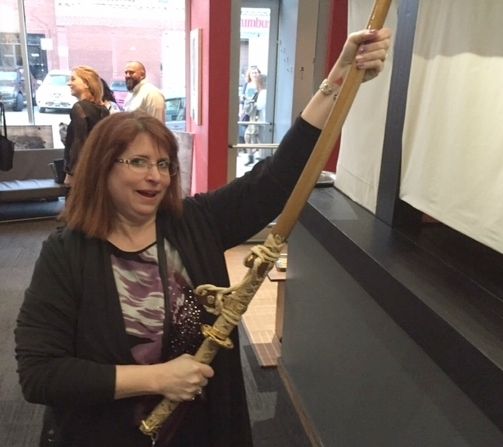
There was also a big silver chest with lots of cards labeled either 1)octopus, 2)chicken feet, or 3) salmon heads. We were all told to pick a card, and put it on the punch table.
Now an MC of sorts gathered us around a punchbowl with a giant cube of superclear ice, and told us all to take out the paperbag from our totes. Everyone had something different, each thing labeled, and we all poured them one by one to the punchbowl, like an old-time hairy buffalo or Wapatuli punch.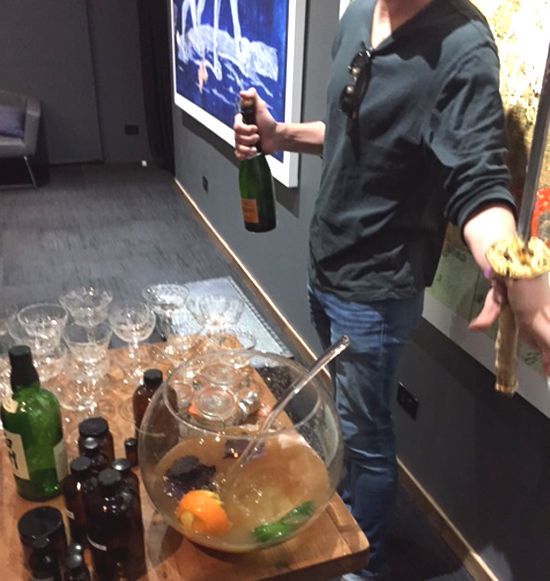
There was different citrus juices, shiso leaves, citrus slices, Frank had a tiny vial of kaffir lime juice, I had a rather largish bottle labeled sesame, someone had a bottle of a Japanese Whisky. The last person to contribute had a bottle of champagne. We were all herded to one side of the room, and the MC/waiter used the Samurai sword to saber open the champagne! It was so cool! I have seen this done on TV, etc, but never in person! The punch was served in beautiful antique etched stemware, and it was delicious and very refreshing. They called it Yokoso punch.
Next 3 appetizers were served from the bar. There was caramelized nori with trout roe, little crispy passionfruit discs layered with foie gras, and a 3rd one which was like a crispy thing on the menu they said it was nigiri but I don’t think it was rice, it seemed more like toast, infused with bone marrow, topped with wagyu beef. They were all OMG-incredibly delicious- I could have literally made a meal of those. Before we moved on, the MC tallied up our weird food cards, and the winner was…”Octopus”, he said someone had been given a key at the bar, and the key appeared, and we opened the silver chest. Inside on a bed of ice were 3 jars filled with the above mentioned weird items. They key holder was given the jar with 2 medium octopi-they looked partly cooked already- and then we had to name them. They were named Lucy and Ricky. We took them with us.
So the group now moved downstairs. The room was all white, there were color photos of naked women holding black and white photos of landscapes. The service bar was full of white tissue paper flowers with little lights kind of. All the tables were 2 tops which was OK since they had only taken reservations for parties of 2. As we were seated, we were told to find the matches in our tote bag and light our candles, then they came around and there was a chilled cube of pineapple to eat,then we poured a shots from our tote bag into a really pretty pineapple shot glass set at our place. They were tequila, pineapple, ? delicious?, Then they had a remove the yellow capped bottle from the tote bag which was an Alsatian chardonnay blend, about 1/3 of a glass pour. (good thing too). This was the Yellow course… They brought a bowl with ½ a fried soft shell crab surrounded by yellow flakes. They then poured a completely clear broth which was a gazpacho of tomato and pepper. I was amazed. There was so much intense flavor in this completely clear liquid, you could really taste the intense brightness of the peppers and sunshine earthiness of the tomato, and it was like looking at water.
Next they told us to take out our white capped bottle, which was a Pinot grigio-Then all of sudden- ALL of the lights cam on super bright in the room, all the waiters came out dressed in white jumpsuits and handed us envelopes that read “enjoy in silence please” we opened the envelopes and there was a card that said “White asparagus, mushroom, almond” They brought out large plates covered with salt, topped with small plates containing the above-mentioned ingredients in a thick rich sauce of cream, and I think pureed almonds.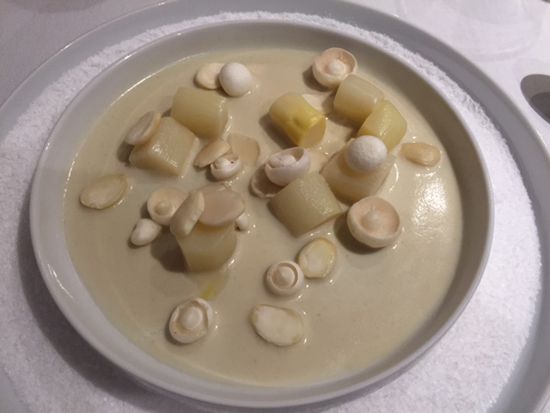
It was clean, rich, and full of umami. It was completely silent, except for the occasional giggle…but the most unusual came next.,
The BLACK course. They had us take out our black capped wine, a zinfandel, poured into black glasses, gave us a black spoon and a candle snuffer. We snuffed our candles, and all the lights were turned off- totally dark. They brought out shallow black bowls with burning pine topped with black bowls containing duck, black lentils, blackberries, black truffles, and black tea bread on the side. The played the Rolling Stones “Paint it Black”. LOL
So as we’re all finishing up, one of the cooks comes in from the kitchen and starts to yell at the room, “What are all you all doing just sitting there? Don’t you know we need your help in here? Get up and get in here, bring everything with you!” So we all get up, and go into the kitchen, and there are stations set up for everyone. In the center of the counter are Japanese hibachi grills. On small metal trays, each person has a par-cooked romaine heart on a skewer, a little bottle of Caesar dressing, and small plate with dried flakes of tuna similar to prosciutto. In addition to grilling our own mini-Caesar, we are told to get the bottle of beer from our tote bag and it is poured over ice and lime per 2 people, with squirts of a green Sriracha added to taste to make a michelada. The caesars were salty, and briny, and slighty crunchy and warm, very yummy- a nice almost palate cleanser. The micheladas were light, cold and refreshing- the tart citrus was so nice. At this point, while we are grilling, Someone yells “shots!” and shots of tequila start getting passed around too OMG. The chefs at the end of the counter were prepping the yellow course for the next seating, so we were sure to send some shots their way.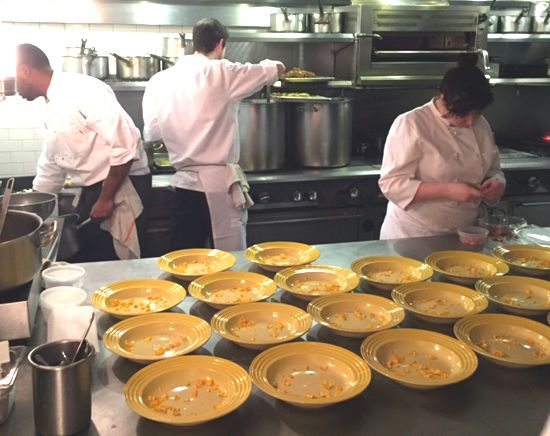
Next it was time for poor Lucy and Ricky to meet their end. The octopi are chopped up and incorporated into tiny little tacos on home-made corn tortillas, with salsa. The octopus was tender and very tasty, but the for me the tortillas were so thin, they just fell apart, and it was hard to eat the dish, so it was not so successful.
So, time to go back upstairs, at the top of the stairs was the “red room” A server in long red underwear with 3 carafes of clear fluid looks at our stamps on our wrist, and gives us a papercone of liquid (thankfully non-alcoholic). I get watermelon, Frank gets cherry, (I don’t know what the third was. It was cold, and sweet and tasted intensely of watermelon even tho it was completely clear. We walk through a hall way of branches and brambles (Frank thought it was a little claustrophobic because he’s tall) into
the final room- kind of a picnic space – I have a picture! LOL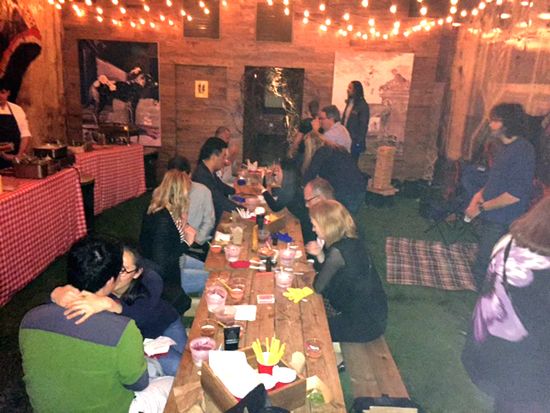
There was grass on the floor- picnic tables, a giant jenga game, cassette tapes, decks of cards, more gorgeous art.
I was hoping for a dessert and coffee room, but here there were actually 3 more entrees!
I tried 1 bite of the udon noodles with egg yolk- it was OK, but I was pretty full. There was something very green, the server said it was like green buffalo chicken- there was a 3rd station- maybe pea soup? I really couldn’t eat any more entrees. LOL
There was one dessert- it was like bubble gum flavored cubes of something with a coconut spuma, and crunchy blueberry powder on top, then they put the whole thing on a mixture of water and dry ice. You had to get out a glove from your tote bag to hold it. It was OK, but maybe my tastebuds were gone.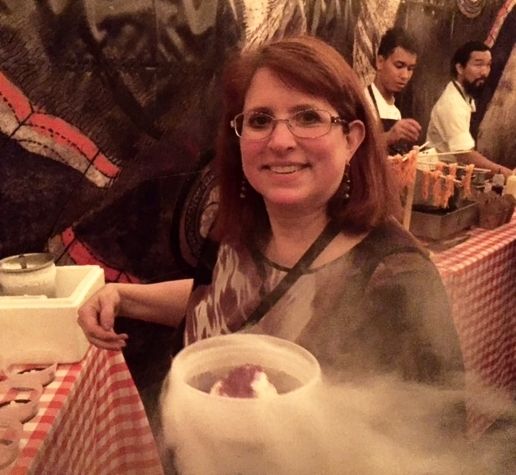
There was a slushy machine with a passionfruit slush, and you had a “hair gel” type tube of alcohol in your tote bag to add to that- it was nice and cool and sweet and very tasty- my kind of drink.
There was one last vial of alcohol and one last drink to make- a John Daly – this is basically an Arnold Palmer that you add Vodka to. It was pretty strong and tart. I only had a sip or two.
I felt this room was more of a miss- they didn’t need any more entrees in my opinion. I was really, really looking forward to desserts sweet, fruits- and I thought that was what this room would be. In addition to what they called their Guava snowcone, they could have had a cookie, a piece of cake, a chocolate truffle that looked like something else- maybe some coffee or tea to help knock off all the liquor, and I think one drink would have been plenty here, but that’s me. And I’m not the world famous chef - LOL- As the experience ended, they opened the end of the room and we exited thru a tunnel of white sheets where we could write on the sheets with sharpies, and by the door was on last tiny nibble- a cube of yogurt with raspberry and a thread of rhubarb as the handle on an anti-griddle. Tart, creamy, ethereal.
All in all, it was a really fun experience that was unlike anything else we had ever done. It really played to my sense of fun- I loved the white and black course experiences, and I really enjoyed getting to go into the kitchen with the chefs. We were two very full, very woozy, happy campers at the end of the evening.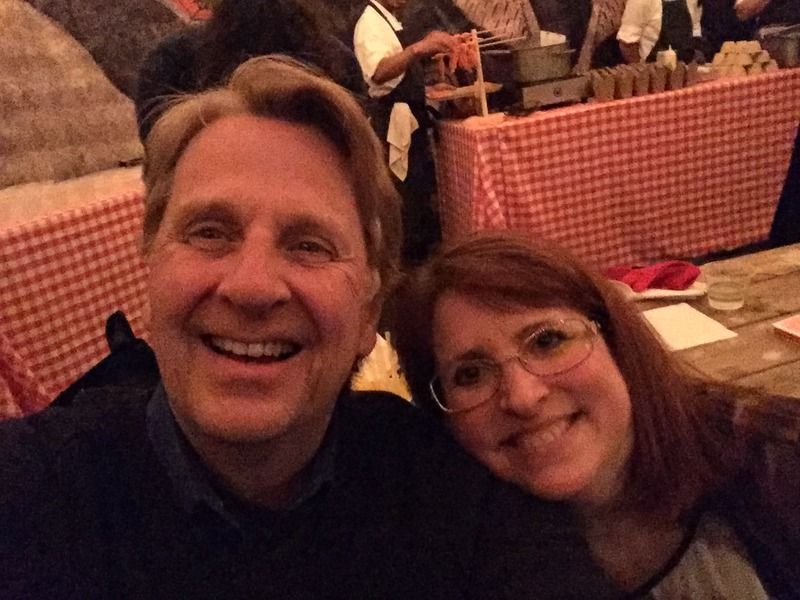
A few days later they emailed us this graphical menu: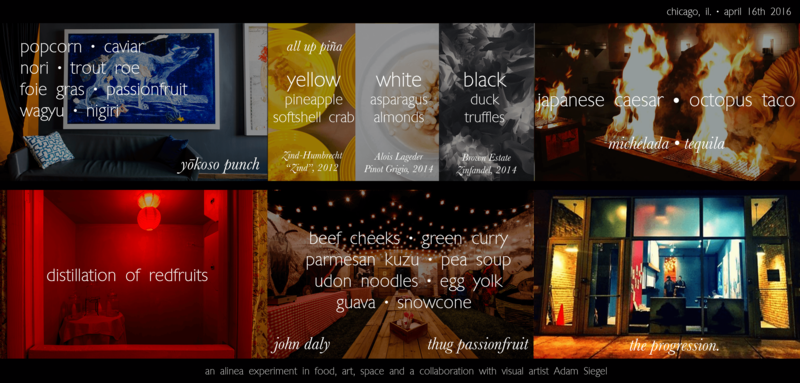 Last edited by irisarbor on April 26th, 2016, 7:42 am, edited 1 time in total."If you reject the food, ignore the customs, fear the religion and avoid the people, you might better stay home."
~James Michener
-
-
-
Post #19 - April 25th, 2016, 4:11 pmThank you for posting that. I like fun, but that seems insufferable. To each their own, I guess. I'm glad you enjoyed it!
Can't wait to introduce my own high concept restaurant, called Putt. The space is actually an indoor glow-in-the-dark mini-golf course, with a table and course at every hole (tee-times paced accordingly). No one gets served until everyone has sunk the ball. The highest score at the end gets the bill. (Symbolically, because everyone has paid in advance, natch.)
Actually, that sounds pretty fun!
-
-
Post #20 - April 25th, 2016, 4:13 pmMany thanks to Gypsy Boy and irisarbor for their thorough and well crafted reports on The Progression.
It sounds like something I would have hated every minute of.fine words butter no parsnips
-
-
-
Post #21 - April 26th, 2016, 7:37 amVitesse98 wrote:Can't wait to introduce my own high concept restaurant, called Putt. The space is actually an indoor glow-in-the-dark mini-golf course,
Actually there used to BE an indoor glow in the dark mini golf course in Lincolnshire...
I don't remember the name, but it WAS a lot of fun...
 "If you reject the food, ignore the customs, fear the religion and avoid the people, you might better stay home."
~James Michener
-
-
-
Post #22 - April 26th, 2016, 8:04 amYesterday I was highly dismissive of this experiment. Today I'm still skeptical but I think it could actually be cool, although the experience could be improved. Reading both GypsyBoy and irisarbor's post it sounds like you're frequently being verbally instructed to do things and herded along. I think it'd be more fun if there was less verbal interaction with the employees and more figuring out what to do next, maybe by looking at pictorial signs, or signs that light up when it's your cue to do something such as move along to the next room. It'd make the whole night more similar to one of those Escapology experiences, except with food.
-
-
Post #23 - April 26th, 2016, 8:09 amI like to think I have a high threshold for twee (I especially enjoyed Heston Blumenthal's themed dinner TV shows), and I enjoy both El Ideas and Alinea, but this is another thing entirely. And if I dragged my wife to this she would have left about 10 minutes in.
-
-
-
Post #24 - April 26th, 2016, 8:25 amspinynorman THIS is EXACTLY why its so great to have a forum like LTH where we can all share our experiences and get an idea ahead of time if we WILL enjoy something.
I would sure hate to spend this much $$ on anything I wanted to duck out of 10 min into...
I would just as much hate to drag out to a resto and open the menu only to find everything looked meh to me, or order something only to find it equally meh.
It's so great to have our LTH friends to suss out some of this for us, and know if it gets LTH love it's likely not to be a complete loser. "If you reject the food, ignore the customs, fear the religion and avoid the people, you might better stay home."
~James Michener
-
-
-
Post #25 - April 27th, 2016, 11:49 amI went the second night of service and enjoyed The Progression from start to finish. The food and beverage pairings were all hits for me, not a single miss in the bunch.
Some of the concepts will obviously not carry over to Alinea 2.0 but I hope a few do. Some were bizarre, absurd, etc. Others like moving from room to room (no spoilers, change of scenery) and the outdoor picnic were really great ideas. Nothing quite like sitting down on a blanket with fluffy fresh smelling grass underneath you,especially when it was snowing outside the night before.
I'm looking forward to what Alinea has evolved into when they reopen. It will definitely be interesting.
-
-
-
Post #26 - April 29th, 2016, 11:48 amFYI: Kevin Pang just published a story on Alinea 2.0 in today's New York Times and it includes some of his descriptions/thoughts on The Progression. Take a look!Gypsy Boy
"I am not a glutton--I am an explorer of food." (Erma Bombeck)
-
-
-
Post #27 - April 29th, 2016, 5:12 pmHalfway up the curving staircase is a nook where a musician or poet may perform.
-
-
Post #28 - April 29th, 2016, 5:13 pmFirst comment on the Times article:Much respect to Grant Achatz, but I see Fonzie revving his motorbike, a ramp and a shark tank. The world doesn't need a 3 Michelin starred Chuck E. Cheese.
-
-
-
Post #29 - April 30th, 2016, 8:13 pmI liked that later in the comments section the fact that Fonzie was on waterskis when he jumped the shark was brought to light.
-