

Lunch Under $5 [List]
Lunch Under $5 [List]
-
-
-
-
-
-
-
Post #31 - October 24th, 2005, 10:54 pmWas in the Pilsen area today at Carnitas Uruapan. Took my somewhat quaking parents through the rain, parked in front of desolate street people beseeching us (things were looking down at that moment) and then was warmly welcomed by the family Guero to delicious platters of meat, fresh cut tomato and the nopales salad I've ever had. My parents couldn't stop talking about how clean it was.
Carnitas Uruapan
1725 W 18TH St
773-226-2654"Don't you ever underestimate the power of a female." Bootsy Collins
-
-
-
Post #32 - October 25th, 2005, 3:49 amDavid Hammond wrote:Was in the Pilsen area today at Carnitas Uruapan... ... and then was warmly welcomed by the family Guero to delicious platters of meat, fresh cut tomato and the nopales salad I've ever had...
DH:
I posted on CU in June '04 and, based on information from a Tribune article, gave a different family name for the proprietor. But so far as I can tell, the same folks are in charge now as were back in the summer of '04 when we started going there. In any event, here's the address of the old post:
http://lthforum.com/bb/viewtopic.php?p=1786#1786
I was at CU two weeks ago on a Saturday morning to pick up some carnitas to take home. As always, the pork was very good but it was really striking the difference in the level of business between CU and Don Pedro's down on the eastside of Pilsen on 18th. Don Pedro's was absolutely mobbed, with an enormous queue waiting for service at the counter, the usual throng out front, and the less amusing parking difficulties all around. CU was, on the other hand, not filled up and only one person stood ahead of me at the counter when I arrived. There are various reasons why there is this difference (and this situation I've seen before) but I'll go into those some other time.
AntoniusAlle Nerven exzitiert von dem gewürzten Wein -- Anwandlung von Todesahndungen -- Doppeltgänger --
- aus dem Tagebuch E.T.A. Hoffmanns, 6. Januar 1804.
________
Na sir is na seachain an cath.
-
-
-
Post #33 - October 25th, 2005, 7:38 amA,
Yes, I did read your name-day post yesterday and, reminded of tasteless pig-art opportunities, decided to make my lunch at Uruapan.
The biz card reads "Props. El Guero, Abby y Marcos," which I interpreted to mean the family name is Guero (the name that is also emblazoned on the chef's jacket of the maniacally laughing porker boiling one of his fellows in oil in the picture on the west wall of the place).
My parents really liked the CA, as did I. One eye-opener: they had some nopales salad left over from the weekend, and I thought it was very good: plump strips of paddle cactus, still salty from what I believe was a briny boiling, slightly vinegary, and very complementary to the rich pork hunks. I realize that most if not all the nopales I’ve had in the past were either canned or bottled; these homemade nopales were reminiscent of the difference between canned asparagus and fresh asparagus – no comparison.
Hammond"Don't you ever underestimate the power of a female." Bootsy Collins
-
-
-
Post #34 - October 25th, 2005, 7:57 amI suspect "el Güero" is the proprietor's nickname: 'the fair-haired or fair-skinned one'. I once overheard my Mexican neighbours refer to me as 'Tony Güero', which I rather liked (much better than being 'Tony Gringo'). In this neighbourhood, the Tonys abound and means to distinguish them are needed.
Don Antonio a.k.a. 'Tony Güero'Alle Nerven exzitiert von dem gewürzten Wein -- Anwandlung von Todesahndungen -- Doppeltgänger --
- aus dem Tagebuch E.T.A. Hoffmanns, 6. Januar 1804.
________
Na sir is na seachain an cath.
-
-
Post #35 - October 25th, 2005, 8:19 amAntonius wrote:I suspect "el Güero" is the proprietor's nickname: 'the fair-haired or fair-skinned one'. I once overheard my Mexican neighbours refer to me as 'Tony Güero', which I rather liked (much better than being 'Tony Gringo'). In this neighbourhood, the Tonys abound and means to distinguish them are needed.
Don Antonio a.k.a. 'Tony Güero'
I always took "Guero" to have a less than favorable meaning, coming to me at first, as it did, from my exposure to the quasi-Mexican, drug-trafficking alter egos of the death metal band Brujeria, whose first album sports a none-too-pretty picture of one of their supposed enemies and the less than appetizing title "Matando Gueros." Imagine my surprise upon first coming to Chicago in 2000 and staying in Pilsen, being taken to go shopping at "El Guero" market on Cermak. Such terminology, anyway, can easily go both ways, either as terms of endearment or derision (eg, a racetrack groom I knew many moons ago known to everyone as "Pepito el cabron", a term which, when used otherwise, would have been the impetus for at least a minor beating). And apropos of Carnitas, I wandered into a small market/tortilleria/taqueria here among the large and varied Mexican area in North Vegas last week and asked for some barbacoa and carnitas, which led the counter man to tell me that I'm the first Norte to ask for such delicacies. I told him I lived in Chicago for years and just moved here, and he gave me a knowing look and nod, and also some of the choicest pieces. Looks like Pilsen's rep precedes itself. Good on ya, Calle Dieciocho !!
-- Rebito, el Judio del desierto (Shimon?)
-
-
Post #36 - October 25th, 2005, 8:29 amhungryrabbi wrote:I always took "Guero" to have a less than favorable meaning, coming to me at first, as it did, from my exposure to the quasi-Mexican, drug-trafficking alter egos of the death metal band Brujeria, whose first album sports a none-too-pretty picture of one of their supposed enemies and the less than appetizing title "Matando Gueros."
A Brujeria cameo in the 'Lunch Under $5' thread?
I love this site...
-
-
Post #37 - October 25th, 2005, 8:35 amIn my experience, guero has certain mildly negative connotations, but only in the complicated, familiar, ribbing way of Spaniards and Latin Americans alike. Consider that many "latinos" are little fazed when one calls another gordo or viejo. It's mostly descriptive, like "bigote."
The guero is usually a lighter, often red-headed and/or blue-eyed person. As opposed to, say, a "rubio." The Spanish-speaking world is not nearly so PC, hyper-put-upon, or falsely respectful as are we, don't forget.
Unlikely, but possible that the guy's real name is guero. On the other hand, guerro, with an "rr," while also the less common spelling/pronunciation of guero, is a common enough surname and place name. I'd not be surprised if the sumermarket chain, Guerro, is actually named after someone.
Hammond, this reminds me of your reference to "Rico's Huaraches" a/k/a ricos huaraches/huaraches muy ricos.
-
-
-
Post #38 - October 25th, 2005, 8:42 amJeffB wrote:The guero is usually a lighter, often red-headed and/or blue-eyed person.
Well, the very nice lady who waited on us yesterday fits this description: she looked like a younger version of Endora from Bewitched (Agnes Morehead).
David "I know just enough Spanish to get into trouble" Hammond"Don't you ever underestimate the power of a female." Bootsy Collins
-
-
-
Post #39 - October 25th, 2005, 8:42 amhungryrabbi wrote:I always took "Guero" to have a less than favorable meaning, coming to me at first, as it did, from my exposure to the quasi-Mexican, drug-trafficking alter egos of the death metal band Brujeria, whose first album sports a none-too-pretty picture of one of their supposed enemies and the less than appetizing title "Matando Gueros"...
Hé Chingón,*
Sure, it definitely can have the sense of 'whitey' or something pejorative along those lines, but it is also a very common nickname for specific individuals, just like 'gordo' (fat one), 'chato' (snub-nosed one), 'panzón' (the one with a paunch), etc. etc. One of our Mexican friends referred to Lucantonius as 'El Chinito' when he was a baby, presumably on account of his (then) curly hair. So then, yes, sometimes 'whitey' (pejorative) and sometimes 'blondy' (hypocoristic).
You see, in this world there's two kinds of people, Blondy: those with loaded guns, and those who dig. You dig.**

Tuco
* Note: 'chingón' used here in the common, hypocoristic sense of 'big guy' or 'stud'.
** I have always assumed 'Blondy' is intended as an English rendering of 'güero' in The Good, the Bad, and the Ugly.Alle Nerven exzitiert von dem gewürzten Wein -- Anwandlung von Todesahndungen -- Doppeltgänger --
- aus dem Tagebuch E.T.A. Hoffmanns, 6. Januar 1804.
________
Na sir is na seachain an cath.
-
-
Post #40 - October 25th, 2005, 9:40 amJeff:
You posted while I was composing the preceding post of mine, so I didn't see yours straightaway.
JeffB wrote:In my experience, guero has certain mildly negative connotations, but only in the complicated, familiar, ribbing way of Spaniards and Latin Americans alike. Consider that many "latinos" are little fazed when one calls another gordo or viejo. It's mostly descriptive, like "bigote."
That's an important point in this context.The guero is usually a lighter, often red-headed and/or blue-eyed person. As opposed to, say, a "rubio." The Spanish-speaking world is not nearly so PC, hyper-put-upon, or falsely respectful as are we, don't forget.
And it should be noted that the scale of colours in relation to hair and complexion and so on differs from one culture to another. My reference to the Clint Eastwood character above in the Good, the Bad and the Ugly brings up a case in point. I've heard people comment that they find it weird that he's called 'Blondy' by Tuco when, by American standards, he has brown hair of a not especially light shade. But between that hair colour and the colour of his eyes, he certainly rates as 'güero', hence 'blondy' in the English of Tuco. Along similar lines, to my relatives in Southern Italy, I am a 'biondo' though my hair is roughly the shade of brown of Eastwood's, a shade that would never be called 'blond' in America or in northern Europe.
Now, whether my old neighbours think of me as güero in the one or the other sense is perhaps an open question, though given the nature of our relationship, I'm fairly sure it's 'blondy' and not 'whitey'.
Back to Carnitas Uruapan: DH said the wife of the couple has reddish hair; I think the husband is also of a light complexion and hair colour too. In any event, it's a very good place for carnitas and nopales. Their fried pork tacos are good too.
AntoniusAlle Nerven exzitiert von dem gewürzten Wein -- Anwandlung von Todesahndungen -- Doppeltgänger --
- aus dem Tagebuch E.T.A. Hoffmanns, 6. Januar 1804.
________
Na sir is na seachain an cath.
-
-
-
Post #41 - October 25th, 2005, 9:49 amAntonius wrote:Back to Carnitas Uruapan: it's a very good place for carnitas and nopales. Their fried pork tacos are good too.
As there seemes to be no printed menu, I had a small challenge eliciting what exactly they serve at CU. They have a huge kitchen (with several massive pots steaming with frying carnitas), and I had to believe they served more than just the weekend nopales salad and menudo that the nice lady told us about. Pork tacos are a natural, and my sense was that they probably offer other items, seasonally and at the whim of the chef.
Hammond
PS. We got a little bag of chicharrones, gratis, and they are really good."Don't you ever underestimate the power of a female." Bootsy Collins
-
-
-
Post #42 - October 25th, 2005, 9:54 amDavid Hammond wrote:As there seemes to be no printed menu, I had a small challenge eliciting what exactly they serve at CU...
It would be nice if they would put a chalk board up but I guess for the regulars it's all obvious. I'm pretty sure I've seen trays filled with some manner of guisado (presumably de puerco) and the last time I was there it looked like they had tray filled with beans, though I may have been hallucinating (I often have visions of beans).
AAlle Nerven exzitiert von dem gewürzten Wein -- Anwandlung von Todesahndungen -- Doppeltgänger --
- aus dem Tagebuch E.T.A. Hoffmanns, 6. Januar 1804.
________
Na sir is na seachain an cath.
-
-
-
Post #43 - October 25th, 2005, 10:00 amAntonius wrote:It would be nice if they would put a chalk board up but I guess for the regulars it's all obvious. I'm pretty sure I've seen trays filled with some manner of guisado (presumably de puerco) and the last time I was there it looked like they had tray filled with beans, though I may have been hallucinating (I often have visions of beans).A
There would be very little room for a chalkboard, given the slogans on the wall, jostling for position with graphic representations of pigs being guillotined by other pigs, etc.
Now that you mention it, the nice lady did say that they sometimes had frijoles. When I queried her whether they were rojos or negros, she said negros, but she may have just been saying anything just to stop me from further abuse of her native language.
Hammond"Don't you ever underestimate the power of a female." Bootsy Collins
-
-
-
-
Post #44 - October 25th, 2005, 6:59 pmAs it's been mentioned earlier in this thread, just thought I'd chime in to say that the Pita Inn is pretty damn good for being so damn cheap. I had a very good kefta kabob pita-sandwich and a big slice of baklava for around 4 bucks. Kabob was very nicely spiced. The place was absolutely jammed. Thought the little extra slice of pita they threw in there was kinda funny.
Def'y a good lunch spot for when I'm back in town working in Des Plaines.
-
-
-
Post #45 - October 25th, 2005, 7:16 pmBelieve it or not... and I hope this doesn't count as a sandwich...
My favorite cheap meal is a veggie burrito from Chipotle (and yes, I know they're owned by McD's.)
It's not really a burrito, I know, more of a wrap.Greasy Spoon
-
-
Post #46 - December 17th, 2005, 4:28 pmBrasa Roja
Carne asada, arroz, frijoles, y ensalada. $4.95
I'm not a huge fan of their chicken, but I have no problem with their grilled meat at all. Especially when it comes with their rice and beans, for under $5.
Brasa Roja
3125 W. Montrose
773-866-225
Best,
Michael
-
-
-
Post #47 - December 18th, 2005, 10:26 amMore west suburban options:
Fabulous Noodles - Soup Noodles (plain or with any number of accompaniments - I favor the shrimp dumpling or bbq pork), includes tea and a cookie. A fine meal for under $5.
Capri Pizza, giant slice & a coke, here:
http://lthforum.com/bb/viewtopic.php?p=53102#53102.
And the sad thing is that I am sure Gary is hopped up on cheap idodized salt, too, not the good stuff .
.
How far the mighty have fallen.d
Feeling (south) loopy
-
-
-
Post #48 - December 31st, 2005, 3:24 pmwe tend to forget oldies (but goodies):
Wing Chan Bar-B-Q
2157 S China Place
(closes by 7pm)
the secret is not to order straight BBQ over rice for $4, but combos, ie:
char siu pork, roasted pig and roast duck. combos are same price as single items and offer invaluable variety. price remains $4.40 (after tax) for combos.
i often find myself the only person eating during weekends/after work in the upstairs mess hall...
-
-
Post #49 - December 31st, 2005, 7:10 pmI wish i had "six wives", then i'd have six, not seven.

-
-
-
Post #50 - January 8th, 2006, 9:07 amWonderburger Basket & a Coke $4.91

 Steve Z.
“Only the pure in heart can make a good soup.”
― Ludwig van Beethoven
-
-
-
Post #51 - January 25th, 2006, 6:00 pmHoang Thanh ($4.95)
Salt and Pepper Tofu over rice w/crisp slightly sweet pickled cabbage chunks, which make a very nice counterpoint to the crisp on the outside, soft and creamy on the inside, scallops of tofu. Includes pot of tea, just-ok egg drop soup and a fortune cookie. Decent chili oil on the table, efficient service, comfortable chairs, and a friendly waitress make for an enjoyable $5 lunch.
Thanks to Peter D for the heads up on Hoang Thanh's Salt and Pepper Tofu.
Enjoy,
Gary
Hoang Thanh
1129 W Argyle
Chicago, IL 60640
773-271-7328
-
-
Post #52 - September 15th, 2006, 5:29 pmApart Pizza ($4.50, including soda)
Apart Pizza has generated quite a bit of conversation in this thread, though no one has mentioned the 8" pizza and fountain drink for $4.50 deal. Eat in or take out
Minimalist pretty much describes Apart Pizza, 5-tier Blodgett pizza oven, industrial mixer, large work space and a few stools with a chest high counter for the casual eat-in, though I'd guess 95% is deliver or pick up.
Apart Pizza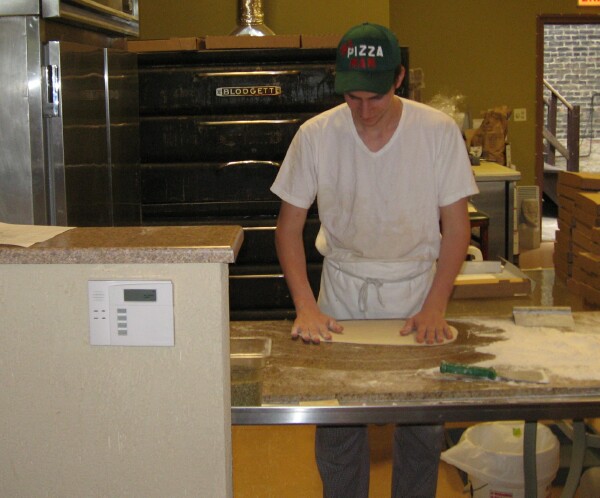
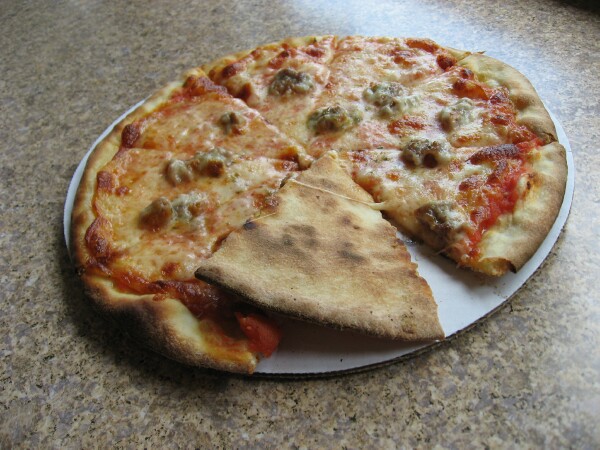
I liked the pizza, thin, crisp crust, little browning, though no blistering, decent quality ingredients, friendly people, quick, inexpensive, nice overall package.
Apart Pizza
One thing I particularly liked was the olive oil on the counter, which had been infused with crushed red pepper flakes.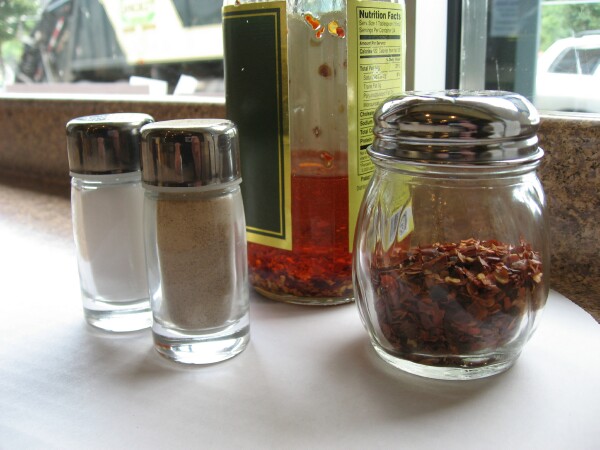
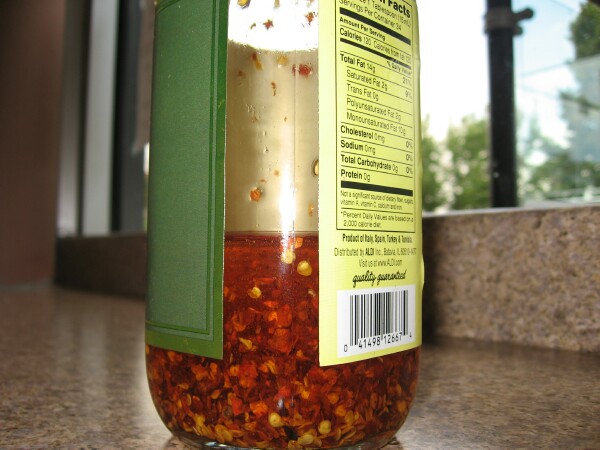
Will I be craving Apart pizza, no, probably not, but was a damn good $5 lunch and I seriously wish they delivered to my neighborhood.
Enjoy,
Gary
Apart Pizza
2205 W Montrose
Chicago, IL
773-588-1550
Lunch special, 11am - 4pm
-
-
Post #53 - September 16th, 2006, 1:06 amAwesome pictures from Apart, Gary; I feel sufficiently inspired to make a visit. Is the place is still closed for lunch on Mondays and Tuesdays? If so, I'll make it a point to stop by for the special Sunday afternoon (if it applies even on the weekend).
Thanks for the comprehensive post,
Dan
-
-
Post #54 - September 16th, 2006, 8:36 amfastfoodsnob wrote:Is the place is still closed for lunch on Mondays and Tuesdays? If so, I'll make it a point to stop by for the special Sunday afternoon (if it applies even on the weekend).
Dan,
Apart's Lunch Specials menu says 11-4, no mention of only on weekdays.
Apart Pizza hours listed are
Mon - Tues: 6pm - 11pm
Wed - Sun: 11am - 11pm
Enjoy,
Gary
-
-
Post #55 - September 16th, 2006, 9:44 pmThe Four Seasons Cafe and Grill has a nice $4.99 lunch special. Their schwarma is very good as is the chipotle chicken. Ask for things a bit less spicy if you're not used to it though. We eat spicy food all the time and it was on the edge of too much for us. They also do breakfast all day, so you could have that for under $5.00 too. I haven't had breakfast there though, so I don't know how it is. If you happen to be in Schaumburg or Arlington Heights for lunch, this is another option.
http://fourseasonscafeandgrill.com/
-
-
Post #56 - September 17th, 2006, 5:11 pmAll right, I followed through and hit up Apart Pizza for their lunch special today, along with a number of friends who followed from church. Gary's pictures were pretty dead-on in terms of the 8" personal pizza, which I also ordered: crisp ultra-thin crust and a minimal coating of cheese (had to get the meat on the Trentina, which comes with sauce, mozzarella, and sausage). A few folks split 14-inchers, but their crusts tended more towards the wet and wild as the larger surface area lent itself less to crispy centers.
Football fans might be disappointed by the lack of TVs by the counter, but I found it amusing that deliveries were being run by taxi today. The pizza was awfully tasty, however, and most everyone seemed to be satisfied with their meals, though the counter area was still a bit too hot temperature-wise for some people. All in all, another successful LTH recommendation! (Poochie's cheddar char cheeseburger really hit the spot last week; another great look at that place comes from Roadfood.com.) Maybe I'll have to hit Herm's on Dempster next... after picking up dogs from Poochie's, that is. Cheap, good food = a happy Snob. Thanks for the recs!
--Dan
-
-
Post #57 - September 17th, 2006, 6:05 pm$4.50 for pizza and a drink? Highway robbery! At Caputo's Cheese in Melrose Park today (and I suspect every day) you get a very filling slice of their yummy cheese pizza, plus a can of pop, for $1. That's right, $1. Want sausage? That'll cost you another two bits. Eat in only.
-
-
Post #58 - September 17th, 2006, 6:33 pmAnn Fisher wrote:$4.50 for pizza and a drink? Highway robbery! At Caputo's Cheese in Melrose Park today (and I suspect every day) you get a very filling slice of their yummy cheese pizza, plus a can of pop, for $1. That's right, $1. Want sausage? That'll cost you another two bits. Eat in only.
Well, in Apart's defense, it is an entire 8" pizza (cut into 8 small pieces) with endless fountain-drink refills, but a dollar is a dollar. So what kind of pizza does Caputo's serve anyway? Thin crust, pan, cracker, foldable, [insert-your-favorite-region-here]-style? Considering Cap's proximity to Johnnie's and Gene & Jude's, I could very well make a stop out there in the very near future. Otherwise, I'll have to stick with a large slice of thin-crust sausage and a drink from Villa Palermo for about two-fifty or so. Come to think of it, two sets of slices and drinks might even come in under the $5 lunch-price requirement (poss. before tax), which would add up to a rather hefty meal.
Villa Palermo
2154 W. Devon Ave.
Chicago, IL 60659
(773) 465-5400
[Edit: only open for lunch at 11 A.M. on Fridays, Saturdays, and Sundays. Discovered this (again) to my regret on 9/25/06.]
--DanLast edited by fastfoodsnob on September 25th, 2006, 9:15 pm, edited 1 time in total.
-
-
Post #59 - September 17th, 2006, 7:33 pmfastfoodsnob wrote: So what kind of pizza does Caputo's serve anyway? Thin crust, pan, cracker, foldable, [insert-your-favorite-region-here]-style? Considering Cap's proximity to Johnnie's and Gene & Jude's, I could very well make a stop out there in the very near future.
--Dan
Pan pizza, baked on a cookie sheet (or, more accurately, I suppose, a jelly roll or bun pan) and served in rectangles about 4X6 inches. So one piece really is a substantial serving and even Ed is full at two. Nice balance between sauce and cheese, not too much of either. Cheese more crunchy than gloppy. Crust well cooked, not crunchy, not doughy, but done. IIRC a cannoli is about 89 cents, and they have lots of other Italian desserts as well.
And, as you observe, once you're at Johnny's or Gene and Jude's you're practically there.
-
-
Post #60 - September 17th, 2006, 8:46 pmAnn Fisher wrote:Pan pizza, baked on a cookie sheet (or, more accurately, I suppose, a jelly roll or bun pan) and served in rectangles about 4X6 inches. So one piece really is a substantial serving and even Ed is full at two. Nice balance between sauce and cheese, not too much of either. Cheese more crunchy than gloppy. Crust well cooked, not crunchy, not doughy, but done. IIRC a cannoli is about 89 cents, and they have lots of other Italian desserts as well.
And, as you observe, once you're at Johnny's or Gene and Jude's you're practically there.
Ooh... thanks for all the info, Ann! I think I might have to check Caputo's out (especially after having mapped out all three locations after your last message). With all that food, though, I might have to make multiple trips just to try fresh samples in their native environments. I'm sure field research never tasted better -- or cheaper.
Thanks again,
Dan


